Hari Om

Menu

From Truth to Truth – The Divine Journey

sathya Sai Baba truth and dharma image
From Truth to Truth - The Divine Journey

Vijaya Dashami gives the Message of Unity

Vijaya Dashami gives the Message of Unity The Dashara Festival has filled your eyes, ears and minds with Ananda for ten days. And, with the bodies transformed by this rich experience, you are returning to your places. Let me tell you something which will grant light, so that weight will be less for the journey of life. Man has always tried to conquer nature. In this contest, he has employed all his physical, mental and intellectual skills. Nature is a composite of the three Gunas: the pure, passionate and dull. Therefore, it can be overcome only by developing the qualities of truth, love and tolerance. When man taps the energy of the Divine in him, he can easily master Nature, which is only the vesture of the Divine. Drawing on the Divine that is inherent in you is the lesson of the Geeta. When you picture to yourself Arjuna in the two-wheeled chariot, four white horses yoked to it, Krishna sitting in it holding the reins and answering the queries of Arjuna, then, you miss a great part of the significance of the scene.  Arjuna is the Jeeva (individual entity) and Krishna is the Deva (Divine entity). When both are in contact, impregnable might results. You may have enormous quantity of electricity, but, it can demonstrate itself as work only through some medium or instrument. So too, Krishna had to work in and through Arjuna, so that the reign of Dharma is re-established. Arjuna means: “white, pure, unblemished;” hence, he is the proper instrument. The other four brothers are the horses, they are also without blemish! Arjuna provided the appropriate heart-throne where the Lord could install Himself. The five brothers represent the five elemental principles – the earth, water, fire, air and the ether (sky). They also symbolise the five vital airs that activate man. God is to be recognised in all human beings The hundred Kaurava cousins were all destroyed, because they stood for aggrandizement and justification of means, provided the end is gained! The Pandavas surrendered completely to the Will of God and so, they could draw on the Divine, and gain victory. When they gave up everything in the end and tramped along the road to the Himalayan silence, one by one, they dropped dead; only the eldest was able to reach the abode of the Gods. His name, significantly, is Dharma Raja (the Monarch of Righteousness)! People are satisfied with repetition of cliches, even in the field of religion. Ask any one where God is, the reply is “Everywhere”. But, the hearts of many have not been filled with Him. Probably, “everywhere” does not include the inside of their hearts! It means only their tongues, presumably) “Worship God,” that is the road to victory. This is another cliche. But, God is worshipped only in pictures, images, idols; He is not recognised in all living beings, in beauty, harmony, melody, truth, goodness. Devotion must be undeviating Let Me tell you one fact, in order to warn you against hoping too much. Worship such as this, offering of incense, flowers, repetition of hymns of praise and other rites are only commendable ways of utilizing time; good activity! Unless they cleanse the heart, widen sympathies and deepen faith in one’s own divinity, they are unworthy of the name Sadhana. Among those who label themselves as theists (believers), 99.75% can be heard complaining, “I believe in God, but, He is making me miserable; that fellow is an unbeliever, but, the same God is heaping one joy after another on him!” Can this be devotion, dedication? Devotion must be undeviating, whatever happens. Prahlada had that unshakable faith; he had surrendered so completely to the Lord that no torture could turn him away from fidelity. When you start judging and pronouncing judgements on the basis of your own prejudices and information, you only demonstrate that your faith is shallow, it is only a fair-weather phenomenon. Those attached to God, aspiring for God, aware of God, adoring God have certain distinct marks by which they can be identified. Pronouncing judgements like this is quite contrary to the nature of dedication. Again, such people have a compassionate heart. If a person tums the rosary on the fingers, and is intently engaged in watching the tip of his nose, unmindful of the distress that dances around him, we can at best name him a sloth, that is all. Get up, place the rosary in its bag, and engage yourselves in relieving distress that is the true spiritual path. Do not waste all your years with stone images, pictures or idols. Learn to see in every living vital active person, the embodiment of all energy, all beauty, all beneficence, namely, God. God is subtler than ether, filling the smallest crevice with His Majesty. Know this and serve His manifestations, wherever you meet them. Turn the mind vigorously towards God Some institutions profess to train persons in Dhyana and hold Dhyana classes! How can any one put trust in these? It may be possible to train to sit aright, and to go through various contortions of the body; but, how can any one help another to concentrate more keenly? Love God and no distraction can turn you from the thought of God. Valmeeki was a highway robber, terrorizing the travelers and killing without mercy. Rajas (passion) was the predominant quality in his make-up. When he chanced to meet the Seven Sages and listen to their counsel, his heroism, bravery and persistence turned God-wards in a flash; he became so ardent an ascetic that an ant-hill grew over him as he sat unmoved.  You need not rely on another for success in Dhyana and Japa and await contact with some sage in order to get from him a Mantra for recitation. Pray to the God within you and you will receive the needed guidance. Turn your mind towards God; dedicate yourselves to God; then you will find life one continuous stream of Ananda (bliss). Have a fan in your hand and sweep it towards you; then, you feel comforted. So also, use the mind as the instrument, and turn it vigorously towards God; then, it can give you the Ananda of liberation. Rama is the name for Ananda that is inherent in every heart; recite His name, let the Ananda respond and upsurge. Do not pretend and

Vijaya Dashami gives the Message of Unity Read Post »
Bhagwan Shri Sathya Sai Baba truth photo.
From Truth to Truth - The Divine Journey

Understanding the Sathya Sai Phenomenon – By Dato J. Jagadeesan

Understanding the Sathya Sai Phenomenon – By Dato J. Jagadeesan An agnostic until the age of 32 asking the question – Did God create man or man created God? I thought I was an atheist at heart until Bhagavan Baba Himself called me an agnostic. A graduate at 21, travelled around the world several times in my official capacity in Government service, successful, with wife, children, house, car etc.-Who needed God?  Baba came into my life at the age of 32 — only to be faced with an anti-Sai tirade that I launched on all devotees who came within the radii of my relationship. It was on June 8, 1976 in Kuala Lumpur that Lord Sai appeared. I asked Him mentally. “If you are truly what you are — show me a sign! The sudden materialization of the Vibhuti on His picture, the stunning revelation, the realization that “Oh God! There is truly a power beyond science and this power can reach into my world even in a physical form”, that was the moment of my transformation — that began my Journey to God.  Subsequently, my life changed and my travels around the world – both on behalf of the Government and on behalf of the SAI EHV Programme have made me come in contact with a great number of beautiful people, SAI devotees, sometimes in very strange places. Though many devotees know of the SAI groups and Centers in USA, South America, Europe, Japan, Australia, Fiji, etc. — very few may be aware that SAI Devotional Groups exist in East Berlin (even before the fall of the Berlin wall) and that SAI groups exist in Seoul, South Korea and Beijing in China … the world which for ever has been and will be the mansion of the cosmic Divine principle, is rapidly becoming the mansion for the “manifested Divine principle.”  We all know that the world is God’s mansion, but the fact that the advent of SAI, in His physical form, is being recognized all around the world during His Life time is perhaps one of the spiritual phenomena of the century, in fact of several centuries.  What about the Omnipresent, Divinity principle? Well! Bhagavan is introducing His “calling cards” everywhere. In my travels around the world, I have seen for myself and shared miraculous experiences with others regarding His Omnipresence. Manifestation of Holy ash, Amrit (Divine nectar) from statues and photographs are happening not only in India, Malaysia, Fiji, USA, Europe, Africa, etc. but most recently I was thrilled to see a photograph of Vibhuti manifestations in the home of a Japanese devotee in Japan. The picture was covered with holy ash and there was a huge Vibhuti ‘OM’ (in Sanskrit) and what appeared like gold flakes over HIS palm. We can but only stand in awe when we see the miracles that take place in homes of devotees thousands of miles away, in different continents, within different cultural heritages – with only but one Universal bond the bond of LOVE: — this perhaps is the greatest Divinity principle that Baba displays.  But other-than the manifestations of ash and Amrit, what about the water that flowed for two days from the knees of a Christ figure on a cross in the home of a SAI devotee in Fiji, what about the strange Indian man in orange robe and Afro-hair-do who got into a cab of a Chinese taxi driver in Malaysia, who only a week later realized it was Baba; what about the shower of bangles, the materialization of dates, pendants, small statues, etc. that appear on altars of devotees in Malaysia and around the world; what about the lady in an African village who was comforted by a strange, bearded man, only to recognize him a week later as Shirdi Sai Baba (as was the case of one of the first Chinese devotees in Malaysia); what about the miraculous cures, that occur not even by consuming Vibhuti but by just calling out Baba’s name from the depth of one’s heart as was the case of an African lady in Zimbabwe who went to  hospital to undergo heart surgery, who on the way, called to Baba to manifest His Love and was sent back home the same day by the hospital saying there appears to be nothing wrong now”.  And thus it goes on, in every part of the world, from Argentina to Zimbabwe, from Japan to Chile, from Fiji to the West Indies, Baba’s Love, the Divinity principle manifest in every room (country) of His Mansion (world), comforting, guarding, guiding. But greater than all the physical manifestations, the cures, the physical manifestations of SAI Himself, greater than all these miracles is the miracle of the ‘TRANSFORMATION OF MAN’. Agnostics, drunkards, drug addicts, gamblers, businessman and politicians, who had made money and power their God, have now turned to the God of Spirituality and have started the process of transformation, of self-improvement, to make themselves useful to themselves, their families and society. One cannot guess the number of tearful wives and mothers raising their hands in thankful prayer to Bhagavan Baba for the transformation that He has wrought in their husbands or children.  But perhaps even greater than the mere turning of man away from his negative habits, perhaps even greater than the miracle of tuning all these millions to the path of God, is the greater miracle of transforming selfish individuals, who had only concern for family and friends, into beings of love, dedicating their time, skill. Money and effort to serve the sick, the poor and the needy. This transformation, in the context of the modern world, where individuals and families caught in the rat race of modern living feel that they have not time for anything else but themselves, manifesting often the ‘I’ and ‘My’ first and last…. everything else be damned, attitude, is perhaps the greatest manifestation of Bhagavan Baba’s divinity principle and the SAI phenomena.  But over and above all the manifestations,

Understanding the Sathya Sai Phenomenon – By Dato J. Jagadeesan Read Post »

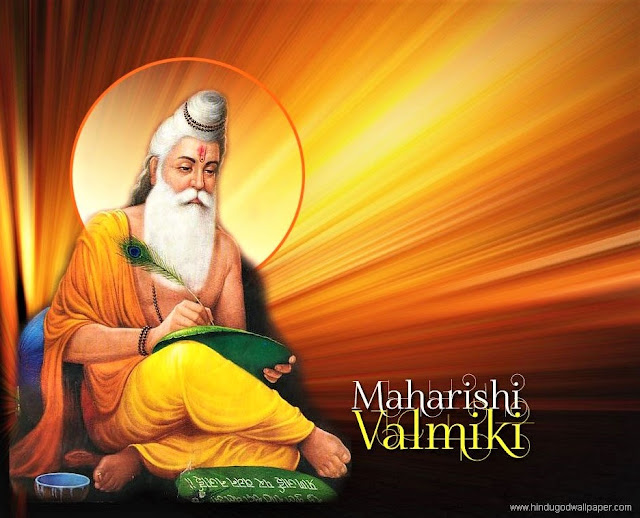
Valmiki
From Truth to Truth - The Divine Journey

The Story of how Ratnakara became Maharishi Valmiki

The Story of how Ratnakara became Maharishi Valmiki Ratnakara forgot the human and Divine qualities in him took recourse to demonic qualities to foster his family and became a wanderer. There should be a close association with Godly persons for Divinity to emerge in humans. There is current in the wire. Without the bulb you cannot see the manifestation of power. Current is there but its result is not known to us. When we fix the bulb only then can we see the current. Even in Ratnakara there was Divinity. After some time he came in the company of some great sages. When we are in good company, good qualities in others will become ours. That is why good teachings are very much essential. Then good qualities are very much fostered even in us. Good company is necessary. Tell me your company and I shall tell you what you are. Depending on the type of company we keep, we develop qualities. Among the seven sages, Sage Gautama spoke to Ratnakara. He said, “Son! You have taken the human form. What is the reason that you have taken recourse to demonic qualities?” Ratnakara replied, “Master my family is very big. Other than this, I didn’t know any other path.” There were no factories and industries in those times. People had to do hard work in order to earn their living. They had to plough the land and make a living. Mother cow and motherland were the reason for their living. The sage then said, “Mad man! Do you think for the sake of family you earn this money? Your family may take the wealth you earn, but the sin that has accrued to you will not be taken by them. They may take a share in your wealth but they cannot share your sins. Your wife and children are not going to share your sins.” Ratnakara was annoyed hearing this. He asked, “As they share my wealth they should also share my sins, is it not?” But Sage Gautama replied in the negative. Two people may sleep on the same cot. Cot is same, but dreams are different. Sleeping on same cot they should get the same dream, but it does not happen that way. That is ignorance. Gautama said, “Whatever you do, you will have to experience, not your wife and children.” Then Ratnakara asked the sage, “Will they really not share my sins?” Gautama said, “Go back and ask your wife and children whether they will share your sins.” Ratnakara went back home and asked his wife, “You and our children are going to share my wealth. For whose sake am I earning this wealth? For your sake only. In the same way you have to share my sins also.” The wife said, “Because you have married me, you have to take care of me. In whatever way you get your wealth is your duty. And our duty is to eat what you get. But sin or virtue is yours only. I didn’t ask you to kill people. I didn’t ask you to harm them. You are doing something which we have not asked you to do. Hence you have to experience the results yourself.” Generally wives will have better intelligence. Women have seven virtues but men have only three. They have better foresight. You might have read this even in the Bhagavad Gita. Generally women have more of discrimination, more of wisdom, more sense of enquiry. She explained to Ratanakara clearly, “Oh ignorant one! You do not understand what I have understood. Your virtues will not come to me and your sins also do not come to me. But I have a share in whatever wealth and property you acquire.” As he heard this, there was transformation in his mind. Why? It was because of the company of saints and the consequent enquiry. He came back and prostrated before the seven sages and said, “Ignorantly I have committed many sins, pardon me. For sustaining my family I did all these. I have killed many people and earned this money. My family will not share my sins. I repent for all these sins. I am happy that they will be happy without sharing my sins.” Gradually the wisdom within him emerged. By the Darshan and listening to the advice of great people, anyone can get transformed. That was the impact of Treta Yuga.  The Glory of Rama Nama In the Kali Yuga, people don’t pay heed to the teachings of good people. Their minds do not change by the sight of good people. That is the impact of Kali Yuga. Even the mind of such a cruel person like Ratnakara changed. By the sight of noble people, sins are destroyed and one gets liberation. Whatever worries you have, they stop bothering you the moment Swami talks to you. By conversing with the Divine, you forget all your worries and troubles. But due to the impact of Kali Yuga, even that does not happen. The reason for this is that man is not able to remove the bad qualities in him. Ratnakara asked the sage, “How can I atone for my sins?” The sage replied, “You go on contemplating on the name of Rama.” Because of harming others, Ratnakara could not even pronounce the name of Rama. He started chanting each letter separately ‘Ra’ and ‘Ma’. He could not even chant that. He chanted as ‘Aa’ and ‘Ma’. Small children will chant ‘Lama’ instead of ‘Rama’. But Ratnakara could only say ‘Aama’.  What is the meaning of the word Rama? ‘Ra’ means the individual self and ‘Ma’ means Divinity. The combination of the individual and the Divine is Rama. The name of Rama indicates the individual and Divinity. In the Bhagavad Gita, there is the ‘Kshetra-Kshetrajna Vibhaga Yoga’. Kshetra means body, Kshetrajna is God. This is called ‘Akshara Brahma Swarupa’. Many think Akshara means letter. In Vedantic parlance Akshara means that which is imperishable. That which is perishable is

The Story of how Ratnakara became Maharishi Valmiki Read Post »

Shri Sathya Sai Baba service to humanity image
From Truth to Truth - The Divine Journey

Science, Technology and Spirituality – By Dr. Jagdish Narain

Science, Technology and Spirituality – By Dr. Jagdish Narain As a humble devotee of Bhagavan Sri Sathya Sai Baba, I cannot forget that one incident, which completely changed my life and my family’s. It was March 1986, when I came to Puttaparthi with a Committee of Vice- Chancellors to review the development of Sri Sathya Sai Institute of Higher Learning, which was being considered for the membership of the Association of Indian Universities. We had earlier visited several Universities on similar missions, but this was different — the serene and disciplined atmosphere of Prasanthi Nilayam Campus, the warm and friendly hospitality and above all, the total involvement of the Chancellor Bhagavan Sathya Sai Baba, in the affairs of the Institute, which had already been elevated to the status of a Deemed University by the Government of India.  Sri Sathya Sai delivering the Valedictory Address during the National Vice Chancellors Symposium – 1987; Dr. Jagdish Narain on the extreme left  During the long interview with the Committee members, Bhagavan discussed about the status of present day education. Education should prepare one for life and not merely for a living. Aim of Education is to build character, not just get jobs…. True education brings about humility and a transformation of heart.”  At the Fourth Annual Convocation of the Institute on November 22, 1985, in the Chancellor’s Benedictory Address, Bhagavan brought out the relationship of Science and Spirituality beautifully:  “In these days of great advances in modern science, there are undoubtedly some great men who have understood the basic synthesis between modern science on the one hand and spirituality and ancient wisdom on the other— Newton, Einstein, Heisenberg, Schrodinger, Dirac…. Their conclusions are nothing but an echo of what the ancient sage, Vyasa, had said “to help others is meritorious, to hurt others is sinful.”  Today many scientists recognize that the birth of the Universe, its existence and expansion, from conditions of apparent disorder and chaos, point towards a powerful principle of organization and orderliness, bringing about integration and harmony, which can be explained only by the plan and design of an intelligent Power, which is not fully understood by man.  In fact, the whole Universe is understood little by the present day scientists, as the sheer magnitude of distances, sizes and material properties which defy human imagination. The Black Hole with high density matter, temperatures of millions of degree Celsius, stars billions of light years away. The human brain with its limited knowledge dimensions cannot comprehend such astronomical numbers! However, man’s limited knowledge of Astronomy and Particle Physics does find a striking similarity between the orbiting electrons of an atom and the movement of the heavenly bodies in space. On the other hand, Modern Physics seems to get farther and farther from the ultimate Truth, as new theories and hypotheses are formulated by the scientists of today.  Most of the scientists, when referring to the mysteries of the Universe, tend to avoid any reference to God. The great scientist-scholar Einstein had no such inhibitions. He said:  “My religion consists of a humble admiration of the illimitable superior Spirit, who reveals Himself if we are able to perceive the minute details with our frail and feeble minds. That deeply emotional conviction of the presence of a superior reasoning Power, which is revealed in the incomprehensible Universe, forms my idea of God.”  In the early Indian and Greek philosophy of life during the ancient times, Science, the knowledge of matter, and Spirituality, the knowledge of ‘Being’ went hand-in-hand. The great scientist-philosopher Aristotle believed that investigations pertaining to the material world are not so important for human welfare as compared to knowledge and understanding of the soul and the Supreme Being. For almost 1,500 years, till about the medieval times, the growth of science in the west was dominated by the religious dogma of the Church. With the Industrial Revolution and softening of the hold of the Church in Europe, somewhat mechanistic scientific investigations were carried out by Newton, Darwin and others, and science seemed to be drifting away from Spirituality in the direction of materialism.  The resulting influence in India was felt right away. There had been a healthy synthesis of Materialism and Spiritualism in India as long as Vedic culture flourished. In the 18th Century, British domination brought the philosophy of Materialism to India, pushing Spiritualism in the background. In spite of the fact that India became free over 40 years ago, the tide of materialism continued to sweep all over the country; till today, Indian Science and Technology has not been able to provide peace and happiness to its people, either materially or spiritually.  Let us look to the scenario in the developed countries of Europe, in USA and in Japan. The overwhelming progress of Science and Technology, the conquest of space and time, new inventions and electronic devices and now the computer revolution have made man’s life materially rich and physically comfortable and happy. For the common man, Science and Technology appear as supernatural powers, capable of giving all that he needs and desires in life. Through scientific achievements, scientist today feels that he is on the ‘top’, he has conquered” Nature, and has the capability to be in control of Nature. With this growing matter – oriented philosophy, materialistic attainments have become the aim of life, whatever methods need to be adopted. Man, in his materialistic race for physical comforts, has become insensitive to the finer instincts and impulses, the precious “human” values, inherent in his nature, and it seems that he has no need for God and Spirituality in this age of Science and Technology. Then we have the brighter side of things too. Some scientists are not out to ‘conquer’ Nature, but have the wisdom and humility of deeper understanding — that science, by itself, cannot stand alone and bestow happiness and peace of mind to the humanity. Such scientists and thinkers, though few in number are coming forward to show the mutual inter-relationship of Science and Technology

Science, Technology and Spirituality – By Dr. Jagdish Narain Read Post »

Shri Sathya Sai Baba peace image
From Truth to Truth - The Divine Journey

Sri Sathya Sai On: How should we celebrate Deepavali?

Sri Sathya Sai On: How should we celebrate Deepavali? The Upanishads say that the human is a spark of Divine Love, encased in five sheaths: the Anna (Gross, material, food component), the Praana (vital air, breath), the Mana (the mental, emotional, volitional), the Vijnana (rational, discriminatory intellectual) and the Ananda (blissful, equanimous, balance). It is the fragrance of that Love that emanates from him as love towards things, beings and ideas. That Love is ever urging and surging for expression, enlargement and enclasping. But the tangles of fear, greed, egoism and aggrandizement do not allow the spark to grow and illumine the sheaths as well as the world around. This day is the Festival of Light; that is to say, of Love. Knowledge too is praised as light, but it is often a clouding fog, a weapon of offence, a burden on the head, a drag on the hand of charity, a shackle on the feet. It ripens into a liberator only when it is earned through love and put into practice through love. Love alone gives Light.  Love unfolds first on the lap of the mother. The eyes of Love fasten themselves on the caressing face of the mother. It then spreads towards the father, brothers and sisters, kith and kin, friend and playmate, region and language, world and its Maker. The I that lives within the body is like a lion in a cave. It is the monarch of the forest; but it limits itself to the few square feet of rocky floor. Let it come out, renouncing the petty possession. So long as you crib yourselves into the body-consciousness (I am the body), you are the lion moping in the musty cave! Do not feel, Dehosmi (I am the body). Roar, Brahmasmi (I am Brahman, I am all this and more, I am all this is, was, and will be) and littleness, time, space, ego, all will flee from your heart! You will be Love, Love, Love and nought else. That is to say, you will be Divine, one with the One. Light has no boundaries, prejudices or favourites Expansion is Love. Expansion is the essence of Love. Love is God. Live in Love. That is the Deepavali Message I give you. When a lamp is lit from another, there are two where there was but one. The first one did not stop emitting light. You can light a million lamps from one; but, yet, the first will not suffer a jot! Love too is like this. Share it with a million, it will still be as bright as when it was alone. There is another lesson too which the illuminations on Deepavali Day tend to teach. Each house in the street, lights a few lamps and keeps them on the door sill, the parapet wall, the gate, the porch, the well, and, what is the effect? The town is filled with light, the residents are happy, the children dance in flee and the sky shines in the glow of earthly joy. Light spreads; it mingles with the light from other sources of light, it has no boundaries, no prejudices, no favourities. You may not like your neighbour. But the light from the lamp on your verandah shines hand in hand with the light from the lamp on his verandah! You cannot keep it back! Hold fast to God through any of three paths Deepavali is intended to teach you this lesson of light and love; move out, clasp, spread, expand, give up limits of mine and thine, his and theirs, caste and creed, in one limitless flow of Love. That is the culmination of all Sadhana. Competition, the desire to defeat and overwhelm the other person, whatever the means necessary for his downfall, the greed to earn wealth, fame, superiority, these have put out the lamp of Love in the human heart today. Resolve on this Festival Day to light it again. When the worship of God starts in the shrine room, the first act of yours is ‘lighting a lamp’, isn’t it? Without a lit lamp, no auspicious ceremony is initiated. When the lamp of love is shining, God manifests! Keep it burning bright and pure, God persists! Allow all to light their lamps from it, God showers Grace! God, first; the world, next; myself last! That is the legitimate sequence for the Sadhaka; and, who is not a Sadhaka? You have to be one, now or later, so that you can be liberated from this cycle of birth-death! Now, man, in his callousness towards his own welfare, has turned it topsy-turvy! It is ‘myself first, the world next and God is last.’ So, God is lost, too! Hold fast to God; then, you will be safe. You can hold fast to him, either through Jnana, Bhakti or Karma Marga (paths of knowledge, worship or work). You may travel first or second or third class in the train; the destination is the same, for all Jnana proceeds on the assumption that God is immanent and transcendent. Bhakti believes that God is Creator, Preserver and Destroyer, that He is to be adored, and propitiated by deeds that He appreciates, that God is Master and you are privileged to serve. Karma takes into account a third category – Nature! It is not simply God and man. Man has to manipulate Nature, live in Nature, live by Nature – always dedicating his activity to the further Glory of God, resigning himself to the worshipful activity, unconcerned with the fruits of his activity, for they are in the hands of God. Do your duty; leave the rest to God. A disc with the seven colours of the rainbow, when rotated quickly gives not the band of vibgyor, but, a band of white! So too, the three colours, Jnana, Bhakti, and Karma are different only when the white light of God is passed through the prism of human reason and mind. Activate them in deed, they are but parts of one ray. Believe that All are God, through Jnana; even then, compassion compels you to love and serve. Believe that God is Master or Father and that you are His children or servants, through Bhakti. Even then, His command is to wipe the tears, nourish the sick and help the lame to climb

Sri Sathya Sai On: How should we celebrate Deepavali? Read Post »

Shri Sathya Sai Baba spiritual light image
From Truth to Truth - The Divine Journey

Conversations with Sri Sathya Sai on Mahabharata, Karna and Eklavya

Conversations with Sri Sathya Sai on Mahabharata, Karna and Eklavya October 18, 2002 (Friday) Morning Swami was inquiring about the Mumbai trip of the research scholars. Swami : When are you all leaving? Scholar : Swami, we are leaving on 21st. Swami : When are you coming back? Scholar : We will start back on the 8th of the next month and be here on the 9th. If our work gets over fast, we will come back earlier. Swami : How is Mahabharata? (Swami often addresses Niranjan, one of the research scholars in this manner as his doctoral research is based on the Mahabharata.) Niranjan : Swami, it is going on well. Swami : Who is Manu? Niranjan : He is the one who wrote Dharma Shastra. Swami : Yes, he gave the Dharma Shastra to the world – the code of conduct. Teacher : Swami, does Manu change from Yuga to Yuga (age to age)? Swami : The Swayambhu Manu gave the laws. He is the original one. After that, some of his descendants had the name Manu, so there are number of them from time to time. Who is Raghu? Student : He was the emperor and founder of Raghu Vamsha, the lineage of Sri Rama. Swami : (Noting a quizzical look on a student’s face) What is the matter? Student : Swami, why did Karna come down to pull out his chariot wheel, which was stuck in the mud? Was it not the duty of Shalya, who was Karna’s charioteer? Swami : No doubt, Shalya was the charioteer; but if it is not possible by the charioteer, the owner himself has to do. If the car tyre is punctured in the middle of the journey and if the driver does not know how to replace it, the owner himself has to come down to change it. Similar was Karna’s predicament. Student : Even though Karna was very good, why was he bound to the Kauravas side? Swami : Because of the bad company, he ate the food of the wicked Kauravas. He moved along with them. He learnt archery and was as good as Arjuna. They all went to Draupadi’s Swayamvaram (the Indian ceremony where the bride selects the groom she wishes to marry). Duryodhana and other great kings failed in the test. When Karna got up, the ministers objected to his participating as he was the son of a low caste person. So, he was not eligible for the contest. Immediately, Duryodhana, who knew Karna’s greatness, made him the king of Anga Rajyam. For this act of kindness, Karna was eternally grateful, continued to serve the Kaurava family and got associated with bad company. Purity of thoughts is very important. Student : Can purity be achieved by Tapas (penance) or merit of previous births? Swami : It is through leading a simple life that we achieve purity of mind. The thoughts should be pure. Student : Swami, what about Ekalavya? Swami : Ekalavya was the disciple of Dronacharya. Once, when Dronacharya and Arjuna were in the forest, they saw one dog barking incessantly. From a far off place, a series of arrows came and hit the mouth of the dog at the same place where Arjuna hit. Dronacharya and Arjuna were surprised by the precision with which the arrows came. When they searched, they found that Ekalavya was practicing in one part of the forest. Arjuna enquired about his Guru who taught him archery. Ekalavya told that his Guru was Dronacharya and showed the idol of Drona under a tree. Even Drona was surprised at the devotion and sincerity of Ekalavya. Arjuna asked Drona how he could teach Ekalavya the technique of archery, which he himself has not learnt. Dronacharya wanted to satisfy Arjuna and asked Ekalavya for Guru Dakshina (an ancient Indian tradition of offering a gift to the Guru on completion of education).  Student : Yes, Swami.  Then both the students gave a talk for about 15 minutes each. Swami expressed His satisfaction and returned to the interview room.

Conversations with Sri Sathya Sai on Mahabharata, Karna and Eklavya Read Post »

Tulsidas
From Truth to Truth - The Divine Journey

Sri Sathya Sai narrates stories of Ashtavakra, Chanakya, Einstein and Tulsidas

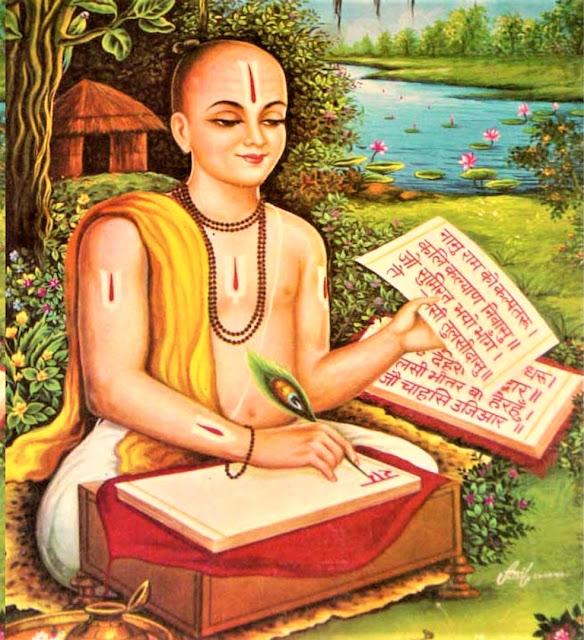
Sri Sathya Sai narrates stories of Ashtavakra, Chanakya, Einstein and Tulsidas While conversing with staff and students, Swami gave a talk to the assembled devotees. It resembled the experience that students have in Trayee Brindavan. Here are the key highlights: One day, Ashtavakra’s father was reciting Mantras (sacred syllables). He was chanting them with wrong intonations. At that time, his wife was lighting a lamp. Within her womb, Ashtavakra criticised his father, telling that his intonations were wrong. Hearing this, his father was annoyed and said, “If he is criticising from within the womb itself, tomorrow, when he grows up, he will criticise me further.” Therefore, he cursed him to be born with bends in his body. Not one, but eight bends. Hence he got the name Ashtavakra.  Once, Ashtavakra went to the king’s court. Noticing the bends in his body, everyone laughed at him. Ashtavakra scolded them saying that they were all cobblers and not scholars. Ashatavakra explained that scholars should have Sama Darshanam (equal vision) and not Charma Darshanam (focus on the physical vision; Charma literally means leather, thereby indicating the physical body). They must not have Vakra Darshanam (crooked vision). A scholar sees a person’s intellect while a cobbler sees the skin.  Why did Chanakya break one of his teeth? Once, Chanakya’s mother was crying. When Chanakya asked her the reason, she replied, “Since you have a handsome body, you may become egoistic. In addition, you also have well-arranged teeth, which means that very soon in your life, you will reach an exalted position and then you may not respect elders or even your own mother.” Hearing this Chanakya said that he never wanted to become such an egoistic person. He even took a stone and broke two of his teeth in the front. Even the limbs of the body indicate the personality of a man as described in the Angashastra (science of the limbs). His mother had studied it. It is not enough if one studies well. He should have obedience, discipline and humility. Ego is expressed in many ways, it manifests in one’s sight, speech and even laughter. Each limb of the body shows traces of ego. Every limb of the body should act according to Dharmashastra (the righteous scriptural injunctions). Sometimes we talk in excess. Too much talk will lead to criticising others. Criticising others will cause disorderliness of lips. At the time of birth, one’s nose may be good, but later it may get bent. Hence, even if one is born with a perfect body, his egoistic actions will lead to physical deformities. What was the secret behind the greatness of Albert Einstein? Einstein (1879-1955 AD; a German-born theoretical physicist, he developed the General Theory of Relativity, one of the two pillars of modern physics, and received the 1921 Nobel Prize in Physics) was never egoistic. He respected all equally. Once someone asked him, “What is the secret of your greatness?” To this he replied, “I will show you the secret”. He then took him to his room. He lived in a very small room. There he pointed to a cupboard. In that, there was a copy of the Bhagavad Gita. Showing that he said, “This has brought me success and reputation”. He had full faith in the Gita.  How did Einstein react when his wife poured a pot of water on him? His unique quality was his forgiveness. He was married to a woman who happened to be his uncle’s daughter. She used to keep waiting for him at the dining table. But he would keep on writing. One day she got very angry. She would tell him, “You keep fasting and don’t listen to me. You and your useless studies”. But Einstein wouldn’t react impulsively. Though his wife would feel very hungry at times, she never ate her meals before her husband had eaten. It was the culture of those days. One day, however, in her frustration, she poured a pot full of water on his head. Still he was very calm. He said, “My dear wife. Be peaceful. Till now, you were ‘thundering’. Now it is a ‘heavy downpour’!! I am not feeling bad that you poured water on me, but the letters have got spoilt. All the matter which I had written has been erased.” In those days, people would dip their pens in ink pots and then write. When Einstein told his wife that everything was erased, she replied, “This means that the ‘intelligence’ was not within you. You got it from outside, and hence you are feeling sorry. If it were inside you, you wouldn’t have felt sorry.” From that day, Einstein reasoned that everything outside was just reaction, reflection and resound; not reality. He accepted his wife as his Guru and began to explore within.  What did Tulsidas learn from his wife? Tulsidas was also the same. (Tulsidas was a poet-saint, reformer and philosopher renowned for his devotion to Rama. A composer of several popular works, he is best known as the author of the epic ‘Ramcharitmanas’, a retelling of the Sanskrit Ramayana in the vernacular Awadhi language. He left his mortal coil in the year 1623 AD.) He composed the Tulsi Ramayan.  How did Einstein react when his wife poured a pot of water on him? His unique quality was his forgiveness. He was married to a woman who happened to be his uncle’s daughter. She used to keep waiting for him at the dining table. But he would keep on writing. One day she got very angry. She would tell him, “You keep fasting and don’t listen to me. You and your useless studies”. But Einstein wouldn’t react impulsively. Though his wife would feel very hungry at times, she never ate her meals before her husband had eaten. It was the culture of those days. One day, however, in her frustration, she poured a pot full of water on his head. Still he was very calm. He said, “My dear wife. Be peaceful. Till now, you were ‘thundering’. Now it is a

Sri Sathya Sai narrates stories of Ashtavakra, Chanakya, Einstein and Tulsidas Read Post »