



















Hari Om

Menu

Bal Vikas – The Divine Foundation

Bhagwan Shri Sathya Sai Baba divine temple gathering photo
Bal Vikas - The Divine Foundation

Shri Sathya Sai Baba Concepts of Bal Vikas Parenting

Parenting PARENTS – PAY RENT “One’s body is derived from the flesh and blood of the mother. The food you eat, the clothes you wear, the life you lead are all the gift of your parents. It is one’s primary duty to please one’s parents. Serve your parents.” Parent means ‘pay rent’. Children should pay the rent of respect and service to parents who gave them the room called body. Mother is the first guru of the child. “Great mothers create great men”. Indian culture emphasizes the importance of mother, father, teacher and God. Swami has said that parents are living Gods. Children are their most valuable treasure. Parenting is nothing other than ‘Family Sadhana’. Parenting Programme of Sri Sathya Sai Balavikas aims atA – AwarenessI – InductionM – Motivation The objectives of parenting programme are : To fulfill Swami’s vision that every home must be a Balavikas class and every mother must be a Balavikas guru. For this we have to work with great momentum.To highlight the need of individual transformation and the family transformation.To heighten the parents self – awareness and self – knowledge.To let every parent get the benefit of Sai experience.To inculcate the idea not to send parents to old age homes. All India Workshop on Parenting – 20-21 November, 2007 – Prasanthi Nilayam On the morning of November 20, Sai Kulwant Hall witnessed the inauguration of the two-day Workshop on Parenting organised by the Education wing of the Sri Sathya Sai Seva Organisation. Swami lit the ceremonial lamp at 9.30 am. A vedic invocation and three short speeches followed. The speeches were by Smt.Nimmi Kanwar, Smt.Vidya Srinivasan and Dr.L.Sasi Bala who spearhead the Balvikas and Parenting initiatives of the Sai Organisation. The content was mainly based on inputs that Swami had given at various times on the Bal Vikas programme and the role parents have to play in bringing up their children. Sri. V. Srinivasan, All India President inaugurating the workshop Parenting Programme in various states Kerala BV trainers are equipped with material and methodology. Parenting programs are conducted regularly and members of EHV wing and Sai Teachers Forum associate with parenting activity. Karnataka Exhibition on dynamic parenting at samithi an taluk levels.Publication of quarterly news letter on parenting.Encourage parents to become Balavikas gurus. Madhya Pradesh and Chattisgarh Intensive house to house parent contact: This was done at least once a year through out the state. For this teams comprising of male Samithi members & B.V.Gurus visit all houses of the specified area. Although the questioner [as per B.V.manual] is not filled but its contents are covered during the verbal talks with the parents.Mothers Meet was conducted at few places. Inviting parents in B.V. classes by respective Gurus.Exhibition on parenting in urban Samithis. Tamil Nadu All the districts have conducted parenting meeting at the Samithi level. All the samithies organize Matru puja where the children worship their parents with all devotion by washing the feet of parents and doing archana by reciting sathya sai Ashtothram.In school Balvikas, parenting meeting was conducted when the parents mentioned that their children stopped taking non-vegetarian food and prevented their parents from cooking non-vegetarian dishes.The parents addicted to alcohol changed their habit because of their children who are in Balvikas. The children who attended Balvikas prayed to Bhagawan to change the habit of their parents.The constant pressure exerted by the children brought about a favourable attitudinal change in the parents.The workshop on parenting facilitated an understanding and adjustment between daughters in law and mothers in law. It helped in eliminating the animosity between the in laws.Parenting has helped the youngsters to respect the elders and the elders to understand the problems of the youngsters.The great weakness among the parents noticed in the parenting programme is that they were highly interested in the academic achievements of their children. It took great deal of time to convince them of the importance of overall personality development consisting of emotional, mental, intellectual, psychological and spiritual dimensions.The parents who were ready to go for divorce actually changed their ideas as the programme on parenting helped them to shed their egoistic attitude and helped in bringing about a positive change in their mental outlook.Successful Parenting programme and balvikas have helped the parents to join in the organization either as Balvikas Gurus or sevadals .One person has become a samithi convenor too. Maharashtra The Parenting Exhibition with sub titles in Regional Language held at Samiti Level was a Great Success.Parenting Workshops — Quiz, Dialogues etc. with active participation of the parents held Funfair with a spiritual themes – where both Parents and children together participated was also a success.

Shri Sathya Sai Baba Concepts of Bal Vikas Parenting Read Post »
Shri Sathya Sai Baba tranquil divine temple photo
Bal Vikas - The Divine Foundation

Shri Sathya Sai Baba Concepts of Bal Vikas Concept

Concepts of Bal Vikas Teaching The Balavikas course is based on two principles – Existence of GodDivinity in man The ultimate aim of Balavikas is to let the child realize that Divinity dwells in him. The child is ignorant that he or she is Divine though pure at heart, soft in physique, tender in mind and nascent in intellect. What you sow, so you will reap. It is here that the teaching techniques assume importance. All the techniques are meant to achieve the two important goals mentioned above. Essence of education and knowledge have been clearly emphasized by Swami as ‘The end of education is character’‘The end of knowledge is Love’ Swami says – “Man is endowed with knowledge, skill, balance and insight, but balance of man is upset today. The cause can be traced to the fact that man is killing knowledge instead of skilling it. As soon as balance is lost, man’s insight suffers a setback.” The imbalance caused by the external education is balanced by the skill of human values and thus the imbalance is corrected and balance is restored. To attain the illumination level of the mind, balance is a pre-requisite. Education process that Bhagawan has designed is for the transformation of man into a human with a character of nobility, compassion and love for mankind. It is the Divine education (Brahma Vidya) not just the academic education (Bahya Vidya) which can achieve this. Balavikas aims to develop the five aspects of child’s personality i.e. Physical, Intellectual, Emotional, Psychological and Spiritual aspects, by kindling the intrinsic human qualities, thereby achieving a complete, well rounded personality aiming at individual transformation. The skill, maturity, intelligence and commitment of guru lies in helping the child blossom into an excellent personality nurturing the five human values and developing the five attributes of an integrated personality. Bal Vikas Teaching Methodology The hall mark of Bal Vikas is that the programme is conducted by devotees who have tremendous commitment, faith and love for Bhagavan and children. The programme has an integrated plan for motivating parents’ participation and involvement of students who complete the 9 years course too. Since the values are inherent in the child, the guru has to gently encourage these values to emerge from within the child by adopting certain teaching methods and helping the children master their minds to become master minds. This task is accomplished by synchronizing the five teaching techniques of Prayer, Silent sitting and Meditation, Group Singing, Story Telling and Group Activities. The Bal Vikas Guru must follow the Divine Principle of “Be, Do and Tell”. “Be, Do and Tell” – Leading by Example Implementation of Bal Vikas curriculum lays stress on using the Five Teaching Techniques in a systematic and integrated manner. The Five Human Values are elicited through lessons based on the Five Teaching Techniques. A Bal Vikas Guru teaches through love. It is through love ultimately the desired transformation takes place. When the process of Educare is uppermost in the mind of the guru, the process of teaching and learning becomes experiential and joyful. For each age group, from young children to teen-age youth the Bal Vikas Guru takes on a specific role linked to psychological development of the child. For Group I, it is that of a mother: discipline established and good behaviour is positively rewarded. In Group II, the teacher takes on the formal teacher’s role and the children develop a sense of order and respect for rules. Finally in group III, the teacher is a friend helping the children to develop firm principles and become actively aware of their conscience. In Group I learning is attained through ‘doing and making’, in Group – II ‘doing and thinking’ and in Group III ‘Planning and Achieving’.

Shri Sathya Sai Baba Concepts of Bal Vikas Concept Read Post »

Shri Sathya Sai Baba tranquil divine temple photo
Bal Vikas - The Divine Foundation

Shri Sathya Sai Baba Bal Vikas Aims

Aims The Sanskrit phrase, Bal Vikas, means “Blossoming of the Child”. Accordingly, rules, regulations and a course syllabus were developed in order to enhance the blossoming of “truth, beauty and goodness” (Satyam, Sivam and Sundaram) in the child. The aims of Bal Vikas are to foster character development and spiritual transformation and To inculcate habits of discipline and self-discipline so that students learn to be masters of the mind and not slaves and have absolute control over sense organs. To engender in children a desire to be of service to all humanity and in this way to be of service to God by helping them learn about the life and teachings of Swami. To Cultivate Humility, Practice Ceiling on Desires and render Self-less Service. To train them to be able to discriminate between right and wrong, between truth and non-truth; that is, to follow always the inner promptings of the Divine. To help children to be fully aware of the Unity underlying all faiths and all mankind. To guide all children to have Purity and Harmony in Thought, Word and Deed. To help children realise their conscience and follow that as the path for attaining Divinity To give priority to the development of character, self-confidence and self-sufficiency. To foster the understanding and practice of the five inherent human values of Truth, Righteousness, Peace, Love and Non-Violence.

Shri Sathya Sai Baba Bal Vikas Aims Read Post »

Shri Sathya Sai Baba orange robe sacred portrait image
Bal Vikas - The Divine Foundation

Shri Sathya Sai Baba Bal Vikas History

History Beginning Bal Vikas is not just a programme. It is a noble movement that took roots in the year 1968 with the founding of Sri Sathya Sai Mahila Vibhag. Swami instructed Mahila Vibhag in 1969 to “run a Bala Vihar for young children where they will listen to stories from the Scriptures, the Epics, and the Lives of Saints belonging to all religions. Children must also be trained to sing Bhajans, enact small plays with themes selected from the classics. They must be taught to cultivate habits of discipline, for these alone can ensure happiness: both individual and social.” “The ideal of the Bal Vikas is to raise a generation of boys and girls who have a clean and clear conscience. Bal Vikas is the primary basis of the great movement to restore Dharma in the world. The young minds of children are not polluted and hence they can be led into good ways of living, simplicity, humility and discipline.” “Guide the children in the spiritual path, through simple and moral living; Install in the young minds, the importance of duty, devotion and discipline; Help them understand the five human values, so that they can practice these in their daily lives; Guide them to Love all and Serve all. In short help them grow into worthy citizens to serve the world; identifying the divinity present in all. Education must aim at providing the child not livelihood, but, a life worth living. The promotion of human values must become an integral part of the educational process.” Bhagavan’s Compassionate Guidance to Gurus Bhagavan’s Compassionate Blessings to Children Structuring The Bala Vihars were started in the year1969 by Mahila Vibhag for the children above six years of age and they were imparted education from the content drawn from ancient scriptures with Divine guidance, through the methodology of story telling, enacting plays and singing Bhajans etc. Thus a new movement of momentous dimensions was set in motion by Bhagavan in the field of education. The children imbibed good habits through mutual help and cooperation which inculcated in them a sense of discipline and devotion. Prof. Kasturi defined Bala Vihar as a Play-Way education system imparting noble values, giving insight to Sanathana Dharma. Bhagavan later changed the name of Bala Vihar into Bal Vikas in 1971, redefining the education system created by Him as the system aiming at the Blossoming of Human Excellence. The early beginnings of the Bal Vikas movement were quite simple. During 1950’s and early 60’s Bhagavan had been repeatedly motivating parents to fulfill the spiritual needs of the children. He insisted that parents should take up the responsibility of moulding the character of children who, in turn, shape the destiny of the nation. Early in the development of Bal Vikas, Swamy emphasized that “the Bal Vikas course is designed to impart the values of Sanathana Dharma, the Perennial Virtuous Conduct. It is imperative that the guru teaches this course with full faith and confidence.” Throughout 1980, Swamy continued to elaborate on his concept of ideal education for children. Adressing students in May 1985 He said, “The process of education involves the process of self-control and self-denial. Wealth, Scholarship, Power and Prestige are all despicable if they are not directed towards moral ends”. As time passed by, slowly and steadily the Bal Vikas Programme designed by Bhagavan for children between 6 years to 14 years of age, in three groups, took shape and with the formation and expansion of Sri Sathya Sai Seva Organisation, Bal Vikas spread far and wide. Training modules were developed, research went in deeper, and with Bhagavan’s active and continuous guidance Bal Vikas was crystallized into a 9 year non-formal education system for children enhancing their learning to become role models in character and also in academic performance.

Shri Sathya Sai Baba Bal Vikas History Read Post »

spe oct12 02
Bal Vikas - The Divine Foundation

Shri Sathya Sai Baba Bal Vikas DasaMahaVidyas – III

DasaMahaVidyas – III Tara is not only an important Hindu Goddess; she is also one of the most important Buddhist Goddesses. The Bodhisattva Tara is the consort of the great Buddha Avalokiteshvara, the Lord who looks down with compassion on all living beings. The term Tara means the deliverer or savior, from the Sanskrit root tri, meaning “to take across,” as to take across a river, the ocean, a mountain, or any difficult situation. The Goddess Tara is called upon in emergencies or at crossroads where we require guidance as to which way to turn. Tara is the saving knowledge. She is the Savior. The idea of the Goddess as saving wisdom is as old as the Vedas, and is a common idea in many spiritual traditions.Tara is the feminine form of Om or Om personified as a Goddess. Tara is the unmanifest sound that exists in the ether of consciousness, through which we can go beyond the entire manifestation. Tara is Om that has the appearance of the ether and which pervades the ether as its underlying vibratory support, but also transcends it. Om is the unmanifest field behind creation, which is the destroyer as well as the creator of the universe. Tara is the purifying force of the vital breaths. Sound that manifests in the ether is the same as the Prana (life-force) that manifests in the ether. Breath is the primal sound of life, and the sound of the breath is the original, spontaneous and unuttered mantra (So’ ham). Both mind and Prana, as word and vibration, have their root in sound. Hence the use of sound or mantra both purifies and energizes the mind. Tara is the radiance of knowledge that arises from the differentiation of meanings through sound. Different sounds serve as vehicles whereby different ideas or meanings flash forth. Om is the underlying light that illumines these different sounds and allows meaning to flow through them. All meanings exist to reintegrate us into the ocean of meaning that is pure consciousness itself. Tara, like Kali,is deep blue in color. She has matted hair, wears a garland of human heads, and has eight serpents for her ornaments. She is dancing on a corpse, has four arms and carries in her four hands a sword or head chopper, a scissors, a severed head and a lotus. OriginThe oral tradition gives an origin to the goddess Tara. The legend begins with the churning of the ocean between the Devas and Asuras. Lord Shiva drank the poison (Halahala) that was created from the churning of the ocean (in the process turning his throat blue and earning him the epithet Nilakantha), thus saving the world from destruction, but fell unconscious under its powerful effect. Tara Ma appeared and took Shiva on her lap. She suckled him, the milk from her breasts counteracting the poison, and he recovered. This story is reminiscent of the one in which Shiva stops the rampaging Kali by becoming an infant. Seeing the child, Kali’s maternal instinct comes to the fore, and she becomes quiet and nurses the infant Shiva. In both cases, Shiva assumes the position of an infant vis-à-vis the Goddess. The similarities in appearances between Kali and Tara are striking and unmistakable. They both are described as standing upon a supine Shiva in inert or corpse like form. However, while Kali is described as black, Tara is described as blue. Both wear minimal clothing; however Tara wears a tiger skin skirt, while Kali wears only a girdle of severed human arms. Both wear a necklace of severed human heads and the previously mentioned girdle of arms. Both have a lolling tongue, and blood oozes from their mouths. Their appearances are so strikingly similar that it is easy to mistake one for the other. Indeed, they are often said to be manifestations of each other; for example, in their thousand-name hymns they share many epithets as well as having each other’s names. Tara, for example, is called Kalika, Ugra-kali, Mahakali, and Bhadra-kali. Tara is said to be more approachable to the devotee (Bhakta) or Tantrika because of her maternal instincts; however a large population of Bengali Hindus approach Kali herself as “Ma” or “mother”.

Shri Sathya Sai Baba Bal Vikas DasaMahaVidyas – III Read Post »

annal dec12 01
Bal Vikas - The Divine Foundation

Shri Sathya Sai Baba Bal Vikas From the Annals of the World History

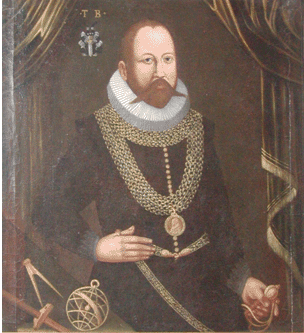
From the Annals of the World History Tycho Brahe — 14 December 1546 – 24 October 1601 Tycho Brahe, born in 1546, was the eldest son of a noble Danish family, and as such appeared destined for the natural aristocratic occupations of hunting and warfare. However, he had an uncle Joergen, a country squire and vice-admiral, who was more educated, and childless. Tycho’s father had agreed with the uncle before Tycho was born that if Tycho was a boy, the uncle could adopt and raise him. He changed his mind and reneged. Then, when a younger brother was born, the uncle kidnapped Tycho. The father threatened to murder the uncle, but eventually calmed down, since Tycho stood to inherit a large estate from the uncle. When Tycho was seven, his uncle insisted that he begin studying Latin. His parents objected, but the uncle said this would help Tycho become a lawyer. At age thirteen, Tycho entered the University of Copenhagen to study law and philosophy. At this impressionable age, an event took place that changed his life. There was a partial eclipse of the sun. This had been predicted, and took place on schedule. It struck Tycho as “something divine that men should know the motions of the stars so accurately that they were able a long time beforehand to predict their places and relative positions”. Perhaps this predictability was especially appealing to one whose personal life was evolving in rather an uncertain way. One of the advantages of being a rich kid was that he could immediately go out and buy a copy of Ptolemy’s Almagest (in Latin), and some sets of astronomical tables, which showed the positions of the planets at any given time. Ptolemy himself had made such tables, and they had been revised in Spain by a group of fifty astronomers in 1252, brought together by Alfonso X of Castile. These were called the Alfonsine tables. Tycho also bought a recent set of tables based on Copernicus’ theory. At age sixteen, the uncle sent Tycho to Leipzig, in Germany, to continue his study of law. He was accompanied by a tutor, the twenty year old Anders Vedel, who himself later became famous as Denmark’s first great historian. However, Tycho was obsessed with astronomy. He bought books and instruments, which he hid from his tutor, and stayed up much of each night observing the stars. When he was seventeen, he observed a special event—Jupiter and Saturn passed very close to each other. (This was on August 17, 1563.) He found on checking the tables that the Alfonsine tables were off by a month in predicting this event, and the Copernicus tables off by several days. Tycho decided this was a pathetic performance by the astronomers, and much better tables could be constructed just by more accurate observation of the exact positions of the planets over an extended period of time. He decided that this was what he was going to do. Vedel realized Tycho was a hopeless case, and gave up trying to tutor him in law. The two remained good friends for life. Meanwhile, the uncle died of pneumonia after rescuing the king from drowning after the king had fallen off the bridge to his castle returning from a naval battle with the Swedes. When Tycho returned to Denmark, the rest of his family were quite unfriendly. They despised his stargazing, and blamed him for neglecting the law. He decided to return to Germany, and fell in with some rich amateur astronomers in Augsburg. He persuaded them that what was needed was accurate observation, and (as telescopes had not yet been invented) this meant rather large quadrants to get lines of sight on stars. They set up a large wooden quadrant, part of a circle with a nineteen foot radius that took twenty men to set up. It was graduated in sixtieths of a degree. This was the beginning of Tycho’s accurate observations. At the age of twenty-six, in 1570, Tycho returned to Denmark. He lived for a while with his family, then with an uncle, Steen Bille, who had founded the first paper mill and glassworks in Denmark. He was the only family member who approved of star gazing. In 1572, another astronomical event took place that changed Tycho’s life. On November 11, walking back from Steen’s alchemy lab, Tycho noticed a new star in the sky that was brighter than Venus. He did not believe his eyes. He called some servants, then some peasants, to reassure him that it was really there. The new star was so bright that it could be seen in daylight. It lasted eighteen months. It was what is now called a nova, a rare event. The crucial question from the astronomical and theological point of view was where exactly was this new star? Was it an event in the upper atmosphere, that is to say, below the moon, what was then termed in the sublunary region? If so, that would be o.k., because this region, below the moon, was where change and decay took place. On the other hand, if it was out there in the eighth sphere, the fixed stars, the edge of heaven, that contradicted Aristotelian and Christian dogma, because that sphere had remained unchanged since the day of creation, and was supposed to stay that way. Maestlin in Tubingen, and Thomas Diggs in England, leading astronomers, tried to detect movement in the new star by lining it up with known fixed stars, using stretched threads. They could see no movement. Tycho had just finished building a new sextant, with arms five and a half feet long, a massive bronze hinge, a metallic scale calibrated in minutes (sixtieths of a degree) and a table of corrections for the remaining tiny errors in the instrument he had detected. His technology was far ahead of the competition, and he was able to settle the argument. The new star did not move at all relative to the fixed stars.

Shri Sathya Sai Baba Bal Vikas From the Annals of the World History Read Post »

Guided Visualisation tile Img
Bal Vikas - The Divine Foundation

Shri Sathya Sai Baba Bal Vikas Children’s Corner

Children’s Corner An Act of Love Dear Children,This is a story of a cab driver in his own words. Twenty years ago, I drove a cab for a living. One time I arrived in the middle of the night for a pick up at a building that was dark except for a single light in a ground floor window.Under these circumstances, many drivers would just honk once or twice, wait a minute, and then drive away. But I had seen too many impoverished people who depended on taxis as their only means of transportation. Unless a situation smelled of danger, I always went to the door. This passenger might be someone who needs my assistance, I reasoned to myself. So I walked to the door and knocked. “Just a minute,” answered a frail, elderly voice. I could hear something being dragged across the floor. After a long pause, the door opened. A small woman in her 80?s stood before me. She was wearing a print dress and a pillbox hat with a veil pinned on it, like somebody out of a 1940s movie. By her side was a small nylon suitcase.The apartment looked as if no one had lived in it for years. All the furniture was covered with sheets. There were no clocks on the walls, any knickknacks or utensils on the counters. In the corner was a cardboard box filled with photos and glassware. “Would you carry my bag out to the car?” she said. I took the suitcase to the cab, and then returned to assist the woman. She took my arm and we walked slowly toward the curb. She kept thanking me for my kindness. “It’s nothing,” I told her. “I just try to treat my passengers the way I would want my mother treated.” “Oh, you’re such a good boy,” she said. When we got in the cab, she gave me an address, and then asked, “Could you drive through downtown?” “It’s not the shortest way,” I answered quickly. “Oh, I don’t mind,” she said. “I’m in no hurry. I’m on my way to a hospice.” I looked in the rear view mirror. Her eyes were glistening. “I don’t have any family left,” she continued. “The doctor says I don’t have very long.” I quietly reached over and shut off the meter. “What route would you like me to take?” I asked. For the next two hours, we drove through the city. She showed me the building where she had once worked as an elevator operator. We drove through the neighbourhood where she and her husband had lived when they were newlyweds. She had me pull up in front of a furniture warehouse that had once been a ballroom where she had gone dancing as a girl.Sometimes she’d ask me to slow in front of a particular building or corner and would sit staring into the darkness, saying nothing. As the first hint of sun was creasing the horizon, she suddenly said, “I’m tired. Let’s go now.”We drove in silence to the address she had given me. It was a low building, like a small convalescent home, with a driveway that passed under a portico. Two orderlies came out to the cab as soon as we pulled up. They were solicitous and intent, watching her every move. They must have been expecting her. I opened the trunk and took the small suitcase to the door. The woman was already seated in a wheelchair. “How much do I owe you?” she asked, reaching into her purse. “Nothing,” I said. “You have to make a living,” she answered. “There are other passengers.” Almost without thinking, I bent and gave her a hug. She held onto me tightly. “You gave an old woman a little moment of joy,” she said. “Thank you.” I squeezed her hand, and then walked into the dim morning light. Behind me, a door shut. It was the sound of the closing of a life.I didn’t pick up any more passengers that shift. I drove aimlessly, lost in thought. For the rest of that day, I could hardly talk. What if that woman had gotten an angry driver, or one who was impatient to end his shift? What if I had refused to take the run, or had honked once, then driven away? On a quick review, I don’t think that I have done anything more important in my life. We’re conditioned to think that our lives revolve around great moments. But great moments often catch us unaware-beautifully wrapped in what others may consider a small one.

Shri Sathya Sai Baba Bal Vikas Children’s Corner Read Post »

Bhagwan Shri Sathya Sai Baba spiritual discourse sacred picture
Bal Vikas - The Divine Foundation

Shri Sathya Sai Baba Bal Vikas Gurus Corner

Gurus Corner A Heart Warming Story One day a woman was walking down the street when she spied a beggar sitting in the corner. The man was elderly, unshaven, and ragged. As he sat there, pedestrians walked by him giving him dirty looks. They clearly wanted nothing to do with him because of who he was — a dirty, homeless man. But when she saw him, the woman was moved to compassion. It was very cold that day and the man had his tattered coat — more like an old suit coat rather than a warm coat — wrapped around him. She stopped and looked down. “Sir?” she asked. “Are you all right?” The man slowly looked up. This was a woman clearly accustomed to the finer things of life. Her coat was new. She looked like she had never missed a meal in her life. His first thought was that she wanted to make fun of him, like so many others had done before. “Leave me alone,” he growled. To his amazement, the woman continued standing. She was smiling — her even white teeth displayed in dazzling rows. “Are you hungry?” she asked. “No,” he answered sarcastically. “I’ve just come from dining with the president. Now go away.” The woman’s smile became even broader. Suddenly the man felt a gentle hand under his arm. “What are you doing, lady?” the man asked angrily. “I said to leave me alone.” Just then a policeman came up. “Is there any problem, ma’am?” he asked. “No problem here, officer,” the woman answered. “I’m just trying to get this man to his feet. Will you help me?” The officer scratched his head. “That’s old Jack. He’s been a fixture around here for a couple of years. What do you want with him?” “See that cafeteria over there?” she asked. “I’m going to get him something to eat and get him out of the cold for awhile.” “Are you crazy, lady?” the homeless man resisted. “I don’t want to go in there!” Then he felt strong hands grab his other arm and lift him up. “Let me go, officer. I didn’t do anything.” “This is a good deal for you, Jack,” the officer answered. “Don’t blow it.” Finally, and with some difficulty, the woman and the police officer got Jack into the cafeteria and sat him at a table in a remote corner. It was the middle of the morning, so most of the breakfast crowd had already left and the lunch bunch had not yet arrived. The manager strode across the cafeteria and stood by the table. “What’s going on here, officer?” he asked. “What is all this. Is this man in trouble?” “This lady brought this man in here to be fed,” the policeman answered. “Not in here!” the manager replied angrily. “Having a person like that here is bad for business.” Old Jack smiled a toothless grin. “See, lady. I told you so. Now if you’ll let me go. I didn’t want to come here in the first place.” The woman turned to the cafeteria manager and smiled. “Sir, are you familiar with Eddy and Associates, the banking firm down the street?” “Of course I am,” the manager answered impatiently. “They hold their weekly meetings in one of my banquet rooms.” “And do you make a goodly amount of money providing food at these weekly meetings?” “What business is that of yours?” “I, sir, am Penelope Eddy, president and CEO of the company.” “Oh.” The woman smiled again. “I thought that might make a difference.” She glanced at the cop who was busy stifling a giggle. “Would you like to join us in a cup of coffee and a meal, officer?” “No thanks, ma’am,” the officer replied. “I’m on duty.” “Then perhaps, a cup of coffee to go?” “Yes, ma’am. That would be very nice.” The cafeteria manager turned on his heel. “I’ll get your coffee for you right away, officer.” The officer watched him walk away. “You certainly put him in his place,” he said. “That was not my intent. Believe it or not, I have a reason for all this.” She sat down at the table across from her amazed dinner guest. She stared at him intently. “Jack, do you remember me?” Old Jack searched her face with his old, rheumy eyes “I think so — I mean you do look familiar.” “I’m a little older perhaps,” she said. “Maybe I’ve even filled out more than in my younger days when you worked here, and I came through that very door, cold and hungry.” “Ma’am?” the officer said questioningly. He couldn’t believe that such a magnificently turned out woman could ever have been hungry. “I was just out of college,” the woman began. “I had come to the city looking for a job, but I couldn’t find anything. Finally I was down to my last few cents and had been kicked out of my apartment. I walked the streets for days. It was February and I was cold and nearly starving. I saw this place and walked in on the off chance that I could get something to eat.” Jack lit up with a smile. “Now I remember,” he said. “I was behind the serving counter. You came up and asked me if you could work for something to eat. I said that it was against company policy.” “I know,” the woman continued. “Then you made me the biggest roast beef sandwich that I had ever seen, gave me a cup of coffee, and told me to go over to a corner table and enjoy it. I was afraid that you would get into trouble. Then, when I looked over, I saw you put the price of my food in the cash register. I knew then that everything would be all right.” “So you started your own business?” Old Jack said. “I got a job that very afternoon. I worked my way up. Eventually I started my own

Shri Sathya Sai Baba Bal Vikas Gurus Corner Read Post »

parenting6
Bal Vikas - The Divine Foundation

Shri Sathya Sai Baba Bal Vikas At the Lotus Feet

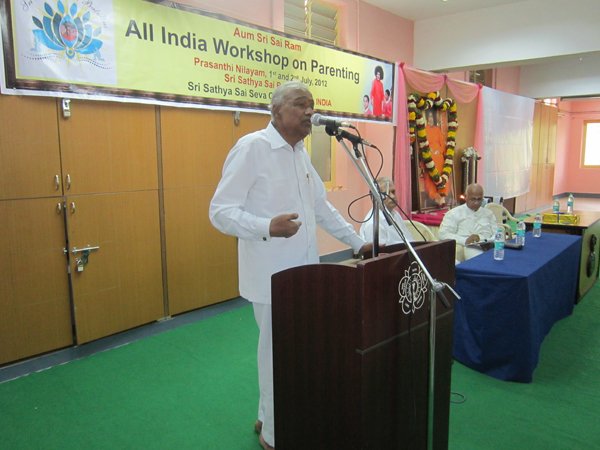
At the Lotus Feet ALL INDIA WORKSHOP ON PARENTINGJULY 1st and 2nd, 2012 – PRASHANTI NILAYAM The All India workshop on Parenting commenced at 10am on 1st July 2012 with the Jyothi Prajwalana (Lighting of the lamp) by Mrs. Sarla Shah, National Coordinator for Education Wing of Sri Sathya Sai Seva Organisations, Sri V. Srinivasan, All India President, Sri Nimesh Pandya, National Vice President and Sri. N.Ramani, National Vice President. Inaugurating the Workshop Sri V.Srinivasan, All India President delivered the key note address on the following lines: Swami has set up our Organisation to function as an effective means to perform spiritual sadhana Transforming individual lives to transform the world is the key note of our Organisation Balvikas, being the heart and soul of our Organisation needs to be a holistic programme for the entire family Full benefits of Balvikas are reaped only if the parents are involved The Balvikas programme has to be made interesting not only for the children but also for parents Parenting programmes are the need of the hour to avoid dualities and resulting conflicts in behavioural patterns at home vis-à-vis what is taught in the class Similar programmes can be targeted at schools for the teachers where school balvikas is being conducted so that the concept of duality is totally removed from the child’s minds Smt. Sarla Shah, released the book “Sai Parenting – The Child is the father of the Man”, containing articles on Parenting received from various states. Smt. Vidya Srinivasan, JNEC then spoke on the Objectives of the Parenting Workshop, in her introductory address. She stressed on the importance of Parenting Workshops and also listed out the Expectations from such Parenting programmes. Restructuring of Balvikas Programme to facilitate dynamic participation of parents, Orientation of Programmes at the entry point of each Group of the Balvikas, Framing of Balvikas prospectus and obtaining a simple sign up form from the parents for more commitment from their end, encouraging the parents to train themselves in Balvikas syllabus to take classes were some of the areas highlighted by her. This was followed by a very inspiring session by Dr. Guru Raj Karjagi on Counselling for Parents and Creative Teaching techniques. Interspersed with animated activities, interesting anecdotes and appropriate video clippings, his session covered different parenting styles and the need for the parents’ accepting the child unconditionally. He also stressed upon the fact that Balvikas should not be a coaching centre but must be a creative learning centre which is child centric. The post lunch session commenced with a presentation by Mrs. Samhitha Nehru, SEC, Delhi NCR, on “Organising Parents Meet in the changed economic scenario.” She focused on the intricate details of the 3Ps of organizing parents meets, namely – Planning, Preparation and Presentation. Prof. E. Mukandan, SP, Kerala now addressed the participants on the”Motivation Methodologies for Parents” He elaborately explained the What, Why and How of Motivating Parents, using many anecdotes and practical illustrations in support of his topic. Dr. D. Syamala of Andhra Pradesh explained how the SSSVIP programme along with Bhagawan’s Aquacare, Medicare and Sociocare projects have motivated and inspired the rural Balvikas students and parents of the tribal areas of East Godavari District. Sharing the findings of a very detailed survey of Balvikas parents of Nanaganallur samithi, Tamilnadu, Sri.Sai Sundar, SSSIHL Alumni, expressed the need for regular Balvikas Parent Contact Programmes for improving the quality and quantity of Balvikas strength. He mentioned that as a follow up of this survey, data from the teachers of the students whose parents’ were surveyed initially, was also collected, which resulted in positive responses from the parents as well as the teachers. The post dinner session started with Parenting Approach in Urban Centres by participants from Mumbai, Maharashtra. Through interesting activities using day-to-day articles the need for acceptance of the children, effective communication and positive parenting practices, was brought out very effectively. This was followed with Sharing of Experiences in Conducting Parenting Workshops in cities by West Bengal, Uttar Pradesh, Karnataka and Gujarat. The speaker from West Bengal shared intricate details regarding planning, organizing and conducting parenting workshops. The speaker from Uttar Pradesh shared real life experiences while conducting workshops and emphasized the role of grandparents also in parenting. The speaker from Karnataka focused on the importance of active participation and involvement of parents in our Organisation activities. Finally the speaker from Gujarat shared the experiences of parents’ transformation after attending parenting workshops. Smt. Kamala Pandya, DNEC compered the entire day’s proceedings. Thus, the first day of the programme ended with the chanting of Shanti Mantra. On the second day of the Workshop speaking to the participants on Expansion of Bal Vikas and SSSSO, Sri Nimish Pandya, National Vice President stressed on laying down the ethos of the Organisation and transforming the world through self transformation. He emphasized on training all the Gurus to realize the Divinity with in and in turn make the children realize the Divinity as indweller. He advised the Gurus to train the children to master the minds and transform themselves as ‘master minds’. He advised the Gurus to enlighten the parents about the holistic programme of Bal Vikas. Citing the examples of successful Bala Vikas children, he advised the gurus to train the children to bring in the desired positive change in parents and the society. He suggested to involve parents in organizational activities and in Bhajans to begin with. He suggested to bring out standard Parenting Manual in Sathya Sai Way. After this inspiring speech by Sri Nimish Pandya, the participants from the states of Odisha, Bihar, Haryana, Madhya Pradesh, Manipur have shared their experiences in conducting Parenting Workshops in Rural Areas. A Team of Gurus from Tamilnadu have presented a lively demonstration on Parenting. Professor Yogendra Verma from Himachal Pradesh guided the parents of teenagers how to conduct themselves and handle sensitive issues of teenage children. He has also given many suggestions to Bal Vikas gurus on Parenting with focus on Young Parents and Parents of teenage children. Later Sri

Shri Sathya Sai Baba Bal Vikas At the Lotus Feet Read Post »

07012012 10
Bal Vikas - The Divine Foundation

Shri Sathya Sai Baba Bal Vikas Activities From State

Activities from States Report of Sri SatyaSaiBalVikas Parents Meet atDharmakshetra on December 2nd 2012 In continuance of Swami’s Birthday Celebrations, the BalVikas wing of Sri SatyaSai SevaOrganisation, Mumbai, held a Sri SatyaSaiBalVikas Parents Meet at Dharmakshetra on 2nd December 2012. Parents, Gurus and children started streaming into Shanti Deep as early as 4.30p.m.A beautiful rangoli near the Altar on Parenting set the mood for the evening’s proceedings. he programme started with Veda chanting by the BalVikas children at 5.30p.m. his was followed by mellifluous rendering of Bhajans by the children ,for half an hour. Three Mumbai level final Elocution winners, SaieeshaShetty, AdityaRao and Ramya Unnikrishnan delivered their award winning speeches. Presentation of certificates to the winners of this year’s MumbaIlevel Final Elocution audition held on 9th September 2012, was the next item on the evening’s agenda. Mumbai District President, Sri.AnoopSaxena distributed the certificates to 31 winners. The Sri SatyaSaiBalVikas Diploma is most coveted by any BalVikas child as it is a testimony of the child having successfully completed the nine year programme of Sri SatyaSaiBalVikas. Sri.RameshSawant, Maharashtra State President,handed over the diplomas to the students, who had completed the course this Year. The audience then split into three groups.TheBalVikas children were engaged in activities like Creative writing and Drawing,hence those who wished to paint and draw were taken to Pragnya Deep and those who wished to write were sent to Gyan Deep. The topics for both painting and drawing were1) My Parents2) My Home The Parents were then treated to awonderful, thought provoking talk on Dynamic Parenting by Sri NimishPandya, All India Vice President of the Sri SatyaSaiSevaOrganisations. Parenting is a divine gift and an art which needs to be practiced skillfully and with care.The audience was exposed to different facets of parenting,throughexamples,games and anecdotes. The parents enthusiastically participated in the games each, of which had a message on parenting.The talk also made them introspect on whether they are doing justice to their role as parents. The parents enthusiastically participated in the games each, of which had a message on parenting.The talk also made them introspect on whether they are doing justice to their role as parents. The programme ended with Vote of Thanks and Mangal Arti by 8.15p.m. Sreya Bhargava, an Alumni of BalVikas was master of ceremonies. ll participants were taken to the lawns of Satya Deep where they partook of a sumptuous MahaPrasadam. Totally 650 people participated in the programme, 450 parents, 200 children and 25 gurus & volunteers.

Shri Sathya Sai Baba Bal Vikas Activities From State Read Post »