














Hari Om

Menu

Yoga of Synthesis

The Divine Life Society Rishikesh Swami Sivananda 1
Swami Sivananda, Yoga of Synthesis

Third Stage

Third Stage Systematically to carry on the Divine Mission on a large scale, I established the DIVINE LIFE TRUST SOCIETY in 1936 and registered the Trust Deed at Ambala. In 1936 when I was returning from Lahore after presiding over a Kirtan Conference, I just thought of a Trust Society and alighted at Ambala and consulted an Advocate and prepared the Trust deed. Then the Divine Life Society was established for the dissemination of spiritual knowledge throughout the world and subsequently about 300 Branches were opened in all important cities. Thousands of students received initiation from me into the order of Sannyasa. So long as they undergo training they stay with me and work. Advanced students start their own Mission in big cities or have their own Sadhana in the Himalayan caves. Thirsty aspirants in all parts of the world receive guidance through post. Series of articles come out on the practical side of Yoga, Bhakti, Vedanta and Health through leaflets, pamphlets and bigger publications, in various languages. Leading newspapers in all countries publish my articles on Yoga, Health and general spiritual matters. Half a dozen periodicals are published at the Ashram in English and Hindi for circulation through the world. The Ashram is now in a position to maintain about 400 persons, learned and cultured scholars, Mahatmas, Yogins, devotees, poor people and the sick, not to mention the school students of the neighbouring villages. A CENTRE OF DYNAMIC SPIRITUAL REGENERATION Many foreigners come to the Ashram and spend some weeks or months and admire the wonderful work turned out at the Ashram. The inhabitants of Shivanandanagar, young and old, men and women, enjoy the peace and bliss of this Holy Centre and help the world in a variety of ways. They all receive my careful, personal attention. I provide them with all comforts and conveniences and help them in their evolution. There are a number of buildings, Kutirs and Guest Houses for their stay. Over thirty typewriters work day and night for attending to correspondence and book-work. The Yoga-Vedanta Forest University trains a large number of students through able and qualified professors and teachers. The students become well-versed in all the scriptures. The University Press is now equipped with several electrically operated automatic machines of composing, printing, folding and binding. For the dissemination of knowledge among youths, Essay Competitions are conducted and scholarships offered to prosecute their studies in Colleges and High Schools. The Sivananda Hospital is a blessing to the Mahatmas, Yogins, pilgrims and the poor people of the neighbouring villages. Experienced doctors in different systems of medicine attend to the Hospital work. The General Hospital is equipped with modern apparatus like X-Ray, Diathermy and a High Frequency Apparatus for E.N.T. and eye cases. Special worship in the Lord Viswanath Mandir has given a new life to the sick persons all over the world. People get peace and prosperity by such worship done in the name of the devotees. I am filled with immense joy when I receive hundreds of letters from devotees who say that their lives were saved through the special prayers conducted in the Temple of all Faiths at the Ashram. They write volumes on the miraculous escapes they had in their lives. Leaders and followers of other religions and cults also come and stay at the Ashram and find this an ideal centre-a common platform-to serve the world. I see before me a huge Spiritual Colony with Joy and Bliss in the face of every resident. People come with many motives (such as attaining material and spiritual benefits) and they are all stunned to have their wishes fulfilled in a large measure. Glory to the Lord for bestowing this Ideal Centre for all types of seekers after Truth. In addition to the normal activities, occasional Blind Relief Camps are organised at the Ashram and at out-stations also. Provincial Divine Life Conferences are organised in important cities of India. Devotees and students come in batches during their holidays and join the daily routine and Satsanga, and derive incalculable spiritual benefits.
Third Stage Read Post »

images 13
Swami Sivananda, Yoga of Synthesis

Second Stage

Second Stage Planning and scheming were not in my nature. I depend on the grace of the Lord. I had decided to leave Swargashram. Where was I to go? That was a great problem. For some days, I stayed in a small room at the Rama Ashram Library. A few of my students lived in a small Dharmashala nearby and depended on the Kshetra for their meals. For some days I too went to the Kshetra for my Bhiksha. To save time, I received my Bhiksha through an elderly Sadhu from the Kshetra. Thus months passed. Then I found a small Kutir in a dilapidated condition nearby. That was improved a bit by fixing doors and windows. I occupied the place and lived there for a period of over 8 years. I could have easily set up some thatched cottages in the jungle. That was not suitable for dynamic work. Books and papers might get damaged by white-ants. I saw a series of rooms in a Dharmashala used by a shopkeeper as a cow-shed. These rooms had no doors. Gradually, one by one, all the rooms were converted into residential quarters for the students. When devotees gave me some money for my personal use, I utilised it in printing leaflets like “Twenty Important Spiritual Instructions,” “Way to Peace and Bliss,” “Forty Golden Precepts” and other pamphlets, and gave them to visitors. I utilised the money in purchasing some useful medicines for the treatment of sick Mahatmas and for postage to send articles to newspapers and letters to thirsty aspirants. The work grew in a steady pace. I did not go out in search of students. True seekers of Truth came to me in large numbers seeking my help and guidance. They all received initiation from me and lived in the adjacent rooms of the Dharmashala and worked day and night. To meet the heavy rush of work, I got a duplicator and a typewriter. People evinced great interest in the divine service done for the spiritual uplift of the world. I admired their devotion to me. In work, they forgot their past and plunged themselves in attaining evolution through service and Sadhana. Devotees gave me voluntary contributions for the noble cause. For the maintenance of the students, I received dry rations for five persons from the Kali-kambliwala Kshetra at Rishikesh. For the rest of the students and the visitors I utilised the meagre donation received from a few admirers. That enabled me to publish some books also for sale. TALENTS FIND THEIR BEST USES With the arrival of new and able hands, I started various fields of activities suited to their taste and temperament. I found out the talents and hidden faculties in them and encouraged them to a great extent. Then a small kitchen was started to provide food for the hard workers, the visitors and the helpless who could not get Bhiksha from the Kshetra. I maintained various kinds of addresses-of devotees, High Schools, Libraries, donors and aspirants for the Sannyasa line. (Nivritti Marga) and sent my books periodically for dissemination of knowledge. The addresses were well-classified under several headings for easy reference. Here I give the titles of a few address books: Ashrams, Associations, Advocates, Judges, Graduates, Book-sellers, Publishers, Firms, Doctors, Correspondence students, Divine Life Society Branches, Libraries, Ladies Section, Brahmacharis and Sannyasi students, Magazines and Periodicals, Maharajahs and Zamindars, Students who have received initiation, Monthly Donors, Household Disciples, Officers, Patrons, Professors, Wonderful Misers. Now there are several address books, a separate volume for each country. I myself used to fill in the correct addresses and note the changes very carefully. Even today, I myself enter the important addresses and permit the students to maintain all the address books in perfect order.

Second Stage Read Post »

The Wisdom of Sivananda Saraswati Quotes ReflectionsA Practical Guide.jpeg
Swami Sivananda, Yoga of Synthesis

First Stage

First Stage I always loved silent Sadhana in seclusion. During the day for a short period I would write some articles and letters to thirsty aspirants. I did not use a kerosene light, nor did I work at night at any time. I used to come out of my Kutir just for an hour in the morning to serve the sick people with medicine, for a brisk walk in the compound, to bathe in the Ganga and to go to the Kshetra for bringing my food. This sort of routine has become my habit during my thirty-five years of life in Rishikesh. I never indulged in loose talks with friends. When I went to the Kshetra, I observed Mauna. To avoid people, I used to walk through a small foot-path through the jungle. While walking to the Kshetra, I combined deep breathing exercises and mental Japa. I had no ambition to become world-famous by any extensive tour or thrilling lectures from the platform. I never attempted to be a Guru to anyone. I am not pleased when people call me: “Sat Guru” or “Avatar.” I am dead against “Gurudom.” That is a great obstacle and has caused the downfall of great men in the spiritual path. “Gurudom” is a menace to society. Even now I ask people to do Namaskar to me mentally. The few lines I wrote to one of my disciples in 1931 convey my attitude clearly:- “I am only a common Sadhu. I may not be able to help you much. Further I do not make disciples. I can be your sincere friend till the end of my life. I do not like to keep persons by my side for a long time. I give lessons for a couple of months and ask my students to meditate in some solitary places in Kashmir or Uttarkashi.” RESERVE AND HUMILITY I never said or did anything to tempt people with promises of grand results like Mukti from a drop of Kamandalu water or Samadhi by a mere touch. I emphasised the importance of silent Sadhana, Japa and meditation for a systematic progress in the spiritual path. Invariably I asked all aspirants to purify the heart through selfless service to mankind. In 1933 the publishers in Madras wrote articles on my life and mentioned me as an “Avatar.” Immediately I gave a reply which explains the attitude I have always maintained:- “Kindly remove all ‘Krishna Avatara’ and ‘Bhagawan’ business. Keep the publication natural and simple. Then it will be attractive. Do not exaggerate much about me very often. The juice will evaporate. Do not give me titles as ‘World Teacher’, ‘Mandaleshwar’ and ‘Bhagawan’. Lay bare the truth, Truth will shine, I lead a simple and natural life. I take immense delight in service. Service has elevated me. Service has purified me. This body is meant for service. I live to serve everyone and make the world happy and cheerful.” Even before donkeys and other animals, I do mental prostrations. To my disciples and devotees, I first do Namaskara. I behold the Essence behind all names and forms. That is real Vedanta in daily life. GUIDING THE STEPS OF NEOPHYTES From 1930, many earnest students with a burning desire to devote their lives to spiritual pursuits came to me for guidance. I had also a burning desire to serve the world. Those were the days when Sadhus and Mahatmas lived in peculiar, pitiable conditions-without necessary comforts and conveniences and proper guidance for spiritual evolution. Many tortured the body in the hot sun and in the Himalayan cold. Some were addicted to intoxicating drinks to induce the so-called Samadhi. With a view to training a band of Sannyasins and Yogins on the right lines, I permitted some aspirants to live in the adjacent Kutirs. I arranged for their meals from the Kshetra and gave them initiation. I arranged all comforts and conveniences for them. I encouraged them and infused Vairagya in them. I took special care of their health. I frequently enquired about their Sadhana and gave useful hints for the removal of their difficulties and obstacles in their meditation. When they offered their services to me, I asked them to go from Kutir to Kutir and find out the old and sick Mahatmas and serve them with Bhakti and Sraddha by bringing food for them from the Kshetra and massaging their legs and washing their clothes. I asked some educated students to take copies of my short articles and send them to magazines and Newspapers for publication, and devote their time to study, Japa and meditation. They all took great pleasure in copying out my articles, as they all contained the essence of the teachings of all sages and saints, and a clear commentary on the difficult portions of the Upanishads and the Gita. My articles contained practical lessons for controlling the turbulent senses and fluctuation of the mind. Instead of studying the ancient sacred scriptures for decades, the students spent a few minutes daily in making copies of my articles and thereby learnt Yoga and philosophy easily in a short period. I closely observed their faces to see if they liked the work and then carefully selected matter suited to their taste and temperament and entrusted them with the work. Sometimes I had to do the whole work. I love the students. Unasked, I attended to their needs. In the case of old persons who had no ties in the world, I welcomed them and encouraged them in carrying on their Sadhana and asked them to take bath in the Ganga and do plenty of Japa and Sravana. I danced in joy when I saw peace and bliss in their face. Thus more and more aspirants came to me, and the Swargashram management could not maintain the increasing number of seekers after Truth. I loved the place and enjoyed the peace, but in the interest of the spiritual uplift of a large number of educated Sadhakas, I decided to

First Stage Read Post »

hridaya
Swami Sivananda, Yoga of Synthesis

On The Anvil – Sharing the Treasure Divine

On The Anvil – Sharing the Treasure Divine Some Mahatmas spend their whole life in deep study of scriptures and derive great pleasure in hot discussions and arguments on abstruse points of Yoga and Vedanta. Some Yogins struggle with Hatha Yoga exercises with the hope of getting Siddhis. They indulge in practices which torture the body. There are a few who are tempted by the Kundalini Yoga and Tantra Sastra for attaining spiritual powers to perform miracles. Devotees spend all their time in Japa and Kirtan and weep for hours because of their separation from the Lord. In this group, you will find also some educated young persons who spend their whole time in writing thrilling articles and lectures. They plan and prepare for a world-tour. I have great love and reverence for all such Mahatmas for the thorough research they do in various directions. Do they all succeed in attaining perfection? I found that they did not have proper facilities, comforts and conveniences. They lacked guidance from a competent person. They could not be steady and systematic in their Sadhana. The planning and scheming nature in them led them to frequent changes in their daily practices. Either they paid undue attention to their wants or completely ignored their health. They all thought much of the future and aspired for Siddhis, miracles, name and fame. That only fattened their ego. A deep study of the ways of Mahatmas opened my eyes and gave me strength to stick to rigorous Sadhana in the right direction. I felt the Grace of the Lord. I derived strength and guidance from within. I found ways for an all-round development. I had the goal of my life as Self-realisation and determined to spend every bit of my energy and time in study, service and Sadhana. HOW I SYNTHESISED MY SADHANA Service of the sick and the poor and the Mahatmas purifies the heart. This is a field for developing all divine qualities such as compassion, sympathy, mercy, generosity. That helps to destroy the evil qualities and impurities of the mind such as egoism, selfishness, pride, hatred, anger, lust, jealousy, etc. Mahatmas and the poor villagers who were sick did not have proper medical aid. Thousands of pilgrims to Badrinath, Kedarnath also needed medical help. Therefore I started a small dispensary, Satyasevashram, at Lakshmanjhula on the way to Badri-Kedar, and served the devotees with great love and devotion. I arranged special diet for the serious cases and provided milk and other requirements. Spiritual evolution is quicker through service done with proper Bhav and attitude. For maintaining a high standard of health, I practised Asanas, Pranayamas, Mudras and Bandhas. I used to go out for long brisk walks in the evenings. I combined physical exercises such as Dand and Bhaitak also. I paid special attention to simple living, high thinking, light food, deep study, silent meditation and regular prayers. I loved seclusion and observed Mauna. I did not like company and futile talk. From the Ram Ashram Library in Muni-ki-reti I used to get some books for my study and devoted some time to study every day. I kept always a Dictionary by my side and looked up the meaning of difficult words. Rest and relaxation gave me enough strength to carry on intense Sadhana. I moved closely with some Mahatmas but I never indulged in discussion and debates. Self-analysis and introspection were my guide. With a view to devoting more time to prayer and meditation, I moved to the Swargashram. I lived in a small Kutir, 8 feet by 10 feet, with a small verandah in front, and depended on the Kali Kambliwala Kshetra for my food. Now the Kutir is numbered as 111 with some additional rooms by its side. I continued my Sadhana and service to the sick persons of the place. Just for an hour daily, I used to go from Kutir to Kutir to attend to the sick Mahatmas, enquire about their welfare and supply their requirements. I spent much of my time in meditation and practised various kinds of Yogas in my Sadhana, and my experiences have all come out in many of my publications as advice to aspirants. I quickly sent out my thoughts and experiences to help the world and struggling seekers after Truth. It was usual for even great Mahatmas to keep their rare knowledge as a secret and teach only a chosen few. LIFE AT SWARGASHRAM I did not spend much time in cleaning the teeth, washing clothes and bathing. I quickly finished these when I was a bit free from my Sadhana, study and service. I never depended on any one though there were a few disciples who were awaiting opportunities to serve me. I had fixed times for all items of work such as study, writing notes and letters to Sadhakas, exercises, going out for Bhiksha, etc. Gradually people came to me in large numbers. That seriously affected my systematic work. With the permission of the Kshetra people, I fixed up a barbed-wire fencing around my Kutir and locked the gate. Before the visitors, I did not show my erudition by discussing high philosophy at length. I gave some short hints on practical Sadhana and disposed of each of them in five minutes. I kept a sign board at the entrance of my compound: “INTERVIEW-between 4 and 5 p.m.-only for five minutes at a time.” During winter, the devotees were not many. I utilised this time for a brisk walk in the compound, singing Bhajans and songs. For some days, I would not come out of my Kutir. For my food, I used to keep some dry bread, remnants from my daily alms. Thus intense Sadhana was my Goal. My joy was indescribable when I spent hours in the evenings on the sand banks of the Ganga or sitting on a fine rock and gazed at wonderful Nature. I became one with Nature. During this period, I established the Swargashram Sadhu Sangha, to obtain

On The Anvil – Sharing the Treasure Divine Read Post »

f11e65157fab15af5856ecc271ac46a1
Swami Sivananda, Yoga of Synthesis

What Life Has Taught Me

What Life Has Taught Me It was, I should say, by a flash that I came to the conclusion early in my life that human life is not complete with its observable activities and that there is something above human perception controlling and directing all that is visible. I may boldly say that I began to perceive the realities behind what we call life on earth. The unrest and feverish anxiety that characterise man’s ordinary existence here bespeak a higher goal that he has to reach one day or the other. When man gets entangled in selfishness, greed, hatred and lust, he naturally forgets what is beneath his own skin. Materialism and scepticism reign supreme. He gets irritated over little things and begins to fight and quarrel; in short, man becomes miserable. The doctor’s profession gave me ample evidence of the great sufferings of this world. I was blessed with a new vision and perspective. I was deeply convinced that there must be a place-a sweet home of pristine glory, purity and divine splendour-where absolute security, perfect peace and happiness can be enjoyed eternally. Therefore, in conformity with the dictum of the Sruti, I renounced the world-and felt that I now belonged to the whole world. A course of severe self-discipline and penance endowed me with enough strength to move unscathed amidst the vicissitudes of the world-phenomena. And I began to feel the great good it would do to humanity if I could share this new vision with one and all. I called my instrument of work “The Divine Life Society.” Side by side, the stirring events since the advent of the twentieth century, had their effects upon all keen-minded people. The horrors of the past and possible wars, and the consequent suffering, touched the minds of people. It was not difficult to see that the pains of mankind were mostly brought on by its own deeds. To awaken man to his errors and follies, and to make him mend his ways so that he may utilise his life for attaining worthier ends, was felt to be the urgent need of the time. As if in answer to this need, I saw the birth of the Divine Life Mission, with its task of rescuing man from the forces of the lower nature and raising him to the consciousness of his true relationship with the Cosmos. This is the work of rousing the religious consciousness, of bringing man to an awareness of his essential divinity. Not by mere argument or discussion can religion be taught or understood. Not by precepts or canons of teaching alone can you make one religious. It requires a peculiar atonement with one’s vast environment, an ability to feel the deepest as well as the vastest. It requires a genuine sympathy with creation. Religion is living, not speaking or showing. I hold that whatever be one’s religion, whoever be the prophet one adores, whatever be one’s language or country, age or sex, one can be religious provided the true implication of that hallowed term “Tapas,” which essentially means any form of self-control, is made capable of being practised in daily life to the extent possible for one, in the environment and under the circumstances in which one is placed. I hold that real religion is the religion of the heart. The heart must be purified first. Truth, love and purity are the basis of real religion. Control over the baser nature, conquest of the mind, cultivation of virtues, service of humanity, goodwill, fellowship and amity, constitute the fundamentals of true religion. These ideals are included in the principles of the Divine Life Society. And I try to teach them mostly by example, which I consider to be weightier than all precepts. The modern thinker has neither the requisite time nor the patience to perform rigorous Tapas and austere religious practices; and many of these are even being relegated to the level of superstition. In order to give the present generation the benefit of real Tapas in the true religious sense, to reveal to them its real significance, and to convince them of its meaning and efficacy, I hold up my torch of divine life, which is a system of religious life suited to one and all, which can be practised by the recluse and the office-goer alike, which is intelligible to the scholar and the rustic, in its different stages and phases. This is a religion which is not other than what is essential to give true meaning to the daily duties of the human being. The beauty of divine life is its simplicity and applicability to the everyday affairs of the ordinary man. It is immaterial whether one goes to the church or the mosque or the temple for offering one’s prayers, for all sincere prayers are heard by the Divine. The average seeker after Truth is very often deceived by the caprices of his mind. A person who takes to the spiritual path is bewildered before he reaches the end of his journey. He is naturally tempted to relax his efforts half-way. Many are the pitfalls, but those who plod on steadily are sure to reach the goal of life, which is universality of being, knowledge and joy. I have laid great emphasis in all my writings upon the discipline of the turbulent senses, conquest of the mind, purification of the heart, and attainment of inner peace and strength, suited to the different stages in evolution. I have understood that it is the foremost duty of man to learn to give, to give in charity, to give in plenty, to give with love and without expectation of any reward, because one does not lose anything by giving,-on the other hand the giver is given back a thousandfold. Charity is not merely an act of offering certain material goods, for charity is incomplete without charity of disposition, of feeling, and of understanding and knowledge. Charity is self-sacrifice in the different levels of one’s being. Charity

What Life Has Taught Me Read Post »

images 7
Swami Sivananda, Yoga of Synthesis

How God Care Into My Life

How God Care Into My Life It would be easy to dismiss the question by saying: “Yes, after a prolonged period of intense austerities and meditation, while I was living at Swaragashram and when I had the Darshan and blessings of a number of Maharishis, the Lord appeared before me in the form of Sri Krishna. But that would not be the whole truth, nor a sufficient answer to a question relating to God, who is infinite, unlimited and beyond the reach of speech and mind. Cosmic Consciousness is not an accident or chance. It is the summit, accessible by a thorny path that has steps-slippery steps. I ascended them step by step the hard way; but at every stage I experienced God coming into my life and lifting me easily to the next stage. My father was fond of ceremonial worship in which he was very regular. To my child-mind the image he worshipped was God; and I delighted in helping father in the worship by bringing him flowers and other articles of worship. The deep inner satisfaction that he and I derived from such worship implanted in my heart a strong conviction that God was in such images devoutly worshipped by His devotees. Thus did God first come into my life and place my foot on the first rung of the spiritual ladder. As an adult I was fond of gymnastics and vigorous exercises. I learnt fencing from a teacher who belonged to a low caste. He was a Harijan. I could go to him only for a few days before I was made to understand that it was unbecoming of a caste-Brahmin to play the student to an untouchable. I thought deeply over the matter. One moment I felt that the God whom we worshipped in the image in my father’s worship room had jumped over to the heart of this untouchable. He was my Guru all right. So I immediately went to him with flowers, sweets and clothes and garlanded him, placed flowers at his feet and prostrated myself before him. Thus did God come into my life to remove the veil of caste distinctions. How very valuable this step was I could realise soon after this, for I was to enter the medical profession and serve all, and the persistence of caste distinctions would have made that service a mockery. With this mist cleared by the light of God, it was easy and natural for me to serve everyone. I took keen delight in every kind of service connected with the healing and alleviation of human misery. If there was a good prescription for malaria, I felt that the whole world should know it the next moment. Any knowledge about the prevention of diseases, promotion of health and healing of diseases I was eager to acquire and share with all. Then in Malaya, God came to me in the form of the sick. It is difficult for me now to single out any instance, and perhaps it is unnecessary. Time and space are concepts of the mind and have no meaning in God. I can look back now upon the whole period of my stay in Malaya as a single event in which God came to me in the form of the sick and suffering. People are sick physically and mentally. To some, life is lingering death; and to others, death is more welcome than life; some invite death and commit suicide, unable to face life. The aspiration grew within me that if God had not made this world merely as a hell where wicked people would be thrown to suffer, and if there is (as I intuitively felt there should be) something other than this misery and this helpless existence, it should be known well and experienced. It was at this crucial point in my life that God came to me as a religious mendicant who gave me the first lesson in Vedanta. The positive aspects of life here and the real end and aim of human life were made apparent. This drew me from Malaya to the Himalaya. God now came to me in the form of an all-consuming aspiration to realise Him as the Self of all. Meditation and service went apace; and then came various spiritual experiences. The body, mind and intellect as the limiting adjuncts, vanished, and the whole universe shone as His Light. God then came in the form of this Light in which everything assumed a divine shape and the pain and suffering that seem to haunt everybody appeared to be a mirage, the illusion that ignorance creates on account of low sensual appetites that lurk in man. One more milestone had to be passed in order to know that “everything is Brahman.” Early in 1950-on the 8th of January-the Lord came to me in the form of a half-demented assailant, who disturbed the night Satsang at the Ashram. His attempt failed. I bowed to him, worshipped him and sent him home. Evil exists in order to glorify the good. Evil is a superficial appearance. Beneath its veil the one Self shines in all. A noteworthy fact ought to be mentioned here. In this evolution nothing gained previously was entirely discarded at any later stage. One coalesced into the next, and the Yoga of Synthesis was the fruit. Idol-worship, service of the sick, practice of meditation, the cultivation of cosmic love that transcended the barriers of caste, creed and religion, with the ultimate aim of attaining the state of Cosmic Consciousness, was revealed. This knowledge had to be shared immediately. All this had to become an integral part of my being. The mission had been gathering strength and spreading. It was in 1951 that I undertook the All-India Tour. Then God came to me in His Virat-Swarupa-as multitudes of devotees-eager to listen to the tenets of divine life. At every centre I felt that God spoke through me, and He Himself in His cosmic form spread out

How God Care Into My Life Read Post »

09fe157c72721c37285e1e8036a5a0ad 1
Swami Sivananda, Yoga of Synthesis

Sivananda Yoga, Talk-fourth

Sivananda Yoga, Talk-fourth In this Integral Yoga, is these a goal? Is there some way by which I can know, or I can reassure myself that I am on the right path, that I am progressing, that I have nearly reached the goal, that I have reached the goal, or I did reach the goal the day before yesterday! How does one know? How does one ever know whether one is on the right track or not? We never discussed this with Shri Gurudev himself, but on rare occasions he gave some kind of a hint that what is called Self-realisation or enlightenment is neither for the mind to describe nor for speech to describe, that one who has reached Self-realisation is touching Brahman. He didn’t suggest that this is the goal. He didn’t even suggest whether such a person would have special vision or other such phenomena. We started these talks by narrating an incident where Gurudev said, “One who is enlightened or who has Self-knowledge is ever in bliss, and in peace,” which again is not easy to understand. What does peace mean to us? Does peace mean a state of inertness, dullness, stupidity? What is the distinction between tamas and sattva? Once again you are at a loss. Such expressions as, “One must have peace, one must have bliss,” raise more questions than answers. When you forget all this and look at his life, what sort of clue do we get as to the state of a siddha, a perfected, being, one who had reached siddhi? It was obvious that in his case there was this cosmic vision-a vision in which there was no division. What does this mean? Does it mean that a sage does not know that this is a towel and this is a key? Would he try to open his door using a towel, and start wiping himself with a key? What does it mean? There is an expression in the Bhagavad Gita that has been grotesquely interpreted to mean that the sage wouldn’t know the difference between a stone and a nugget of gold. I’m not sure it means that. I’ve watched Shri Gurudev very carefully, and I have seen him pick up clips and pins from the roadside and put them into his bag, and I have at the same time seen that he took theft, cheating, calmly, as though nothing had happened. Great loss meant nothing, but one pin or a clip lying on the roadside had to be picked up. If someone cheated him of ten thousand rupees, that’s all right. So there again, did he walk with his eyes turned into his eyebrows as though he were not interested at all in life? No, he was deeply interested in life, and that again is the Bhagavad Gita’s definition. Saarva bhutahi divata. He would not even allow his own devoted disciples to kill the bugs that were keeping him awake at night. When we were using some insecticide Gurudev said, “No, no, don’t do that, take the can, put it in the forest. Let the bugs go away, but don’t kill them.” So once again we are where we started. What are the signs of enlightenment. Are there any signs at all? What are the signs of total egolessness? Are there any signs at all? If there are signs, they must manifest themselves, and not be produced by the sage. Is that right? ‘If this person is egoless, he is not going to produce signs and proofs for you to admire and give him a testimonial.’ He is not interested in all that. And so, whenever they who were very close to him were watching him, occasionally they would get glimpses of what egolessness may mean. But then before you tried to grasp and admire it, it changed. I don’t know if I must submit for your consideration that the surest sign of an enlightened person is unpredictability, which does not mean that all unpredictable characters are enlightened. There is a description in some scriptures of the sage. “The sage behaves like a child, or a madman or a goblin,” but that does not mean that all madmen are sages. In his case we found this unpredictability. That is, there was no ego-sense to determine or predetermine an action, and direct the action towards the attainment of a certain goal-the people’s admiration, more and more disciples, more and more name, more and more glory, and so on. When that goal is set up, it is easy for you to guide your life in such a way that that goal is reached. There was one swami who didn’t belong to Gurudev’s ashram but stayed there doing tremendous tapasya. What was the goal? He said, “I am going to have rajas and ranis as my disciples. That’s all I want.” He had rajas and ranis as his disciples. He did achieve that! So the goal-oriented practice of austerities, of yoga and meditation is easy. Then it is possible to know that this is the goal and this I have reached. I know also how far I am from that goal and when I have reached that goal. But in this practice of yoga that we have been discussing, whose aim is aimlessness and the total eradication of the ego-sense, what are the signs? Practically none at all. Now comes the crux. Since there are no goals, there is the continuing goal, which is to be vigilantly watchful for any sign of the resurrection of the ego. And here Gurudev used to insist upon this vigilance: be vigilant till the end that the ego does not come up. The ego-sense shouldn’t start to play again, whether that play is superficially diagnosed as worldly or otherworldly, sacred, secular or even spiritual. Spiritual vanity is as good or as bad as vanity of wealth or pedigree. It’s all the same. “I am so and so” is the devil, is the obstacle. Can that

Sivananda Yoga, Talk-fourth Read Post »

images 3
Swami Sivananda, Yoga of Synthesis

Sivananda Yoga, Talk-THREE

Sivananda Yoga, Talk-THREE We have been considering the principal aspects of sadhana as expounded by Gurudev and illustrated in his life. I think we should remind ourselves once again that neither the teachings nor the illustrations in his life could be positively described as “this is it”. Then you miss it-it is neither/nor; it is the extremely subtle middle path. What is considered the middle path is imperceptible and, if we invent a new word, ‘inconceptable.’ Not only imperceptible but it is inconceptable. You cannot form a concept with it. Gurudev had supreme renunciation but not as a concept. Gurudev had the highest form of karma yoga, but not as a concept, not limited to it, not only this. Why do we slip into specialisation instead of following the subtle middle path, the path of neither/nor? Because in this neither/nor yoga, in pursuing this subtle middle path, one has to be constantly vigilant. One little wink or nod and you slip on one side or the other. Of course by God’s grace you wake up and go on, because the subtle middle path is neither this nor that, but something which partakes of both. That is what we have to bear in mind throughout our study of the life as well as teachings of Shri Gurudev. If we forget this, then we become fanatic, and that is almost contrary to what Gurudev was. So far we have gone over his teachings concerning what we call karma yoga and what we call bhakti. And it was pointed out that even the essential raja yoga sadhana of meditation was made to flow on from the bhakti practice of japa. ‘Flow on’ reminds me of a beautiful thought which I would like to share with you. These yogas – karma yoga, bhakti yoga, jnana yoga, and hatha yoga and what have you-these are not separate watertight compartments, but can be compared to the seasons. This is an example which is given in the Yoga Vasishtha. One season flows into the other, it is not as though one fine morning winter comes to an end and spring commences. One season flows, it is an unceasing flow; in the same way one yoga blends into another. Karma yoga blends with bhakti yoga etc. If it does not, there is something wrong somewhere. You are chewing the words, hoping that you might get enlightened or illumined. Gurudev’s as well as Krishna’s is an intelligent practice of yoga, not a bland ritual, not a superstitious, repetitive, mechanical set of practices, nor a set of dogmas to which we could give our intellectual assent-it is intelligence in operation, it is intelligence alive. Previously jnana yoga was isolated from the rest on the understanding that first we practise karma yoga, and once our heart becomes purified, then we go to the temple, and once we develop a little devotion, then we sit down and practise a little raja yoga. All this may take some two hundred years. Never mind, we come back again and again and pursue, and then we will go to the forest, go to a guru and learn the Upanishads from him. The sanyasins in Rishikesh sit and listen to the Upanishads at the feet of Swami Krishnanandaji Maharaj, because Shri Gurudev insisted that these too shall form part of our daily sadhana. This aspect of jnana yoga was introduced into our life as swadhyaya. I don’t know what this word swadhyaya literally means, but to me the first two syllables suggest something. ‘Swa’ means self, ‘dhya’-dhyana or meditation. Maybe it is swadhyaya – someone sitting alone and reading a scripture-I don’t know. It is also possible to see that while I am reading it, there is contemplation. It is not a mechanical reading of the scripture but an intelligent reading of the scripture. Gurudev often repeated, “Study daily a chapter of the Gita”. Why must I go on studying this? We ask this question only when it comes to the Bhagavad Gita or the Upanishads. You do not ask this question when it comes to a physics textbook or Shakespearean drama. We read these again and again; we even memorize them. Why? In order that the message may be inscribed on the tablet of one’s heart. These words are also Gurudev’s. This swadhyaya or daily reading (I’m deliberately avoiding the use of the word study) of the Gita, Ramayana, Upanishads or other scriptures, the Bible or the Koran, is like the continuous flow of a river. You have heard it said that you cannot take a bath in the same water twice. Every moment the water is flowing, as you dip and come up and dip again, it’s fresh water-not the water in which you had your previous dip. Something has happened. Here it’s the other way round. The scripture seems to be the same, but you who read the scripture-you are not the same. You are not the same as you were last year. Something has happened, and therefore keep on reading this and it is possible you will discover that newer and newer facets of meaning are revealed to you. That is the beauty of swadhyaya. That sounds mechanical, perhaps and therefore Gurudev said, swadhyaya is important, but not the mechanical type. Keep your heart open, keep your mind open, be alert and vigilant as you read this, whether you understand the meaning or not. Let your heart be open. How did he achieve that? I was particularly interested in this because as Vaishnava Brahmins of South India we had become accustomed to this routine, mechanical reading of at least Valmiki’s Ramayana. We didn’t read the Gita or the Upanishads. But we were asked to recite at least one chapter of Valmiki’s Ramayana before breakfast, otherwise we wouldn’t get our coffee. I still remember the delightfully jet-age speed with which we read the Ramayana! Why? The mind was on the coffee, not on the Ramayana. We weren’t interested in the Rama story

Sivananda Yoga, Talk-THREE Read Post »

images 2
Swami Sivananda, Yoga of Synthesis

Sivananda Yoga, Talk-TWO

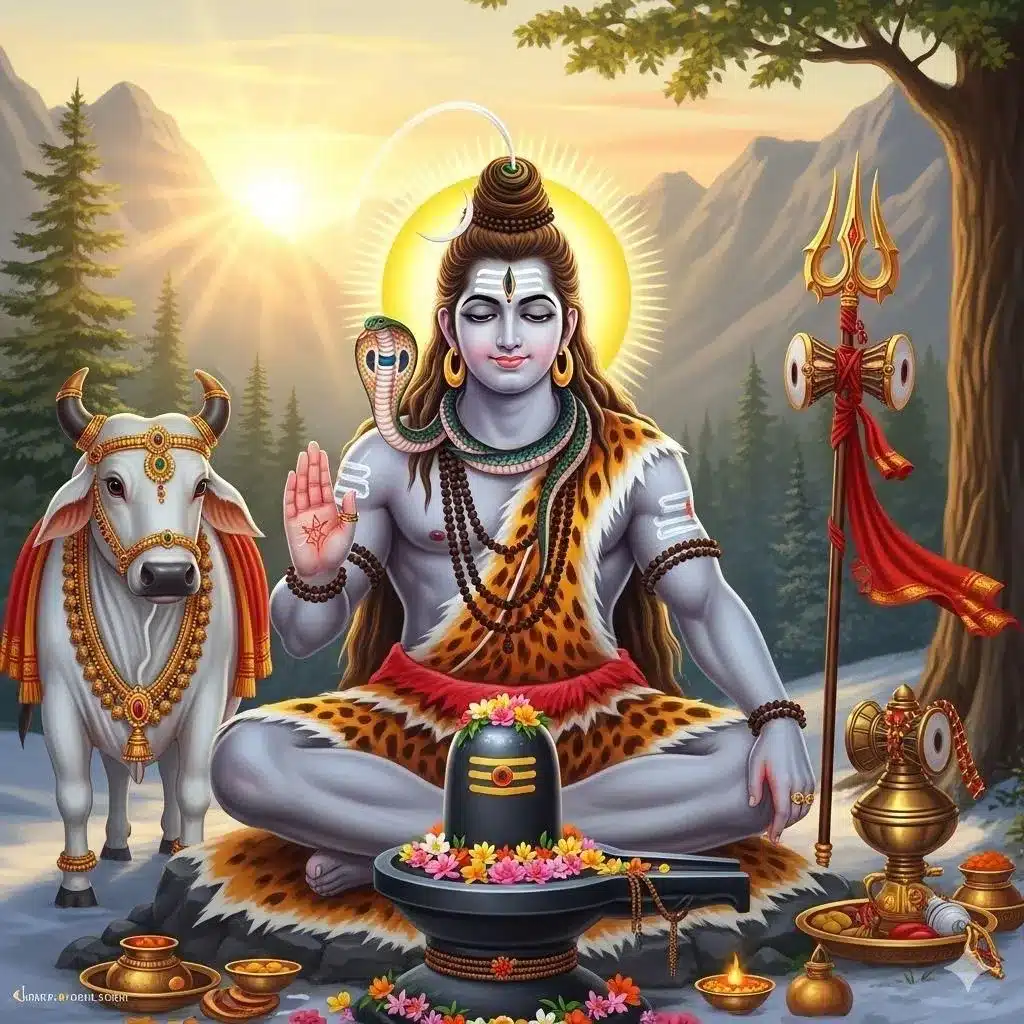
Sivananda Yoga, Talk-TWO Gurudev’s Integral Yoga rests on two fundamentally vital factors: one, to see God in every face, and two, to ensure that the body-mind complex, which has somehow been considered an individual personality, becomes a free-flowing channel for the divine will, grace, or power. Therefore the whole thing appears to be one of selfless service, nishkarma seva, and it has to partake of the vital elements of what we usually consider other yogas. In Gurudev’s mind there was no ‘other yoga.’ There was only one yoga, Integral Yoga-yoga means ‘integration,’ so “Integral Yoga” is already a redundant expression. Gurudev often used to liken the best devotee and the best yogi to Krishna’s flute. The emptier it is, the more divine the music. So, the first part involves what we have come to regard as bhakti yoga, and the second part involves what we leave come to regard as raja yoga – dhyana yoga – jnana yoga. Therefore he included in his sadhana vital elements of the bhakti sadhana. Why do I say vital elements and not just bhakti? When we think (“think” is the most important word in the sentence) of bhakti, we have an image, and the image is made up of largely showy emotionalism. One must wear some kind of a tilak and some kind of a cloth around one’s shoulders; whether the man repeats “Om Namah Sivaya” once or twice a day or not, he has a whole shirt and shawl made of Om Namah Sivaya. Or he must sing and shout and do all kinds of things. All these practices may have their own benefits, but these according to Gurudev’s life and teachings are of secondary importance. There were some vital practices in his sadhana. First and foremost of these was Murthi Puja. Amongst Gurudev’s initial devotees were great Arya Samajis who don’t like Murthi Puja at all. As a matter of fact Gurudev even attended the wedding in the house of one such devotee. He mixed freely with them and even sang the maha mantra. Gurudev himself has said somewhere that when he presided over sankirtan conferences, even Arya Samajis who came to criticise and disrupt the proceedings, later joined in and started dancing! When he performed murthi puja, it was not as many of us do it, regarding the statue as a statue as a stone, but as a living presence. There was this deep-seated realisation, not conviction but realisation, that it is God l am worshipping-not a stone. He did not even use the expression, ‘through this I am worshipping God. Through this stone image, which somehow represents Lord Krishna, I am worshipping God.’ No. I am worshipping Krishna here. This is Krishna. I used to be pujari in the temple for quite a number of years, and Gurudev used to come three times a day, and every time with some flowers or bael leaves he entered the temple, it was an unforgettable and indescribable sight. I used to stand with my back towards the window and watch Gurudev’s face. He used to look up, and in that look there was definitely the unmistakable look of greeting a friend. During Shivratri particularly there used to be puja in the evening, and after the arati some people used to be given bael leaves. It was customary to drop some leaves on the Nandi, the bull, as a token of seeking the bull’s permission for worshipping Siva. Then they used to offer a few bael leaves or flowers on the Siva lingam. I have never seen Gurudev throw a flower or a leaf-he placed it so softly. Why? Because it is a living thing, it is a living divine presence. If I throw flowers at your face, I don’t think you will appreciate it very much. When he looked at Krishna, it was friendship, supreme intimate friendship. “Hello, how do you do?” You could almost read it in his eyes. “Ah, how are you, alright today?” Just as he used to ask me and you and everybody, “What would you like to have, some tea or some coffee?” – that same blissful look of intimate friendship. In the office where he used to sit, a few pictures hung in front of him from the ceiling, and those pictures had to be there in that order. They were not pictures at all. They were living beings, the divine presence. As soon as he walked into the office he tossed a glance at them. If somebody meddled with them, “hmm, what has happened to that!” Because, he thought, my friends have gone, they are my friends and assistants here in my work, and they have been disrupted. In all this there was absolute and total naturalness, there was no showiness at all. We greet each other, laugh at each other, make fun of each other – “Narayana!” He would never do that. And sometimes we shout while stretching or when we hurt ourselves, “Hare Ram, Hare Ram”. All that showiness was completely absent, but deep within him he believed, he taught and his life was a continual demonstration of the fact that this bhakti is a totally intimate love affair between your soul and God. No one need know, you don’t have to parade it; you don’t have to exhibit it to anyone else. I mentioned a minute ago that he used to look at those pictures. Even that was done in a very subtle almost imperceptible way. Unless you were very carefully watching, you couldn’t have noticed it. Sometimes he would close his eyes, and just with one eye, lift it up and take a look and close the eyes again. In those five seconds some magic thread was re-established. Very often we think that we are so highly advanced that worship is unnecessary. He never forgot his worship. Only when he could not come to the temple did he confine himself to the worship in his own room. He was very fond

Sivananda Yoga, Talk-TWO Read Post »

ba65fd770686f01e15cf5c5e336632d5
Swami Sivananda, Yoga of Synthesis

Sivananda Yoga, Talk-ONE

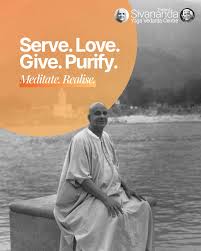
Sivananda Yoga, Talk-ONE Gurudev’s Yoga was Integral Yoga, represented by the four words “serve, love, meditate, realise”. Integral Yoga suggests not a step-by-step progression, but an expansion of integrated consciousness. There is a slight difference. Take for instance the famous word ‘Ashtanga’ in raja yoga. It is not one step following another, but more like the birth and growth of a baby. On the very first day the baby has all the limbs of the future grown-up. But they are small, undeveloped. As this person grows up, his limbs attain their fullness of perfection. Similarly, in this Integral Yoga, all the limbs of the Integral Yoga are found in the very beginning of the sadhak’s career. If that is not there then you are deluding yourself again. You may feel, ‘I am progressing in karma yoga,’ but then something else is lacking. Your jnana is lacking or your devotion is lacking. Then as you go on you find your karma yoga is no better than social service. Gurudev never tolerated that. Gurudev was dynamic in comparison to the other “holy men” we found in Rishikesh. Some of us went round and saw swamis sitting under a tree gazing at the sky, or on the Ganges bank, meditating or reading or gossiping. Here was one who was dynamic, constantly engaged in some form of activity, and we young men inferred from this that Gurudev liked activity. When he started doing some work, we could see from Gurudev’s behaviour that he was very happy; the only thing that Gurudev would not really tolerate was tamas. You are active; he was thrilled, but not entirely. About 15 minutes after we walked into the ashram – two of us came together – we were both provided with typewriters. Half an hour later came paper, and another half an hour later some books or manuscripts for us to copy. So the first impression that we gained was that Gurudev liked work and workers. This was true, but not entirely. So we went on working, doing more and more and more – sometimes the best part of the night was spent in work. It was pleasing to Gurudev, no doubt about that. But then one day, very early in 1946, he walked past the mops in the old kitchen that was part of our office. He looked in. “How many malas of japa did you do today? Did you meditate at all? No? Take the typewriter and throw it into the Ganges! Go and do some japa. “So this Swami likes japa more than typewriters? It’s not that; it’s ‘nothing more than anything else.’ So you start rolling beads. “Aha, what is this – sitting in the corner rolling beads?” You go this side, there is a kick, go that side, and there is a kick! And in the same context I’ll bring in one other story of our life in the initial stages of the ashram. In those days there were no steps, no ghat, nothing like that on the Ganges banks. There was an enormous rock, with a platform built over it. And there was a young man from Andhra who used to sit very straight, a human rock over a mountain rock. We had a morning meditation session that also included some asanas, some pranayama, some japa and all that. The class used to conclude usually at about six. Everyday Gurudev used to see this young man sitting on the rock, and every day he used to see him sitting there when he went back to his kutir. And occasionally he would just glance at him and walk by. One day it so happened that after the morning class, Gurudev was still sitting on one of those cement benches, discussing something with somebody. This gentleman who had been meditating got up in the meantime and walked into the kitchen. “Aha”, Gurudev closed one eye and looked at him. “Hmm, Hmm. Meditation – Ah, samadhi. Ahh.” He thought that Gurudev was really admiring him! “Yes Swamiji”. “How long did you sit?” “Three hours, Swamiji.” “Every day.” “Three hours every day, Swamiji.” “Ahcha.” We were all very happy that this man was being encouraged. “Hmm.” Suddenly, within one fifteenth of a second the whole thing changed. “Ah – look at this. Sleepy, drowsy. What kind of meditation are you practising?” He didn’t know what to do. I cannot describe to you the speed with which the expression on Gurudev’s face changed in those five minutes – like a baby. Once he seems to be serious, then he seems to be almost cross, next he seems to be compassionate, next he seems to be full of affection and love, and then he seems to be mocking – mischievous. “What you are doing is useless! Meditation is useless? No! Meditation is not useless, what you are doing is useless. It is not meditation.” Then Swami Sivananda explained, “Do you know what meditation means?” And now the mood changed again. Those of us who were standing there could see. You have heard about meditation, you have read about meditation, you have thought about meditation. But for those few moments, we saw meditation. “Hah – do you know what meditation means? Touch Brahma – touching the infinite, touching the absolute.” When he said that, you could see the touching. “And if you touch this absolute infinite power for even one moment, you leave the energy, the strength, the wisdom to roll up the whole sky and play ball with the whole earth.” This is important. The other thing is important too, but one is not more important than the other. All of them together have to be done. One goes with the other. It is an integral yoga – ashtanga yoga. The whole thing must be done at the same time, and therefore a little of each -that was his joy. And so even though we may consider these factors one by one, please let us not go

Sivananda Yoga, Talk-ONE Read Post »