Hari Om

Menu

Introduction to Yogasanas

image 18
Introduction to Yogasanas, Swami Sivananda

Surya Namaskara

Surya Namaskara The Suryanamaskara or offering prostrations to the Sun, is practised in the early morning or evening, facing the Sun. The Sun is supposed to be the deity for health and long life. The genius of the Indian Sage has, in the Suryanamaskara Exercise, evolved a unique method of effecting perfect synthesis of culture of body, mind and spirit. With his intuitive insight into the nature of the mass mind, the Indian Sage has cleverly woven into every man’s daily routine this unparalleled system of all-round self-culture. A harmonious development of the body and mind alone can enable man to fulfil his ambitions and live a fruitful and happy life here in this world. A sickly body acts as a dead-weight preventing the mind from soaring into the higher realms. An excellent, well-built body, strong and healthy, if it serves only to house an undeveloped or diseased mind, is capable of much harm and little good to anyone. A good body, and a keen mind, with the inner spirit entirely dormant is like a lovely mansion without foundation liable to topple over at any moment. A perfectly harmonious development of the body, mind and spirit makes one perfect. Suryanamaskara achieves this harmonious development. Suryanamaskara is combined process of Yoga Asanas and Pranayama (Yogic postures and regulated breathing). Before students take up the practice of more complicated and difficult Yogic postures and exercises in Pranayama, the spine and body muscles should acquire some flexibility. This exercise of Suryanamaskara reduces abdominal fat, brings flexibility to the spine and limbs, and also increases the breathing capacity. There are twelve spinal positions each stretching various ligaments and giving different movements to the vertebral column. The vertebral column is bent forward and backward alternately with deep inhalation and exhalation of breath and a little of retention of breath in some cases. Whenever the body is bent forward, the contraction of the abdomen and diaphragm, throws out the breath. When the body bends backward the chest expands and deep inhalation occurs automatically. In this way the body becomes flexible and the entire portion of the lungs begins to function which results in correct breathing. Moreover, it gives mild exercises to leg and arm muscles and ensures good circulation of blood. At the same time, the sun’s life-giving rays play on the man’s body, sucking away the toxins along with perspiration invigorating circulation and imparting life to the human organism-the life which the sun alone can give. For a person with stiff limbs and spine the Suryanamaskara exercise is a boon to bring back lost flexibility. TECHNIQUE Caution: During all these positions, movements of the limbs and breathing must be very, very slow and rhythmical. Sudden jerks of any part of the body and hard inhalation and exhalation in quick succession including retention of breath causing strain in the lungs, should be completely avoided. Position No. 1: Face the sun, fold the hands, keep the palms together touching the middle of the chest with both thumbs, keep legs together and stand erect. Position No. 2: Slowly inhale and raise the arms overhead. Bend backward. Position No. 3: Slowly exhale and bend forward till the palms are kept flat in line with the feet. Touch the knees with your head keeping the legs straight without bending. In the beginning there may be slight bend at the knees to effect this, but after some days’ practice, the legs could be kept straight. Position No. 4: After slow and deep inhalation, move the right leg from the body in a long backward step. Keep the hands and the left foot firmly on the ground without moving, raise the head, and look forward. The left knee should be between the hands. Position No. 5: Retain the breath. Move the left leg and keep the left foot along with the right foot, thus making the body a straight line. The entire weight of the body should rest on the hands and toes. Position No. 6: Exhale, slowly lower the body and let eight limbs of the body-two toes, two knees, two hands, chest and forehead-alone touch the floor. The abdominal region is to be kept slightly raised. Position No. 7: With inhalation, slowly raise your head and bend the spine backward as much as possible. Position No. 8: Exhale, slowly lower your head and raise the body, the toes and hands resting on the floor. Position No. 9: Inhale and bring the left foot along the level of the hands. The right foot and knee should touch the ground. Look forward (Same as Position No. 4). Position No. 10: Exhale, bring the right leg also forward and come back to Position No. 3. Position No. 11: Inhale and raise the hands overhead and bend backward as in Position No. 2. Position No. 12: Slowly bring your hands as in Position No. 1. Simultaneously exhale and relax in Tadasana. This is one Namaskara. After completing twelve namaskaras lie down flat on the ground on your back and relax each and every limb one by one from toes to the crown of the head. This is called Savasana (corpse pose). To begin with if one feels tired after three or four Namaskaras, he may stop with that and increase the number gradually (one everyday or every two days) all the time taking care that too much strain is not caused on any account, on any part of the body. The number may be increased according to each one’s capacity. There are persons who can do 108 Namaskaras at a stretch without great strain. Those who are spiritually or religiously inclined, would do well to follow, in addition, the instructions given below: Before doing the Suryanamaskara the student may chant the prayer to the Almighty Lord: PRAYER TO THE SUN “Om Suryam Sundaralokanathamamritam Vedantasaram Sivam, Jnanam Brahmamayam Suresamamalam Lokaikachittam Svayam; Indradityanaradhipam Suragurum Trailokyachudamanim, Brahmavishnusivasvarupahridayam Vande Sada Bhaskaram.” Meaning: I always adore Surya, the sun, the beautiful Lord of the world, the immortal, the

Surya Namaskara Read Post »

swami sivananda Black-and-white photo of monk with garland holding flowers image
Introduction to Yogasanas, Swami Sivananda

Special Instructions

Special Instructions by Swami Sivananda SPECIAL INSTRUCTIONS 1. Asanas should be practised in a well-ventilated, clean room where there is free movement of fresh air. The floor must be even. Asanas can be practised on the sandy bed of rivers, open airy places and by the sea-side also. If you practise them in a room, see that the room is not congested so as to allow free movement of hands, legs and of the body. 2. Asanas should be done on empty stomach in the morning or at least three hours after food. Morning time is best for doing Asanas. 3. It is always better to start Japa and Meditation in the early morning at 4 a.m., as soon as you get up from bed. At this time the mind is quite calm and refreshed. You can catch the meditative mood now quite easily. Meditation is more important. In the early morning, as soon as you get up from bed, the mind is like a clean slate, free from worldly thoughts. The mind will enter into the meditative mood without effort or struggle. 4. The vast majority of persons waste their precious time in the early morning in answering the calls of nature for half an hour and washing their teeth for another half an hour. The sun rises before they sit for meditation. This is bad. Aspirants should try to defecate within five minutes and cleanse their teeth within five minutes. If the bowels are constipated have vigorous practice of Salabha, Bhujanga and Dhanur Asanas for five minutes as soon as you get up from bed. If you are habituated to answer the calls of nature late in the day, you can do so after finishing Asana and Pranayama, Japa and meditation. 5. Get up at 4 a.m. Answer the calls of nature. Wash your face. Then practise your Asanas, Pranayama and Meditation. This order is beneficial. If you are very particular to meditate from 4 to 6 a.m., you can do Sirshasana for 10 to 15 minutes and then sit for meditation. When meditation is over, you can take to other Asanas. If you are not in the habit of answering the calls of nature in the early morning, you can practise Asanas without answering the calls. After finishing the Asanas and Meditation you can go to the latrine. Then motion also will be free. 6. Those who suffer from chronic constipation, can practise GANESA KRIYA, removal of excreta by introducing the middle finger lubricated with soap or oil into the rectum. Occasional douching will be beneficial to empty the loaded stomach. 7. Spread a blanket on the floor and practise the Asanas over the blanket. Use a pillow or four-folded blanket for practising Sirshasana and its varieties. 8. Wear a Langoti or Kowpina or suspendary bandage when you practise Asanas. You can have a banian on the body. 9. Do not wear spectacles when you do Asanas. They may be broken and may injure your eyes. 10. Those who practise Sirshasana, etc., for a long time should take light tiffin or a cup of milk after finishing the Asana. 11. If you can devote half an hour or more to Sirshasana alone, you can cut short the time for other Asanas. 12. Be regular in the practice. Those who practise by fits and starts will not derive any benefit. Mitaharam vina yastu yogarambham tu karayet, Maharogo bhavettasya kinchid yogo na sidhyati. (Ghe. S. Chap. V-10) Without observing moderation of diet, if one takes to the Yogic practices, he cannot obtain any benefit but gets various diseases. 13. Before starting the practice of Asanas, take a dose of worm powder santonin, gr. 1 or 2 at bed time and castor oil 2 oz., early in the next morning. Float the oil in peppermint water, tea or pepper water and then take. Take oil alone if you like. Thorough cleansing of the bowels is necessary when you take to the Yogic practices. 14. Start with minimum time of doing Asanas and then gradually increase the period. You can do the Asanas as long as you can comfortably keep up the posture. 15. Asana is the third Anga in Ashtanga Yoga. When you are established in Asanas, then only you will derive the benefits of Pranayama. 16. Maximum benefits can be achieved if Japa also is done during the practice of Asanas and Pranayama. 17. If the foundation of a building is not properly laid, the superstructure will fall down in no time. Even so, if a Yogic student has not gained mastery over the Asanas, he cannot successfully proceed in his higher course of Yogic practices. 18. Regularity in the practice is very necessary if one wants to realise the maximum benefits of Asanas. Generally, people practise for two months in the beginning with great interest and enthusiasm and leave off the practice. This is a sad mistake. They want a Yogic teacher always by their side. They have got the effeminate leaning mentality. They are lazy, torpid and slothful. 19. Nowadays, outdoor games have become very costly. Nets, rackets, balls, inflators have to be purchased again and again. No expense is needed for the practice of Asanas. 20. Physical exercises draw the Prana out. Asanas send the Prana in, and distribute it quite evenly throughout the body and different systems. Asanas are not only physical but also spiritual, as they awaken the Serpent Power that is sleeping in the Muladhara Chakra. This is the third Anga (limb) of Ashtanga Raja Yoga of Patanjali Maharshi. A particular Asana removes a particular disease. 21. Asanas are not mere physical exercises alone. They are something more than that. They have a spiritual basis. They help a long way in controlling the senses, mind and body. Body-nerves and muscles are purified (Sarira Suddhi and Nadi Suddhi). Kundalini is awakened which gives Bliss, Power and Yogic Samadhi to the aspirant. If you do Dand and Bhaitaks (native physical exercises) 500 times a

Special Instructions Read Post »

swami sivananda Monk in red robes with garland in decorative floral frame image
Introduction to Yogasanas, Swami Sivananda

Good Vision

Good Vision by Swami Karunananda Lost in the never-ending and ever-increasing distractions and sensual excitement of modern living, man is abusing his senses far beyond their normal capacity and then complaining that they begin to lose their efficiency long before the normal fading out of old age. To satisfy the jaded palate, hotter and hotter, sweeter and sweeter, saltier and saltier or sourer and sourer condiments are added to his food-long since have the original tastes of vegetables, fruits and cereals been lost and forgotten, never to be recaptured by his coarsened tongue. The scent of the rose or the ripening corn, the perfumes wafted by a cool evening breeze-all are lost to the nose now adapted to petrol fumes. The stench of duco-spraying and the suffocating atmosphere of entertainment-halls.But surely the most abused of man’s senses is sight as, from the days when he first invented the printing of black letters on dazzling white paper and took to reading this print under artificial light, extending his open-eyed period by a third to half a day and, under the cruel stress of competitive examinations, even to two-thirds of a day, he enjoys normal vision for a mere fraction of his life-span and frequently becomes a `four-eyed’ long before leaving school. The pleasure of walking after dark unaided by torch or street-light, using instead eyes, ears and nose, is unbelievable to this `civilised’ man who would rather fill his pre-slumber hours staring at a rectangle of flickering pictures, for the last forty or fifty years in the cinema hall, but now more temptingly in the television of his own home.Man cannot renew his organs of sense but, once convinced of the futility of their further abuse and inevitable weakening, he can reduce unnatural living habits and begin to recover a little of their intended power, flexibility and usefulness by exercising lazy muscles. Most eye-fatigue is due to the eyes being held for long periods at the one focus, that of reading, relieved occasionally by glancing about the room or a few feet ahead while walking. Break this wearing habit by, at every excuse, getting outdoors and gazing into the distance. Try to revitalise those eye muscles, day by day, seeing the horizon more clearly. Look at the clouds but not directly at the sun.

Good Vision Read Post »

Swami Sivananda Framed portrait of Swami Sivananda imge
Introduction to Yogasanas, Swami Sivananda

Flexibility

Flexibility by Swami KarunanandaThe grasses bow before the gale and again raise their heads to the midday sun. The proud giants above remain stiff, not budging an inch, only to be rudely uprooted.The humble servant prostrates to all and goes on serving till retired by old age while his unbending master is envied, deposed and disposed of in his prime.“Truly a flexible back makes for a long life.” (Chinese Proverb) Also for a spiritual aspirant mental flexibility is necessary. Great civilisations have come and gone, sometimes, as with Atlantis, leaving little or no trace for the curious historians, often due to rigidity of ideas-an inability to adapt to changing conditions-whereas Hindu culture, surely the world’s oldest unbroken tradition, lives on and flourishes because it modifies itself and becomes richer with the changing pattern of history. In the individual, mental and physical flexibility go together. Physical flexibility and discipline are necessary for successful concentration and development of mental power.The great Rishis and Yogis of our timeless heritage gained their incomparable spiritual insight only after Tapasya or physical disciplines, which freed the body from the pangs of hunger and thirst, heat and cold. Complete freedom, resulting in remarkable agility of mind and body, comes only after a long, severe self-disciplining. From time immemorial a part of the physical disciplining has been the regular and devoted practice of Yoga Asanas and Pranayama, performed reverently and selflessly even to the day of discarding one’s earthly body. Such practice helps greatly in the act of dying also. How blessed is the man who leaves his body while meditating in the All-pervading One! O Seeker! Make Asanas and Pranayama part of your daily devotional offering to God, doing them whole-heartedly and with the utmost perfection of which you are capable. Your aim should be to do them more perfectly from day to day, always knowing that real perfection moves on before you, ever leading you on but never to be captured.To increase your mastery over Asanas start daily with flexibility exercises, mostly based on the largest possible circular movement at the main joints of the body, beginning with: I. Neck (can be done seated or standing). (1) With neck relaxed drop head back as far as possible. Hold for a few seconds, then slowly lift head. Let it drop forward till chin touches chest at hollow at the base of throat. Hold for a few seconds. (2) With head upright and shoulders steady, turn head slowly to look as far as possible over left shoulder. Hold for a few seconds, then slowly turn head to look as far as possible over right shoulder. Hold for a few seconds, then slowly face front. (3) With head facing front and neck relaxed, drop head towards left shoulder as far as possible. Hold for a few seconds, then slowly lift head. Let it drop towards right shoulder as far as possible. Hold for a few seconds then. (4) Begin slowly to circle head on completely relaxed neck, three times in each direction. II. Shoulder circling (can be done seated or standing). (1) Circle as large as possible with left shoulder only, forward, down, back and up, three times. Repeat with right shoulder. Then moving both shoulders together. (2) As (1) above but circle in reverse, back, down, forward and up. (3) Raise left shoulder as far as possible. Hold for a few seconds, then drop. Repeat three times. Repeat with right shoulder. Repeat with both shoulders together. All the following exercises are done standing. III. Arm circling with concentration on shoulder-joint. Arm straight but relaxed. (1) Make a smooth circle as large as possible with left arm, three times-back and up breathing in, forward and down breathing out. Repeat with right arm. (2) As (1) but forward and up breathing in, back and down and stretch three times. Reverse. (3) Make a smooth circle as large as possible with both arms moving to the sides and crossing above the head, breathing in. Then continue circling of arms across body on the way down, breathing out. Repeat three times. (4) As (3) but begin crossing arms in front of body on way up, breathing in deeply till arms part above head, then breathe out as arms come down to sides of body. IV. Lower arm circling with concentration on elbow-joint and with upper arm steady. Being with arms stretched to sides, then bend at elbows, moving lower arms up, down and stretched three times. Reverse. V. Hand circling with concentration on wrist, arms stretched to sides. (1) Forward, down, back and up three times, then (2) Reverse. (3) Lift hand as far as possible, not moving the rest of arm. Let hand drop. Repeat three times. VI. For flexibility of knuckles stretch arms fully to sides, then relax at knuckles, letting fingers drop. Stretch fingers and drop, three times. VII. With arms stretched to sides clench fists tightly, then stretch fingers. Repeat three times. VIII. Stretch arms to sides, then relax at elbow and wrist, letting arms bend. Stretch and relax three times. Finish by stretching arms to sides as far as possible. Hold for a few seconds, then let arms drop. IX. To stretch and strenghthen muscles of arms, shoulders, chest and back, raise arms to side as you breathe in deeply, then clench hooked fingers in front of body with arms parallel to ground. Hold breath and pull hard as though to pull fingers apart. Hold for a few seconds then let arms drop and relax. Once only. X. Hands pressed together as in Indian salutation but with arms stretched above the head. Breathe deeply and hold breath. Press hands hard then slowly bring arms down, keeping fingers pointing upwards, until at about waist level hands start to part. Flick them apart suddenly breathing out. Once only. XI. Hands pressed together as in Indian salutation but with arms behind the back. Slowly work the hands as far as possible up the spine. Then press them together hard

Flexibility Read Post »

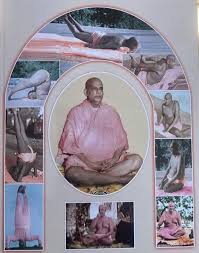
Swami Sivananda yoga master performing asanas and meditation in different scenes
Introduction to Yogasanas, Swami Sivananda

Introduction to Yogasanas

Introduction to Yogasanas by Swami Sivananda I bow with folded hands, crores of times, to Brahman, the destroyer of all fears, miseries and tribulations of those who betake themselves to Him, which though absolutely unborn (Aja) appears by the power of His greatness to pass into birth, which appears as if in motion, though always at rest (Achala), and which, though one, (Ekam-eva-advitiyam Brahma) appears as many to those whose inner vision is dimmed by the perception of an endless variety of illusory appearances. I salute Thee, first Lord Siva (Adinatha), who taught to Parvati the Hatha-Vidya that is a step to the attainment of the most excellent Raja Yoga. Goraksha and Matsyendra knew well the Hatha-Vidya. Yogi Swatmarama learnt it from them by their favour. To those who wander about in the darkness of this science or branch of Yoga unable to obtain any knowledge of Hatha Yoga, the most merciful Swatmarama Yogi offers the light of Hatha-Vidya. The goal of life is Self-realisation. All systems of Indian philosophy have one goal in view, the liberation of the soul through perfection. Every man wants happiness. He shuns pain. No one teaches anyone to seek happiness. It is the innate, inherent Svabhava (nature) of everyone to seek happiness. Ananda is embodiment of one’s own nature. Gratification of desires cannot bring in real peace of mind though the nerves are tickled for a second. Just as ghee when poured over the fire aggravates the fire, so also enjoyment intensifies a desire and makes the mind all the more restless. How can you expect real, lasting happiness from objects that are conditioned in time, space and causation and so are Vinasi (perishable) and Anitya (impermanent)? The happiness that you get from sensual objects is fleeting and transitory. For a philosopher it is no happiness at all. It is like scratching the skin when you get itching. Sensual happiness is attended with severe exertion, sin, fear, pain, worry and several evils. Amidst the din and boisterous bustle of worldly activities there come moments of tranquillity and peace when the mind, for the time being, however short it may be, soars above the filthy worldly things and reflects on the higher problems of life-viz., “Who am I? Whence? Where? Whither? Why of Universe?” etc. The sincere enquirer becomes serious and extends his reflections. He begins to search and understand the truth. Discrimination dawns on him. He takes to the study of Atma-Jnana books, reflects, meditates, purifies his mind and eventually attains the highest knowledge of the Self. But the man whose mind is saturated with worldly Vasanas and cravings is quite heedless and is irresistibly carried away by the two currents of Raga-Dvesha and tossed about helplessly in the tumultous Samsaric stream of birth and death with its concomitant evils. The spiritual path is thorny, precipitous and nevertheless has been trodden by man of strong determination, undaunted spirit and indomitable energy. When once you make up your mind to tread the path, everything will become smooth and easy. You will have descent of Grace from the Lord. The whole spiritual world will back you up. The path will directly take you to realms of Infinite Bliss, Supreme Peace, Eternal Sunshine-realms where three kinds of Tapa, cares, worries, anxieties and fear, which torment the soul here dare not enter, where all distinctions of caste, creed and colour vanish altogether in the one embrace of Divine Love and where desires and cravings find their full satiety. Just as one and the same coat will not suit Mr. John, Mr. Das or Mr. Pantulu, so also one path will not suit all people. There are four paths to suit people of four kinds of temperament. They all lead to the same goal, the attainment of ultimate Reality. Roads are different but the destination is the same. The four paths that are inculcated for the achievement of this ultimate Truth from the different stand-points of the man of action, the man of devotion, the mystic man and the philosopher or the man of reason, are respectively termed Karma Yoga, Bhakti Yoga, Raja Yoga and Jnana Yoga. The four paths are not antagonistic to one another, but, on the other hand, they are complementary. They only indicate that the different methods of the Hindu religion are in harmony with each other. Religion must educate and develop the whole man, his heart, intellect (head) and hand. Then only will he reach perfection. One-sided development is not commendable. Karma Yoga removes Mala, purifies the mind and develops the hand. Bhakti Yoga destroys Vikshepa and develops the heart. Raja Yoga steadies the mind and makes it one-pointed. Jnana Yoga removes the veil of ignorance (Avarana), develops will and reason and brings in knowledge of the Self. Therefore one should practise the four Yogas. You can have Jnana Yoga as the centre and the other Yogas as auxiliaries to get rapid progress in the spiritual path. The word `Yoga’ means union between Jivatma and Paramatma (individual soul and Supreme Soul). The science that teaches the way of acquiring this occult knowledge is called Yoga Sastra. Hatha Yoga concerns with the physical body and control of breath. Raja Yoga deals with the mind. Raja Yoga and Hatha Yoga are necessary counterparts of each other. No one can become a perfect Yogi without a knowledge of the practices of both. Raja Yoga begins where properly practised Hatha Yoga ends. Hatha is considered to be a compound word formed of two syllables `Ha’ and `tha’; `Ha’ means the moon (Ida Nadi) and `tha’ means the sun (Pingala). These correspond to the breaths, which flow through the left and right nostrils. Hatha Yoga teaches the way to unite the sun and the moon, the Prana and Apana through the regulation of breath. Hatha Yoga is conducive to health and longevity. Its practice regulates the action of heart, lungs and brain. It promotes digestion and circulation of blood. Kidneys, liver and all other internal viscera work efficiently.

Introduction to Yogasanas Read Post »