













Hari Om

Menu

Saints and Masters

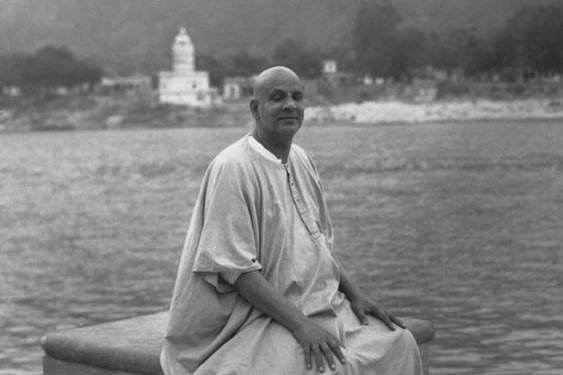
Swami Sivananda seated wearing garland candid photo
Saints and Masters, Swami Sivananda

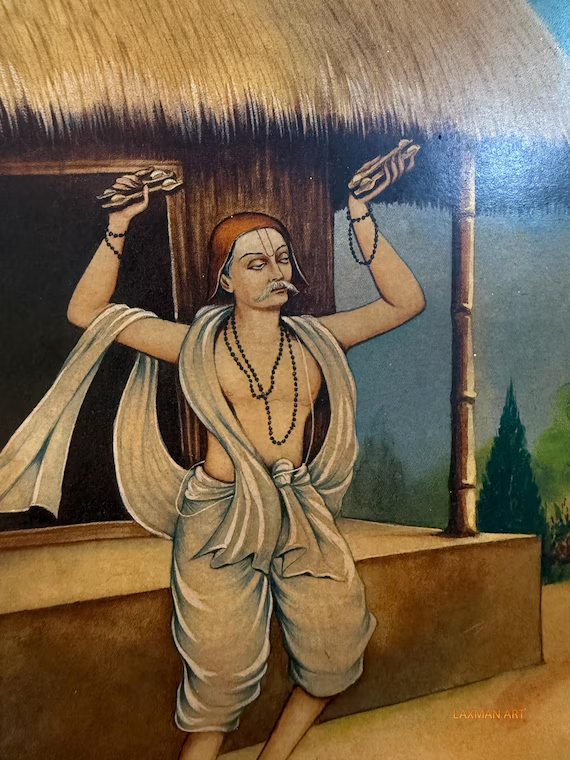
Samartha Ramdas

Samartha Ramdas by Swami Sivananda Introduction Ramdas was one of the greatest saints of the world. He was the inspirer of Shivaji. He was born of Suryaji Panth and Renuka Bai in Jamb, Maharashtra, in 1608 A.D. His original name was Narain. Ramdas was a contemporary of Sant Tukaram. He was a great devotee of Hanuman and Lord Rama. He had Darshan of Lord Rama even when he was a boy. Lord Rama Himself initiated him. As a boy, Ramdas acquired some knowledge of the Hindu scriptures and developed a liking for meditation and religious study. One day he shut himself in a room and began to meditate on God. When his mother asked him what he was doing, Ramdas replied that he was meditating and praying for the good of the world. His mother was surprised at the precocious religious inclination of the boy and felt happy. When Ramdas was twelve years of age, all arrangements were made for his marriage. He sat in front of the bride. There was a screen between the bridegroom and the bride. When the priests chanted “Sawadhan!’ (be alert), Ramdas bolted away from the place and disappeared within the twinkling of an eye. Studies and Penances For twelve years Ramdas stayed at Nasik on the banks of the Godavari. He used to get up very early in the morning, go into the Godavari river, and with his body half-immersed in water, recite the sacred Gayatri Mantra till about noon. Then he would go round for alms. He first offered the collected food to his Deity Sri Rama and then took it as Prasad. After resting a while, he used to attend religious discourses in the various temples of Nasik and Panchavati. Ramdas also studied Sanskrit and copied in his own hand the Ramayana of Valmiki. This manuscript is still preserved in the collection of Sri S.S. Dev of Dhubliah. Ramdas did Purascharana of the Rama Mantra of thirteen letters Sri Ram Jaya Ram Jaya Jaya Ram thirteen lakhs of times at Tafali, near Nasik, on the banks of the Godavari. After the Purascharana was over, once again Ramdas had Darshan of Lord Rama. It is said that Ramachandra ordered Ramdas to visit holy places such as Nasik, Haridwar, Kasi, etc. Ramdas sprinkled over a dead body holy water uttering the name of Rama and the dead body was restored to life. Ramdas had to do this, because he had blessed a woman who had just lost her husband. Pilgrimage Ramdas was an Advaitin and a Bhakta in one. He had this very noble quality that he never hated any religion or nation. His main object was to spread the Hindu religion throughout India. Ramdas had not visited Pandharpur, as he had not known the existence of this holy place. One day, the tradition says, Lord Panduranga Vittal, in the form of a Brahmin, with a batch of three hundred pilgrims, appeared before Ramdas and asked him whether he had any objection to see Lord Krishna. Ramdas replied in the negative. Panduranga then took Ramdas to Pandharpur, and when the Bhaktas approached the temple, the Brahmin disappeared. Ramdas then knew that it was none other than the Lord that had brought him to that holy place. He entered the temple, and to his great surprise, found Sri Rama standing alone on a brick. Ramdas addressed the Deity thus: “O Lord, what are You doing here alone? Where is Your brother Lakshmana and Your consort Sita Mata? Where is Maruti and where are the monkey hordes?”. On hearing these words, the image at once transformed itself into Sri Pandarinath. Ramdas then praised Panduranga for His kindness, prostrated before Him and sang songs of joy for getting His rare Darshan. Ramdas now felt doubly convinced that the several incarnations of the Lord were but His several forms and preached that everyone should respect and worship the One who took care of one and all in the world. Ramdas then worshipped Panduranga to his heart’s content and became a frequent visitor and Bhakta of Panduranga Vittal also. In Pandharpur, Ramdas came in contact with Tukaram and other saints of Pandharpur. In his pilgrimages, Ramdas observed and studied the social, political and economic conditions of Indians and their utter helplessness in life. It is said that Sri Rama ordered Ramdas to go to the banks of the Krishna and help the cause of Shivaji, the incarnation of Siva and founder of the Kingdom of Maharashtra. Ramdas came to the Krishna and went about preaching from Mahabaleshwar to Kolhapur. He established eleven principal seats of Maruti which emphasized the importance of physical development. He installed the shrines of Sri Ramachandra at Champavati and introduced Sri Rama Navami Mahotsava and the procession of Sri Rama’s chariot. It was at the place called Singanvadi that Shivaji became the disciple of Ramdas. Shivaji placed the sandals of his Guru on the throne and acted as regent of the kingdom under the orders and guidance of his Guru and adopted as ensign the flag of orange colour. There is a beautiful and romantic incident current in the Maharashtra country about Shivaji’s adoption of the Gerua flag and his ruling the kingdom in the name of Saint Ramdas. One day Shivaji saw, from the terrace of his palace, his Gurudev Ramdas going about the streets with his begging bowl. Shivaji was surprised and could not understand why his Guru should beg when he himself had already placed all his resources at the disposal of his Gurudev. However, Sadhus are difficult to understand. Shivaji therefore called for his companion Balaji, wrote a small chit and asked him to give it to Guruji when he came to the palace. About noon, Ramdas came to the palace with his bowl and Balaji prostrated before Gurudev and placed the chit at his feet. Briefly, the chit conveyed that Shivaji had made a gift of his whole kingdom to Gurudev and he humbly solicited his Gurudev’s blessing. The
Samartha Ramdas Read Post »

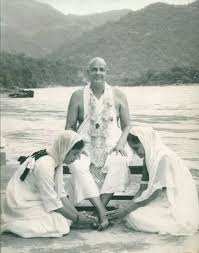
Swami Sivananda seated beside river image
Saints and Masters, Swami Sivananda

Appayya Dikshitar

Appayya Dikshitar by Swami Sivananda Introduction There had risn the Moghul Empire From the glowing ashes and fire Of the Battle of Panipat, When in a southern Brahmins hut Was born a lad that blew again The Vedantic bugle amain, And stirred from slumber and from sloth With the urge of righteous wrath The guardians of the Vedas, Heirs of the Upanishads, And made them stand alert intent To hear the tune of sad lament Break forth from Indias anguished soull No longer may they sprawl and loll On downy beds of idleness, Complacent with their past greatness When loud the manly bugle blared, And the need for action declared. The great Appayya Dikshitar Was a saint, a sage and scholar. He it was the clarion sounded, Our hearts then with clat bounded; He it was that called in that age To us to guard our heritage. Versed was he in philosophy, And eer did he win the trophy In duels and combats of learning, Leaving, savants with shame burning. In rhetoric peerless was he, And his fame Pundits did envy And on him much mud they slung; The aspirants to him they clung. Sweet in praise, of Siva he sang Hymns that with rich melody rang, And devotees still love to sing Hymns by him, among poets a king. For aspirants and learned men, With learned skill and acumen, The four schools of thought he surveyed, And their tenets to all conveyed In learned treatises and books, Unblemished by jaundiced looks, And in commentaries bejewelled, With Vedic wisdom unexcelled. Like a golden ring on the spire Of the Vedantic shell of fire, Appayya Dikshitar did glisten Among the wheel of lesser men. Once to Tirupathi the sage Went on a lonely pilgrimage, And there the Mahant to him told: “Enter not the fane; it cant hold Within its precinct a Saivite; To enter here you have no right.” Wrath was the saint and quietly he By occult power did oernight change The fanes image of Lord Vishnu To Siva. The Mahant turned blue When in the morn he, aghast, saw Vishnus image changed to Siva. To the great sage he now did run And of him humbly beg pardon, And asked the image be restored To the shape he loved and adored. Such was the great saint Appayya, An incarnation of Siva, Whom men still love and have reverence For his wisdom and intelligence. Appayya Dikshitar was born in Adayapalam, near Ami in the North Arcot district, in 1554 A.D., in the Krishna Paksha of the Kanya month of Pramateecha Varsha under the Uttara Proushthapada constellation. His fathers name was Rangarajudhwari. Appaya had the name Vinayaka Subramanya when Namakarana ceremony or christening took place. Acharya Dikshitar or Acchan Dikshitar was the younger brother of Appayya. Appayya studied the holy scriptures under Guru Rama Kavi. He completed the fourteen Vidyas while he was quite young. What a great marvel! Chinnabomma, Raja of Vellore, invited Appayya and Acchan Dikshitar to his capital after the death of Rangaraja, who was the Chief Pundit of the State. Srinivasa Thathachari, the Dewan, had great dislike for the worshippers of Lord Siva. He censured the devotees of Lord Siva. Appayya praised the Siva Lilas and the glory of Lord Siva. Appayya was very intelligent. He was a master logician. He was well-versed in grammar, metaphysics and other sciences. He was a master in all branches of learning. His exposition of Vedanta was unique. He cleared the doubts of all. His name and fame spread far and wide. The Rajas of Thanjavur, Kalahasti and Tirupathi invited him. Marriage Ratna Kheta Srinivasa Dikshitar, an erudite scholar in Sanskrit, a devotee of Kamakshi Devi, Kancheepuram, was the Chief Pundit of the Court in the Chola kingdom. The Chola king asked the Pundit, “O Pundit, what is the day today?” The Pundit replied, “Today is Full Moon day”. But, really, it was New Moon day. Everybody laughed. Srinivasa Dikshitar felt greatly mortified. He was a true devotee of Kamakshi Devi. Her grace was fully upon him. Srinivasa prayed to Her. The Devi appeared before Srinivasa, gave him one of Her earrings and asked him to throw it in the sky. Srinivasa acted accordingly. The earring attained the form of a full moon and shone brilliantly. The king, the ministers and other people witnessed this marvellous scene and were struck with amazement. The king made Srinivasa sit on the golden throne, adorned him with jewels and honoured him highly. Srinivasa came to know that Appayya was a great scholar. He wanted to defeat him. He proceeded to Kancheepuram to propitiate Kamakshi Devi in order to get Her blessings. He did severe Tapas. The Devi appeared before him and said, “O Bhakta, choose your boons from Me”. Thereupon Srinivasa said, “Let all the Kalas be seated on my tongue. I have to conquer Appayya, who is a great scholar and orator, through Thy grace and help only. The whole world knows my name and fame. Please help me to keep up the same”. The Devi replied, “O Bhakta, Appayya is not an ordinary human being. He is verily the incarnation of Lord Siva. I am verily your form. Do not enter into a controversy with him. Give your daughter Mangalambika in marriage to Appayya and become the revered father-in-law to him. Then only your desire will be fulfilled”. At the same time, Lord Siva appeared in Appayyas dream and said, “O child, go to Kancheepuram. Srinivasa will give his daughter in marriage to you”. Appayya went to Kancheepuram immediately and lived there. Srinivasa took his daughter and reached Appayyas residence. Appayya honoured Srinivasa duly with Arghya (offering of special hospitality by way of respectful libations and glorification), Padya (washing of the feet), Asana (offering of an elevated seat), etc. Srinivasa said, “The Devi has ordered me to give my daughter in marriage to you. O Appayya, please marry her and attain fame, prosperity and tranquillity”. Appayya married Mangalambika. He led

Appayya Dikshitar Read Post »

swami sivananda Sepia portrait of monk seated cross-legged with calm expression image
Saints and Masters, Swami Sivananda

Goswami Tulsidas

Goswami Tulsidas by Swami Sivananda Tulsidas was born in Rajpur, in the district of Banda in Uttaranchal, in Samvat 1589 or 1532 A.D. He was a Sarayuparina Brahmin by birth and is regarded as an incarnation of Valmiki, the author of Ramayana written in Sanskrit. His fathers name was Atmaram Shukla Dube and his mothers name Hulsi. Tulsidas did not cry at the time of his birth. He was born with all the thirty-two teeth intact. In childhood his name was Tulsiram or Ram Bola. Tulsidass wifes name was Buddhimati (Ratnavali). Tulsidass sons name was Tarak. Tulsidas was passionately attached to his wife. He could not bear even a days separation from her. One day his wife went to her fathers house without informing her husband. Tulsidas stealthily went to see her at night at his father-in-laws house. This produced a sense of shame in Buddhimati. She said to Tulsidas, “My body is but a network of flesh and bones. If you would develop for Lord Rama even half the love that you have for my filthy body, you would certainly cross the ocean of Samsara and attain immortality and eternal bliss”. These words pierced the heart of Tulsidas like an arrow. He did not stay there even for a moment. He abandoned home and became an ascetic. He spent fourteen years in visiting the various sacred places of pilgrimage. While returning from answering the calls of nature, Tulsidas used to throw the water that was left in his water-pot at the roots of a tree which a spirit was occupying. The spirit was very much pleased with Tulsidas. The spirit said, “O man! Get a boon from me”. Tulsidas replied, “Let me have Darshan of Lord Rama”. The spirit said, “Go to the Hanuman temple. There Hanuman comes in the guise of a leper to hear the Ramayan as the first hearer and leaves the place last of all. Get hold of him. He will help you”. Accordingly, Tulsidas met Hanuman, and through His grace, had Darshan or vision of Lord Rama. Tulsidas wrote twelve books. The most famous book is his RamayanRam-charit-manasin Hindi. He wrote this book under the directions of Hanuman. This Ramayan is read and worshipped with great reverence in every Hindu home in Northern India. It is an inspiring book. It contains sweet couplets in beautiful rhyme. Vinaya Patrika is another important book written by Tulsidas. Some thieves came to Tulsidass Ashram to take away his goods. They saw a blue-complexioned guard, with bow and arrow in his hands, keeping watch at the gate. Wherever they moved, the guard followed them. They were frightened. In the morning they asked Tulsidas, “O venerable saint! We saw a young guard with bow and arrow in his hands at the gate of your residence. Who is this man?” Tulsidas remained silent and wept. He came to know that Lord Rama Himself had been taking the trouble to protect his goods. He at once distributed all his wealth among the poor. Tulsidas lived in Ayodhya for some time. Then he shifted to Varanasi. One day a murderer came and cried, “For the love of Rama give me alms. I am a murderer”. Tulsi called him to his house, gave him sacred food which had been offered to the Lord and declared that the murderer was purified. The Brahmins of Varanasi reproached Tulsidas and said, “How can the sin of a murderer be absolved? How could you eat with him? If the sacred bull of SivaNandiwould eat from the hands of the murderer, then only we would accept that he had been purified”. Then the murderer was taken to the temple and the bull ate from his hands. The Brahmins were put to shame. Tulsidas once went to Brindavan. He visited a temple. He saw the image of Lord Krishna. He said, “How shall I describe Thy beauty, O Lord! But Tulsi will bow his head only when You take up bow and arrow in Your hands”. The Lord revealed Himself before Tulsidas in the form of Lord Rama with bow and arrows. Tulsidass blessings brought the dead husband of a poor woman back to life. The Moghul emperor at Delhi came to know of the great miracle done by Tulsidas. He sent for Tulsidas. Tulsidas came to the emperors court. The emperor asked the saint to perform some miracle. Tulsidas replied, “I have no superhuman power. I know only the name of Rama”. The emperor put Tulsi in prison and said, “I will release you only if you show me a miracle”. Tulsi then prayed to Hanuman. Countless bands of powerful monkeys entered the royal court. The emperor got frightened and said, “O saint, forgive me. I know your greatness now”. He at once released Tulsi from prison. Tulsi left his mortal coil and entered the Abode of Immortality and Eternal Bliss in 1623 A.D. at the age of ninety-one at Asighat in Varanasi.

Goswami Tulsidas Read Post »

Swami Sivananda seated with devotees near river image
Saints and Masters, Swami Sivananda

Mira Bai

Mira Bai by Swami Sivananda Mira is regarded as an incarnation of Radha. She was born in Samvat 1557 or 1499 A.D. in the village Kurkhi, near Merta, a small state in Marwar, Rajasthan. Mira was the daughter of Ratan Singh Ranthor and the grand-daughter of Dudaji of Merta. The Ranthors of Merta were great devotees of Vishnu. Mira Bai was brought up amidst Vaishnava influence, which moulded her life in the path of devotion towards Lord Krishna. She learnt to worship Sri Krishna from her childhood. When she was four years of age, she manifested religious tendencies. Once there was a marriage procession in front of her residence. The bridegroom was nicely dressed. Mira, who was only a child, saw the bridegroom and said to her mother innocently, “Dear mother, who is my bridegroom?”. Mira s mother smiled, and half in jest and half in earnest, pointed towards the image of Sri Krishna and said, “My dear Mira, Lord Krishnathis beautiful imageis your bridegroom”. Child Mira began to love the idol of Krishna very much. She spent much of her time in bathing and dressing the image. She worshipped the image. She slept with the image. She danced about the image in ecstasy. She sang beautiful songs in front of the image. She used to talk to the idol. Miras father arranged for her marriage with Rana Kumbha of Chitore, in Mewar. Mira was a very dutiful wife. She obeyed her husbands commands implicitly. After her household duties were over, she would go to the temple of Lord Krishna, worship, sing and dance before the image daily. The little image would get up, embrace Mira, play on the flute and talk to her. Ranas mother and other ladies of the house did not like the ways of Mira, as they were worldly-minded and jealous. They were all annoyed with her. Miras mother-in-law forced her to worship Durga and admonished her often. But Mira stood adamant. She said, “I have already given up my life to my beloved Lord Krishna”. Miras sister-in-law Udabai formed a conspiracy and began to defame the innocent Mira. She informed Rana Kumbha that Mira was in secret love with others, that she with her own eyes had witnessed Mira in the temple with her lovers, and that she would show him the persons if he would accompany her one night. She further added that Mira, by her conduct, had brought a great slur on the reputation of the Rana family of Chitore. Rana Kumbha was very much enraged. He straightaway ran with sword in hand towards the inner apartments of Mira. Fortunately, Mira was not in her room. A kind relative of the Rana checked him and said, “Look here Rana! Do not be in haste. You will repent later on. Consider well. Enquire into the matter very carefully. Find out the truth. Mira is a great devotional lady. What you have heard now may be a wild rumour only. Out of sheer jealousy some ladies might have concocted a cock-and-bull story against Mira to ruin her. Be cool now”. Rana Kumbha agreed to the wise counsel of his relative. The Ranas sister took him to the temple at dead of night. Rana Kumbha broke open the door, rushed inside and found Mira alone in her ecstatic mood talking to the idol. The Rana said to Mira, “Mira, with whom are you talking now? Show me this lover of yours”. Mira replied, “There sits Hemy Lordthe Nanichora who has stolen my heart”. She fainted. There was a wild rumour that Mira was mixing very freely with Sadhus. She, no doubt, had great regard for Sadhus and mixed freely with them. Mira never cared a bit for the meaningless scandals. She stood unruffled. Mira was persecuted in various ways by the Rana and his relatives. She got the same treatment which Prahlad got from his father Hiranyakasipu. Hari shielded Prahlad. Here, Sri Krishna always stood by the side of Mira. Once the Rana sent a cobra in a basket to Mira with the message that it contained a garland of flowers. Mira took her bath and sat for worship. After finishing her meditation, she opened the basket and found inside a lovely idol of Sri Krishna and a garland of flowers. Then the Rana sent her a cup of poison with the message that it was nectar. Mira offered it to Lord Krishna and took it as His Prasad. It was real nectar to her. Then the Rana sent a bed of nails for Mira to sleep on. Mira finished her worship and slept on the bed of nails. Lo! The bed of nails was transformed into a bed of roses. When Mira was thus tortured by her husbands relatives, she sent a letter to Tulsidasji and asked the advice of the saint. She wrote thus: “All my relatives trouble me, because I move amongst Sadhus. I cannot carry on my devotional practices in the house. I have made Giridhar Gopal my friend from my very childhood. I am strongly attached to Him. I cannot break that attachment now”. Tulsidasji sent a reply: “Abandon those who do not worship Rama and Sita as if they are your enemies, even though they are your dearest relatives. Prahlad abandoned his father; Vibhishana left his brother Ravana; Bharata deserted his mother; Bali forsook even his Guru; the Gopis, the women of Vraja, disowned their husbands in order to attain the Lord. Their lives were all the happier for having done so. The opinion of holy saints is that the relation with God and love of God alone is true and eternal; all other relationships are unreal and temporary”. Once Akbar and his court musician Tansen came in disguise to Chitore to hear Miras devotional and inspiring songs. Both entered the temple and listened to Mirs soul-stirring songs to their hearts content. Akbar was really moved. Before he departed, he touched the holy feet of Mira and placed a

Mira Bai Read Post »

Saints and Masters, Swami Sivananda

Narsi Mehta

Narsi Mehta by Swami Sivananda Narsi Mehta belonged to a Vadanagar Nagar-Brahmin family of Junagarh in Kathiawar, Gujarat. He was born of a very poor family. From his very boyhood he had great devotion to Lord Krishna. He lived with his brother. All the time he kept singing songs on Krishna and Gopi Lila and dancing in ecstasy. As he did not care a bit for any of the household matters and as he did not earn anything, his brother’s wife taunted and ill-treated him. Narsi Mehta never entertained any idea of earning his livelihood. He had the firm conviction that Lord Krishna would provide him with all his wants. This was due to his previous Samskaras. He was of a happy-go-lucky nature. He did Tapasya at Gopinath, situated on the seaside. He had the Darshan of Lord Krishna through the grace of Lord Siva. He came back to his house and got married. He had a son by name Shyamaldass and a daughter by name Kunwarbai. Narsi Mehta was a contemporary of Mira Bai. He had Sakhya Bhav. He would address Lord Krishna in terms of equality. He was a simple-minded, frank Bhakta. He saw Lord Krishna everywhere and in everything. He had Para Bhakti and cosmic consciousness. He composed a poem ‘Hari Mala’. It is said that his daughter’s marriage was conducted by Lord Krishna Himself with great pomp and eclat. Though Narsi Mehta was very poor, rich marriage-presents given to Kunwarbai’s mother-in-law greatly astonished all. Many miracles happened in Narsi Mehta’s life. He had direct Darshan of Lord Krishna on several occasions. Once he was moving with his brother along a road. He was very hungry. He could not get any food on the way. There Lord Krishna took the form of a shepherd boy and gave him good food in a small cottage. Narsi asked his orthodox brother to partake of the food and said to him that it was Lord Krishna Himself who was serving him. His brother had no faith. Narsi and his brother continued their journey onwards. Narsi’s brother forgot to take his vessel from the cottage. He ran back to the place and found out the vessel, but there was neither cottage nor shepherd boy. It was all the grace of Krishna, who served His Bhakta to keep up His word in the Gita: Ananyaschityanto Mam Ye Janah Paryupasate Tesham Nityabhiyuktanam Yogakshemam Vahamyaham (Ch. IX-22) Narsi’s brother repented very much for not taking food along with Narsi. On another occasion, Narsi was performing his father’s Sraddha (the annual offering of Pindas to the departed souls). There was shortage of ghee. Narsi went to the bazaar to purchase ghee. On the way he met a Sankirtan party and joined them. He began singing Hari Bhajans and dancing in an ecstatic mood. He entirely forgot all about Sraddha and ghee. His poor wife was waiting and waiting anxiously for him. Two miracles happened then. It was all Krishna’s grace to help His Bhakta. The first miracle was that the sun did not move a bit in the firmament. It stood still. Nobody knew how much time had actually passed. Secondly, Lord Krishna assumed the form of Narsi, brought ghee and handed it over to Narsi’s wife. She gave mild rebuke also to Krishna who was there acting the part of Narsi. All the Brahmins were nicely fed. They departed with joy. The function was over. Narsi’s wife started arranging the things and cleaning the room and the verandah. Then came Narsi with ghee in hand and apologised to his wife for coming late. After the death of his wife and son, Narsi became more free. He began devoting all his time to worship and singing of Bhajans. He became an Ativarnashrami. He broke down all caste rules and observances. He held Kirtan everywhere, even in the houses of sweepers and men of inferior caste. The other Nagar-Brahmins hated Narsi and also outcasted him. They refused to admit him in one of their feasts. Another miracle happened now. A Dom or a man of inferior caste was found by the side of each Brahmin. The haughty Nagar-Brahmins were cowed down. They began to show respect to Narsi. They openly admitted and declared that Narsi Mehta was a great Bhakta. The world has not produced a Bhakta greater than Narsi in this Yuga. Narsi’s devotion was of a unique nature. He has pointed out to the world the true path of devotion. That is the reason why he still lives in our hearts, why his inspiring song, ” Vaishnava Janato Thene Kahiye”, which gives a fine description of a true Vaishnava, is sung even today by all the Bhaktas. Glory to Narsi! Glory to Hari! Glory to His Name!

Narsi Mehta Read Post »

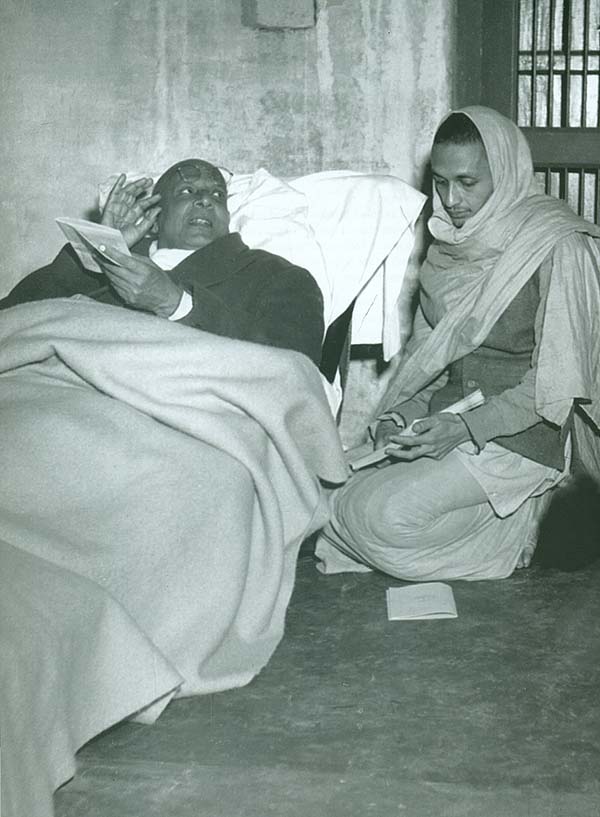
swami sivananda Black-and-white photo of guru resting in bed with disciple reading nearby picture
Saints and Masters, Swami Sivananda

Kabir

Kabir by Swami Sivananda Kasbir was born in 1440 A.D. The probable date of his death is 1519 A.D. as mentioned in Kabir Ka Santi. Kabir died at Maghar near Gorakhpur. He was found lying as a child in the lake called Lahar Talao near Kashi on a leaf of lotus. Here he was found by Niru, a childless Mohammedan weaver who was going with his wife Nima to attend a function in a neighbouring village. They took compassion on the forsaken baby. They took him to their home and there they brought him up as their own child. A Kazi was called in to give the child a name. The Kazi told Niru that the child was a demon and should be killed immediately. A miracle happened. The knife was plunged into the heart of the child. No drop of blood came out. Kabir uttered a verse which made them understand that he was not ordinary flesh and blood. Then the name ‘Kabir’ was given to the child. The word ‘Kabir’ means ‘great’ in the Arabic language. Kabir seems to have been of Hindu parentage, though adopted and brought up as a Mohammedan. It is said that he was born of a Brahmin girl-widow, who, to hide her shame, left the child in the lake. But in a stanza, Kabir denies his own conception in a womb. He says that he was not born nor did he dwell in a womb {vide page 122, Vol. VI, of Macauliffs Sikh Religion). Kabir grew up without food. His adopted parents became very anxious about him. Then he began to drink the milk of a calf which yielded milk daily in a miraculous manner. The life of Kabir is shrouded in mystery. We know nothing of his early training and career. What has been discovered in the way of his biographical details is very little. Beyond the facts that he was a weaver, born of poverty-stricken parents, that he lived at Kashi during the reign of Sikander Lodi, that he was the disciple of the great religious reformer Ramananda, and that he himself was the Guru of a number of distinguished disciples, we know positively nothing about Kabir. From his early boyhood, Kabir was very much religiously inclined. He was of a reflective disposition. He had very often his mystic moods. Even in his childhood he engaged himself in discussions about God with Sadhus. He received and served Sadhus and Sannyasins with intense devotion and faith. Though his foster father got him married, Kabir was not attached to home and family. He used to roam about the holy city of Kashi. He earned his livelihood from the loom. Kabir’s initiation Kabir remained for a long time without a Guru. He wanted to become the disciple of Ramananda. As he was a Mohammedan, he doubted whether Ramananda would accept him as his disciple. One day, he went and hid himself on the steps of the Ghat of the Ganga to which Ramananda used to come every morning to take his bath. That day, the great preacher, Ramananda came to bathe as usual. It was dark. Ramananda did not see the sleeping Kabir. He placed his feet upon Kabir’s chest. As soon as he found out that he had trodden upon a human body, he cried out ‘Ram…Ram…’ Kabir started up and said, “I have found him at last.” He fell at the feet of Ramananda and said, “Thou hast given me the word of initiation and I am thy disciple now.” Ramananda was struck with the sincerity and devotion of Kabir and accepted him as his disciple. Kabir was formally initiated by the great teacher. Kabir joined in the theological and philosophical disputes which his master held with all the great Mullahs and Brahmins of his day. A famous Brahmin named Sarvajit, who was well versed in logic, came to Kashi. The Pundits of Kashi informed Ramananda of the arrival of the learned Brahmin and told him that no one could defeat the erudite logician. Ramananda sent Kabir to argue with him. The orthodox Pundit asked: “O Kabir! What is your caste?” Kabir replied, “I am a weaver.” The proud Pundit sneered at Kabir in a contemptuous manner and asked what a weaver was. Kabir replied: ‘Wo one Knowelh the secret of the weaver, God hath woven the warp of the whole world. Ifthou listen to the Vedas and the Puranas. Thou shall hear: 7 have stretched the warp so long; I have made the Earth and Firmament my workshop, I have set the Sun and the Moon in alternate motion. Working my legs I did one workwith such a weaver my heart is pleased. ” (Macauliff) Kabir was like Guru Nanak. He was loved by both the Hindus and the Mohammedans. He was not of one religion or of one nation. He was the prophet of universal brotherhood. He did not observe the rules of caste. He recognised the higher harmony of Hinduism and Islam. He realised the truth that religion, spirituality, love, devotion, faith and divine life were the monopoly of no one religion, but were common to all religions. Kabir’s religion was a religion of simplicity. His motto was love. His means of salvation was devotion to God and God alone. Kabir’s home was the universe, his brother was mankind and his great father was the Father in Heaven. Kabir did not renounce the world in order to devote himself to the practice of severe austerities and meditation. He was a dynamic Yogi. He worked at the loom, and at the same time, his mind was ever fixed on God. Kabir began to attract a large number of people. Many became his disciples. They all gathered round him-at the loom or in the marketplace to listen to his sweet, soul-stirring and sublime songs and inspiring discourses. Mysterious are the ways of prophets and saints! They preach silently. Wise men only are profited by their teachings. They only can really

Kabir Read Post »

Swami Sivananda Monks walking together by riverside image
Saints and Masters, Swami Sivananda

Jnanadev

Jnanadev by Swami Sivananda The name of Saint Jnaneshwar is on the lips of everyone in Maharashtra. He was a born Siddha. He was a Yogi of high attainments. He had control over the elements. His work Jnaneshwari is the crest-jewel of Marathi literature. The simple style, the beautiful illustrations and the apt similes have rendered the book attractive, charming and extremely useful. Jnaneshwari is to Maharashtrians what the Ramayan of Tulsidas is to the Hindi-speaking people. Jnanadev lived for a few years, but he did wonders. He was a genius, a Yogi of deep spiritual experiences and a sage of supreme order. He boldly criticized his predecessors. He was a great social and religious reformer. He laid the foundation of the great Bhakti movement in Maharashtra. He was a fine poet to boot. The life-history, origin and other particulars of great saints, prophets and world teachers are all very strange and mysterious. Jnanadev was born of a Sannyasin. Lord Jesus was born of immaculate conception. And he was the son of a village carpenter. He was not born in a palace; he was born in a stable or a cave where there was a bundle of straw. Kabir was the son of a weaver. He was found in a lake. Sankara was a poor child of Kaladi. Jnanadev, or Jnaneshwar (Lord of Jnana or knowledge) as he is sometimes called, was one of the ancient saints of Maharashtra. He, and Mukund Rai who lived about a hundred years earlier to him, are the founders of the Bhakti Panth in Maharashtra. In the thirteenth century, there lived in Apegaon a village-accountant called Govindapanth. He had only one son named Vittalpanth. Vittalpanth was the father of Jnanadev. Vittalpanth was pious and dispassionate even from his boyhood. He was fond of pilgrimage to holy places. He was a profound scholar in Sanskrit. His heart yearned for Self-realisation. He had a great liking for taking Sannyasa. Vittalpanth married Rukmabai, daughter of Sridharpanth of Alandi, which is twelve miles from Pune and which contains the Samadhi of Jnanadev. Vittalpanth was disgusted with worldly life. He went out on a pilgrimage and returned back to Alandi. He wanted to take Sannyasa. His wife and father-in-law were not in favour of his taking Sannyasa. Vittalpanth went to Varanasi and took Sannyasa from Sripad Yati (Ramananda Swami). Rukmabai came to know that her husband had entered the fourth Ashrama of life. This was a great shock to her. She prayed to God fervently for reunion with her husband. Sripad Yati, the Guru of Vittalpanth, happened to come to Alandi on his way to Rameswaram. Rukmabai approached him and prostrated before him. The Yati blessed her: “You will be the mother of eight sons”. Rukmabai wept bitterly. The Yati said, “O blessed lady! What is the cause of your sorrow?” Then Rukmabai explained everything to the Yati. The Yati thought that the young man who took Sannyasa from him must be the husband of this lady. At once he gave up his idea of going to Rameswaram. He returned to Varanasi, rebuked his disciple and said, “Go back to Grihastha Ashrama and make your wife happy. She wants to serve you. My blessings are with you”. Then Vittalpanth carried out the orders of his Guru and came back to Alandi and lived with Rukmabai. The orthodox Brahmins of Alandi outcasted him and his wife. They said, “It is against scriptures to take to married life again after taking Sannyasa”. But Vittalpanth thought that he was doing the right thing as he was following the instructions of his Guru. In course of time, four children were born to Vittalpanth and Rukmabai�Nivritti in 1273 A.D., Jnanadev in 1275 A.D., Sopan in 1277 A.D. and Muktabai in 1279 A.D. (three sons and a daughter). Nivritti is regarded as an incarnation of Siva, Jnanadev as an incarnation of Hari, Sopan of Brahma and Muktabai of Sarasvati. On one occasion, Vittalpanth went with his children to Tryambakeshwar, near Nasik, situated in the vicinity of the source of the river Godavari. As they were going round the Brahmagiri mountain, they met a tiger. Vittalpanth hurried away with his children, but missed Nivrittinath. Nivrittinath entered the cave of Jnaninath. Jnaninath initiated Nivritti into the mysteries of Yoga and gave him all his spiritual wealth. Some days later, Nivritti joined his father and younger brothers. Nivritti became a disciple of Jnaninath, who himself was a disciple of Gorakhnath. Gorakhnath was a disciple of Matsyendranath who received spiritual instructions from Lord Siva Himself. Nivritti and Jnanadev studied Vedas under their father. They now made great progress in the study of spiritual books. Vittalpanth, on his return to Alandi, was treated as an outcaste by the Brahmins. He and his family members were put to a great deal of hardship and humiliation. Other children of the village would not mix with their children in play. The sons attained boyhood. The parents wanted to perform their holy-thread ceremony. The Brahmins declined to perform it. They said, “A Sannyasin should not lead the married life. The scriptures do not allow the performance of the thread ceremony of a Sannyasin�s children. Sons born of a Sannyasin cannot have the right of wearing the thread. They cannot be considered as Brahmins. You and your wife have violated the sacred laws of the scriptures. There is only one Prayaschitta for you both. You both should give up your lives in the Triveni of Prayag”. Vittalpanth and Rukmabai left Alandi and sacrificed their lives at the confluence of the Ganga and the Yamuna at Prayag. They thought that the Brahmins would take pity on their sons at least then and perform the thread ceremony. Nivritti was then about ten years, Jnanadev about eight and the youngest about five years. Jnanadev was very keen on wearing the holy thread in order to fulfil the desire of his parents who had sacrificed their lives even for that purpose. He again approached the Brahmins of Alandi.

Jnanadev Read Post »

images 2026 02 16T185043.167
Saints and Masters, Swami Sivananda

Namdev

Namdev by Swami Sivananda Introduction Namdev of Maharashtra was a saint of mediaeval India. He was not a servant of Lord Krishna, but His companion. Namdev was an Amsa (part) of Lord Krishna. Namdev was a contemporary of Jnanadev, the famous saint of Maharashtra, being his senior in age by about five years. He was born in 1269 A.D. He came of a family of tailors who were sincere devotees of Vittala of Pandharpur. The family members were observing the Wari of Pandharpur, i.e., going on pilgrimage twice a year on the first eleventh day of the Ashadh (June-July) and Kartik (October-November) months. The family originated from a village called Narsibamani on the bank of the river Krishna, near Karad, in district Satara. Being a great devotee of Vittala and wishing to improve his material prospects, Dama Setti, the father of Namdev, had moved to Pandharpur a year or two before his sons birth. Namdev, from his very childhood; was like Prahlad. At the age of two, when he began to talk, the first correct word he uttered was Vittala, and since then, he continued with the repetition of that sacred name incessantly, without any help or instruction from others. He found great pleasure when every day his mother Guna Bai took him to the temple of Vithoba for offering worship to the Deity. His next step was, when at the age of about seven, he prepared a pair of cymbals and spent his time in dancing and singing, doing Bhajan, to the neglect of everythingfood, studies in school, rest, sleep, etc. His devotion to Vithoba was so innocent and sincere that he used to treat Him sometimes as his dearest brother or as his playmate. One day, as Namdevs mother was busy, she asked Namdev to take the plate of offerings to Vithoba. Namdev went to the temple, placed the plate of eatables before Vithoba and asked Him to accept the offering. However, when Namdev did not find any evidence of acceptance by Vithoba, he cried so bitterly that Vithoba actually assumed a human form and accepted the offerings gratefully. Namdevs mother was surprised when her son came back in great joy with an empty plate and explained to her that Vithoba had accepted the offerings by actually consuming the eatables presented in the plate. So, the next day, she herself accompanied Namdev (but without his knowledge) to see and verify for herself the correctness of Namdevs explanation. The same performance was repeated and the mother had the satisfaction of seeing the Lord actually accepting their offerings. Her joy and pride in Namdev was unbounded. She felt grateful to the Lord that she was the mother of such a great devotee. Lord Vithobahis only interest In other respects, however, Namdev was the despair of his parents, and later, of his wife and other relatives. From the beginning he had no interest in worldly affairs; he neglected studies in school; he would not take interest in his fathers profession as a tailor, or in any other trade. His sole interest was to spend day and night in devotion to Vithoba. His parents were getting old; the family prosperity was waning. Therefore, their dearest wish was that Namdev, while devoting a reasonable spare time to his devotions, should help in maintaining the family in comfort. So, Namdev was sent to the bazaar one day to sell a few pieces of clothes. But Namdev was innocent of the tricks of the trade. To him, such things as prices, and money and its value, were unknown subjects. He went to the bazaar with the clothes, because his father forced him. He sat there on a stone doing Bhajan, entirely forgetting that he had gone there to sell the clothes. After a few hours the sun set and it was time for him to go to the temple for the evening devotional performance. Then only he remembered that he had not sold the clothes and that he would get a thrashing from his father. He was impatient to go to the temple. He therefore sold all the clothes to the very stone on which he was seated, i.e., he kept the clothes on the stone, appointed another stone as a guarantee that the first one would pay the money the next day, and went to the temple. Namdev�s father was furious on hearing his sons adventures and asked him to bring forth Dhondya (which means a stone and which is also used as a proper name among certain classes of people of Maharashtra) who had guaranteed the money. The next day Namdev went back to the bazaar, found that the clothes had vanished during the night and took the second stone (Dhondya) home, as it refused to pay the money, and locked it in a room. He then went to the temple and narrated all the events to Vithoba and explained his difficulties also. When Namdevs father asked him to show him Dhondya who had guaranteed the money, Namdev replied that Dhondya had been kept in a closed room in the house and ran to the temple. When the father opened the room to demand the money, he found, to his surprise, a lump of gold. Great was the fathers joy; but Namdev was quite indifferent to it. He only praised God for saving him from a thrashing. Thus it went on. His marriage In the meantime, Namdev married Radha Bai. Radha Bai was a worldly-minded woman. In response to Namdevs invitation, Vittal attended the naming ceremony of Namdevs child in the guise of a human being, named the child Narayanaand gave good gifts on the occasion. There was extreme poverty in the house of Namdev. Namdev neglected his worldly duties. Namdevs mother and wife abused Lord Krishna. Under the guise of Dharma Setti of Vaikunthapuram and the pretence of past friendship with Namdev, the Lord visited Namdevs house, gave magnificent gifts to Radha Bai and disappeared. A Bhakta, named Parisha Bhagavat, propitiated

Namdev Read Post »

154052 add6fb38c6454c1da7f3830d51e1a467mv2
Saints and Masters, Swami Sivananda

Maharshi Vyasa

Maharshi Vyasa by Swami Sivananda In ancient days, our forefathers, the Rishis of Aryavartha, went to the forest to do Tapasya during the four months following Vyasa Purnima-a particular and important day in the Hindu calendar. On this memorable day, Vyasa, an incarnation of the Lord Himself, began to write his Brahma Sutras. Our ancient Rishis did this Tapasya in caves and forests. But times have changed and such facilities are not common nowadays although Grihasthas and Rajas are not wanting who are able and willing to place at the disposal of the members of the fourth Ashrama such help and facilities as they can afford. The forests and caves have given place to the rooms of Sadhus in their own Gurudwaras and Mutts. One has of necessity to suit himself to time and place; and change of place and situation should not be allowed to make such a difference in our mental attitudes. Chaturmas begins from the Vyasa Purnima Day when, according to our Shastras, we are expected to worship Vyasa and the Brahmavidya Gurus and begin the study of the Brahma Sutras and other ancient books on ‘wisdom’. Our mythology speaks of many Vyasas; and it is said that there had been twenty-eight Vyasas before the present Vyasa-Krishna Dvaipayana-took his birth at the end of Dvapara Yuga. Krishna Dvaipayana was born of Parasara Rishi through the Matsyakanya-Satyavathi Devi-under some peculiar and wonderful circumstances. Parasara was a great Jnani and one of the supreme authorities on astrology and his book Parasara Hora is still a textbook on astrology. He has also written a Smriti known as Parasara Smriti which is held in such high esteem that it is quoted by our present-day writers on sociology and ethics. Parasara came to know that a child, conceived at a particular Ghatika or moment of time, would be born as the greatest man of the age, nay, as an Amsa of Lord Vishnu Himself. On that day, Parasara was travelling in a boat and he spoke to the boatman about the nearing of that auspicious time. The boatman had a daughter who was of age and awaiting marriage. He was impressed with the sanctity and greatness of the Rishi and offered his daughter in marriage to Parasara. Our Vyasa was born of this union and his birth is said to be due to the blessing of Lord Siva Himself who blessed the union of a sage with a Jnani of the highest order, although of a low caste. At a very tender age Vyasa gave out to his parents the secret of his life that he should go to the forest and do Akhanda Tapas. His mother at first did not agree, but later gave permission on one important condition that he should appear before her whenever she wished for his presence. This itself shows how far-sighted the parents and the son were. Puranas say that Vyasa took initiation at the hands of his twenty-first Guru, sage Vasudeva. He studied the Shastras under sages Sanaka and Sanandana and others. He arranged the Vedas for the good of mankind and wrote the Brahma Sutras for the quick and easy understanding of the Srutis; he also wrote the Mahabharata to enable women, Sudras and other people of lesser intellect to understand the highest knowledge in the easiest way. Vyasa wrote the eighteen Puranas and established the system of teaching them through Upakhyanas or discourses. In this way, he established the three paths, viz., Karma, Upasana and Jnana. To him is also attributed the fact that he continued the line of his mother and that Dhritarashtra, Pandu and Vidura were his progeny. Vyasa’s last work was the Bhagavata which he undertook at the instigation of Devarshi Narada who once came to him and advised him to write it as, without it, his goal in life would not be reached. Vyasa is considered by all Hindus as a Chiranjivi, one who is still living and roaming throughout the world for the well-being of his devotees. It is said that he appears to the true and the faithful and that Jagadguru Sankaracharya had his Darshan in the house of sage Mandana Misra and that he appeared to many others as well. Thus, in short, Vyasa lives for the welfare of the world. Let us pray for his blessings on us all and on the whole world. Everybody knows that there are six important systems of thought developed by our ancients known as the Shad Darshanas or the six orthodox schools of philosophy, viz., Sankhya, Yoga, Nyaya, Vaiseshika, Purva Mimamsa and Uttara Mimamsa or Vedanta. Each system has a different shade of opinion. Later, these thoughts became unwieldy, and to regulate them, the Sutras came into existence. Treatises were written in short aphorisms, called “Sutras” in Sanskrit, meaning clues for memory or aids to long discussions on every topic. In the Padma Purana, the definition of a Sutra is given. It says that a Sutra should be concise and unambiguous; but the brevity was carried to such an extent that the Sutra has become unintelligible and particularly so in the Brahma Sutras. Today we find the same Sutra being interpreted in a dozen ways. The Brahma Sutras written by Vyasa or Badarayana-for that was the name which he possessed in addition-are also known as Vedanta Sutras as they deal with Vedanta only. They are divided into four chapters, each chapter being subdivided again into four sections. It is interesting to note that they begin and end with Sutras which read together mean “the inquiry into the real nature of Brahman has no return”, meaning that “going by that way one reaches Immortality and no more returns to the world”. About the authorship of these Sutras, tradition attributes it to Vyasa. Sankaracharya, in his Bhashya, refers to Vyasa as the author of the Gita and the Mahabharata, and to Badarayana as the author of the Brahma Sutras. His followers-Vachaspathi, Anandagiri and others-identify the two as one and the

Maharshi Vyasa Read Post »

images 2026 02 16T155022.074
Saints and Masters, Swami Sivananda

Sage Yajnavalkya

Sage Yajnavalkya by Swami Sivananda The name of Yajnavalkya of Mithila stands distinguished both in the Srutis and in the Smritis. Yajnavalkya is especially known for his unsurpassed spiritual wisdom and power. The seer of a Veda Samhita from Bhagavan Surya, the revealer of Brahma Jnana to Janaka, Maitreyi and others, Yajnavalkya hails supreme among sages of sacred memory. As to his obtaining the Shukla Yajurveda Samhita from Bhagavan Surya, there is the following history. Yajnavalkya was the son of the sister of Mahamuni Vaishampayana, the Vedacharya of the Taittiriya section. He was studying the Taittiriya Samhita from Vaishampayana who was also his Guru. Vaishampayana had many other disciples too and they all were students of the Taittiriya Shakha. Once all the Rishis decided to form an association near the Meru mountain and made a rule that any Rishi who absented himself at the appointed hour should incur the sin of Brahmahatya (the sin of killing a Brahmin) for seven days. On that appointed day fell the Sraddha ceremony of Vaishampayana�s father. Vaishampayana thought, “Somehow I have to perform my father�s ceremony. If the sin of Brahmahatya comes to me, my disciples will observe the expiatory penance therefor”. So Vaishampayana did not attend the meeting of the Rishis. And accordingly he incurred the sin of Brahmahatya. Then Vaishampayana said to his disciples, “Now I have to expiate this great sin of Brahmahatya. Therefore, you all will observe, for my sake, an expiatory penance for seven days”. At once Yajnavalkya stood up and said, “O Guru! All these are poor-spirited young students. They will not be able to undergo such a hard penance. So, instead of all, I myself alone shall observe it in the manner in which nobody else can”. Vaishampayana told Yajnavalkya not to undertake it alone. But Yajnavalkya persisted. The preceptor was offended at this audacious attitude of the disciple and said, “O proud one, you are very conceited. You get away from me. Enough of you who is disposed to despise wise Brahmins. Give back to me immediately whatever you have learnt from me”. Upon the order of the Guru, Yajnavalkya, the son of Devarata, vomited out the collection of the Yajus in the form of food. The other disciples ate that food taking the form of the Tittiri birds, because they were very eager to receive the same. They then had the direct revelation of those Yajurveda collections. As the Tittiri birds ate this Veda, it is thenceforth called the Taittiriya Yajurveda. It is also known as Krishna (black) Yajurveda on account of its being vomited substance. Then Yajnavalkya determined not to have any human Guru thereafter. Thus he began to propitiate the Sun-God, Surya. Yajnavalkya worshipped and extolled the Sun, the master of the Vedas, for the purpose of acquiring the fresh Vedic portions not known to his preceptor, Vaishampayana. Yajnavalkya said, “Prostration to the glorious Aditya, who in the form of the Atman, abides in all beings. I bow to Him who surrounds all like Akasa, who is one and not separated or distanced by limiting conditions. O Great God, O Creator, I contemplate upon that glowing sphere which lights and warms the whole world! O God who burns all miseries wrought by unrighteous activities, who burns ignorance which is the seed of activity! O Lord, I worship Thy lotus-like feet praised and worshipped by the rulers of the three worlds. Give me those portions of the Veda which are not known to others”. The Sun-God, the glorious Lord Hari, pleased with Yajnavalkya�s penance, assumed the form of a horse and taught the sage such fresh portions of the Yajurveda as were not known to any other. This portion of the Yajurveda goes by the name of Shukla Yajurveda. It is also known as Vajasaneya Yajurveda, because it was evolved in great rapidity by Surya in the form of a horse through his manes. Yajnavalkya divided this Vajasaneya Yajurveda again into fifteen branches, each branch comprising hundreds of Yajus Mantras. Kanva, Madhyandina and others learnt those branches. Yajnavalkya married two wives. One was Maitreyi and the other Katyayani. Of the two, Maitreyi was a Brahmavadini. When Yajnavalkya wished to divide his property between the two wives before starting for the fourth Ashrama of his life, Maitreyi asked whether she could become immortal through wealth. Yajnavalkya replied that there was no hope of immortality through wealth and that she would only become one among the many who were well-to-do on earth. On hearing this, Maitreyi requested Yajnavalkya to teach her what he considered as the best. Then Yajnavalkya elaborately described to her the sole greatness of the Absolute Self, the nature of Its existence, the way of attaining infinite knowledge and immortality, etc. This immortal conversation between Yajnavalkya and Maitreyi is recorded in the Brihadaranyaka Upanishad. The central theme of the discourse is this: “All things are dear, not for their sake, but for the sake of the Self. This Self alone exists everywhere. It cannot be understood or known, for It alone is the Understander and the Knower. Its nature cannot be said to be positively as such. It is realised through endless denials as ‘not this, not this�. The Self is self-luminous, indestructible, unthinkable”. The other wife Katyayani, the daughter of Bharadhwaja, was of common intelligence, and through her Yajnavalkya had three sons�Chandrakanta, Mahamegha and Vijaya. Yajnavalkya, though a great Brahmajnani, was a great Karmakandi too. He caused many Yajnas to be performed and himself became the Acharya of those great Yajnas. He was a celebrated Srotriya and a Brahma-nishtha Guru. Once King Janaka of Videha wanted to know from which real Brahmanishtha to receive Brahma Vidya. In order to find out who was the real Brahma-nishtha, Janaka performed a huge Bahu-dakshina sacrifice to which all the Rishis from far and wide were invited. And he offered one thousand cows with their calves, all their horns being decked with enormous gold. Then he proclaimed to the assembled ones, “Whosoever is the best

Sage Yajnavalkya Read Post »