



Hari Om

Menu

Saints and Masters

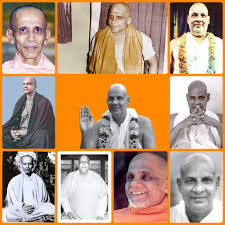
swami sivananda Collage of multiple spiritual guru portraits image
Saints and Masters, Swami Sivananda

Swami Omkar

Swami Omkar Swami Omkar was born in the East Godavery District. His parents were without children and prayed fervently to God in the hope of getting a child. One very auspicious day, a tall Mahatma came to their home and blessed the couple, giving them some holy water to drink. The mother drank this water with all reverence and devotion. The Mahatma disappeared as suddenly as he had come. After some months, to the great joy of the couple, a little baby boy was born to them. They named him Venkateswara. Little Venkateswara was later to grow up to be the great saint, Swami Omkar. At the age of three Venkateswara would sit still like a statue beside his father during the daily prayer. He would listen to the reading of the Gita very attentively. In this way, the boy was given a strong spiritual foundation from early childhood. Swami Omkar often said later, “As are the parents, so are the children”. Venkateswara’s mother died when he was very young. His father now became like a mother to the little boy. He was utterly devoted to his son and gave him everything he desired, both materially and spiritually. The boy went to the best school and wore the most expensive clothes. Venkateswara had a little sister who looked after all his needs until she was twelve years old, when she developed a blood condition. But she was not to live long and very soon passed away, taking her brother’s name. Since then, whenever Swami Omkar served women, he would feel that he was serving the form of his little sister. Even while he was still young, Venkateswara went away to Rishikesh, in the Himalayas. Here he assumed the name Omkar, and spent many years in deep meditation. Now he had a call from within to go to America. He described his visit as follows: “I went as a seeker of Truth, not to teach but to learn all that is best in America. There is so much to learn in order to rise from darkness to light.” Even at this early age, Venkateswara had unusual mental and psychic powers. He could heal the sick, whether their ailments were mental or physical. He would write the sacred symbol Om on water, and give this sacred water to the patient. The patient would feel immediate relief. Gifted with a universal vision from his early boyhood, Swami Omkar soon realised the eternal Truth. He founded the Sri Shanti Ashram, the abode of peace, at Totapalli Hills in the Andhra province. Swami Omkar was a great Karma Yogi. From dawn to dusk he would be engaged in endless activity-helping devotees in their spiritual progress, watering the plants, or feeding the animals. He had a very compassionate heart from his very boyhood, and would not hurt any living creature. He loved plants and would often talk to them. Many saints visited his Ashram and stayed with him for some time. During the early years of his life as a monk, the Divine Master, Swami Sivananda, also stayed at Shanti Ashram for some months and served the sick. Many years later, Swami Omkar, too, visited the Master at his Ashram at Rishikesh. Both the saints had great love for each other. Shanti Ashram is a beautiful place surrounded by hills and enchanting scenery. There is a small hospital and a school for children run by the Ashram. There is a mobile clinic also to serve the needs of the hill people. There are several other branches of the Ashram, at Waltair and in other places. At the Waltair Ashram there is a small school for deaf and dumb children. Swami Omkar had a very broad and liberal heart. He had great love and reverence for the saints of all religions. All approaches to God were valid for him. Swami Omkar was so compassionate that he once gave a piece of bone from his own thigh to be grafted in a little girl to save her life. He spent several months in hospital as a result of this great sacrifice on his part. Such a noble personality, who worked heart and soul for spreading peace in the world, passed away in his ninety-third year, on 10 June, 1982. Shanti Ashram, which is located at the foot of the beautiful Totapalli hills in Andhra Pradesh, is currently rendering active service to the poor and needy, under the able and loving guidance of Mother Jnaneshwari, who was appointed by Swami Omkar as his successor.

Swami Omkar Read Post »

Swami Sivananda blessing young child during spiritual ceremony photo
Saints and Masters, Swami Sivananda

Swami Papa Ramdas

Swami Papa Ramdas If anyone wants me to tell them something about Beloved Papa, I ask them to visualise what it would be like if, by some divine alchemy, Love and Bliss were to coalesce and stand before them as one luminous entity. That is how Papa can be seen with the naked eye. Papa was indeed the very image of Love and Bliss divine. What was the source of that Love? When he opened out his heart to Ram, his eternal Beloved, Ram flooded his heart with never-ending, never-fading Love. This happened when Papa turned to his beloved Ram with pure devotion and utter self-surrender, turning his back on the world and the attractions it might hold for him. It was born of the realisation of his oneness with the Infinite and the Eternal Self. Every fibre of his being then thrilled to the sweet rhythm of Love. Bliss ineffable flowed over and saturated him, rising like an artesian spring from the heart’s core when Papa realised the entire universe of name and form as the vibhuti or manifestation of the Self. In the state of pure Bliss-consciousness he carried on his spiritual ministry till his last day on earth. Through his talks and actions he gave those who sought him a taste of the love and bliss divine. The purest pearls of wisdom that fell from his tips spread sweetness and light all round, dispelling gloom, fear and anxiety that held the people in a tight grip. Earnest seekers were lifted up to higher levels of consciousness, getting a glimpse of the true life of the Spirit, with the result that a deep yearning for that life was kindled in them. Papa’s talks were often punctuated with jokes and laughter. The total impression left on the mind of the listener was never to be forgotten. Once, to illustrate the futility of empty, theoretical advaitic knowledge, Papa narrated the following story. He was staying in a small mandir in Jhansi when a man approached him and asked, “Who are you?””I am Ramdas,” he replied simply. “No, you speak a lie there,” returned his visitor. “You are Ram Himself. When you declare you are Ramdas, you do not know what you say. God is everything and in everything. He is in you and so you are He. Confess it right away. “True, dear friend,” Ramdas replied, “God is everything. But at the same time, it must be noted God is one, and when He is in you and everywhere around you, may I humbly ask to whom you are putting this question?” After a little reflection, the man could only answer, “Well, I have put the question to myself “. Papa always stressed the necessity of absolute honesty and sincerity as essential in the great Quest. Better an honest, dualistic bhakti than a hypocritical advaita. Whereas bhakti, however dualistic, will lead ultimately to jnana as jnana mata, the mother of jnana, advaita practised only with the head leads merely to confusion and hypocrisy. Another incident illustrates this point well. When Papa was staying at Mount Abu he was taken to meet a “great saint”, Swami Kaivalyananda, a young sannyasin living in a cave, his body completely shaved, but surrounded by a number of books. Papa approached him and prostrated.With a look of surprise, the sannyasin asked, “To whom are you offering this salutation?” “To Ram,” Papa replied. “Who are you?” “Ramdas. “ “Ramdas. Ramdas, funny, isn’t it? There is only one Truth. Why do you assume this false duality?” “It is Ram Himself, being One, who has chosen to be many. “ “Wrong,” retorted the advaitin. “He is always One; many is false, illusion.” “Truth has become God and His devotee for the sake of lila, the divine play,” Papa responded. “Why play?” “For love and bliss; so when Ramdas prostrates before you, it is yourself who do it in the form of Ramdas,” Papa went on. “Bosh!” cut in the sannyasin. “There is only one, never two.” “Then to whom are you talking, dear Swamiji,” asked Papa, pulling out his brahmastra. The sannyasin reflected a while and had to reply, “To myself”. “Exactly. You assume there are two although in the light of absolute Truth there is only one.” “No, no–no realised person believes in duality,” maintained the advaitin, getting jumpy. “Here, take this book and read it. You will understand things more clearly, I assure you. It is written by me.” He pressed Papa to accept it. Noticing the author’s name on the cover, Papa noted that he referred to himself as “Swami Kaivalyananda, M.A.”! Papa, known as Vittal Rao in his purvasrama days, was born in 1884 at Hosdrug, Kerala, to Sri Balakrishna Rao and Smt. Lalita Bai, a devout Saraswat couple. Papa lived the ordinary life of a householder until he was thirty-six. During that time he experienced many trials and tribulations from the worldly point of view, but in his case they caused him to enquire deeply into the true meaning of life. A wonderful transformation was wrought in him of which nobody had any inkling until he was suddenly fired with an intense wave of dispassion. He came to realise the futility of worldly pursuits, and the need for real, everlasting peace and happiness. Inspired by the teachings of Sri Ramakrishna, Swami Vivekananda and Swami Ram Tirtha, Papa became thoroughly convinced that God alone can give one eternal peace and happiness. The path of pure devotion and self-surrender shone forth for him with an irresistible appeal. All attachments to family, friends and business dropped away just as a fully ripened fruit falls from the tree. He was inwardly ready to give himself up wholly and unreservedly to God. At that critical time, his father, noticing his son’s waning interest in secular pursuits and his waxing love for and devotion to God, initiated him into the Ram mantram and assured him that by repeating it unstintingly he would, in due time, find the true

Swami Papa Ramdas Read Post »

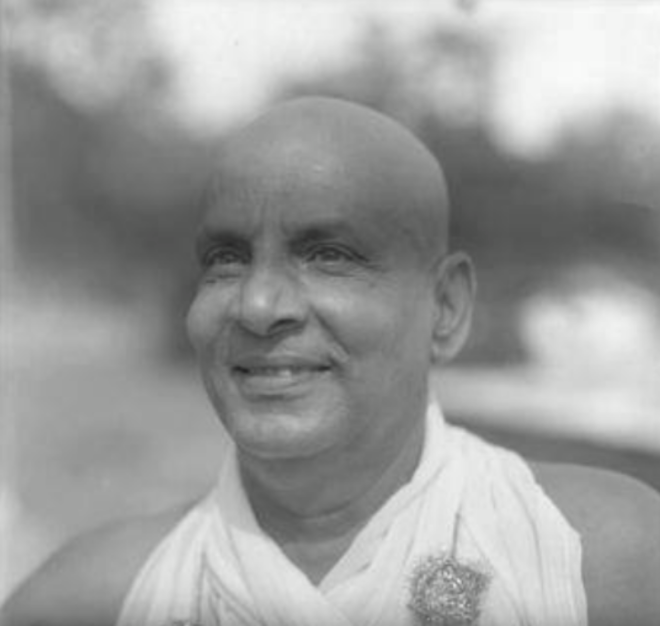
Swami Sivananda smiling portrait image
Saints and Masters, Swami Sivananda

Paramahansa Yogananda

Paramahansa Yogananda by Swami Sivananda Paramahansa Yogananda was born on 5 January, 1893, near the Himalayas, in Gorakhpur. His parents, brothers and sisters were all saintly and pious, but Mukunda (the boyhood name of Yogananda) was unique amongst all of them. He displayed his spiritual gifts and powers even from his childhood. His line of Gurus descended from Babaji, the deathless Guru said to be the reincarnation of Lord Krishna. Babaji�s disciple was Lahiri Mahasaya, who in turn had as his disciple, Sri Yukteswar. It was Sri Yukteswar who was destined to be the spiritual master of Paramahansa Yogananda. For ten years Yoganandaji trained for his high duty at the Ashram of his Guru, pursuing his university career at the same time. After his rigorous training, filled with the light of God-vision, he was now ready to undertake the mission entrusted to him by his line of Gurus. The education of the youth was always dear to the heart of Yoganandaji. He set up his first school in Bengal in 1917. Its curriculum includes the standard high school subjects as well as Yoga concentration, meditation and the Yogoda system of physical development. In 1920, Yoganandaji went to America as a delegate from India to the International Congress of Religions at Boston, and from then on America became his home. Five years later he founded the Self-Realization Fellowship with its head quarters at Mount Washington, Los Angeles. In his famous Autobiography of a Yogi, Yoganandaji has given graphic descriptions of his spiritual experiences and his contact with the great Yogis of India. This book has since become one of the greatest spiritual classics in the world and has been translated into many languages. Paramahansa Yogananda had a broad and liberal heart. Even though he himself was a great Master, he approached other saints with great reverence. Kriya Yoga was the method of God-realisation taught by Yoganandaji. His mission in the West was to spread the knowledge of Yoga practices, by which man can enter into union with God. Yoganandaji also gave new explanations to the teachings of the Bible, showing the similarity of its teachings with that of Hinduism. He promoted the cause of a better understanding between the East and West. Numerous students got personal instructions in Yoga teachings in the classes conducted by him in his ministry of thirty-two years. He spoke in churches, societies, universities and clubs. In 1935, Yoganandaji�s class instructions were published in the form of lessons and mailed to students all over the world. In India the same teachings were spread by the Yogoda Satsanga Society, with its headquarters at Dakshineswar. The Self-Realization Fellowship today has hundreds of centres throughout the world. There are seven large centres in California, where renunciates stay to serve and practise Yoga. A number of trained monks tour all over the world, giving discourses and Kriya Yoga initiation to students. Besides giving instructions on Yoga and balanced living, SRF also conducts many social services, especially in India. Yoganandaji attained Mahasamadhi on March 7, 1952. The great Master showed his power over death, for his body did not decay for many weeks.

Paramahansa Yogananda Read Post »

swami sivananda Framed portrait of monk in red robes with garland and floral decoration image
Saints and Masters, Swami Sivananda

Sri Ramana Maharshi

Sri Ramana Maharshi by Swami Sivananda Introduction Sri Ramana Maharshi was born on 30th December, 1879. He was known as Venkataraman. Born in a pious middle class Brahmin family, he went to a mission school and learnt a little English. Flight From Home On the 29th of August 1896, Venkataraman left his home in the district of Madurai in search of his Father, Lord Arunachala, to whom he reported himself on the 1st of September 1896, thus: O Lord, obedient to Thy call Here have I come, deserting all, No boon I ask; no loss bemoan, Take me in and make me Thine own. From that day till the end of his earthly sojourn, Venkataraman made Arunachala (Tiruvannamalai) his abode, transmitting through Mouna, the golden language of his egoless state, the Message of Eternal Truth, to the four corners of the globe. Venkataraman left a note behind to his rebuking brother: “I have, in search of my Father, according to His command, started from this place. On a virtuous enterprise, indeed, I have this day embarked. Therefore, for this action none need grieve or trace this one. No money need be spent for searching me”. The Great Enlightenment “It was about six weeks before I left Madurai for good, in the middle of the year 1896, that the great change in my life took place” said Sri Ramana Maharshi, when asked by devotees as to how he was transformed, “It was so sudden. One day I sat up alone on the first floor of my uncles house. I was in my usual good health. But a sudden and unmistakable fear of death seized me. I felt I was going to die and at once set about thinking as to what I should do. I did not care to consult anyone, be he a doctor, elder or friend. I felt I had to solve the problem myself then and there. The shock of the fear of death made me at once introspective or introverted. I said to myself mentally, Now that death is come, what does it mean? Who is it that is dying? This body dies. I at once dramatised the situation. I extended my limbs and held them rigid as though rigor mortis had set in. I imitated a corpse to lend an air of reality to my further investigation. I held my breath and kept my mouth closed, pressing the lips tightly together, so that no sound could escape. Well then I said to myself, this body is dead. It will be carried to the crematory and there burnt and reduced to ashes. But with the death of my body, am I dead? Is the body I? This body is silent and inert. But I am still aware of the full force of my personality and even of the sound of I within myself as apart from the body. The material body dies, but the Spirit transcending it cannot be touched by death. I am therefore the deathless Spirit. All this was not a feat of intellectual gymnastics, but came as a flash before me vividly as living Truth, which I perceived immediately, without any argument almost. I was something very real, the only real thing in that state, and all the conscious activity that was connected with my body was centred on that. The I or myself was holding the focus of attention with a powerful fascination. Fear of death vanished at once and for ever. The absorption in the Self has continued from that moment right up to now”. Tapas of Maharshi Ramana practised Tapas in the thousand-pillared Mandapam, near the Patala Linga, in Subrahmanyas shrine, in the Mango garden, the Sadguru Swami cave and Cora hills. From 1909 to 1916 he lived in the Virupakshi Cave. During his days of Tapas, mischievous boys pelted him with stones and hurled tiles at him; and yet Ramana was ever peaceful and calm through the strength of meditation and penance. Ramana Maharshi was known as Brahmana Swami in Tiruvannamalai. Kavya Kanta Ganapathy Sastri, the great Sanskrit scholar, came to Ramanas Ashram in 1908 and stayed with Maharshi and wrote the Ramana Gita. The life of the Maharshi was one continued meditation, Ananda Anubhavam. Maharshi established peace within. He lived in the Light of the Lord within. He encouraged others to do the same thing. To him all the world was one. Maharshi seldom talked, and whenever he did speak, he did so only because it was absolutely necessary. His Divine Message Ramana was a living example of the teaching of the Upanishads. His life was at once the message and the philosophy of his teachings. He spoke to the hearts of men. The great Maharshi found Himself within himself and then gave out to the world the grand but simple message of his great life, “Know Thyself”. “Know Thyself. All else will be known to thee of its own accord. Discriminate between the undying, unchanging, all-pervading, infinite Atma and the ever-changing, phenomenal and perishable universe and body. Enquire, Who am I?Make the mind calm. Free yourself from all thoughts other than the simple thought of the Self or Atma. Dive deep into the chambers of your heart. Find out the real, infinite I. Rest there peacefully for ever and become identical with the Supreme Self.” This is the gist of the philosophy and teachings of Sri Ramana Maharshi. Sri Ramana says, “The world is so unhappy because it is ignorant of the true Self. Mans real nature is happiness. Happiness is inborn in the true Self. Mans search for happiness is an unconscious search for his true Self. The true Self is imperishable; therefore, when a man finds it, he finds a happiness which does not come to an end. “In the interior cavity of the heart, the One Supreme Being is ever glowing with the Self-conscious emanation I…I… To realise Him, enter into the heart with an one-pointed mindby quest within or diving deep or control

Sri Ramana Maharshi Read Post »

Swami Sivananda standing with children sharing blessings and spiritual guidance
Saints and Masters, Swami Sivananda

Swami Rama Tirtha

Swami Rama Tirtha by Swami Sivananda Swami Rama Tirtha, previously known as Gossain Tirtha Rama, was born in 1873, at Murariwala, a village in the district of Gujranwala, Punjab, India. His mother passed away when he was but a few days old and he was brought up by his elder brother, Gossain Gurudas. As a child, Rama was very fond of listening to recitations from the holy scriptures and attending Kathas. He often put questions to holy men and even offered explanations. He was very intelligent and loved solitude. Rama was barely ten years old when his father got him married. His father left him under the care of his friend, Bhakta Dhana Rama, a man of great purity and simplicity of life. Rama regarded him as his Guru, and offered to him his body and soul in deep devotion. His surrender to his Guru was so complete that he never did anything without first consulting him. He wrote numerous loving letters to him. Rama was a brilliant student, especially in mathematics. After completing his degree, he served for a while as Professor of Mathematics in the Forman Christian College. It was at this stage that his spiritual life began to blossom. He began to read the Gita and became a great devotee of Lord Krishna. His intense longing gave him a vision of Sri Krishna. He used to deliver lectures on Bhakti under the auspices of the Sanatana Dharma Sabha of Lahore. Rama Tirtha commenced his spiritual life as a Bhakta of God and then turned to Vedanta, studying under the inspiration of Sri Madhava Tirtha of the Dwaraka Math. A great impetus was given to his spiritual life by Swami Vivekananda, whom he saw for the first time at Lahore. The sight of the great Swami as a Sannyasin kindled in him the longing to don the ochre robe. His passion for the vision of the all-pervading Lord began to grow more and more. He longed and pined for oneness with God. Indifferent to food and clothes, he was always filled with ecstatic joy. Tears would often flow in a limpid stream down his cheeks. It was not long before he had the vision he yearned for, and thereafter he lived, moved and had his being in God. Swami Rama was a living Vedantin. He saw and felt God in all names and forms. His beautiful words are often addressed to the trees, rivers and mountains. Rama soon resigned his post and left for the forest. His wife and two children and a few others accompanied him to the Himalayas. Owing to ill-health, his wife later returned with one of her sons. The other was left at Tehri for his schooling there. Rama Tirtha took Sannyas a few days before the passing of Swami Vivekananda. Swami Madhava Tirtha had already allowed him to take Sannyas whenever he wished. A few years later he returned to the plains to preach. The effect of his presence was marvellous. His infectious joy and his bird-like warbling of Om enchanted everyone. Swami Rama’s burning desire to spread the message of Vedanta made him leave the shores of India for Japan. He went with his disciple Swami Narayana. After a successful visit to Tokyo, he departed for the U.S.A. He spent about a year and a half in San Francisco under the hospitality of Dr Albert Hiller. He gained a large following and started many societies, one of them being the Hermetic Brotherhood, dedicated to the study of Vedanta. His charming personality had a great impact on the Americans. Devout Americans even looked upon him as the living Christ On his return to India, Swami Rama continued to lecture in the plains, but his health began to break down. He went back to the Himalayas and settled at Vasishtha Ashram. He gave up his body in the Ganges on 17 October, 1906, when he was only thirty-three. The Rama Tirtha Publication League has brought out most of the writings of this great saint of India. They are given in several volumes, entitled, In the Woods of God-realisation. His inspiring writings show us that he saw his Beloved Lord in all names and forms. In many of his poems he sings the glory of nature.

Swami Rama Tirtha Read Post »

Swami Sivananda blessing young child during spiritual ceremony photo
Saints and Masters, Swami Sivananda

Sri Aurobindo Ghosh

Sri Aurobindo Ghosh by Swami SivanandaBirth and Parentage On Thursday, the 15th August, 1871, at about 5 a.m., Sri Aurobindo was born of Sri Krishnadhan and Swamalata, at Calcutta, in Bengal, in a reputed Ghosh family of Konnagar. Sri Krishnadhan went to England and returned an M.D., full of honours. Raj Narayan Bose, an acknowledged leader in Bengali literature, a writer in the “Modern Review” and the grandfather of Indian nationalism was Sri Aurobindos maternal grandfather. Aurobindo owes not only his rich spiritual nature, but even his very superior literary capacity, to his mothers line. An Accomplished Scholar Aurobindo was sent to the Loretto Convent School at Darjeeling when he was four years old. As a boy, Aurobindo received his early education in a public school in England. The old headmaster of the school observed, “Of all the boys who passed through my hands during the last 25 or 30 years, Aurobindo was by far the most richly endowed with intellectual capacity”. From school Aurobindo went to Kings College, Cambridge, where he distinguished himself as a student of European classics. He passed the Indian Civil Service Examination with great credit in 1890. Failing, however, to stand the required test in horsemanship, he was not allowed to enter the Covenantal Service of the Indian Government. But, returning to India, he became the Vice-principal of the State college in Baroda. He was held in great respect by the Maharaja of Baroda. Aurobindos scholarship soon attracted the notice of all. He was loved by the educated classes in Baroda State. He was exceedingly popular with the general public. Sri K.M. Munshi was one of his students. Munshi admired and loved Aurobindo. To the younger generation, Aurobindo became a veritable god and by them he was called as “Aru Da”, meaning “elder brother Aurobindo”. Aurobindo married Mrinalini Devi. Aurobindo was an accomplished scholar in Greek. He got high distinction in Latin. He learnt French very well and picked up a little of German and Italian to study Goethe and Dante in the original. He was steeped in the lore of our ancient Vedic scriptures. Sri Aurobindo was a genius in history and poetry, a scholar in English and Latin. He was in England for fourteen years. When he was only seven years of age, Dr. K.D. Ghosh sent him to England to be steeped in Western education. That early age was chosen deliberately in order that Aurobindo might forget the native touch and learn to adopt the Western forms instead. Apostle of Indian Nationalism It was in 1893 that Aurobindo came back to India. He drew a salary of Rs. 750/- in the Baroda Educational Service. From 1893 to 1906 he drank deep from the fountains of Sanskrit and Bengali literature, philosophy and political science. He then resigned his job and joined the Bengal National College on a salary of Rs. 150/-. He plunged headlong into the revolutionary movement. He was a great figure in the nationalist movements of the time. Aurobindo edited the English daily Bande Mataram and wrote fearless and pointed editorials. During the next few months, he started the English weekly Dharma. He spread his message: “Our ideal of Swaraj is absolute autonomy, absolute self-rule, free from foreign control”. In those days, Aurobindo openly advocated the boycott of British goods, British courts and everything British. He always asked the people to prepare themselves for passive resistance. Sri Aurobindo, the prophet of Indian nationalism, was one of the pioneers of political awakening in India. He was the leader of the revolutionary movement. He played a great part in the countrys national struggle from 1908. He was in the forefront of the national struggle during the days of the partition of Bengal. Awakened to the Divine Mission The famous Alipore Bomb Case was the turning point in Sri Aurobindos life. For a year Aurobindo was an undertrial prisoner in solitary confinement in the Alipore Central Jail. It was in a dingy cell of the Alipore Jail that he dreamt the dream of his future life, the divine mission ordained for him by God. Aurobindo bore the rigours of the imprisonment, the bad food, the inadequate clothes, the lack of light and free air, the strain of boredom and the creeping solitariness of the gloomy cell. He utilized this period of incarceration for an intense study and practice of the teachings of the Bhagavad Gita. Chittaranjan Das defended Sri Aurobindo, who was acquitted after a memorable trial. His Practice of Yoga Sri Aurobindo began his Yoga in 1904. He had no helper or Guru in Yoga till he met Lele, a Maharashtrian Yogi in Baroda; and that was only for a short time. Meditating only for three days with Lele, Aurobindo followed the Yogis instructions for silencing the mind and freeing it from the constant pressure of thought. Sri Aurobindo himself once wrote in a letter about his practice of Yoga: “I began my Yoga in 1904 without a Guru. In 1908 I received important help from a Mahratti Yogi and discovered the foundations of my Sadhana”. He started Yoga by himself, getting the rule from a friend, a disciple of Brahmananda of Ganga Mutt. It was confined at first to assiduous practice of Pranayama, for six or more hours a day. Aurobindo practised and meditated on the teachings of the Gita and the Upanishads. Ashram at Pondicherry Sri Aurobindo migrated from Calcutta to Chandranagar and later reached Pondicherry on April 4, 1910. At Pondicherry, he stayed at a friends place. At first, he lived there with four or five companions. Gradually the number of members increased. An Ashram grew up around him. Now there are hundreds of inmates in the Ashram accommodated in more than a hundred houses. The Ashramites are engaged in various activities connected with the Ashramsome in the dairy, some in the vegetable garden, yet, others in the laundry and the small bakery. Most of the young girls work in the Ashrams own printing press. To the Ashram inmates,

Sri Aurobindo Ghosh Read Post »

swami sivananda Framed portrait of garlanded spiritual guru
Saints and Masters, Swami Sivananda

Sri Ramakrishna Paramahamsa

Sri Ramakrishna Paramahamsa by Swami Sivananda On 18 February, 1836, a child was born at Kamarpukur near Calcutta, in Bengal. This divine child was destined to return to Hinduism the glory it had enjoyed before the foreign conquest of India. The child was named Gadadhar. He later grew to become Sri Ramakrishna, who was described by Romain Rolland as “the perfection of two thousand years of the spiritual life of three hundred million people”. As a child, Sri Ramakrishna showed wonderful qualities of purity and love. He loved the company of Sadhus. When he was nineteen, his elder brother, Ramkumar, appointed him priest of the Kali temple at Dakshineshwar. It was the duty of the young priest to dress and decorate the image of the Divine Mother, Kali. His love for the Mother began to grow beyond all bounds. To him, She alone was real and the world became a mere shadow. He poured his soul into his daily worship, and longed to obtain a vision of the Mother of the universe. Sometimes, in agony he would rub his face against the ground and weep bitterly. Such was his longing to obtain Her vision. He reached a point when his agony was so great that life held no more meaning for him. It was then that he had his first vision of the Divine Mother. Thereafter, he would see the form of the Divine Mother often and get Her instructions and guidance. Sri Ramakrishna was initiated into Vedantic meditation by Totapuri, a reputed monk who attained oneness with God after forty years of penance. Such was the devotion of Sri Ramakrishna that, to the amazement of his Guru, he attained in one day, what the Guru took forty years to achieve! In his very first sitting, he remained absorbed in the state of Samadhi or God-vision for three days! Sri Ramakrishna was unique in every respect. He explored each of the world’s great religions and found that he could have the vision of God by following any one of their paths. He could neither read nor write, yet he soon knew the basic teachings of all the sects of Hinduism. When a Sufi taught him about Islam, Sri Ramakrishna lived the life of a devout Muslim and soon had the vision of Prophet Mohammed. Not long afterwards, he was attracted to the life and teachings of Jesus Christ. Soon he had the vision of Jesus also, and another of Mother Mary and the holy child. In the same manner he had a vision of Lord Buddha. When Sri Ramakrishna was twenty-three, he selected as his bride, Sarada Devi, who was then five years old. But the couple never led a householder’s life. The marvellous girl, who was herself a great soul, later became the Holy Mother, showering her Grace and blessings on the thousands who eagerly flocked to her for solace and comfort. Sri Ramakrishna taught the world that God can be realised through all religions. This great truth came to him through his direct spiritual experience. A great part of Sri Ramakrishna’s life was spent in training his disciples, among whom Swami Vivekananda stood foremost. Swami Brahmananda, Swami Shivananda and Swami Saradananda were some of his other well-known disciples who expanded and spread his mission far and wide. Sri Ramakrishna’s teachings are given in a great work entitled, The Gospel of Sri Ramakrishna. It consists of his daily talks recorded by one of his very faithful disciples, Mahendra Nath Gupta. It is a marvellous book giving us the teachings of the great Master in a simple, lucid form. Sri Ramakrishna left his physical body in the year 1886, after suffering for some time from throat cancer. His teachings, given by means of many stories and parables, are today read by almost every spiritual aspirant treading the path of Yoga. His spiritual impact on India and the world has been tremendous. Mahatma Gandhiji said in a tribute to this great soul: “The story of Sri Ramakrishna’s life is a story of religion in practice. His life enables us to see God face to face. Sri Ramakrishna was a living image of Godliness. His sayings are not those of a mere learned man but they are pages taken from the book of life.”

Sri Ramakrishna Paramahamsa Read Post »

swami sivananda Spiritual collage with monk seated between Hindu deities and floral border image
Saints and Masters, Swami Sivananda

Mahatma Gandhi

Mahatma Gandhi by Swami Sivananda Introduction MOHANDAS Karamchand Gandhi, the youngest son of Karamchand Gandhi and Putlibai, was born on October 2, 1869. His birthplace was Porbander, a small seaside town in the Kathiawar peninsula of western India. His mother was a devout and religious woman who attended temple services daily and never ate before she prayed. At school in Porbander, Gandhiji was very shy and lacked the confidence and poise necessary to talk to strangers. But he was admirably punctual and obedient, and participated actively in school games. In compliance with the prevailing custom of child marriage, Mohandas married at the age of thirteen. Kasturbai, his illiterate wife, was simple, persevering, bold and independent. A Student of Law in England Karamchand Gandhi died in the year 1885, leaving little property for his family. In 1887, Mohandas completed his matriculation and left for England to study law. He lived in London, where he found the life strange and difficult to adjust to. Although he adopted English dress and took dancing and violin lessons, he was nevertheless quite unsuccessful in conforming to the British mode of life. His friends tried to compel him to eat meat but he abstained, adhering very rigidly to a vegetarian diet. He joined vegetarian clubs and very soon became a champion of vegetarianism. It was in fact in England where Gandhiji�s experiments in diet began. A transformation in Gandhiji�s life and character now began to take place. His heart ached deeply for religion. He was inspired by meetings with Madame Blavatsky and Annie Besant. He read their books on Theosophy and read the Bible. He was impressed by the similarity of the teachings of the Sermon on the Mount and the Gita. He began reading the Gita only during his second year in London, and in it found the comfort and solace he sought. Gandhiji studied French, Latin and science. He was called to the Bar in 1891, after which he at once sailed for India. On his return to his native land he began to study Indian Law. At Rajkot he established a moderately successful practice. While there, he was insulted by a political agent, a British officer who was prejudiced against Gandhiji�s brother. This insult changed the course of his life, inspiring him with the desire to learn something about the politics his of country. Fight Against Racial Prejudice in S.A. At this time, Gandhiji accepted an offer from the Meman firm of Porbander to go to South Africa as their legal representative. He arrived in Natal in 1893 and was immediately requested to go to Pretoria where his presence was required. He confronted difficulty when he entered a first-class compartment on a train to the Transvaal. At Pietermaritzburg he was ejected from the train with all his luggage. He now became resolved to fight colour prejudice. The ill-treatment that the Indians received at the hands of colonialists was abhorrent to Gandhiji, and he was determined to champion their cause. This led him, in 1894, to found the Natal Indian Congress. In 1899, on the outbreak of the Anglo-Boer War, he led the Indian Ambulance Corps of one thousand members. They engaged in active service and on one occasion were under attack of heavy fire. In 1901, Gandhiji�s health broke down and he returned to India. After a year or two he was again summoned to South Africa. While there, in 1901, he founded the newspaper, Indian Opinion. Five years later, when a native rebellion broke out in Natal, Gandhiji offered a Stretcher-Bearer Corps. During the First World War he raised an Ambulance Corps and conducted a recruiting campaign in Karia. It was in South Africa that Gandhiji first adopted Satyagraha, the method of non-violence, to fight the injustice to which Indians were subjected. The entire Indian community rallied around him magnificently, for he had readily identified himself with all. His powerful Satyagraha campaign with which he confronted the unjust laws of the local government was overwhelmingly successful. He showed that this “soul force”, as he called it, could be universally applied to bring peace and abolish despotism and ever-growing militarism. Struggle for Independence His mission accomplished, Gandhiji arrived in India in 1915. In 1918, he assumed leadership of the Indian National Congress and associated himself with the Khilafat movement. He used the peaceful method of non-co-operation and non-violence for achieving freedom for his country from the yoke of foreign rule. The Gandhi movement spread like wild fire. He roused the masses to political consciousness and proved to them that they possessed immense soul-force. He was sentenced to six years imprisonment and was released in February, 1924. In that same year he became President of the Indian National Congress. In April 1930, the Salt Satyagraha was started by Gandhiji. For his breach of the Salt Laws he was interned on the 5th May, 1930. He was released on the 25th January, 1931 in order to attend the Round Table Conference in London. He was again arrested in January, 1933 and released in May of the same year. Gandhiji�s intense love for his fellow men, his long fasts, his great sacrifices for his country�s cause, indomitable will, moral force and deep spiritual life, won for him the hearts of his countrymen. In their excessive devotion, love and reverence for him they bestowed upon him the title of “Mahatma”, meaning “Great Soul”. They addressed him affectionately as Bapuji. It means “beloved father”. The tremendous soul-power of which Gandhiji spoke was essentially derived from the chanting of Ram-Nam and the study of the Gita and Ramayana. Not a day passed without a study of the second chapter of the Gita, in which, Gandhiji felt, was contained its entire philosophy. On the 15th of August, 1947, Gandhiji won freedom for India. Soon after this he was shot at three times at point-blank range by Nathuram Vinayak Godse, a Hindu extremist. On Gandhiji�s lips, just before he gave up his last breath, were the words “Hey Ram!” Thus

Mahatma Gandhi Read Post »

swami sivananda Collage of multiple spiritual guru portraits image
Saints and Masters, Swami Sivananda

Swami Vivekananda

Swami Vivekananda by Swami Sivananda This illustrious patriot-saint of modern India was born in Calcutta on 12 January, 1863. He was named Narendra. His father, Viswanath Datta, was a brilliant lawyer. He was highly respected for his intelligence and culture. His mother, Devi Bhuvaneshwari, was a devout woman with a great ability for training her children. As a boy, Narendra was very naughty and self-willed, and often had to be placed under a water tap to curb his mischief. Nevertheless, he was very generous, loving and devoted, with a strange attraction for wandering Sadhus. He enjoyed doing worship of Lord Rama and Lord Krishna with his mother. After his matriculation, Narendra went to college. He was rarely absent from social parties. He was the “soul of social circles” and no gathering was deemed complete without his presence. One day, his neighbour received a surprise visit from the saint of Dakshineshwar, Sri Ramakrishna. Narendra was also invited to sing devotional songs. As he sang, he sent thrill after thrill through Sri Ramakrishna until the saint fell into a state of ecstasy. When he became normal again, he made Narendra sit beside him and enquired lovingly of the boy. With time their friendship grew. The death of his father forced Narendra to find work and support the family. During these years of great struggle, his sheet anchor was his Guru, Sri Ramakrishna. Narendra yearned intensely for God and began to plague the Master for realisation. Narendra, now known as Swami Vivekananda, founded an Ashram near Calcutta, in order to organise better the Master’s mission. This was the beginning of the Ramakrishna Mission. From 1888 to 1890 Swami Vivekananda travelled widely. He went on a pilgrimage all over the country, studying the conditions of the people. Wherever he went, his magnetic personality created a great impression. In 1893, Swami Vivekananda went to America to attend the World Parliament of Religions in Chicago. His powerful speech at the opening session of the Parliament brought him instant fame and acclaimed him as a great orator and the most ideal interpreter of India’s wisdom. He instantly became very popular in America. Swami Vivekananda’s powerful personality and his passionate call of service of the poor, is still influencing people all over India and the world. Swami Vivekananda arrived in America penniless and depending only on God’s Grace. After the Parliament he began to receive the homage and hospitality of all America. He lectured at all the important centres. As a true Sannyasin he refused to sell religion for the sake of amassing money. He preached the gospel of unity of faiths and scattered the seeds of purity, knowledge and faith. After his stay of two years in America he toured England and Europe for three months. The tremendous ovation he received on his return to India in no way took his mind away from his mission of bringing religion to the doors of the poorest. His aim was to awaken the masses by reviving Vedic religion, and to clean it of the dross and impurity that had clung to it for so many centuries.In 1902 Swami Vivekananda entered Mahasamadhi. Six years of discipleship under Sri Ramakrishna had taken him to the realms of God-vision. Seven years of travelling in India had broadened his outlook on life. Nine years of a national and international career were all that were left for him; yet, how filled with glorious work those nine years were! Swami Vivekananda’s gospel was one of hope, faith and strength. He never succumbed to despair, for he knew that India was capable of expansion and growth. His clarion call to the nation was: “Awake, arise, and stop not till the goal is reached.”

Swami Vivekananda Read Post »

swami sivananda Framed portrait of Swami Sivananda with garland and spiritual words image
Saints and Masters, Swami Sivananda

Sri Ramakrishna Paramahamsa

Sri Ramakrishna Paramahamsa by Swami Sivananda � On 18 February, 1836, a child was born at Kamarpukur near Calcutta, in Bengal. This divine child was destined to return to Hinduism the glory it had enjoyed before the foreign conquest of India. The child was named Gadadhar. He later grew to become Sri Ramakrishna, who was described by Romain Rolland as “the perfection of two thousand years of the spiritual life of three hundred million people”. As a child, Sri Ramakrishna showed wonderful qualities of purity and love. He loved the company of Sadhus. When he was nineteen, his elder brother, Ramkumar, appointed him priest of the Kali temple at Dakshineshwar. It was the duty of the young priest to dress and decorate the image of the Divine Mother, Kali. His love for the Mother began to grow beyond all bounds. To him, She alone was real and the world became a mere shadow. He poured his soul into his daily worship, and longed to obtain a vision of the Mother of the universe. Sometimes, in agony he would rub his face against the ground and weep bitterly. Such was his longing to obtain Her vision. He reached a point when his agony was so great that life held no more meaning for him. It was then that he had his first vision of the Divine Mother. Thereafter, he would see the form of the Divine Mother often and get Her instructions and guidance. Sri Ramakrishna was initiated into Vedantic meditation by Totapuri, a reputed monk who attained oneness with God after forty years of penance. Such was the devotion of Sri Ramakrishna that, to the amazement of his Guru, he attained in one day, what the Guru took forty years to achieve! In his very first sitting, he remained absorbed in the state of Samadhi or God-vision for three days! Sri Ramakrishna was unique in every respect. He explored each of the world’s great religions and found that he could have the vision of God by following any one of their paths. He could neither read nor write, yet he soon knew the basic teachings of all the sects of Hinduism. When a Sufi taught him about Islam, Sri Ramakrishna lived the life of a devout Muslim and soon had the vision of Prophet Mohammed. Not long afterwards, he was attracted to the life and teachings of Jesus Christ. Soon he had the vision of Jesus also, and another of Mother Mary and the holy child. In the same manner he had a vision of Lord Buddha. When Sri Ramakrishna was twenty-three, he selected as his bride, Sarada Devi, who was then five years old. But the couple never led a householder’s life. The marvellous girl, who was herself a great soul, later became the Holy Mother, showering her Grace and blessings on the thousands who eagerly flocked to her for solace and comfort. Sri Ramakrishna taught the world that God can be realised through all religions. This great truth came to him through his direct spiritual experience. A great part of Sri Ramakrishna’s life was spent in training his disciples, among whom Swami Vivekananda stood foremost. Swami Brahmananda, Swami Shivananda and Swami Saradananda were some of his other well-known disciples who expanded and spread his mission far and wide. Sri Ramakrishna’s teachings are given in a great work entitled, The Gospel of Sri Ramakrishna. It consists of his daily talks recorded by one of his very faithful disciples, Mahendra Nath Gupta. It is a marvellous book giving us the teachings of the great Master in a simple, lucid form. Sri Ramakrishna left his physical body in the year 1886, after suffering for some time from throat cancer. His teachings, given by means of many stories and parables, are today read by almost every spiritual aspirant treading the path of Yoga. His spiritual impact on India and the world has been tremendous. Mahatma Gandhiji said in a tribute to this great soul: “The story of Sri Ramakrishna’s life is a story of religion in practice. His life enables us to see God face to face. Sri Ramakrishna was a living image of Godliness. His sayings are not those of a mere learned man but they are pages taken from the book of life.”

Sri Ramakrishna Paramahamsa Read Post »