












Hari Om

Menu

Getting Started

Swami Sivananda Guru seated with disciples indoors image
Getting Started, Swami Sivananda

Ethics as Means to Yoga

Ethics as Means to Yoga by Swami Sivananda 1. All aspirants commit mistakes now in jumping to Samadhi and Dhyana all at once as soon as they leave their houses without caring a bit for ethical perfection. The mind remains in the same condition although they have practiced meditation for fifteen years. They have the same jealousy, hatred, idea of superiority, pride, egoism, etc. Meditation and Samadhi come by themselves when one has the ethical perfection. 2. Sadachara or right conduct is the foundation of Yoga. Yoga is rooted in virtue. Ethical discipline is very necessary for success in Yoga. Ethical discipline is the practice of right conduct in life. One should be well established in Sadachara to begin with. Sadachara is the practice of Yama-Niyama. Yama and Niyama are the two moral backbones of Yoga, which the aspirant must practice in his daily life. These correspond roughly to the ten commandments of Jesus or to the noble eight fold path of Lord Buddha. Practice of Yama-Niyama will eradicate all impurities of the mind. 3. Yama is the very foundation of Yoga, without which the superstructure of Yoga cannot be built. Yama is the practice of Ahimsa (abstinence from injury and killing), Satyam (truthfulness), Asteya (abstinence from theft or falsehood), Brahmacharya (continence) and Aparigraha (abstinence from avariciousness or greed). Patanjali Maharshi mentions the above five chief items for practice in Yama. In every religion you will find this to be the foremost. Great emphasis is given in every chapter of the Gita on the practice of Yama. 4. Niyama is the observance of the five canons, viz., Saucha, Santosha, Tapas, Svadhyaya and Isvara Pranidhana. According to Sandilya Rishi, the practice of Saucha, Daya, Arjava, Dhriti and Mitahara is included in Yama. Saucha is external and internal purity. Washing the hands, taking baths, etc., are for external purity. Filling the mind with pure divine thoughts is internal purity. 5. “The mind becomes pure by cultivating habits of friendliness, compassion, complacency and indifference towards happiness, misery, virtue and vice.” Whosoever shows friendliness towards all those who are found in the enjoyments of pleasures, the dirt of envy leaves him. When the mind shows compassion towards those who are suffering from pain and the wish to remove the miseries of others as if they were his own, the dirt of the desire to do evil to others is removed. Whoever shows complacency towards those who are virtuously inclined beings, the dirt of envy is removed from his mind. Whoever shows indifference towards the vicious and taking to the middle path and not taking sides, towards the viciously inclined, the dirt of the impatience is removed from his mind. 6. By this removal of the characteristics of the qualities of disturbing energy (Rajas) and inertia (Tamas), the characteristic of essential purity (Sattva) manifests itself. He becomes possessed of a very high manifestation of essential purity. His mind becomes inclined to the side of the restraint of mental modifications, because this enlightenment is natural to that state. When the mind becomes pure it attains the state of steadiness and becomes one-pointed. If these moral qualities are not cultivated, the means cannot lead to steadiness. Therefore, one should be well established in Sadachara if he wants to attain perfection in yoga. When one is established in it perfectly, then Samadhi or Nishtha will come by itself.

Ethics as Means to Yoga Read Post »
swami sivananda Sepia photo of garlanded monk seated cross-legged with calm smile image
Getting Started, Swami Sivananda

Ethical Discipline

Ethical Discipline by Swami Sivananda 1. ‘Atman or Self is one. There is one common consciousness in all beings. All Jivas are reflections of the one Supreme Soul or Paramatman. Just as one sun is reflected in all pots of water, so also the one Supreme Being is reflected in all human beings. One cannot become many. One appears as many. One is real. Many are illusory. Separateness is illusory. Separateness is temporary. Unity is real. Unity is Eternal. One life vibrates in all beings. Life is common in animals, birds and human beings. Existence its common.’ This is the emphatic declaration of the Upanishads. This primary truth of Religion is the foundation of ethics or Sadachara. If you hurt another man, you hurt yourself. If you help another man, you help yourself. On account of ignorance one man hurts another man. He thinks that other beings are separate from himself. So he exploits others. So he is selfish, greedy, proud and egoistic. If you are really aware that one Self pervades, permeates all beings, that all beings are threaded on the Supreme Self, as the row of pearls on a string, how can you hurt another man, how can you exploit another man? 2. Who of us is really anxious to know the Truth about God or Divine Life? We are more ready to ask ourselves: “How much money you have got in the Imperial Bank? Who said that against me? Do you know who I am? How are your wife and children doing?” and questions of this sort than questions like: “Who am I? What is this Samsara? What is bondage? What is freedom? Whence have I come? Whither shall I go? Who is Isvara? What are the attributes of God? What is our relationship to God? How to attain Moksha? What is the Svarupa of Moksha?” 3. The beginning of ethics is to reflect upon ourselves, our surroundings and our actions. Before we act we must stop to think. When a man earnestly attends to what he recognises as his duties, he will progress and in consequence thereof his comfort and prosperity will increase. His pleasures will be more refined; his happiness, his enjoyments and recreations will be better and nobler. Happiness is like a shadow; if pursued it will flee from us, but if a man does not trouble himself about it and strictly attends to his duties, pleasures of the best and noblest kind will crop out everywhere in his path. If he does not anxiously pursue it, happiness will follow him. 4. The increase or rather refinement of happiness, however, cannot be considered as the ultimate aim of ethics, for pain and affliction increase at the same rate because man’s irritability, his susceptibility to pain grows with the growth of his intellectuality. The essence of all existence is evolution or a constant realization of new ideals. Therefore the elevation of all human emotions, whether they are painful or happy, the elevation of man’s existence, of his actions and aspirations, is the constant aim of ethics. 5. The Socratic formula: “Virtue is knowledge,” is found to be an adequate explanation of the moral life of man. Knowledge of what is right, is not coincident with doing it, for man, while knowing the right course is found deliberately choosing the wrong one. Desire tends to run counter to the dictates of reason; and the will, perplexed by the difficulty of reconciling two such opposite demands, tends to choose the easier course and follow the inclination rather than to endure the pain of refusing desire in obedience to the voice of reason. Hence mere intellectual instruction is not sufficient to ensure right doing. There arises the further need for chastisement or the straightening of the crooked will, in order to ensure its cooperation with reason in assenting to what it affirms to be right, and its refusal to give preference to desire or the irrational element in man’s nature when such desire runs counter to the rational principle. 6. The pure reason urges a man to what is the best. The Asuric nature of a man fights and struggles against the man. The impulses of a man who has not undergone the ethical discipline runs counter to his reason. All advice, all rebuke and exhortation, all admonition testify that the irrational part is amenable to reason. 7. The basis of good manners is self-reliance. For such reasons have the great founders and eminent teachers of all religions repeatedly proclaimed the need for recognising the Godhead within and for self-reliance in the last resort rather than any texts and persons and customs. Self-reliance is the basis of behaviour. 8. Self-control is the greatest in the man whose life is dominated by ideals and general principles of conduct. The final end of moral discipline is self-control. The whole nature of man must be disciplined. Each element requires its specific training. Discipline harmonises the opposing elements of his soul. The self-control will enable the aspirant to know the Truth, to desire the good and win the right and thus to realise the Reality. 9. Discipline is the training of our faculties, through instructions and through exercise, in accordance with some settled principle of authority. You must discipline not only the intellect but also the will and the emotions. A disciplined man will control his actions. He is no longer at the mercy of the moment. He ceases to be a slave of his impulses and Indriyas. Such mastery is not the result of one day’s effort. One can acquire the power by protracted practice and daily self-discipline. You must learn to refuse the demands of impulses. A self-controlled man will be able to resist the wrong action to which a worldly man is most strongly impelled.

Ethical Discipline Read Post »

Swami Sivananda seated with musical instrument image
Getting Started, Swami Sivananda

Sadachara or Right Conduct

Sadachara or Right Conduct by Swami Sivananda 1. Ethics or ethical science treats about Sadachara or right conduct, morality or duty. Ethics is the science of morals, that branch of philosophy which is concerned with human character and conduct. 2. Conduct is behaviour. Deportment, carriage, demeanour, conduct, behaviour are synonymous terms. The way in which rational beings should behave towards each other as well as towards other creatures is dealt with in the science of morals or ethics. 3. To speak the truth; to practice Ahimsa; not to hurt the feelings of others in thought, word and deed; not to speak harsh words to anyone; not to show anger towards anybody; not to abuse others or speak ill of others and to see God in all beings is Sadachara. If you abuse anyone, if you hurt the feelings of others, really you are abusing yourself and hurting the feelings of God only. Himsa (injuring) is a deadly enemy of Bhakti and Jnana. It separates and divides. It stands in the way of realising unity or oneness of Self. 4. That act or exertion which does not do good to others, or that act for which one has to feel shame should never be done. That act on the other hand, should be done for which one may be lauded in Society. This is a brief description of what right conduct is. 5. Lord Manu says in the Smriti: “Achara (good conduct) is the highest Dharma, declared by the Sruti and by the Smriti. Thus beholding the path of Dharma issue from Achara, the sages embrace Achara as the root of all Tapas.” 6. Righteousness, Truth, good works, power and prosperity all originate from conduct. You will find in the Mahabharata: “The mark of Dharma is Achara (good conduct). Achara is the mark of good. Higher than all teaching is Achara. From Achara, Dharma is born, and Dharma enhances the life. By Achara man attains life; by Achara he attains prosperity; by Achara he attains fair fame, here and hereafter. He who is the friend of all beings, he who is intent on the welfare of all with act, thought and speech-he only knoweth Dharma.” 7. Dharma is extremely subtle (Ati Sukshma) intricate and complex. Even sages are perplexed. Dharma gives wealth, satisfaction of desires and liberation in the end. Dharma tops the list of the four Purusharthas, viz., Dharma, Artha, Kama and Moksha. Dharma is generally termed as duty, righteousness, etc. Any action that is best calculated to bring Sreyas (Moksha) is Dharma. That which brings well-being to human beings is Dharma. 8. All that is free from any motive of injury to any being is surely morality. For, indeed the moral precepts have been made to free the creatures from all injuries. Dharma is so called because it protects all. Indeed morality saves all creatures. 9. The conduct is the root of prosperity. Conduct increases fame. It is conduct which prolongs life. It is conduct which destroys all calamities and evils. Conduct has been said to be superior to all the branches of knowledge. 10. It is by conduct that one acquires a long life, and is by conduct that one acquires riches and prosperity. It is a means to attain the goal of life. Without good conduct no one can achieve the goal. Good conduct brings in fame, longevity, wealth and happiness. It eventually leads to Moksha. It is conduct that begets virtue, and it is virtue which prolongs life. Conduct gives fame, long life and heaven. Conduct is the most efficacious rite of propitiating the celestials. 11. The good and virtuous are so on account of the conduct they follow. The marks, again of good conduct are afforded by the deeds of those that are good or righteous. Indeed, it is by conduct that one acquires the fame that depends upon great deeds both in this world and in the next. For sooth, one may, by his conduct alone, conquer the three worlds. There is nothing which virtuous persons cannot obtain. A person of good deeds and good, pleasant and sweet speech has no peer. People regard that man who acts righteously and who does good acts even if they only hear of him without actually seeing him. 12. The man whose conduct is improper or wicked never acquires a long life. All creatures fear such a man and are oppressed by him. If therefore one wishes his own advancement and prosperity, one should in this world, follow the path of righteousness and conduct himself properly. Good conduct succeeds in removing the inauspiciousness and misery of even one who is sinful. 13. The man of right conduct has ideals, principles and mottoes. He strictly follows them, removes his weaknesses and defects and develops good conduct and becomes a Sattvic man. He is very careful in behaving with his elders, parents, teachers, Acharyas, sisters, brothers, friends, relatives, strangers and others. He attempts to know what is right and wrong, by approaching Sadhus and Mahatmas and by studying scriptures very carefully and then treads the path of righteousness or Dharma. 14. The man of right conduct always cares for the welfare of all beings. He lives in harmony with the neighbours and all people. He never hurts the feelings of others, never speaks lies. He practices Brahmacharya. He checks the evil tendencies of the mind and prepares himself through the practice of right conduct to attain the Bliss of union with Paramatman. 15. An aspirant went to Veda Vyasa and said: “O Maharshi, Avatara of Vishnu, I am in a dilemma. I cannot properly comprehend the right significance of the term ‘Dharma.’ Some say it is right conduct. Others say that which leads to Moksha and happiness is Dharma. Anything, any action that brings you down is Adharma. Lord Krishna says: ‘Even sages are puzzled to understand perfectly what is Dharma, what is Adharma. Gahana karmano gatih-Mysterious is the path of action.’ I am bewildered. O Maharshi, kindly

Sadachara or Right Conduct Read Post »

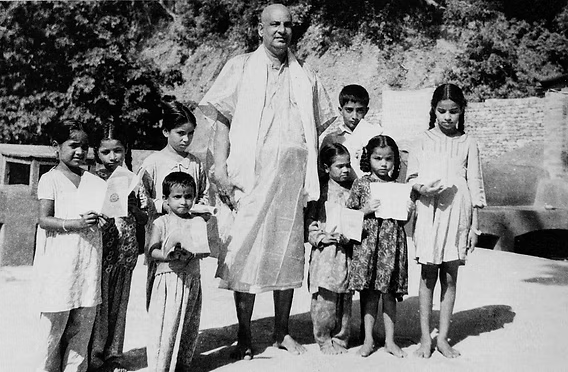
Swami Sivananda standing with children sharing blessings and spiritual guidance
Getting Started, Swami Sivananda

Light

Light by Swami Sivananda DO YOU REALLY WANT GOD? Do you really want God? Do you really thirst for His Darshan? Have you got real spiritual hunger? He who thirsts for the Darshan of God only will develop love. Unto him alone He will reveal Himself. God is a question of supply and demand. If there is sincere demand for God, the supply will come at once. Pray fervently like Prahlada. Sing like Radha. Repeat His name like Valmiki, Tukaram and Tulsidas. Do Kirtan like Gouranga. Weep in solitude like Mira over the separation from the Lord. You will have Darshan of the Lord this very second, THE LIGHT IS WITHIN YOUBe righteous always. Never deviate from the path of righteousness. Stand upright. Be bold. Be fearless. Practise Truth. Proclaim it everywhere. March forward in the spiritual path. The light is within you. Fix the mind on the Lord. Kill egoism and pride. Cultivate fellow-feeling and universal brotherhood. Love all. You will have full life. Control the senses. Pray fervently with intense faith and sincerity. Have an unshakable conviction in the existence of God and in the efficacy of spiritual practices. Be humble and simple. You will attain Immortality. LESSON OF LIFE Get up at 4 a.m. daily. Practise to sing God’s name in the early morning hours in the form of Nama Kirtan (like, Govinda Jaya Jaya, Gopala Jaya Jaya, Radha Ramana Hari Govinda Jaya Jaya). When you sing Hari’s Name, feel that the Lord Hari is seated in your heart and is hearing all your songs. Study systematically Gita, Ramayana, Bhagavatam, Vishnu Sahasranama, Lalita Sahasranama from half an hour to one hour daily. Obey your parents. Speak the truth at any cost. Speak little. Speak sweet. May the Divine Flame grow brighter in you! May you tread the path of righteousness and attain God-realisation in this very life! BE GOOD, DO GOOD Do thou always without attachment perform action which should be done; for by performing action without attachment, man reaches the Supreme.-Gita II-19. When the thought of good becomes part and parcel of man’s very being, then he will not entertain any bad motive at all. He takes immense delight in serving others, in doing good to others. There is peculiar joy and Ananda in doing selfless service. Expand. Purify your heart. Live in the true spirit of selfless service. Live every second for the ideal and goal of life. Then and then alone will you realise the true glory of selfless service. May you shine as a dynamic Yogi by the practice of selfless service! May you enjoy the true bliss of the eternal. DO AS YOU WISH TO BE DONE BY All the phenomena of nature are governed by one important law, the law of causation, the law of Karma. It is that law that keeps up the inner harmony and logical order of the universe. No phenomena can escape from the operation of this mighty law. The cause is bound in the effect and effect is in the cause. The effect is similar to the cause. This world runs on this fundamental vital law. This law is inexorable and immutable. Any action is bound to react upon you with equal force and effect. If you do some good to another man, you are really helping yourself. Because there is nothing but the Self. “Atmaivedam Sarvam” is the emphatic declaration of the Srutis or Upanishads. This virtuous action will react upon you with equal force and effect. It will bring you joy and happiness. BE UP AND DOING The power of prayer is indescribable. Its glory is ineffable. Sincere devotees only realise its usefulness and splendour. Sit not idly craving God to help thee, but be up and doing as God helps those who help themselves. Do the best you can and leave the rest to God. Serve the devotees. Remain in their company. Do Japa and Kirtan. Study Ramayana and Bhagavatam. You will soon develop devotion. The Divine Grace will descend upon you. PRACTISE AHIMSA Goal of life is God-realisation. Never forget this. Aspire ceaselessly for His Grace. Thirst for His Darshan. Have constant Satsanga. You will realise Him. Practise Ahimsa. Speak the Truth. Have faith in God. Do everything for the sake of God (Ishvararpan). Serve untiringly. Pray with complete devotion. Fight with the mind and the Indriyas. Turn them towards God. Weep for the separation from the Lord. You will have His Darshan. Feel that God works through your hands, sees through your eyes, hears through your ears. You will become a changed being. You will have a new angle of vision. You will enjoy the Supreme Bliss. BE KIND Extract the essence from all scriptures, great or small just as the bee does from flowers. Abandon all vain expectations and evil desires and take refuge in the Supreme Lord. Perceive the immanence of God in all objects. Be kind and compassionate to inferiors, friendly to your equals and respectful to your superiors. Get possession of the wealth of Vairagya. Cool your mind with the bliss of the Self. Rejoice yourself in the ambrosia of the serenity of the mind induced by the eradication of the Vasanas and the dawn of Tattva-Jnana. DEVELOP PURE LOVE Love is the immediate way to Truth or Kingdom of God or the vast domain of perennial peace and joy. It is the life-principle of creation. It was the driving force behind Mira, Tukaram and Gouranga. Therefore, develop pure, unselfish love. Pure love is a rare commodity. Cultivate it gradually. All your negative qualities like dislikes, prejudice will be eradicated. Love is a great purifier of the mind. Abandon all sorts of wrong beliefs, weaknesses, superstitions, wrong notions, and ideas of impossibilities. Live in Love. Cling fast to the faith in Divine Life. Aspire fervently and constantly to live in the Divine. You will enjoy the Supreme joy. HAVE EQUAL VISION Have equal vision for all. Give up dry idle talking. Learn to be wise. Have

Light Read Post »

Swami Sivananda surrounded by disciples image
Getting Started, Swami Sivananda

Qualifications of Aspirants

Qualifications of Aspirants by Swami Sivananda Who is a qualified person for attaining immortality? That man who has shaken off earthly impurities, who has removed worldliness and all sorts of worldly attachments is fit to tread the path of Yoga. He must have purity of nature and cleanliness of life also. A man who has removed his sins by lot of Tapascharya, who is calm (Santa) and free from attachment (Veeta Raga Purusha) and who longs for liberation from Samsara (wheel of birth and death) is only entitled to read books on Vedanta and other Atma Jnana books. Those spiritual aspirants, who have destroyed their sins by severe Tapas (austerities), who possess a tranquil mind, who are free from attachment of all sorts, who have controlled the Indriyas, who have intense faith in Guru and Srutis, and who long for liberation are fit for the attainment of Jnana (Knowledge of the Self). They are Adhikarins to approach Brahmanishtha Guru for getting instructions. Have Vairagya with the world and its objects and Prema (love) with God and spiritual Sadhana. The way of the enlightened sage is sinless. The way to liberation of freedom of perfect happiness and peace is through perfect purity of mind and heart, of every act, of character and life, through self-restraint and control of mind, and through regular meditation on the pure, self-luminous, indivisible, all-pervading Atman. Even if there is a small white patch (leucoderma) on the face of a young damsel, it certainly mars her beauty. Even so, even if there is a small defect in an aspirant, it undoubtedly spoils his character and life. An aspirant should be absolutely free from all kinds of weaknesses and faults. He should be an ideal person endowed with all virtues. Direct realisation of the Self is a means to liberation. He who is endowed with the four means of salvation will be able to realise the Self. One can acquire these four qualifications-Viveka, Vairagya, Shad-Sampat and Mumukshutva, by following strictly the duties of his own caste and order, by Tapas and selfless service, by propitiating his own Ishta Devata or tutelary deity and serving his Guru. You cannot do tailoring without scissors, needle and thread. You cannot dig the earth without a spade. Even so, you cannot attain Brahma Jnana without possessing the four means-Discrimination, dispassion, sixfold virtues and yearning for liberation. The teachings of Vedanta can enter the mind of that person who has attained purity of heart by performing selfless service or Nishkamya Karma Yoga. Even an Avatar will not help you unless you possess these qualifications of an aspirant: “santo, veeta-raga, nishpriya, sarvasanga parityaga, astika, sadachara, jitendriya, real sustained Vairagya, strong determination, patience, perseverance, obedience, humility, etc.” The preliminary qualification for a student of Vedanta is an earnest desire to search for the truth. He must always keep alive this desire for truth. It is the fundamental pre-requisite for an aspirant. If one has this qualification or merit, all merits will cling to him. All good qualities will come by themselves. Then alone he will be able to tread the path of truth easily. Manushyatva (human birth), Mumukshutva (keen yearning for liberation), Sat-sanga (company of sages), service of Guru, hearing of Srutis, reflection and constant, protracted and profound meditation are necessary for the attainment of salvation. Faith, dispassion, self-restraint, one-pointedness of mind, purity of heart, devotion, desire for liberation and meditation are the immediate factors of liberation for the aspirant. He who is endowed with these qualities attains immortality and knowledge. Absence of egoism, development of good qualities, cheerfulness, self-surrender, absence of passion and anger, keeping up a balanced mind at all times, facing honour and dishonour with same feeling, aversion to sensual objects, heat and cold are some of the signs of the person who is on the path of Realisation. These are not to be achieved in a day or two. It is the work of years of ceaseless and protracted Sadhana. In the spiritual path, there is no preference for graduates Masters of Arts or Doctors of Philosophy. University qualifications can hardly benefit a man in the rigorous path of truth. He who is endowed with dispassion, discrimination, humility, devotion and power of endurance, who has subdued his mind and senses is a qualified person for this path. You are nowhere if you argue too much. The education of the present day induces a man to enter always into unnecessary discussions and controversies. He misses the goal. He only becomes a dry, talkative Pundit. The Guru will only impart spiritual instructions to that aspirant who thirsts for liberation, who duly obeys the injunctions of the Sastras, who has subdued his passions and senses, who has a calm mind, and who possesses virtues like mercy, cosmic love, patience, humility, endurance, forbearance, etc. Uttama Adhikarins (first class aspirants) only can have Self-realisation within 3 days. Madhyama Adhikarins (middle class) should do rigorous Sadhana for a long time. An aspirant should be firm as the Meru, free as the ether, fragrant as the jasmine, broad as the sky, forbearing as the earth, forgiving as the parents, radiant as the sun, fearless as the lion, generous as Ranti Deva. Live without the feeling of “I-ness”, and attachment. Restrain the senses. Observe the rules of right conduct. Get purity of the heart. Hear the Truth. Abide in the Self. Be happy. A selfish man is unrighteous. Attachment and sense of separateness are present in him to a remarkable degree. He cannot develop those qualities which Yoga needs. A desire to become a Yogi and to learn Yoga can only arise in a man who is free from selfishness, who is righteous, and who has religious disposition. Selfishness constricts the heart and forces a man to do injury to others and to get hold of the property of others by foul means. It is selfishness that prompts a man to do sinful acts. Austerity, study of religious books and Japa of Mantra, devotion to the Lord and

Qualifications of Aspirants Read Post »

Swami Sivananda walking with group outdoors image
Getting Started, Swami Sivananda

Guru and Disciple

Guru and Disciple by Swami Sivananda One who is versed in Vedas, who has knowledge of Brahman, who has a balanced mind, who is an ocean of mercy and who is able to remove the doubts and Avarana of the aspirants is a real Guru. A true Sat Guru is absolutely free from passion, anger, selfishness, greed, hatred and egoism. He is beyond worldly temptations. He is able to remove the ignorance of people. He can clear any kind of doubt. He can give practical, easy lessons to control the mind and the senses. His instructions are very impressive. Even an arrogant proud man bends his head before him. He is able to take the students to the door of Moksha. He can remove the obstacles, pitfalls and snares on the path. He is versed in the Vedas. He is sinless. He is an ocean of mercy. He is a friend to all. There are some Sattvic souls in these days but sages who have Brahmic experience are very rare. These Sattvic souls have no direct experience and they are mistaken for liberated sages. Even Sattvic aspirants who are treading the path of Truth, who possess virtuous qualities must be adored. Such aspirants also are very rare. Some Sattvic souls pose for Jivanmuktas. This is deplorable. Their disciples begin to worship them, gradually they get a downfall by becoming a slave to respect, honour and worship. Maya havocs in a variety of ways. It is very difficult to understand her ways and operations. Doubtless there is dearth of genuine Gurus. But there is still more dearth of genuine disciples also. Aspirants complain: “We cannot get good Gurus in these days.” Gurus also complain: “We do not get good disciples these days.” Who is right? Who is wrong? The lower court cannot decide this point. The matter will have to be assuredly placed before the Privy Council of Jnanins. Can a patient gauge the merits of a doctor as soon as he enters the consultation room? Ignorant disciples who have not even an iota of experience in the spiritual path at once begin to test and examine the Gurus. They make serious remarks, some hasty, wrong conclusions and inferences from external appearances and ways of living. Paramahamsas have different mysterious ways of living. Even though you live with them shoulder to shoulder for twelve years, you can hardly understand their hearts and depth of knowledge. Jnana and spiritual experiences are quite internal states. Foolish Chelas run from one Guru to another Guru. Pitiable is their lot! Do not dig here and there shallow pits for getting water. The pits will dry soon. Make a very deep pit in one place. Centralise all your efforts here. You will get good water throughout the year. Even so, try to imbibe thoroughly the spiritual teachings from one preceptor alone. Drink deep from one man. Sit at his feet for some years. There is no use of wandering from one man to another man out of curiosity, losing faith in a short time. Do not have the ever-changing mind of a prostitute. With the help of one light you can light up several other lights. Even so, a realised soul can make several others to realise God, provided they are in a fit condition to receive the light imparted by him. Therefore serve your preceptor with great devotion. Out of compassion on you one day or other he will enlighten you. He will lift you up. Wait patiently. Surrender yourself unto him completely. He alone who sits at the lotus feet of a preceptor, who has knowledge of the Self and who is also well-versed in scriptural knowledge is able to grasp the Truth. In the Gita also, Chap. IV-34, Lord Krishna says: “Know it by means of prostration to the Guru, interrogation and service. The wise who have cognised the Truth will instruct thee in that knowledge of the Self.” Initiation into the mysteries of Brahman will fructify only in that disciple’s mind who is desireless and will produce Jnana in him. It takes a long time for the charcoal to catch fire but gun powder can be ignited within the twinkling of an eye. Even so, it takes a long time for igniting the fire of knowledge for a man whose heart is impure. But an aspirant with great purity of heart gets knowledge of the Self within the twinkling of an eye, within the time taken to squeeze a flower by the fingers. Unless you are pure, you will not be able to realise the true greatness of a liberated sage. When he appears before you, you will take him for an ordinary man only, and you will not be benefited. You will try to find out defects in him on account of your fault-finding nature (Dosha Drishti). Even if Lord Krishna or Sri Sankara remains with you, He will not do anything for you, unless you are fit to receive Him, unless you are ready to receive the spiritual instructions. It is quite true that mere Grace of a Guru, his touch, sight or Sankalpa can work wonders, but that does not mean that the disciple should sit idle. Guru will show the path and remove obstacles, snares and pitfalls. The student will have to place his feet on the rungs of the ladder of Yoga. The Gita says: “uddharet atmana atmanam na atmanam avasadayet-Let him raise the Self by the Self, let him not lower himself.” Chap. VI. 5. Guru’s Grace is needed by the disciple. This does not mean that the disciple should sit idle and expect a miracle from the Guru to push him directly into Samadhi. The Guru cannot do Sadhana for the student. He can guide the student, clear his doubts, pave the way, remove snares, pitfalls and obstacles and throw light on the path. The disciple himself will have to place each foot step in the spiritual path. He himself will have to place

Guru and Disciple Read Post »

Swami Sivananda Group of monks standing by riverside image
Getting Started, Swami Sivananda

Necessity for A Guru

Necessity for A Guru by Swami Sivananda Knowledge of the Self can be attained only by the Grace of the Guru or the spiritual preceptor. The knowledge is transmitted from the preceptor to disciple. You can know the unknowable (Brahman) by purifying your mind, by serving a Guru who is a Brahmanishtha (established in truth), by getting lessons from him and by meditation. A medical student is in urgent need of a Professor of medicine. A Junior Vakil needs the help of a senior advocate for his guidance. A junior cook needs the help of a senior cook. When such is the case with worldly matters, what to speak of Adhyatmic spiritual subjects which deal with hidden, subtle Atman! The help of a Guru who has realised the Self is imperatively necessary for the aspirant for his guidance. Otherwise he will be groping in the thick forest of darkness, of ignorance. The aspirant gets obstacles or impediments, dangers, snares, pitfalls on the spiritual path. He will have to be very careful in Sadhana also. A Guru who has already trodden the path and reached the goal is very necessary to guide him. Young aspirants should always live under the guidance of a perfect Guru for some years. They should be under subjection. They should learn perfect obedience and humility. If they have their own ways, they become arrogant and conceited. They do not make even an iota of progress in spirituality. In nature no two trees are alike; no two leaves are alike; no two persons are alike; no two vibrations are alike; no two temperaments are alike; no two minds are alike. Therefore there are various ways for controlling the mind to suit people of different temperaments. Each can have his own way of Sadhana. For yourself if you are not able to chalk out the path, get it from a Guru or preceptor. Learn Yoga under a Guru. Then only you will be able to understand the subtle points of Yoga. He will inspire you when you are depressed, will remove your doubts when you come across stumbling blocks on the path, and show you the right path because he has already trodden the path himself. If you are sincere and earnest, the Guru’s grace will flow to you like Tailadhara a continuous flow of oil. He will infuse energy, love, wisdom and spiritual current if you have true receptive attitude, sincere faith and devotion to him. Now stick to one path and one Guru. Do not waver. Be patient. Be sincere. Aspirants do not possess unshakable faith in the Guru or Srutis. They have half or wavering faith. That is the reason why they fail in attaining success in Yoga or Jnana. The Lord and the Guru are both one. Try to see the Lord in your Guru. Then only you will have progress in the spiritual path. Then only you will attain Self-realisation. If you try to see defects in your Guru, you will not be benefited in the least. Guru is your father. Guru is your mother. Guru is your saviour. Guru is your sole refuge and support. Therefore revere your Guru as the Lord Himself. The real aspirant should drink the Charanamrita of his Guru, should take the Guru’s Ucchishta, should meditate on the form of his Guru as Brahman Himself and should do Japa of his Guru Mantra constantly. Then he will have Self-realisation easily. The duty of a soldier is to obey implicitly the commands of the commander. He must not question anything. Even so, the duty of an aspirant is to obey implicitly the orders of his Guru. Then only he can grow quickly in the spiritual path. He who is devoted to his Guru and has done Upasana can only comprehend the depths of the teachings of the Vedanta. You will find also in Svetasvatara Upanishad: “Whoso hath highest love for God and for the Guru as for God, to that Mahatman, the truths here taught shine in full.” Section VI-23. The teachers in this world is said to be of three kinds, viz., the one who commands, the one who imparts knowledge, and the supreme one who gives release. The one who commands shows the way; the one who imparts knowledge teaches the supreme place; and the one who gives release reveals the supreme truth, knowing which you will attain immortality. The people after crossing a river, wanted to see whether all the passengers were alive. But each of them counted all the nine others except himself, and found that one was missing and all began to weep bitterly for the loss of one of them. At last they were disillusioned by some one telling each of them that the reckoner himself was the tenth. Just as the iron filings are magnetised in the presence of a magnet, so also aspirants are magnetised when they are in close contact with their masters or Gurus. Just as iron is transmuted into gold by the touch of philosopher’s stone, so also persons with evil tendencies are transmuted into veritable saints when they come in close contact with sages and Yogins. When a Guru is in the physical body, he can help the aspirants and disciples more. If the disciple has faith in his Guru, he will help him even after he has abandoned his physical body. Sri Sankara, the propounder of the Advaita philosophy, Sri Dattatreya, Sri Jnana Dev of Alandi even now bless the aspirants who have devotion unto them. They have no body on earth but yours, no hands and feet but yours. Yours are the eyes through which they behold this universe. They move about through your feet and do good to the world.

Necessity for A Guru Read Post »

swami sivananda Portrait of Swami Sivananda seated with floral background image
Getting Started, Swami Sivananda

Purity and Contentment

Purity and Contentment by Swami Sivananda Sauca is internal and external purity. External purity generates pure thoughts. Practice of sauca brings disgust for one’s own body and the body of others also. You will soon give up mamata (mineness of body). Take a bath in the early morning and wear simple, clean cloth. You will get the meditative mood quickly. Sauca helps to maintain brahmacarya. The practice of celibacy, kindness, love, mercy, patience, japa (repetition of God’s name) and meditation will purify the heart and eradicate jealousy, cruelty, hatred, anger and lust. This is internal sauca. This is the first anga or limb of niyama (discipline). Niyama and yama (self-restraint) are interdependent. Niyama strengthens and safeguards yama. Removal of lust, anger, hatred, jealousy etc., constitutes internal purity. Internal purity is more important than external purity. Internal purity makes the mind one-pointed; it bestows serenity, cheerfulness, joy, strength, harmony, poise and happiness; it instils love, patience and magnanimity. Therefore develop internal purity through diligent and vigilant effort. Contentment (santosa) cuts at the root of all desires. It gives success in the practice of yama. It gives peace, one-pointedness of mind, serenity and eternal satisfaction. Divine light will descend in a contented mind alone. A contented man is satisfied with his lot, he is happy in whatever condition he is placed, he does not crave for things he has not got. Contentment is a mystic stream of joy that cools the three fires of samsara and joins the ocean of immortal bliss. Contentment – this is a most vital subject. You all know the maxim: “A contented mind is a continual feast”. The mind is always restless on account of greed. Greed is a kind of internal fire that consumes a man slowly. Contentment is a powerful antidote for the poison of greed. There are four sentinels who guard the domain of moksa (liberation). They are: santi, santosa, satsanga and vicara (peace, contentment, company of the holy and enquiry). If you can approach any of these sentinels, you can get hold of the other three. If you get hold of santosa (contentment) you can easily see the other three following you.

Purity and Contentment Read Post »

swami sivananda Monk seated in front of snowy mountains wearing shawl and beads image
Getting Started, Swami Sivananda

Purity

Purity by Swami Sivananda A Bania once approached a Sadhu for initiation. The Sadhu said, “Wait, I will initiate you after some time”. The Bania pressed the Sadhu again and again on several occasions for quick initiation. The Sadhu totally declined and went away. He, however, visited the Bania after a couple of years with his Bhiksha-bowl containing some mud, hair, urine and excreta, and asked the Bania for alms. The Bania brought out nice sweetmeats, Kheer, Halva, etc. He had prepared these nice dishes, as he thought that he would be initiated this time by the Sadhu. The Sadhu said to the Bania, “Put everything into the bowl”. The Bania said, “How can I place them, Swamiji, in this dirty bowl! Kindly clean the bowl and bring it to me. I will then place in it all the nice preparations”. The Sadhu replied: “When such is the case with this bowl, how can I place the pure Lord in your heart which is filled with various impurities, viz., lust, anger, pride, greed, etc? How can I initiate you now, when your mind is very dirty like this bowl?”. The Bania got depressed and went away in shame. He then purified himself through charity, selfless service, etc., and got initiated by the Sadhu later. Just as the coloured water penetrates freely and nicely into a piece of cloth when it is pure white, so also, the instructions of a sage can penetrate and settle down in the hearts of aspirants only when their minds are calm, when there are no desires for enjoyments, and when the impurities of their minds are destroyed. Discipline and purification of the mind and the Indriyas are the prerequisites for an aspirant in the path of Truth and Self-realisation. The ground must be well-prepared first. Then initiation will come by itself. Internal Purity and External Purity Purity is of two kinds, internal purity and external purity. Freedom from Raga-dvesha, purity intentions, purity of motives, and purity of Bhava constitute internal purity. Purity of body through bath, etc., purity of clothes, purity of surroundings like the house and its neighbourhood, constitute external purity. External purity generates pure thoughts. Practice of external purity brings disgust for one’s own body and the body of others also. You will soon give up Mamata, mineness of body. Internal purity is more important than external purity. Internal purity makes the mind one-pointed, bestows serenity, cheerfulness, joy, strength, harmony, poise and happiness, instils love, patience and magnanimity. If you take pure food, you will have a pure mind. If you have purity of mind, you will remember God. If you always remember God, the knots of the heart, viz., ignorance, desire and action, will be rent asunder. You will attain Moksha. Sadhana without Purity is a Fruitless Waste Mental purity through ethical training is, therefore, of paramount importance, if you wish to achieve success in meditation and Samadhi. To practise meditation or contemplation in a mind perturbed by non-adherence to the moral precepts, is like building a house on a rotten foundation. You may build up the house, but it will surely fall. You may practise meditation for many years, but you will not realise any tangible result or fruit, if you have no ethical training as foundation. If you want to enthrone God in your heart, you must eradicate all evil modifications in the mind. What do you do when you expect to receive a very high personage in your bungalow? You keep the compound quite clean and remove all the weeds and rubbish. You clean all the rooms and spread nice carpets. Similarly, you will have to remove all the dross of impurities from the mind if you want to have communion with the Lord, if you desire to call upon God earnestly to take His seat in your heart. It takes a long time to purify the heart. Just as various kinds of dirt and dust are hidden underneath the carpet, so also, various kinds of impurities are hidden in the different corners of the mind. Mind is such a mischievous imp. It is the Mara that tempted Buddha. It is the Satan that allured Jesus. It is the Kama who disturbed Siva when He was in deep meditation. It is the ghost of lust that spoiled the Tapas of Visvamitra. You cannot wash the mind with soap and water to get rid of its impurities; but if you eradicate desire and attachment, the mind will be purified itself. Desires move the senses. Desires can be controlled only if the senses are curbed. Tapas curbs the senses and annihilates desires. Purity is the passport to the land of bliss Tapascharya is essential. Tapasya is useful. Tapasya is a great help. Understand it truly. Practise it wisely. Intensify it gradually. Exercise it vigilantly. Give up foolishness. Be discriminate. Give no leniency. Adhere your vows. Be firm and resolute. Aspire fierily. Assert and manifest your mastery over the mind and senses as a true Tapasvin. Shine with spiritual radiance. You will achieve the glorious goal of spiritual life. You will attain immortality and supreme Kaivalya-moksha. Purity is the path way to the kingdom of God. Without purity, no spiritual progress is possible. Brahman is purity. You will have to attain Brahman, or know Him and become one with Him, only through purity. There is no other way. Your soul is Nitya Suddha, eternally pure. Through your contact with the mind and senses, you have become impure. Regain your original purity through Japa, Kirtan, prayer, meditation, enquiry of “Who am I?”, the practice of Pranayama, study, Satsanga and Sattvic food. Purify the intellect. Purify your heart. Purify your speech. Purify your body. Purify your senses. Purify your Prana. Purify, purify, purify. Purity of heart is the gateway to God. It is antechamber to the presence of the Lord. It is the key by which the doors of intuition that lead to the abode of supreme peace are opened. Therefore, attain purity

Purity Read Post »

Swami Sivananda with Western devotee indoors image
Getting Started, Swami Sivananda

What you need

What you need by Swami Sivananda FAITH, THE GREATEST THING Faith is sraddha. Faith is the greatest thing in the world. Even the greatest philosopher has faith as his stronghold. No intellectualism can prove good if it is unsupported by faith. The whole world stands on faith, is guided by faith. Religion has faith as its root. One cannot prove God if he has no faith in God. And this faith is the outcome of samskaras (past mental impressions). Faith is guided by impressions of actions done in previous births. Blind faith should be turned into rational faith through understanding. Bhakti (devotion) is the development of faith. Jnana (self-knowledge) is the development of bhakti. Faith leads to the final experience. Whatever a person strongly believes in, that he experiences and that he becomes. This whole world is a product of faithful imagination. If you have no faith in the world, the world does not exist. If you have no faith in sensual pleasure, you will not get pleasure from sensual objects. If you have no faith in God, you will never reach perfection. Wrong faith can even turn existence into non-existence. Faith is the fundamental necessity for spiritual sadhana (practice). Aspiration is a development of faith. The flame of faith burns as the conflagration of spiritual aspiration for moksa (liberation). The devotee longs to have union with the beloved – he has no sleep, no rest. He always contemplates how to attain the object of his love. He prays, he sings, he gets mad with his Lord. Divine madness overtakes the devotee and he completely loses his personality in the aspiration for attaining God. This is called self-surrender. You must have an ideal to live for – otherwise you will be heedless, depressed and negative. Understand well before you take a step. Have a clear cut ideal and then have right attempt. Faith in God, faith in oneself, faith in the guru (preceptor), faith in the wise teachings, faith in all that is good and noble – this is the sap of life. FAITH VERSUS REASON Faith is first and reason is second. Faith is life and doubt is death. Reason is powerless to know God. Faith alone takes one to God. He who has faith has everything. He who has no faith has nothing. Have intense, unswerving faith – in the measure in which you have faith, you will achieve. Faith brings God closer and reason puts Him far away. Faith is not blind belief – it grows out of the wisdom of the heart. Do total surrender to the Lord – keep nothing back, not even a little pride. Surrender yourself and your all to the Lord. Say to the Lord: “O Lord! Give me only that which is best for me, because only you know what that is.” A life of faith and devotion and of absolute faith in the name of the Lord will always be successful in the long run. Through love, faith and devotion alone is God-realisation possible. Prayer releases God’s power. It should consist of confession, praise and petition. Prayer is a spiritual tonic – it purges the mind of all its impurities – such as desire, attachment, anger, lust, etc. It also strengthens a man’s aspiration and brings him closer to God. It brings him into the presence of God. Pray to the Lord for strength and help as soon as you get out of bed in the morning. Satsanga (the company of holy men), faith, single-minded devotion to one’s ideal, intense love for God, bhava (feeling), and prema (divine love) bring the devotee face to face with God. Trust in the Lord with all thy heart. Acknowledge him in all thy ways. He will direct thy spiritual path. God helps the sincere aspirant at every step. God will help you too. He will bless you, inspire you and throw light upon the path. Never mind about the external environments. Create your own internal environments, wherever you are. BALANCE OF MIND Samadhana is mental balance. There is perfect concentration now. This is the fruit of the practices of sama (control of mind), dama (control of the senses), uparati (turning away), titiksa (endurance) and sraddha (faith). It is fixing the mind on atman (self) without allowing it to run towards objects and have its own way. It is self-settledness. Sri Sankaracharya defines in “Atma-Anatma Viveka”: “Whenever a mind engaged in sravana (hearing) and the rest wanders to any worldly object or desire, and finding it worthless, returns to the performance of the three exercise such returning is called samadhana.” The mind is free from anxiety amid pains. There is indifference amid pleasures. There is stability of mind or mental poise. The aspirant or practitioner lives without attachment. He neither likes nor dislikes. He has a great deal of strength of mind and internal peace. He has unruffled supreme peace of mind. Some aspirants have peace of mind when they live in seclusion, when there are no distracting elements or factors. They complain of great tossing of mind (viksepa) when they come to a city, when they mix with people. They are completely upset. They cannot do any meditation in a crowded place, This is a weakness. This is not achievement in samadhana. There is no balance of mind or equanimity in these persons. Only when a student can keep his balance of mind even in a battlefield when there is a shower of bullets all round, as he does in a solitary cave in the Himalayas, can he be really said to be fully established in samadhana.Lord Krishna says in the Gita: “Perform all actions, O Dhananjaya, dwelling in union with the divine, renouncing attachments, and balanced evenly in success and failure.” This is samadhana. Again you will find in the Gita: “The disciplined self, moving among the sense objects with senses freed from attraction and repulsion, mastered by the self, goeth to peace.” This is also samadhana.

What you need Read Post »