Hari Om

Menu

Annapurna

annapurna6
Annapurna

Brahmarpanam Brahma Havih

Brahmarpanam Brahma Havih ब्रह्मार्पणं ब्रह्म हविः ब्रह्माग्नौ ब्रह्मणा हुतम् ।ब्रह्मैव तेन गंतव्यं ब्रह्मकर्म समाधिना ।। brahmārpaṇaṃ brahma haviḥ brahmāgnau brahmaṇā hutam .brahmaiva tena gaṃtavyaṃ brahmakarma samādhinā .. Any means of offering is Brahman, the oblation is Brahman, the fire in which the offering is made is Brahman, and the one who offers is Brahman. Such a person who abides in Brahman indeed gains Brahman. ब्रह्मार्पणम् (brahmārpaṇaṃ) – the offering is Brahman; ब्रह्म हविः (brahma haviḥ) – the oblation is Brahman; ब्रह्माग्नौ (brahmāgnau) – into the fire of Brahman; ब्रह्मण (brahmaṇa) – by Brahman; हुतम् (hutam) – it is offered; ब्रह्मैव (brahmaiva) – Brahman alone; तेन (tena) – by that; गन्तव्यं (gaṃtavyaṃ) – is to be attained; ब्रह्मकर्म (brahmakarma) – action pertaining to Brahman; समाधिना (samādhinā) – by the one who is absorbed. Description Invocation before food. We should partake food with a sathvic (pure, serene) mind. Our ancestors recommended the offering of food to God before partaking. Food so partaken becomes prasad (consecrated offering). Prayer cleanses the food of the three impurities caused by the absence of cleanliness of the vessel, cleanliness of the food stuff, and cleanliness in the process of cooking. It is necessary to get rid of these three impurities to purify the food, for pure food goes into the making of a pure mind. It is not possible to ensure the purity of the cooking process because we do not know what thoughts rage in the mind of the man who prepares the food. Similarly, we cannot ensure the cleanliness of the food ingredients because we do not know whether it was acquired in a righteous way by the person who sold it to us. Hence, it is essential on our part to offer food to God in the form of prayer so that these three impurities do not afflict our mind.This verse from the Bhagavad Gita (Chapter 4, verse 24) and is traditionally chanted before meals. Brahman is the name of the Lord, the cause of the whole creation. Looking at the whole creation as an effect, Brahman is seen as the cause of everything. The effect does not exist separate from its cause. This verse likens food that is eaten to an oblation poured into the fire during ritual. By chanting this prayer before meals, the food that is eaten is offered to Brahman, the Lord.

Brahmarpanam Brahma Havih Read Post »

amnapurna5
Annapurna

Annapurne Sadapurne

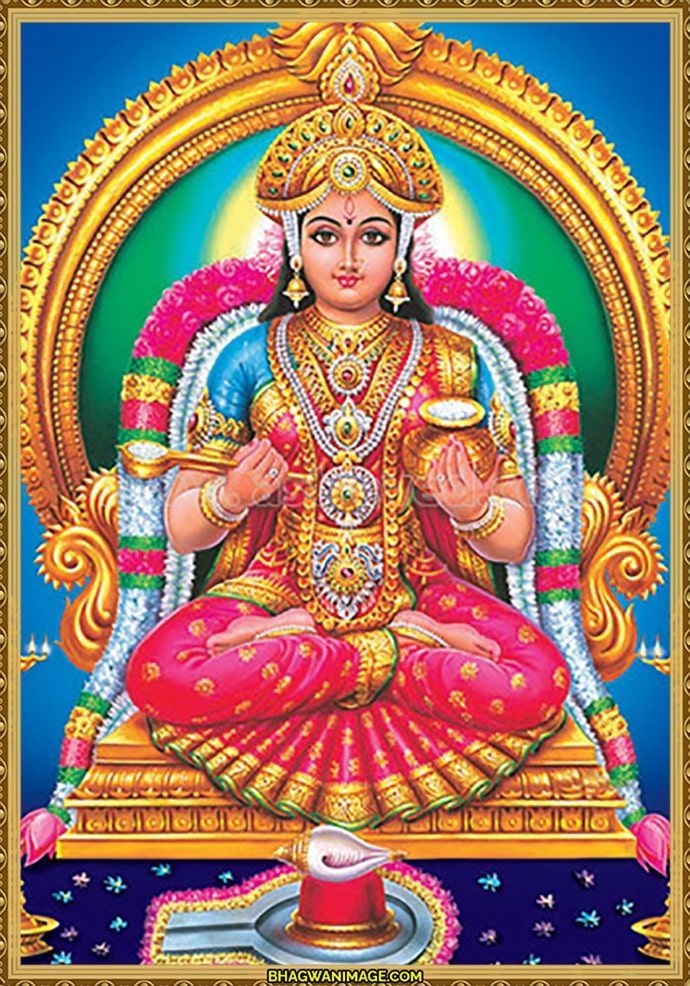
Annapurne Sadapurne अन्नपूर्णे सदापूर्णेशंकर प्राणवल्लभे ।ज्ञान वैराग्य सिध्यर्थंभिक्षां देहिच पार्वति ॥ माता च पार्वती देवीपिता देवो महेश्वरः ।बान्धवाः शिवभक्ताश्चस्वदेशो भुवनत्रयम् ॥ annapūrṇe sadāpūrṇeśaṃkara prāṇavallabhejñāna vairāgya sidhyarthaṃbhikṣāṃ dehica pārvati mātā ca pārvatī devīpitā devo maheśvaraḥbāndhavāḥ śivabhaktāścasvadeśo bhuvanatrayam Salutations to Mother Annapoorna: O Mother Annapoorna, You who are always full (with the gift of Food and Blessings), You who are the beloved of Shankara (Shiva),O Mother Parvati, Please grant me the alms of your Grace, to awaken within me Spiritual Knowledge (Jnana) and detachment, freedom from all worldly desires (Vairagya). Salutations to Mother Annapoorna, my Mother Devi Parvati, and my Father, Deva Maheswara (Shiva). My friends are the devotees of Lord Shiva, and my residence is all the Three Worlds (whose Lord is none other than Shiva-Parvati). अन्नपूर्णे (annapūrṇe) – O Annapūrṇa, the goddess of nourishment and food, representing the divine provider of sustenance. सदापूर्णे (sadāpūrṇe) – Ever full, symbolizing Annapūrṇa’s limitless capacity to provide and nourish all beings without end. शंकर (śaṃkara) – Refers to Lord Shankara (Shiva), the consort of Goddess Annapūrṇa, representing auspiciousness and protection. प्राणवल्लभे (prāṇavallabhe) – Beloved of Śaṃkara, signifying the deep and eternal love between Shiva and Parvati, where Annapūrṇa is adored as Shiva’s beloved. ज्ञान (jñāna) – Knowledge, referring to spiritual knowledge and wisdom, the highest form of understanding. वैराग्य (vairāgya) – Detachment, or renunciation of worldly attachments, an essential quality for spiritual progress. सिद्ध्यर्थम् (sidhyarthaṃ) – For the accomplishment of, indicating the purpose of the prayer, which is the fulfillment of spiritual goals. भिक्षां (bhikṣāṃ) – Alms, symbolizing the humble request for spiritual sustenance and divine grace. देहि (dehi) – Give, a plea for receiving the blessings and alms. पार्वति (pārvati) – O Pārvatī, invoking Goddess Parvati, the mother goddess, as Annapūrṇa who grants food and spiritual nourishment. माता (mātā) – Mother. The verse starts by acknowledging Pārvatī, the divine mother, symbolizing nurturing love and protection. च (ca) – And. This connects Pārvatī as the mother, and Shiva as the father. पार्वती देवी (pārvatī devī) – Goddess Pārvatī. Refers to Goddess Pārvatī, the consort of Shiva, embodying compassion, strength, and maternal care. पिता (pitā) – Father. Here, Lord Shiva is recognized as the father, representing the supreme protector and transformer of the universe. देवो महेश्वरः (devo maheśvaraḥ) – Lord Maheshvara (Shiva). Shiva, the god of destruction and regeneration, is portrayed as the fatherly figure, offering guidance and divine authority. बान्धवाः (bāndhavāḥ) – Relatives. This word refers to one’s kin, but here it expands to include spiritual family, those connected by devotion to Shiva. शिवभक्ताः च (śivabhaktāḥ ca) – And the devotees of Shiva. The devotee acknowledges that their true family consists of those who worship Shiva, placing spiritual connections above worldly relations. स्वदेशः (svadeśaḥ) – My homeland. The word means “homeland,” but in this context, it refers to a spiritual home. भुवनत्रयम् (bhuvanatrayam) – The three worlds. Refers to the three realms—heaven, earth, and the underworld—suggesting that the entire cosmos is the devotee’s homeland, beyond physical boundaries. Description Food is considered sacred in Hinduism, and prayers are offered before consuming it. Hence this prayer is chanted before we consume food. It is important to note that even here, food is considered only a means towards the ultimate goal of human birth, which is Moksha, Jnana or Liberation attained through Vairagya, detachment. The person who identifies the importance of Annam (food) within the five layers of the body helps carry life in the worldly process and subsequently seeks to identify Brahman, the ultimate Reality, God or Self. This Shloka is part of the Sri Annapurna Stotram composed by Sri Adi Sankaracharya. Annapurna (Annapoorna, Annapurneshwari or Annada ) is the goddess of food and nourishment. She is a form of Parvati, the inseparable shakti of Lord Shiva. Anna is translated as “food” and “grains” and Purna means “full” or “complete”. Annapoorna literally means filled with food. Annapurna devi holds in one hand a jeweled bowl full of grains and in the other a golden ladle, symbolizing the abundant nourishment she gives to all. She is the Mother Goddess, the sustainer of all life. Annapurna is an aspect of Devi Adishakti and is known as the Hindu Goddess of food and nourishment. Worship and offering of food are highly praised in Hinduism, and therefore, the Goddess Annapurna is regarded as a popular deity. A few temples exist that are dedicated to her, the most prominent being the Annapurna Devi Mandir in Varanasi. LegendOne day, Lord Shiva and his consort Parvati got into an argument about the material world. Shiva said that everything materialistic was just an illusion, including the food that the humans ate. This infuriated Parvati, who governs materialistic aspects. To show Shiva and the world her importance, she disappeared, saying that she wanted to see how the world would survive without her. With Parvati’s disappearance, the world was deprived of food, and there occurred a famine. Shiva’s followers begged him for food; even the Gods were forced to beg for food, but could not find any food. Finally, Shiva and his followers came to know that there was only one kitchen on earth, in the city of Varanasi (Kashi), where food was still available. Shiva went to Kashi to beg for food. To his surprise, the kitchen was owned by his wife Parvati, but in the form of Annapurna. She wore celestial purple and brown garments, which were lightly adorned with ornaments. She was seated on a throne, serving and distributed food to the starving gods and hungry inhabitants of the earth. Annapurna offered her food as alms to Shiva and made him realize that as Brahman, Shiva might have outgrown hunger; but his followers had not. There is also another legend from the southern Indian states that the Shiva was cured of a curse of bharamahatidosha (for removing one head of Lord Bhrama’s five heads) after getting food from the hands of Devis (Saraswathi, Lakshmi, Parvathi). The skull of Bhrama deva stuck to the hands of lord Shiva, hence the name Kapalieshwara. It fell from his hands after he was offered food from Annapurani Devis hand. Hence all tri-devi goddesses are called Annapurani devis.

Annapurne Sadapurne Read Post »

annapuena4
Annapurna, Stotra

Annapurna Stotram

Annapurna Stotram नित्यानन्दकरी वराभयकरी सौन्दर्यरत्नाकरीनिर्धूताखिलघोरपावनकरी प्रत्यक्षमाहेश्वरी ।प्रालेयाचलवंशपावनकरी काशीपुराधीश्वरीभिक्षां देहि कृपावलम्बनकरी माताऽन्नपूर्णेश्वरी ॥ १॥ nityānandakarī varābhayakarī saundaryaratnākarīnirdhūtākhilaghorapāvanakarī pratyakṣamāheśvarī .prāleyācalavaṃśapāvanakarī kāśīpurādhīśvarībhikṣāṃ dehi kṛpāvalambanakarī mātā’nnapūrṇeśvarī .. 1.. Oh! Mother Annapurna! renderer of the support of compassion, the bestower of eternal happiness, the donor of gifts and protection, the ocean of beauty, the destroyer of all sins and purifier, the great goddess, the purifier of the family of Himavan, and the great deity of Kasi, (thou) grant us alms. नानारत्नविचित्रभूषणकरी हेमाम्बराडम्बरीमुक्ताहारविलम्बमान विलसत् वक्षोजकुम्भान्तरी ।काश्मीरागरुवासिता रुचिकरी काशीपुराधीश्वरीभिक्षां देहि कृपावलम्बनकरी माताऽन्नपूर्णेश्वरी ॥ २॥ nānāratnavicitrabhūṣaṇakarī hemāmbarāḍambarīmuktāhāravilambamāna vilasat vakṣojakumbhāntarī .kāśmīrāgaruvāsitā rucikarī kāśīpurādhīśvarībhikṣāṃ dehi kṛpāvalambanakarī mātā’nnapūrṇeśvarī .. 2.. Oh! Mother Annapurna! renderer of the support of compassion, one who is adorned with ornaments made up of different kinds of gems, wearer of golden-laced dress, the space, in between whose breasts shines with the pendant garland of pearls, the beautiful – bodied, rendered and the presiding deity of Kasi, (thou) grant us alms. योगानन्दकरी रिपुक्षयकरी धर्मार्थनिष्ठाकरीचन्द्रार्कानलभासमानलहरी त्रैलोक्यरक्षाकरी ।सर्वैश्वर्यसमस्तवाञ्छितकरी काशीपुराधीश्वरीभिक्षां देहि कृपावलम्बनकरी माताऽन्नपूर्णेश्वरी ॥ ३॥ yogānandakarī ripukṣayakarī dharmārthaniṣṭhākarīcandrārkānalabhāsamānalaharī trailokyarakṣākarī .sarvaiśvaryasamastavāñchitakarī kāśīpurādhīśvarībhikṣāṃ dehi kṛpāvalambanakarī mātā’nnapūrṇeśvarī .. 3.. Oh! Mother Annapurna! the renderer of the support of compassion, the giver of happiness obtainable through yoga, the destroyer of the enemies, the cause of (men) getting deep-rooted in righteousness, the possessor of the waves of splendour of the three worlds, the donors of all riches, the bestower of the fruits of penance, and the presiding deity of Kasi, (thou) grant us alms. कैलासाचलकन्दरालयकरी गौरी उमा शङ्करीकौमारी निगमार्थगोचरकरी ओङ्कारबीजाक्षरी ।मोक्षद्वारकपाटपाटनकरी काशीपुराधीश्वरीभिक्षां देहि कृपावलम्बनकरी माताऽन्नपूर्णेश्वरी ॥ ४॥ kailāsācalakandarālayakarī gaurī umā śaṅkarīkaumārī nigamārthagocarakarī oṅkārabījākṣarī .mokṣadvārakapāṭapāṭanakarī kāśīpurādhīśvarībhikṣāṃ dehi kṛpāvalambanakarī mātā’nnapūrṇeśvarī .. 4.. Oh! Mother Annapurna! the renderer of the support of compassion, the resident of the caves of the Kailasa mountains, golden-complexioned, Oh! Uma! the consort of Sankara, endowed always with maidenhood, the cause of our comprehension of the purport of the Vedas, whose basic syllable is the syllable `Om’, the opener of the doors of emancipation and the presiding deity of Kasi, (thou) grant us alms. दृश्यादृश्य विभूतिवाहनकरी ब्रह्माण्डभाण्डोदरीलीलानाटकसूत्रभेदनकरी विज्ञानदीपाङ्कुरी ।श्रीविश्वेशमनः प्रसादनकरी काशीपुराधीश्वरीभिक्षां देहि कृपावलम्बनकरी माताऽन्नपूर्णेश्वरी ॥ ५॥ dṛśyādṛśya vibhūtivāhanakarī brahmāṇḍabhāṇḍodarīlīlānāṭakasūtrabhedanakarī vijñānadīpāṅkurī .śrīviśveśamanaḥ prasādanakarī kāśīpurādhīśvarībhikṣāṃ dehi kṛpāvalambanakarī mātā’nnapūrṇeśvarī .. 5.. Oh! Mother Annapurna! the renderer of the support of compassion, the conveyor of the visible and invisible prosperity, the container of the primordial egg, the directress of the sportive drama (of the world), the flame of the lamp of true knowledge, the source of the mental happiness of Sri Visvanatha, and the presiding deity of Kasi, (thou) grant us alms. उर्वी सर्वजनेश्वरी भगवती माताऽन्नपूर्णेश्वरीवेणीनीलसमानकुन्तलधरी नित्यान्नदानेश्वरी ।सर्वानन्दकरी सदाशुभकरी काशीपुराधीश्वरीभिक्षां देहि कृपावलम्बनकरी माताऽन्नपूर्णेश्वरी ॥ ६॥ urvī sarvajaneśvarī bhagavatī mātā’nnapūrṇeśvarīveṇīnīlasamānakuntaladharī nityānnadāneśvarī .sarvānandakarī sadāśubhakarī kāśīpurādhīśvarībhikṣāṃ dehi kṛpāvalambanakarī mātā’nnapūrṇeśvarī .. 6.. Oh! Mother Annapurna! the renderer of the support of compassion, the form of the earth, the governess of all men, the cause of victory, the mother, the ocean of compassion, the possessor of beautiful and dark braid of hari resembling the flower of the indigo plant, the giver of food daily, the direct bestower of emancipation and eternal welfare, and the presiding deity of Kasi, (thou) grant us alms. आदिक्षान्तसमस्तवर्णनकरी शम्भोस्त्रिभावाकरीकाश्मीरा त्रिजलेश्वरी त्रिलहरी नित्याङ्कुरा शर्वरी ।कामाकाङ्क्षकरी जनोदयकरी काशीपुराधीश्वरीभिक्षां देहि कृपावलम्बनकरी माताऽन्नपूर्णेश्वरी ॥ ७॥ ādikṣāntasamastavarṇanakarī śambhostribhāvākarīkāśmīrā trijaleśvarī trilaharī nityāṅkurā śarvarī .kāmākāṅkṣakarī janodayakarī kāśīpurādhīśvarībhikṣāṃ dehi kṛpāvalambanakarī mātā’nnapūrṇeśvarī .. 7.. Oh! Mother Annapurna! the renderer of the support of compassion, the maker of the letters ‘a’ (‚) to ‘ksha’ (®¸), he cause of the three acts of Sambhu, namely, the creation, protection and destruction, the wearer of saffron, the consort of the destroyer of the three cities, the consort of the three-eyed lord, the governess of universe, the form of the goddess of night, the opener of the gates of heavens, and the presiding deity of Kasi, (thou) grant us alms. देवी सर्वविचित्ररत्नरचिता दाक्षायणी सुन्दरीवामे स्वादुपयोधरा प्रियकरी सौभाग्य माहेश्वरी ।भक्ताभीष्टकरी सदाशुभकरी काशीपुराधीश्वरीभिक्षां देहि कृपावलम्बनकरी माताऽन्नपूर्णेश्वरी ॥ ८॥ devī sarvavicitraratnaracitā dākṣāyaṇī sundarīvāme svādupayodharā priyakarī saubhāgya māheśvarī .bhaktābhīṣṭakarī sadāśubhakarī kāśīpurādhīśvarībhikṣāṃ dehi kṛpāvalambanakarī mātā’nnapūrṇeśvarī .. 8.. Oh! Mother Annapurna! the renderer of the support of compassion, Oh! Goddess! adorned with different kinds of gems, the daughter of Daksha, the most beautiful, bearer of benign breasts, doer of good to all, endowed with good fortune, fulfiller of the desires of the devotees, doer of auspicious acts, and the presiding deity of Kasi, (thou) grant us alms. चन्द्रार्कानलकोटिकोटिसदृशा चन्द्रांशुबिम्बाधरीचन्द्रार्काग्निसमानकुण्डलधरी चन्द्रार्कवर्णेश्वरी ।मालापुस्तकपाशसाङ्कुशधरी काशीपुराधीश्वरीभिक्षां देहि कृपावलम्बनकरी माताऽन्नपूर्णेश्वरी ॥ ९॥ candrārkānalakoṭikoṭisadṛśā candrāṃśubimbādharīcandrārkāgnisamānakuṇḍaladharī candrārkavarṇeśvarī .mālāpustakapāśasāṅkuśadharī kāśīpurādhīśvarībhikṣāṃ dehi kṛpāvalambanakarī mātā’nnapūrṇeśvarī .. 9.. Oh! Mother Annapurna! the renderer of the support of compassion, one who resembles crores and crores of suns, moons and fires, endowed with lips resembling the red pearl and the bimba fruit, bearer of ear-ornament resembling the moon, sun and fire (in radiance), having a complexion of the goad, and the presiding deity of Kasi, (thou) grant us alms. क्षत्रत्राणकरी महाऽभयकरी माता कृपासागरीसाक्षान्मोक्षकरी सदा शिवकरी विश्वेश्वरी श्रीधरी ।दक्षाक्रन्दकरी निरामयकरी काशीपुराधीश्वरीभिक्षां देहि कृपावलम्बनकरी माताऽन्नपूर्णेश्वरी ॥ १०॥ kṣatratrāṇakarī mahā’bhayakarī mātā kṛpāsāgarīsākṣānmokṣakarī sadā śivakarī viśveśvarī śrīdharī .dakṣākrandakarī nirāmayakarī kāśīpurādhīśvarībhikṣāṃ dehi kṛpāvalambanakarī mātā’nnapūrṇeśvarī .. 10.. Oh! Mother Annapurna! the renderer of the support of compassion, the protector of the dominion remover of great fear, the mother, the ocean of compassion, the cause of the happiness of all, the eternal doer of good, the consort of Visvesvara, the form of Lakshmi, the destroyer of the sacrifice of Daksha, one who makes us free from diseases, and the presiding deity of Kasi, (thou) grant us alms. अन्नपूर्णे सदापूर्णेशङ्करप्राणवल्लभे ।ज्ञानवैराग्यसिद्ध्यर्थंभिक्षां देहि च पार्वति ॥ ११॥ annapūrṇe sadāpūrṇeśaṅkaraprāṇavallabhe .jñānavairāgyasiddhyarthaṃbhikṣāṃ dehi ca pārvati .. 11.. Oh! Parvati! Annapurna! always full, the dear consort of Sankara, grant us alms for the sake of securing knowledge and detachment. माता च पार्वती देवीपिता देवो महेश्वरः ।बान्धवाः शिवभक्ताश्चस्वदेशो भुवनत्रयम् ॥ १२॥ mātā ca pārvatī devīpitā devo maheśvaraḥ .bāndhavāḥ śivabhaktāścasvadeśo bhuvanatrayam .. 12.. Goddess Parvati is my Mother, Lord Mahesvara is my Father, the devotees of Lord Siva are my relatives; and the three worlds are my own country. Description Sri Annapurna Stotram is composed by Sri Adi Shankaracharya. Annapurna (Annapoorna, Annapurneshwari or Annada ) is the goddess of food and nourishment. She is a form


Annapurna Stotram Read Post »

Annapurna2
Annapurna

Annabrahma Rasovishnu

Annabrahma Rasovishnu अन्नब्रह्मा रसोविष्णुःभोक्ता देवो महेश्वरः ।एवम् ज्ञक्त्व तु यो भुन्क्तेअन्न दोषो न लिप्यते॥ annabrahmā rasoviṣṇuḥbhoktā devo maheśvaraḥ .evam jñaktva tu yo bhunkteanna doṣo na lipyate .. Food is Lord Brahmā, the essence is Lord Vishnu, and the one who partakes is the great Lord Shiva. One who eats with this understanding is not tainted by any fault of eating. annabrahmā – Food is Lord Brahmārasoviṣṇuḥ – The essence (taste) is Vishnubhoktā – The partakerdevaḥ – The deity (Lord)maheśvaraḥ – The great Lord Shiva evam – Thusjñaktvā – Knowing, understandingtu – Butyaḥ – Whoeverbhunkte – Eats anna doṣaḥ – Faults of food (negative effects of food)na lipyate – Do not affect, are not tainted Description Translation: Food is Lord Brahmā, the essence is Vishnu, and the one who partakes is the great Lord Shiva. One who eats with this understanding is not tainted by any fault of eating. This verse is a traditional mantra often recited before meals, recognizing the divine presence in the food, the essence of the food, and the one who consumes it. It reflects a holistic understanding of divinity being present in every aspect of nourishment. Meaning and Interpretation: annabrahmā – Food is Lord Brahmā.The verse begins by declaring that Anna (food) is Lord Brahmā, the creator aspect of the divine trinity, emphasizing the creative energy of food. rasoviṣṇuḥ – The essence (taste) is Vishnu.The Rasa or essence of the food is considered to be Vishnu, the preserver of the universe. This suggests that the nourishing quality and essence of food are imbued with Vishnu’s sustaining energy. bhoktā devo maheśvaraḥ – The one who partakes is Lord Shiva.The act of consuming the food is associated with Maheśvara (Lord Shiva), the great God who transforms and absorbs. This points to the role of Shiva as the one who takes in and transforms the energy from the food. evam jñaktvā tu yo bhunkte – Whoever eats with this knowledge.One who eats with the understanding that food is Brahmā, its essence is Vishnu, and the one who consumes is Shiva, approaches the act of eating with mindfulness and reverence. anna doṣo na lipyate – Is not tainted by the faults of eating.When eating is done with this spiritual awareness, it transcends any negative implications or attachments, and the person is not affected by the faults typically associated with consumption. Understanding for Devotees: Sanctity of Food:This verse encourages a devotee to regard food as sacred, treating every meal as an opportunity to connect with the divine. By recognizing Brahmā, Vishnu, and Shiva in the process of eating, a simple act becomes a profound spiritual experience. Mindful Eating:Eating with the awareness that the entire process—from the food itself to its digestion—is part of the divine cosmos helps devotees engage in mindful eating, ensuring that the act is done with gratitude and reverence. Spiritual Purification:Consuming food with such knowledge purifies the individual, as they are not burdened by the negative consequences of overindulgence, attachment, or the potential impurities in food. Unity of the Divine:The verse encapsulates the idea that all aspects of life, including food, its essence, and the act of eating, are intertwined with the divine presence. It reinforces the non-dualistic belief that the divine is present in every element of existence. Meditation on the Verse: When reciting this verse before meals, devotees can meditate on the presence of Brahmā, Vishnu, and Shiva in the food and the act of eating. This reflection can help cultivate a deeper sense of gratitude, reminding one that all nourishment comes from the divine and should be treated with the utmost respect

Annabrahma Rasovishnu Read Post »

mqdefault
Annapurna

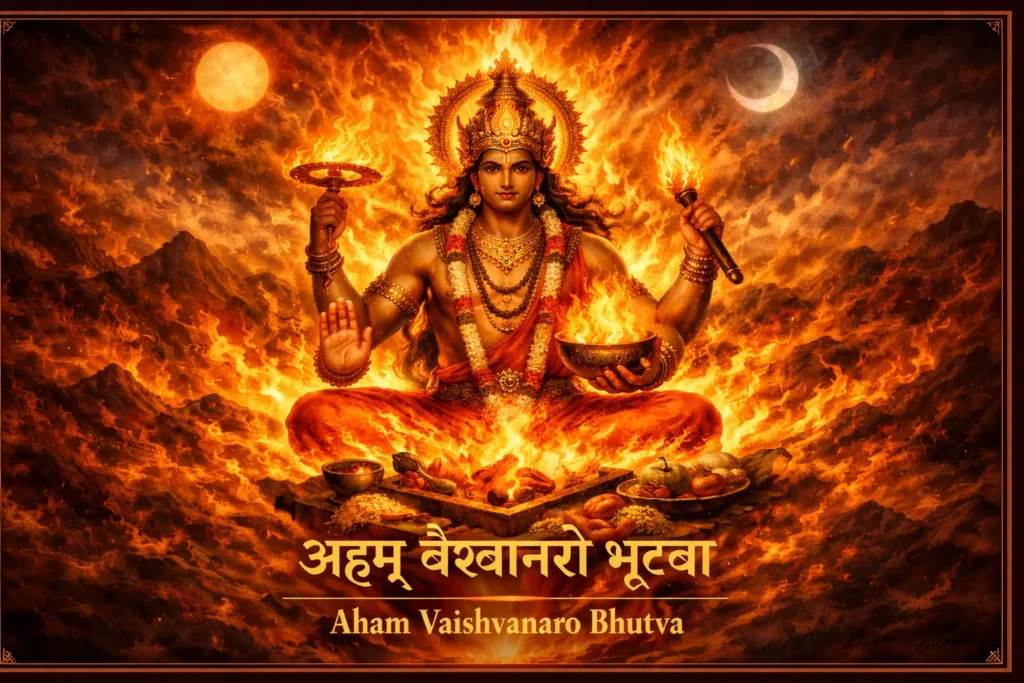
Aham Vaishvanaro Bhutva

Aham Vaishvanaro Bhutva अहं वैश्वानरो भूत्वा प्राणिनां देहमाश्रितः ।प्राणापान समायुक्तः पचाम्यन्नं चतुर्विधम् ॥ ahaṃ vaiśvānaro bhūtvā prāṇināṃ dehamāśritaḥ .prāṇāpāna samāyuktaḥ pacāmyannaṃ caturvidham .. Becoming the fire of life, I enter into the bodies of all creatures and mingling with the upward and downward breath I digest the four kinds of food (masticated, drunk, licked, sucked). ahaṃ – Ivaiśvānaraḥ – the universal firebhūtvā – having becomeprāṇināṃ – of living beingsdeham – the bodyāśritaḥ – residing in prāṇāpāna – connected with the inward and outward breathssamāyuktaḥ – united withpacāmi – I digestannaṃ – foodcaturvidham – of four types Translation: I, having become the universal fire, residing in the bodies of living beings, and united with the inward and outward breaths, digest the four kinds of food. Source: This verse is found in the Bhagavad Gita, which is one of the most revered texts in Hindu philosophy and spirituality. The Gita, consisting of 700 verses, is a dialogue between Lord Krishna and Arjuna, taking place on the battlefield of Kurukshetra. It contains the essence of various aspects of life, including ethics, devotion, philosophy, and the nature of reality. Meaning and Interpretation: ahaṃ vaiśvānaraḥ bhūtvā – I (Krishna) have become the universal fire (Vaiśvānara).In this line, Lord Krishna identifies Himself as the Vaiśvānara, which refers to the cosmic fire, or digestive fire present in all living beings. It symbolizes Krishna’s presence as a vital force that sustains the life process. prāṇināṃ deham āśritaḥ – Residing in the bodies of living beings.Here, Krishna emphasizes that He resides in the body of every living being. He manifests as the life force that nourishes and sustains the body. prāṇāpāna-samāyuktaḥ – United with the inward and outward breaths.This refers to the prāṇa (the life energy that flows through inhalation) and apāna (the energy associated with exhalation). Krishna says that He is intimately connected with both these energies, controlling and facilitating the process of life and digestion. pacāmi annaṃ caturvidham – I digest the four types of food.The four types of food are: Bhakṣya (भक्ष्य) – food that is chewed (solid food). Bhojya (भोज्य) – food that is swallowed (liquid or soft food). Lehya (लेह्य) – food that is licked (like chutneys or honey). Choṣya (चोष्य) – food that is sucked (like juices). Krishna explains that He is the force behind the digestion of all kinds of food, maintaining the health and well-being of living creatures. Understanding for Devotees: When chanting this verse, a devotee can reflect on several key insights: Meditation on the Verse: While chanting this verse, a devotee can meditate on Krishna as the life force within, the nourisher who ensures the body’s functions, and the supreme presence that sustains the universe as well as the individual self. By doing this, they can deepen their devotion and their awareness of the divine in every aspect of existence.

Aham Vaishvanaro Bhutva Read Post »