


















Hari Om

Menu

Vishnu Avatar

shri Krishna Bhagavad Gita
10 vishnu avatar, Vishnu Avatar

Narasimha Avatar

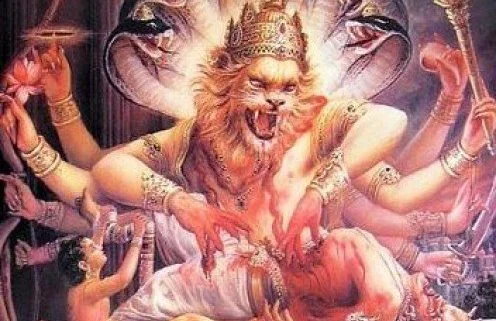
In the grand tapestry of Hindu mythology, the avatars of Lord Vishnu weave tales of divine intervention and cosmic balance. Narasimha Avatar, the incarnation where Lord Vishnu takes the form of a half-man, half-lion, is a compelling narrative of the triumph of divine justice over tyranny. This ancient tale, primarily recounted in the Bhagavata Purana and revered across various Hindu scriptures, captures the imagination and imparts profound lessons about the unwavering commitment to righteousness. The Narasimha Avatar saga unfolds against the backdrop of cosmic upheaval. Hiranyakashipu, a powerful demon, obtains a boon that seemingly renders him invincible. With arrogance and tyranny consuming him, he becomes a menace to the cosmic order, challenging the very fabric of dharma. Brahma’s boon grants Hiranyakashipu immunity from being killed by humans or animals, indoors or outdoors, during day or night, and by any weapon. These conditions, however, open the door for divine intervention in a form beyond conventional definitions. To counter the growing menace of Hiranyakashipu, Lord Vishnu assumes the formidable form of Narasimha. This being is neither completely man nor beast, created to bypass the conditions of the demon’s boon. Narasimha embodies a lion’s raw power and a man’s intelligence, a fusion of ferocity and divine wisdom. The Battle with Hiranyakashipu As the sun sets, Narasimha bursts forth from a pillar in Hiranyakashipu’s palace—a testament to the fulfillment of neither indoor nor outdoor conditions. The half-man, half-lion incarnation strikes fear in the heart of the demon king. With unparalleled strength, a fierce battle ensues, and Narasimha defeats Hiranyakashipu. Importantly, Narasimha slays the demon on his lap, in the threshold between day and night, adhering to the conditions set by Brahma’s boon. Narasimha Avatar is replete with profound symbolism. The man-lion hybrid represents the transcendence of divine power beyond conventional forms, emphasizing the infinite possibilities inherent in the divine. The image of Narasimha emerging from a pillar underscores the omnipresence of the divine—no space is devoid of the divine presence. The battle with Hiranyakashipu symbolizes the eternal struggle between the forces of good and evil, righteousness and tyranny. Narasimha’s victory serves as a poignant reminder that no matter how formidable the forces of darkness may seem, the divine will inevitably prevail. Lessons and Moral Insights of Narasimha Avatar The story of Narasimha Avatar imparts timeless lessons. It underscores the significance of unwavering commitment to dharma and the inevitable consequences of straying from the path of righteousness. Narasimha’s measured wrath teaches that divine justice operates in accordance with a higher order, beyond mortal comprehension, and that the cosmic balance will be restored, even in the face of seemingly insurmountable challenges. Narasimha Avatar is more than a mythological tale. It is a profound narrative that delves into the intricacies of divine justice, the triumph of righteousness, and the enduring power of the divine. As we grapple with our own moral dilemmas and confrontations with injustice, the story of Narasimha Avatar beckons us to embody the unwavering spirit of righteousness and to trust in the ultimate victory of divine justice over the forces of darkness.
, , ,

Narasimha Avatar Read Post »

shri narayan varah avatar
10 vishnu avatar, Vishnu Avatar

Varaha Avatar

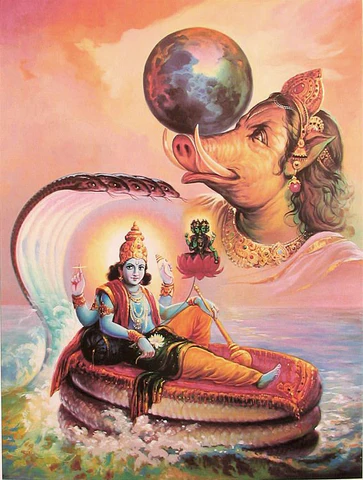
The ten avatars that the Lord and Preserver of the universe Lord Vishnu is believed to have is no new news to any of us. A third of the Holy Trinity, containing Lord Shiva and Lord Brahma, Lord Vishnu is one of the principal deities in Hinduism, and is believed to have ten primary avatars known as the Dashavatara. These ten avatars represent different manifestations of Lord Vishnu in various forms throughout different time periods. The ten avatars of Vishnu are believed to have been born for the same purpose. This is to reinstate Dharma, that is justice and righteousness on the Earth and help good triumph over evil, be it demons, asuras, or mortals. Lord Vishnu’s third avatar which is believed to have been born during the Sath Yug resembles the appearance of a boar. Popularly called the Varaha Avatar, this manifestation helped save the planet once again. Why Did Lord Vishnu Take Varaha Avatar? According to the legends of Hindu scriptures, the demon Hiranyaksha was responsible for sinking the planet to the ocean floor. To save it, Lord Vishnu assumed the appearance of a wild boar (Varaha Avatar). It is believed that the fight lasted for a millennium, which is a thousand whole years. The Varaha Avatar then used his tusks to slay the demon and bring the Earth up out of the depths of the ocean. The Varaha Avatar is typically represented in its animal form or sometimes with the body of a man and the head of a boar, making it a hybrid incarnation. He is often represented as a mighty boar who holds afloat the earth with one of his tusks. The hybrid half-animal-half-human incarnation of his is shown bearing the weight of Bhuma Devi on his leg. In the Satya Yuga, Lord Vishnu assumed the form of Varaha to rescue Earth from the clutches of the Asuras and restore Dharma. He took the form of a boar to protect Prithvi, which refers to the earth. The Varaha Avatar gets its name from the Sanskrit term for “boar” or “wild boar” (Devanagari:,varha). In the Rig-Veda, “Varaha” is translated as “wild boar.” The Third Incarnation Of Lord Vishnu | Varaha Avatar Story The fascinating tale of Varaha Avatar traces back to the doorkeepers of Lord Vishnu. Vaikuntha Loka is the well-known divine dwelling place of Lord Vishnu. The two formidable gatekeepers, Jaya and Vijaya, stood watch over it. Their deep affection for Lord Vishnu and their undivided loyalty were vowed to protect Lord Vishnu. The story goes with Jaya and Vijaya holding the power to grant people access to the divine realm of Vaikunta Loka, where they could catch a glimpse of the almighty Lord. Legend has it that once Lord Vishnu was paid a visit by Lord Brahma’s four sons in his heavenly abode of Vaikunta Loka. However, at that moment, Lord Vishnu was taking a well-deserved rest. And thus, Jaya and Vijaya stopped them from meeting Lord Vishnu. Jaya and Vijaya had managed to incur the wrath of Lord Brahma’s sons, leaving them seething with anger. Jaya and Vijaya were cursed to take on human form and be born on Earth. Despite Jaya’s and Vijaya’s pleas for forgiveness, Lord Brahma’s sons remained unmoved. Lord Vishnu then graced them with his presence. He expressed regret for the behavior of his guards. He let the sons of Brahma know that they were acting upon the rules given to them by Lord Vishnu. But, the sons of Lord Brahma showed no change of heart and stood firm in their decision, stating that the curse could not be lifted. Lord Vishnu delivered this bad turn of events to Jaya and Vijaya stating that the only way to break the curse was for them to meet their demise at his hands. The guards however did not seem deterred by this fate. And as fate would have it, Jaya and Vijaya were reincarnated as brothers named Hiranyakashipu and Hiranyaksha. The devotion of Hiranyaksha towards Lord Brahma was truly immense. After years of devoted worship, he received a powerful boon from Lord Brahma himself – the assurance that no being, divine or mortal, could ever bring about his demise. Hiranyaksha was filled with a sense of invincibility as he believed he had attained immortality. His evilness knew no bounds then as he began inflicting excruciating pain upon unsuspecting victims on our planet. Hiranyaksha wreaked havoc on the Devas and even went so far as to launch an attack on Indra’s celestial palace. The Devas were forced to flee for their safety and seek refuge in the hidden caverns nestled deep within the Earth. Hiranyaksha then seized the Earth and plunged it into the depths of Patal Loka. This caused the Earth to sink as the Earth’s weight was too much for the ocean to bear. During these happenings, the Earth was under the reign of the powerful Manu and Shatrupa. Manu and Shatrupa approached Lord Brahma seeking solace for their sorrow. According to legend, Lord Brahma revealed that seeking Lord Vishnu was the only way forward. Lord Brahma then turned his focus inward and began to meditate upon Lord Vishnu. A tiny piglet was seen emerging from his nostrils. The once small creature underwent a remarkable transformation, gradually expanding in size until it towered over the landscape like a colossal mountain. This was an avatar of Lord Vishnu. With determination in his voice, he declared that he would plunge into the vast ocean and save Mother Earth. With a thunderous roar, Lord Vishnu transformed into a mighty boar and launched himself into the sky, his hooves ripping through the clouds. With unbridled determination, he plunged into the depths of the ocean, on a mission to find Mother Earth. Venturing across the vast ocean, he finally arrived at the other side and made an incredible discovery – deep within its mysterious depths lay Bhoomidevi, the revered Mother Earth herself. As he journeyed through the vast expanse of the ocean, he came face to face with Varuna, the mighty

, , ,

Varaha Avatar Read Post »

lord vishnu kurma avatar
10 vishnu avatar, Vishnu Avatar

Kurma Avatar

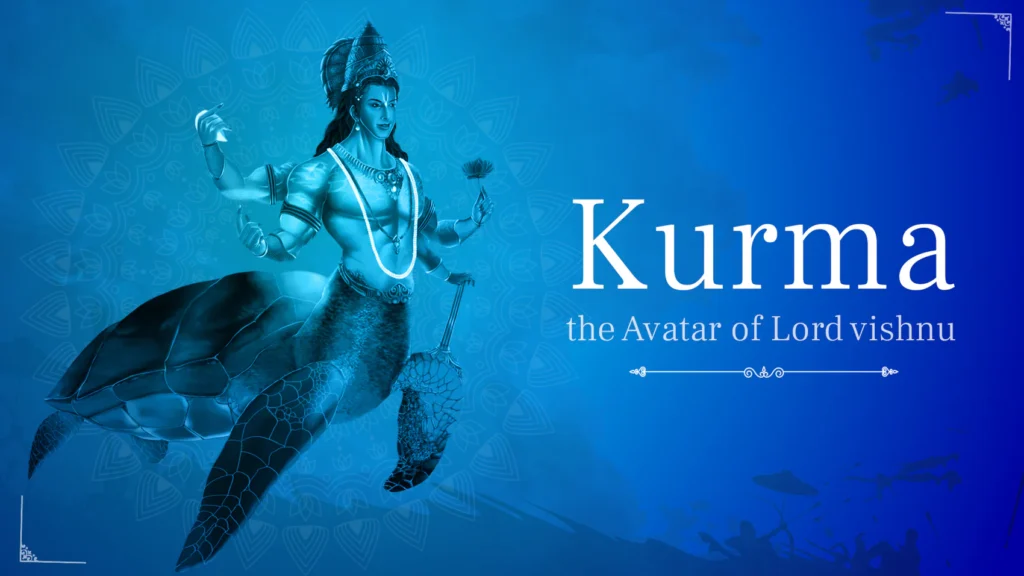
In Hindu mythology, Lord Vishnu is known to have taken many avatars to restore cosmic order and protect the universe from evil forces. One of his lesser-known avatars is the Kurma Avatar, where he appeared in the form of a tortoise. This avatar holds deep symbolic and spiritual significance, and its story is a testament to the power and compassion of the divine. This blog will help you learn more about the Kurma avatar of Lord Vishnu and how he took over the reins to save the universe.  The Mythological Story Kurma avatar is the second avatar of Lord Vishnu in Hindu mythology. The word Kurma means Turtle in Sanskrit. According to Hindu scriptures, Lord Vishnu took this avatar to help the Devas and Asuras churn the ocean of milk (Samudra Manthan) to obtain the nectar of immortality (amrita). The Devas and Asuras jointly decided to churn the ocean of milk to obtain Amrita, which would end their eternal conflict. However, they needed a pivot to support Mount Mandara which was chosen as the churning rod. Herein, Lord Vishnu stepped in and played the role of a pivot by supporting the mountain on his back. In addition to providing support for the churning, Kurma also acted as a protector, ensuring that the process could proceed without any disruption or imbalance.  As the churning of the ocean progressed, various divine beings and treasures emerged including the wish-fulfilling tree – Kalpavriksha, the divine cow – Kamdhenu, and the celestial elephant – Airavata.  Eventually, Dhanvantari, the physician of the gods, emerged carrying the pot of Amrita which was then distributed among the devas by Lord Vishnu to restore their strength and vitality.  Symbolism and significance The Kurma Avatar is rich in symbolism. The tortoise is known for its patience, resilience, and ability to withdraw into its shell, symbolizing detachment from the material world. Lord Vishnu taking the form of a tortoise signifies his ability to remain calm and steadfast in the face of challenges, teaching us the importance of patience and perseverance in our lives. The Kurma Avatar also represents the idea of balance and harmony. Just as the tortoise supported the mountain to maintain balance during the churning of the ocean, Lord Vishnu’s presence ensures that the universe remains in balance, with good triumphing over evil. Lessons From the Kurma Avatar The story of the Kurma Avatar teaches us several valuable lessons. It reminds us of the importance of humility, as even the mighty Lord Vishnu took the form of a humble tortoise to serve a greater purpose. The avatar also teaches us the significance of selflessness and sacrifice, as Lord Vishnu willingly bore the weight of the mountain to help others.

, , ,

Kurma Avatar Read Post »



