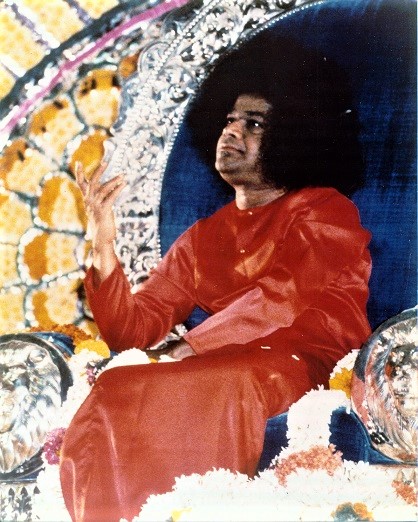
Thursday Veda chanting at Prasanthi Nilayam
Thursday Veda chanting at Prasanthi Nilayam GANAPATHI ATHARVASEERSHAM VISHNU SUKTAM LAGHUNYASAM HIRANYAGARBHA SUKTAM DURGA SUKTAM SHIVOPASANA MANTRAM
Thursday Veda chanting at Prasanthi Nilayam Read Post »
Devotional India(TM) is an International E-Spiritual Hub for all Devotees. It’s Masterpiece, a Dream Project which promotes the Sacred Indian Heritage & its sublime glory. God is not bound by any sect, religion or gender. He transcends it all, and is approachable by men of all faiths. This website promotes a vibrant concept about Spirituality & Glory of India. Our Group sends forth the message of Devotion, Love & Sacredness to people from all walks of Life. Our aim is to take our Visitors and Members to an Unforgettable Voyage in this Holy Land of Bharat.
Love All – Serve All
All Rights Reserved – All Wrongs Reversed
Copyright © The Devotional India Group – 2025-2027
Devotional India(TM) is an International E-Spiritual Hub for all Devotees. It’s Masterpiece, a Dream Project which promotes the Sacred Indian Heritage & its sublime glory. God is not bound by any sect, religion or gender. He transcends it all, and is approachable by men of all faiths. This website promotes a vibrant concept about Spirituality & Glory of India. Our Group sends forth the message of Devotion, Love & Sacredness to people from all walks of Life. Our aim is to take our Visitors and Members to an Unforgettable Voyage in this Holy Land of Bharat.
Love All – Serve All
All Rights Reserved – All Wrongs Reversed
Copyright © The Devotional India Group – 2025-2027
Devotional India(TM) is an International E-Spiritual Hub for all Devotees. It’s Masterpiece, a Dream Project which promotes the Sacred Indian Heritage & its sublime glory. God is not bound by any sect, religion or gender. He transcends it all, and is approachable by men of all faiths. This website promotes a vibrant concept about Spirituality & Glory of India. Our Group sends forth the message of Devotion, Love & Sacredness to people from all walks of Life. Our aim is to take our Visitors and Members to an Unforgettable Voyage in this Holy Land of Bharat.
Love All – Serve All
All Rights Reserved – All Wrongs Reversed
Copyright © The Devotional India Group – 2025-2027
Thursday Veda chanting at Prasanthi Nilayam GANAPATHI ATHARVASEERSHAM VISHNU SUKTAM LAGHUNYASAM HIRANYAGARBHA SUKTAM DURGA SUKTAM SHIVOPASANA MANTRAM
Thursday Veda chanting at Prasanthi Nilayam Read Post »
Wednesday Veda chanting at Prasanthi Nilayam GANESHA SUKTAM PROKSHNA MANTRAM ISAVASYOPANISHAD NARAYANA SUKTAM ARUNAM (ALTERNATE WEEKS)
Wednesday Veda chanting at Prasanthi Nilayam Read Post »
Adaptability, A Means To Peace Sri Swami Sivananda Adaptability is a virtue or noble quality by which one adapts or fits himself with others, whatever their nature may be. The man of adaptability accommodates himself with others, whatever their temperament may be. This is a most desirable quality for success in life. This has to be developed slowly. The vast majority of persons do not know how to adjust themselves with others. Adaptability is a peculiar knack or pluck to win the hearts of others by a little bending. The wife does not know how to adapt herself with her husband. She displeases her husband always and makes quarrels in the house and gets a divorce. The clerk does not know how to adapt himself with his boss or superior. He quarrels with the superior and gets an immediate sack. The disciple does not know how to adapt himself with his Guru. He misbehaves, and leaves the Guru. The businessman does not know how to adapt himself with the customers and loses his customers and business. The Diwan does not know how to adapt himself with the Maharajah. He has to leave the State Service. The world runs on adaptability. He who knows this art or science of adaptability pulls on quite well in this world and is always happy under any conditions of life. The man must be pliable if he wants to adapt himself. It does not need much wisdom or ingenuity for developing adaptability. If the clerk understands well the ways and habits and temperament of his superior and adjusts himself nicely to suit his ways, his superior becomes a slave of the clerk. You will have to use some kind, sweet words. A little lubricant to soften his heart is needed. That is all. Speak gently and sweetly. Carry out his orders to the very letter. Never retort him. “Obedience is greater than sacrifice.” Remember this maxim at all times. The superior wants a little respect. Say, Hanjhi, Hanjhi. Ji huzur, very well Sir.” It costs you nothing. Then your superior becomes your slave. He has for you a soft corner in his heart. You become his pet. He will do whatever you want. He will excuse your mistakes. Humility and obedience are necessary for developing adaptability. An egoistic, proud man finds it very difficult to adapt himself. He is always in trouble. He always fails in his attempts. Egoism and pride are two important obstacles in the way of developing adaptability. When one student does not know how to adapt himself with his fellow-mate who is living in the same room, friction comes in and their friendship is broken immediately. Adaptability makes friendship last for a long time. Students fight for little things. One student says, “I gave Mr. X tea for several days. I took him to cinema on my own account for several days. I asked him to lend me the book “Boswell’s Life of Johnson” for reading. He has bluntly refused now. What sort of friend he is? I do not like him.” The friendship is broken now. A simple thing upsets the mind. Adaptability is a strong catgut ligature that links people in unbroken love and friendship. A man of adaptability can pull on with anybody in any part of the world. People unconsciously love a man of adaptability. Adaptability gives immense strength and profound joy. Adaptability develops will. A man of adaptability has to make some sacrifice. Adaptability develops the spirit of sacrifice. It kills selfishness. A man of adaptability has to share what he has with others. He has to bear insult and harsh words. A man of adaptability develops the feeling of unity or oneness of life. For Vedantic Sadhana it is of great help. He who practises adaptability has to destroy the feelings of Ghrina and contempt and the idea of superiority. He has to mix with all. He has to embrace all. Adaptability develops universal love and kills the feeling of hatred. A man of adaptability has to put up with the unkind words and harsh treatment of his friends. He has to develop patience and endurance. These virtues develop by themselves unconsciously when he tries to adapt himself with others. A man of adaptability can live in a cool place. He can bear the heat of Benares or Africa. He develops balance of mind. He can bear extreme heat and cold. Adaptability brings eventually Atma-Jnana. He who has this noble virtue is a great man in this world. He is always happy and successful.
Adaptability, A Means To Peace Read Post »
Tuesday Veda chanting at Prasanthi Nilayam BHRIGU VALLI (TAITTIRIYA UPANISHAD) BHOO SUKTAM PAVAMANA SUKTAM AYUSHYA SUKTAM DEVI SUKTAM
Tuesday Veda chanting at Prasanthi Nilayam Read Post »
Monday Veda chanting at Prasanthi Nilayam SHEEKSHA VALLI (TAITTIRIYA UPANISHAD) ATMA SUKTAM
Monday Veda chanting at Prasanthi Nilayam Read Post »
The Ultimate Success Sri Swami Chidananda Introduction There are a fortunate few into whose lives God has brought an awareness of a goal higher than merely being born, making a living and being called successful. Often we say, “He has succeeded in life; he has distinguished himself in his career, earned a lot of money, and attained a high social position.” Yet, is being a successful person merely accumulating some things, being called a success, and then leading a comfortable life? In terms of ultimate values it would be a very small life. In an impartial evaluation, one could ask, “What did he actually accomplish? He was born, managed life competently, and then ultimately he died.” Death seems to be the ultimate outcome of whatever you might apparently have gained or achieved–name, fame, position or wealth. To live a life of striving and desiring, then to leave all you have worked and sweated for and go into oblivion–isn’t that the ultimate irony of death? Who cares about you once you have gone? Who is thinking of all the great bigwigs who shouted and thundered while they were alive–the politicians, financiers and multimillionaires? Who really cares for them? If the truth were known, ants, flies and worms all take birth, manage to live for a while, and ultimately perish. If you want to be completely frank, what is the ultimate difference in this respect between the multimillionaire and the insect? Maybe the insects ate each other, but they couldn’t help it. Yet, maybe the insects did not do many of the nasty things the millionaire did–no lies, tax evasion, bribery, dishonesty or hurting people. Man in his cleverness many times cuts a sorry figure in comparison with the animals. In one of his humorous moods, Swami Sivananda wrote a poem about a conference of monkeys. They deliberated and came to one important conclusion: they should register a firm protest against Darwin for having said that monkeys were the ancestors of man! No monkey ever does the horrible things man does in society, so the monkeys rejected the idea as an insult. If one considers the way in which man is making use of his God-given intelligence, then they surely had a right to be insulted. The great masters of wisdom of the East had a much more elevated vision of the possibilities of mankind. They have always preferred to evaluate man and his life in terms of the search for a higher meaning in life. They discovered in man a dimension that was more than merely mental and physical and was not limited in time. Their discovery is one of the most important insights of human society, for out of it came an experience of a state of absolute illumination, wondrous beatitude, indescribable bliss and perfect peace and freedom. Those who went into that experience were ecstatic. The scriptures are replete with expressions of this unbearable ecstasy. This experience threw open the doors to absolute perfection and freedom. Man has access to tremendous pinnacles of higher experience and the ability to rise up and become established in that experience. These great realisers said, “Yes, man has this potential for perfection, because he was made in the image of God. If he can become a seeker, he can exert rightly and attain That. Nothing can come in his way if he has the will and he wants it heart and soul. Seek and ye shall find; ask and it shall be given. That is your birthright.” All great messengers of God have again and again borne out this truth. Claim Your Birthright Swami Sivananda said that man is an extraordinary mixture of the animal, the human and the divine. Man has the same biological nature as the animals–hunger, thirst, fear, procreation and the desire to survive. There is at the same time a uniqueness that is denied to any other form but man–such as reasoning, the ability to discover, to be aware, to ask questions and to progress in knowledge. What is more, what the physical sciences cannot see is that in addition to these evident aspects, there is also an unseen, nonmaterial dimension available to man. The true identity of man is deathless and eternal. This was clearly perceived by the mystics and the illumined sages, who boldly stated, “You are divine, you are a child of immortality.” These sages called on mankind to claim its birthright. They possessed the vision of this divine dimension of man’s personality that is not seen by scientists, because despite tremendous knowledge in their own fields, the scientists have only the outer knowledge. These great sages saw all of life’s endeavours in the light of that supreme destiny of man. For them the real attainment always had to do with this ultimate fulfilment, and success in life was meaningless if it did not relate to that supreme goal. A life lacking in the aspiration for this attainment would have been wasted. No matter how much you have succeeded and how wonderful your life is, if it lacks this ultimate purpose, you have gone off the track and wandered into a desert. These selfsame masters were not mere impractical visionaries who ignored the secular aspects of life. They gave it its due, and they said, “Yes, do all that you have to do in order to prosper in life. Acquire the necessities to live a successful and comfortable life, and of course strive to improve your lot.” They never looked down upon man’s endeavours to improve his situation, but these endeavours should not be limited to just physical well-being. You should also try to improve yourself as a person by building up your character and integrity through your principled living. Life becomes meaningful only if, in addition to living a life of comfort above want, it also brings a person further towards the attainment of that supreme goal. Otherwise, this life had no intrinsic worth. Just to make a living and to manage to get

The Ultimate Success Read Post »
Guru Oriented Life Sri Swami Chidananda The devotee who has devotion and reverence for God tries his level best to live his life in accordance with the will of God; he does not go contrary to the will of God. Reverence and devotion cannot coexist with contrariness to His will, at the same time in the same person. If there is reverence, there is obedience. If there is reverence, there is the attempt to carry out His will in thought, word and deed. If we say that we revere and do not do this, then it means that there is something wrong. There is an essential inner contradiction. Similarly with the guru. Our life should be guru-oriented. Our life should be a life of harmony with his will and teaching. That would be therefore the way we express our reverence for the guru. And that we should do daily. We should live a guru-oriented life in close accordance with the teachings to us, not only daily but also every hour from morning till night. If you revere some being, you would also wish to carry out his instructions and orders, the way that he wants to walk you to walk, the way that he has shown by his teachings as well as by his living. The genuine manner of showing reverence in a practical way would be to live in accordance with his will, and not contrary to it. We must be aware that this orientation in our life is one of the essential ingredients of discipleship. We may even say that it is the essence of discipleship. Then indeed all blessings will be ours. Then indeed day by day we will proceed and progress towards the Goal. The guru’s teachings will find fulfilment in the disciple’s living, and all blessedness will follow. We must sincerely, earnestly and diligently strive to this end without ceasing. Our supreme good and highest welfare lies in this. May the divine grace of the Supreme and benedictions of the guru enable us to do so and live so! May God and Gurudev’s grace and blessings enable you to do so most effectively, most fully, for the benefit of all humanity!
Guru Oriented Life Read Post »
Running After The Shadow Sri Swami Sivananda A drama asserting in unequivocal and convincing terms the paramount importance of the Divine Life and Spiritual Propaganda at all times and in all conditions–in war and peace, in freedom and bondage, in poverty and luxury. Synopsis A conversation takes place among four friends–an advocate, a doctor, a professor of Economics and a spiritual culturist. The politically and economically degraded condition of India is attributed to the emphasis laid in the past by Indians upon spirituality. The spiritual culturist meets the arguments halfway, when his Guru, a Swamiji, appears on the scene and, by his brilliant exposition of the essence of spirituality, opens the eyes of all to the Real Truth. Also this play serves as an introduction to the Plays that follow. Scene: Drawing room of a wealthy advocate. He is talking to a friend–Spiritual Culturist–who is a selfless worker in the religious field. Two other friends of the advocate enter at this time. One is a Doctor, a follower of the Epicurean school, wholly engaged in earning money and feeding his own family with luxuries and comforts. The other is a Professor of Economics who strongly believes that industrial expansion and economic independence alone is the ultimate goal. After usual introductions, the topic of conversation is switched on to the problem of the hour. Advocate: (Addressing the Spintual Culturist): My friend, I am strongly of the opinion that your precious energy and intellectual capacity are being wasted in worthless activities which cannot solve our immediate problems. Spiritual Culturist: The immediate problem can only be solved by striking at the root-cause of our present state. A nation cannot survive or prosper unless the majority of its individuals possesses a high degree of culture and character. India had a glorious past and a culture of its own, which is now confined to a few. We must revive it and raise it to more glorious heights if we are to regain our lost heritage, both material and spiritual. Professor: But how can the masses and lower middle classes, who are steeped in poverty, who cannot make the two ends meet and who have nothing to eat, assimilate these cultural teachings before their physical needs are satisfied? Spiritual Culturist: If our well-to-do educated people first develop their character and culture by practising religion and philosophy in their daily life, we shall regain our lost glory and economic independence, by generating the spirit of self-sacrifice and selfless service among them for the uplift of the poorer classes. Doctor: I do not believe in all this talk about culture and character or economic betterment of the masses. Where is the time or leisure for any public work? Everyone should mind his own business. All my time upto late hours at night is occupied by professional activities and calls. I must have time for recreation, shopping, cinemas and other social obligations. Spiritual Culturist: You seem to have a gross and limited vision and are ignorant of higher, transcendental matters. This is an Asuric attitude of life described in the Gita (Ch. XVI) which leads to degeneration, bondage and suffering in the future lives. Where there is a will, there is a way. If you earnestly wish to serve humanity, you will find the leisure and energy also. Advocate: I think we should direct all our energies to the political and economic field instead of wasting our energy in the propagation of spiritual culture. When we get freedom and economic independence, we shall see about culture, character and the life hereafter. Spiritual Culturist: In that case you should also stop your eating, drinking and professional activities until freedom and economic betterment are attained. Culture, character and religion are as important for the soul, as food is for the body and wealth for material life. If you wait till freedom is attained, you may never be able to progress at all. Who can say that freedom will be attained in his lifetime? You will be wasting this precious life and human birth. Professor: It is the overstress on spiritual life and religion that has brought about our downfall and slavery. We neglected our material progress in the past, hence others overpowered us and we have remained a poor and backward people. We should, therefore, develop our material resources and physical powers and reach the same peak of progress, power and comfort as the western nations, before we can even think of dabbling in idle pursuits like religion and philosophy. Spiritual Culturist: Even those who work in the political, economic and social fields cannot turn out beneficial work, without disciplining themselves on a spiritual basis, and without undergoing religious training. Social and political leaders, with a few exceptions work with selfish motives and fight for their own name, fame, wealth, superiority and power. Doctor: No nation in the history of the world has ever gained freedom or economic independence by the study of scriptures and leading Divine life or by prayers, Bhajans and Kirtans. Spiritual Culturist: India has been in bondage for only a few centuries. Of what significance is this period in comparison with the millions of years which have elapsed since the advent of man on this earth? Even if we regain freedom now, it may not last for more than a few hundred years and the people then living will have to make stupendous efforts to regain it. A thing which does not last for ever, cannot be the ultimate goal of life. It only provides a field for selfless service leading to purity of mind and heart. To that extent, work in that field is helpful. It is a means for progress on the spiritual path and should not be confused with the end or goal. Professor: We must strike a mean between spiritual and material life. By over-stressing the spiritual aspect, we have come to the present stage. Hence we should have more of material and industrial progress, as far as India is concerned. Spiritual

Running After The Shadow Read Post »
Qualification For Sadhana Sri Swami Sivananda Life is the greatest of all teachers and this world is its school. Truly, the world is the best school. All its lessons are taught through the books of nature. Nature everywhere abounds with such lofty lessons which alone are quite sufficient to bestow the highest wisdom to man. Each day is a valuable page in this book and each thing and natural phenomenon embodies a lesson to one who observes and reflects. And if you carefully analyse and reflect upon every phenomenon of nature, you will find that they all speak of the glory of God, the grandeur of the inner spiritual life; a life of unalloyed peace, bliss and perennial happiness–yes; it urges you to launch upon the actual Sadhana to make you happy and to free you from grief, affliction and sorrow. All the ancient saints and seers–the men of God who have had intuition–have been declaring to all the mankind the great bliss, the vast power and knowledge that can be experienced if only man would turn from the sensual, sinful life and strive for the higher divine life. Yet we see today that man is as much immersed–if not more–in worldliness as he was centuries ago and the state of mankind is as apathetic and lethargic towards these questions of a ‘life’ in the spirit as it was in the beginning of creation. Why is it that in spite of the clarion call of very many great seers, of the confident assurance of the scriptures, of the repeated experiences of man himself in failing miserably to attain happiness amidst external physical world, you are again and again being deceived? Because man does not have a deep and abiding faith in the admonitions of saints in the scriptures, in the words of those who have trodden the path and attained the goal. If only man did really believe in these great ones, he would certainly be induced to act up to their words. It is this basic lack of faith in man that is at the root of his failure to do Sadhana. Thus if only man has faith in spiritual course of action, he will act up to it. If man has to take up Sadhana, if he really wants to obtain this bliss which is not mixed with pain, he will certainly have to repose faith. The entire social structure and order upon which mankind smoothly runs is based upon faith and trust. And when you are prepared to put faith in mankind which is but a passing phenomenon, why should you not put faith upon the very Creator of these things? Thus you see that the first quality you have to acquire is faith. Now comes the question that having first of all full faith in the words of the seers and realised the necessity of Sadhana, what is the procedure; what is to be done? You may have faith, but if you do not put them into practice–if you do not begin to translate them into action, they will ever remain plans in the blueprint stage. So after the faith in Sadhana comes practice. You must set about doing. No question of believing. A belief must become an act. Having reposed faith in the words of sages and scriptures, you begin doing Sadhana. Once you commence Sadhana, the next important thing you should bear in mind that you should not give it up. Perseverance is of the utmost importance. All processes in this universe are gradual. They have got stages. If you want to go through all the stages of Sadhana and attain the goal, you must have patience and perseverance. Therefore, you should have to always persevere, exert and plod on till the goal is reached. There is another important point that in spiritual Sadhana you should not merely be contented with the positive forces. There are active forces that oppose the Sadhaka, that actually assail him and pull him down. Herein comes the necessity of the fourth important weapon–that is fortitude. While persevering man has to have a little courage, not to be easily shaken by the obstacles that assail him. He will have to brave the storm and proceed in spite of the difficulties and adverse conditions, trying to cow him down, to push him off from the path of Sadhana. It is with fortitude he refuses to be discouraged and relying upon the inner Self he proceeds with the Sadhana, and ultimately he attains the ideal for which he has been born upon earth; and while going through the process he will have to see that he keeps in mind the necessity of giving minute attention to all the small details upon the path, because in every process all such small details of the process are to be attended to, very carefully. If any small detail is left out, thinking that it is superfluous he will find that ultimately he has lost his valuable time and labour. This delays progress. It is the conglomeration of small things that go up to achieve high ideals. Therefore, with firm faith, practical application, perseverance, careful attention to even small details and fortitude in trials, you must set foot and proceed on the path of Sadhana. Raise aloft the banner of Divine Life. Feel all humanity to be one and spread the message of man’s divinity, the message of brotherhood and cosmic love, to every home and broadcast them to all. Ever assert your divinity every moment of your life. Ever strive to live in the consciousness that you are essentially divine and you have been given this human birth only to recognise your essential divine nature.


Qualification For Sadhana Read Post »
Daily Veda chanting at Prasanthi Nilayam GANANAM TWA & RUDRAM CHAMAKAM PURUSHA SUKTAM DURVA SUKTAM SWASTHI PRAJABHAY PARIPALAYANTAAM
Daily Veda chanting at Prasanthi Nilayam Read Post »