








Hari Om

Menu

February 2026

images 2026 02 26T143544.184
Bhrama Muhurata Meditative Talks at Swami Sivananda Ashram - Rishikesh, Swami Sivananda

Testing Our Spiritual Life

Testing Our Spiritual Life By Sri Swami Atmaswarupananda Early Morning Meditation Talk given in the Sacred Samadhi Hall of Gurudev Sri Swami Sivanandaji Maharaj, Sivananda Ashram, Rishikesh It is normal in human life that if we put a lot of time and effort into any endeavour, we want to be able to measure our progress. Whether it is studies, professional life, or business, we want to know in some way what our score is, how well we are doing. The same seems to apply to the spiritual life. After we have put in sufficient effort, sufficient time, there is a factor in us that wants to know whether we are getting proper results. Normally that inclination is discouraged in the spiritual life, and it is discouraged for three reasons. First of all, scriptural. “Yours is the effort. The result is up to God. Leave it to Him.” The second reason is a very practical one. There is no practical way that we can judge whether we are being freed from egoism, lust, greed, hatred, anger and jealousy or whether divine virtues are developing in our heart. If we try to keep score, it will normally be a matter of self-deception. Rather, as Pujya Swami Chidanandaji once said, “From time to time you discover what changes have come about. Sometimes, this can be a pleasant discovery. Sometimes it can be rather a shocking one–some negative factor that you thought had long ago disappeared suddenly comes to life again. Therefore, any judging we do on our progress should be left to discovery rather than to analysis. But there is a third reason that we’re discouraged from trying to keep score on our spiritual life. And that is that the ultimate spiritual life is at a level deeper than virtues and vices. One teacher has said that there are only two things, finally, in this universe: one is love; the other is fear. This love, of course, is not the normal type of love, but rather a divine love that has no object. It is just love or perhaps more correctly, it is described as universal goodwill. The other factor, fear, is also not fear with an object, but rather an underlying sense of fear that at any moment can light upon an object such as death, old age, ill health, loss of money, security etc. Therefore, in the final analysis the only way our spiritual life can be judged is to the degree that universal goodwill and trust has replaced that nagging feeling of uncertainty or fear in the depths of our being. How do we bring about this ultimate change? There is no other way than a total letting go and trusting in God. That is why Lord Krishna told us that the only way we can cross samsara is by taking refuge in Him alone. And even more specifically, in the last teaching verse of the Gita, He tells us to abandon all dharmas and take refuge in Him alone. Therefore, we cannot really judge our spiritual life by normal measurements. Ours is to make the effort; the results are in God’s hands. From time to time we discover whether we have made progress or not, and ultimately the only real test is the degree of total surrender in the depth of our heart, which means that universal love has replaced all fear.

Testing Our Spiritual Life Read Post »

Krishna showing Vishwaroop to Arjuna in chariot
Bhrama Muhurata Meditative Talks at Swami Sivananda Ashram - Rishikesh, Swami Sivananda

God Is Present in the Midst of the Human Condition

God Is Present in the Midst of the Human Condition By Sri Swami Chidananda Worshipful homage to that supreme, universal Spirit Divine that is here and now mingling with the spiritual presence of Gurudev in this sacred Samadhisthan. Gurudev’s spiritual presence is here because the mortal vehicle in which he dwelt and used for bringing about a spiritual renaissance in the modern world has been interred here with due honour. The supreme universal Spirit is here because although It is transcendental, It is at the same time intensely relative and personal. The great mystery of Its transcendence, immanence and indwelling presence is the experience and declaration of sages of towering spiritual illumination and experience. Thus it is that we are in a dual presence, at once spiritual, at once divine. It is in this context that we have to see that both a method of spiritual evolution and attainment as well as a certain solution to our human predicament is contained in this truth. A method has been given: Keep yourself aware of this truth, then no matter where you are your experience will always be God-experience. No matter where you are, in what state, what surroundings, what condition, you will know that simultaneously you are in the presence of God. Therefore, the practice of this presence becomes to you a method of growing in God-awareness which will ultimately culminate in God-experience. Simultaneously, this truth also offers a solution to the human predicament. The human problem is that the place where He has reserved as the most suitable place for you to be constantly in communion with Him–the inner spiritual heart–usually is invaded by multifarious, miscellaneous considerations about the passing world. The great ones, who had established themselves in that transcendental experience, have come forward and told us, “Do not distress yourselves. In the midst of all this so-called invasion by outer factors and distractions, there is this centre of ever-present, undiminished, unshaken Divinity. In the midst of all vikshepa, all turmoil and all miscellaneous thought, This abides at the very centre, unassailable.” To cling firmly to this unassailable truth, this reality within, to abide ever in that reality of His presence, is to be practised with every breath. Then, even dwelling in the world, you will be dwelling in God. Even in the midst of ever-changing situations and experiences that are part of your unavoidable and inevitable earth life, there is this never-changing, unaffected truth about the reality within. To contemplate it daily–to consciously contemplate it–is the heart of spiritual sadhana and spiritual life. And this awareness is greatly helped by satsanga, by svadhyaya, by smarana, remembrance: “I abide in You. You abide in me.” This is the truth. All other things may be changing. They do keep changing. This is the Unchanging in the midst of countless ever-changing movements in this outer world. Contemplate this truth! Cultivate the practice of this truth, and thus find your own solution to your human predicament. Success is sure because God made you in His own image to succeed in life and not to fail. He did not send us here to fail but to succeed. And this privilege, this birthright is the common heritage of all human beings of all times, for all are made in the image of God. It is the uniqueness of man, but it is a common human heritage. If you have inherited it, it is not because you are something special. It is because of your uniqueness which you share with all other human beings. You are unique in the eyes of God, but you need not think that you are special in the eyes of God. If you are special, then everyone is special. Therefore, we should be humble and simple and not be unduly self-important, because we are not very important. We are important, as all other human beings are important, but not in any special way. So the fine distinction between being unique and being special should be grasped. Special brings with it the danger of being ego-oriented regarding ourselves, whereas uniqueness makes us humble. Uniqueness does not carry this inherent danger of ego. Thus, the truth to be practised is that even in the midst of our human predicament, God is very much there. So this fact, this truth, should be made our focus. We should emphasise more on it than upon the human predicament. It should be given greater importance, more value, more emphasis in our being. Then all will be well. When you make God central, other things naturally have to occupy the circumference–because there is only one centre. So there is the key to being established always in the feeling of God’s presence. Make Him central in your life. Then other things will fall into their place. May the grace of God and the loving blessings of Gurudev enable us to achieve this truth-oriented state of inwardness, this state of mind!

God Is Present in the Midst of the Human Condition Read Post »

swami sivananda Yoga demonstration by river with group watching
Bhrama Muhurata Meditative Talks at Swami Sivananda Ashram - Rishikesh, Swami Sivananda

The Practice of Truth

The Practice of Truth By Sri Swami Atmaswarupananda Early Morning Meditation Talk given in the Sacred Samadhi Hall of Gurudev Sri Swami Sivanandaji Maharaj, Sivananda Ashram, Rishikesh The Father of the Nation, Mahatma Gandhi, was a votary of truth. He used to declare, “They say that God is Truth. But I declare unto you, truth is God.” This would suggest that when Gurudev wants us take a vow of truthfulness, satyam, that if it is practised in all sincerity, then we become God. But what is involved in the practice of truth? If we reflect upon it, we will recognise that we need to practice truth at three levels of our being. The first level of the practice of truth is the obvious one, of telling the truth to each other in our day by day affairs. To practise the truth to the standard of Mahatma Gandhi means that ultimately we become incapable of telling a lie. If by chance a lie should escape our lips, we become immediately aware of it and make the necessary correction. The next level of truth is the practice of truth in our inner being. Gurudev said, “Scrutinise always your inner motives.” Normally, most of us have two reasons for doing something: One, a reason that sounds good to ourselves and others, and second, the real reason. We have to scrutinise carefully our inner motives, recognise what our real motives are, and never claim to be doing anything for other than our real motivation. But there is a third level of truth that most of us find almost impossible to practice. And that is truth at the level of yoga. The scriptures can declare “That thou art,” we can affirm, “I am Brahman,” we can believe with our intellect that “All this is Brahman,” but to come to grips with the truth of it is something else altogether. It requires tremendous strength, tremendous clarity of intellect, tremendous devotion to the truth, tremendous will-power and, above all, the character built by the practice of truth with others and within ourselves. It is this final practice of the truth that will convert us into the Divine. But it is an absolute practice and it is not a practice that we can do in the ordinary way. It is a practice–no matter how we describe it–of total letting go, total renunciation, total surrender, and it is affirming that the ultimate Truth is That which we can never grasp, in anyway, with the mind. The scriptures declare that we are That. But they also declare that That is unknowable and unthinkable. So to practise the real truth, we have to exchange that which we think we are for the truth that is unknowable by the mind. It is this practice that brings us to the peace that is beyond understanding. It is this practice that results in total humility. We are nothing, but paradoxically, we are everything. We have given up everything; we gain everything. We had confusion; now we have clarity. It comes through the practice of truth at all levels of our being.

The Practice of Truth Read Post »

swami sivananda Black-and-white photo of monk with garland holding flowers image
Celestial Collection of Divine Messages - Awakening the Divinity in Man, Swami Sivananda

Bases of Spiritual Sadhana

Bases of Spiritual Sadhana Sri Swami Sivananda A man abandoning society and activity as evil and shutting himself up in seclusion, isolated from mankind so that he might grow in virtue and into sainthood through meditation, will in all probability be found to be less ready to overlook the transgressions of an erring brother than a practical humanitarian earnestly exerting himself in the field of sincere selfless service. If a monkey or a stray dog happens to enter his Kutir and upset his water-pot or run away with his rottis (bread), the Ekantavasi Virakta (dispassionate recluse) will perhaps shout and curse the animal and nurse a grudge against it to the end of his days! Then, again, the admirable virtue of adaptability comes only by mixing and moving among men in many moods and dealing with different peoples of diverse temperaments. It is through selfless activity and service that one acquires the ability to accommodate oneself to the peculiarities of personalities and of places. If, thinking to experience oneness of Self and to feel universal brotherhood, you confine yourself to a solitary cell and take to repeating Vedantic formulae, you run the risk of becoming Tamasic instead and turning eccentric and intolerant. Slowly you will lose what good traits you had previously. It is to guard against this risk that we have the wise counsel “Let not virtue wither for want of its exercise.” It is evident that the recluse in retreat and the Sannyasi in seclusion may well learn a useful point or two from the Nishkama Karma Yogi and the humble Svayam Sevak. No doubt through the method of meditation one may develop several virtues of a subjective type, subjective in that they centre round and concern the Sadhaka’s own immediate personality. Through constant contemplation subjectively one may acquire non-attachment to one’s body, and imperviousness to environment or a victory over the Rajasic urge to wander aimlessly, etc. Restraint and self-denial too could be acquired to some degree. On the other hand, it is only through selfless activity, unattached work and loving service that one can acquire precious gems of purity, patience and humility. Humility especially comes through service alone. In this connection it is of a great profit to remember one point of immense practical value, i.e., of all virtues humility forms the basis. It is only when a man is humble and feels that there is much that he does not possess and has to acquire that, there arises in him the eager desire to grow into those noble qualities he is deficient in. Here begins his systematic endeavour and attempt to acquire and possess them. The proud and arrogant man has little scope for growth, because he feels he knows everything. There is that self-sufficiency in his pride which leads him to think that there remains nothing for him to strive for and to acquire. Therefore it is said that humility is the fruitful source of all virtues and that everything that is kind and good naturally grows from it. Generosity and kindness too are the outcome of active contact with the suppliant and the needy, the helpless, the wretched and the distressed. Herein lies the unique distinctive quality of Nishkamya Karma, works reverently done as worship of the Almighty. Moreover, certain noble traits exist in man in dual aspects, latent and manifest. For example, the latent quality of purity is manifest as chastity in actual life. Fearlessness becomes manifest as positive courage when a sudden crisis calls it forth, when a dangerous emergency arises. A habitual state of self-restraint manifests itself as a deliberate act of self-control in the face of an actual temptation or trait. So far as complete and balanced development of both the aspects is concerned, Karma Yoga becomes indispensable. Again subjective virtues developed by a life of seclusion and isolation, to attain to fullness and perfection should be actively exercised. One must not rest satisfied in merely eliminating evil, in being virtuous in a negative way. There must be a positive passion for putting into practice the good in us for the enhancement of the joy and welfare of all creatures. Then alone these virtues justify themselves; they become, as it were, ripe fruits, fully blossomed flowers. They will then expand in their breadth and from the individual circle gradually extend to all humanity, then of the whole universe and finally become all-embracing and cosmic. Development and progress if they are to extend thus into infinity must be dynamic. On the path of moral and spiritual happiness, a life of quiescence carries with it the danger of stagnation setting in at some stage or other. This is the reason why many fail to reach ethical perfection even after years of seclusion and meditation. Selfless activity and loving service should therefore never be underestimated and neglected. Finally one would do well to bear in mind an important point. It has been seen how humility forms the fundamental basis of all good. Then, to the virtues that are acquired with great toil and patient effort, it is humility, again, that acts as the sustainer and vigilant preserver. Humility is the shield and armour against the arch-enemy of the aspirant, moral and spiritual pride. For having progressed considerably in the path of virtue, the virtuous man will unconsciously fall a prey to vanity. An insidious feeling of self-approbation will creep in unnoticed. This will later manifest itself in the form of a sort of indulgent attitude and a lofty contempt for those who are not following a similar life. A constant humility kept alive by a ceaseless exercise of it in service is the only sure armour against this foe. It vigilantly protects the striving seeker in his quest after true and abiding happiness. He who effaces his little “self” through a life of motiveless, humble and loving service with Narayana Bhava obtains a unique happiness and bliss. Who can gauge the exquisite joy that he experiences! May all therefore realise the

Bases of Spiritual Sadhana Read Post »

istockphoto 1837747725 612x612 1
Bhrama Muhurata Meditative Talks at Swami Sivananda Ashram - Rishikesh, Swami Sivananda

The Path and the Goal Are the Same

The Path and the Goal Are the Same By Sri Swami Atmaswarupananda Early Morning Meditation Talk given in the Sacred Samadhi Hall of Gurudev Sri Swami Sivanandaji Maharaj, Sivananda Ashram, Rishikesh Most of us here are what we might call children of the Vedic way of life. Of course, some of us are adopted children, or as Swamiji once said, we have adopted the Vedic way of life. But in any case, to each one us, consciously or unconsciously, the Vedic way is central to our life. And of all the ramifications of the Vedic way of life, there is nothing more important or more intelligently thought out than the stages of life–student stage, householder stage, retired stage and sannyas or renunciate stage–and the aims of life. Indeed, if we wanted to describe the Vedic way of life–like any way of life–it could be described in terms of its aims. While the Vedic way of life lays down four aims–dharma or righteousness, artha or the earning of wealth, kama, the satisfaction of legitimate desires, and moksha, liberation–in actual fact, the earning of wealth and the satisfaction of legitimate desires are meant to be done in the context of dharma with the ultimate aim of moksha always in mind. So that from this point of view, we could say that the essence of the Vedic way of life is dharma and moksha, and certainly that would not contradictGurudev Swami Sivanandaji’s teachings. He constantly said that the goal of life is God-realisation and his fundamental teaching is Be good, Do good. Generally speaking, dharma usually means the way we should act and moksha our eventual liberation. However, the fundamental declaration of the Vedic way of life is that One alone is without a second. Therefore, any other teachings or aims must derive from that fundamental truth. Dharma, therefore, means functioning in accordance with the truth that One alone is. What am I to do in a certain situation? Remember that One alone is. Everything is my own Self, and I act in accordance with that truth. That knowledge solves all ethical questions for us. How can we justify acting in a selfish way when everything is our own Self? We, therefore, act in harmony with the will of God. And what is moksha? Moksha is spontaneously acting according to the will of God. It is the firm knowledge that all is One, and spontaneously we act in the light of that knowledge. What then is the difference between dharma and moksha? Dharma means that with our minds we consciously act according to the will of God. Moksha means that we do it spontaneously, because there is no second factor in us saying I am a separate individual who needs to act according to dharma. The question of separation is gone forever, and, therefore, we act according to our true nature spontaneously, instead of acting according to our true nature by effort. This equivalence between dharma and moksha reminds us of the saying: The path and the goal are the same. What is the difference, in the final analysis, between someone who is spontaneously acting in the knowledge that all is One and one who is consciously, by surrender, by understanding, acting in the knowledge that all is One? Furthermore, if One alone exists, then the only real sin in this world is not acting in that light–it is acting as if I am a separate individual who can look after my selfish interests and ignore the Whole. This is what creates karma which will have to rebound on us. However, if we consciously act in the light of dharma, on the basis that One alone is, then we are free from karma and the ego, we are liberated from them. But, of course, our goal is to be permanently liberated from them, and that is why the goal of life is God-realisation. This is an entirely different way of looking at our sadhana. Because most of us feel that I am a separate individual who needs to be liberated so I won’t be reborn. Whereas, in actual fact, I am That, because there is nothing except That, and my salvation and happiness is in living according to that truth–until I become so habituated to it that it becomes my natural state. Whether it becomes my natural state by an awakening, that is, as Swamiji once described, “Oh!” or whether it becomes my natural state through some cosmic inner explosion, doesn’t matter. If One alone is, all that matters is that we are acting in accordance to Its will. Lord Krishna says, “I have got everything in this universe, but I keep working, I keep acting.” We were born into this world to act, not to sit and do nothing, not to reach some blissful state. Our glory is to act according to the will of the universe, to participate in the universe, not as a tree or a cow, but as an intelligent human being. Swamiji has also, in his own way, tried to point out the equivalence of dharma and moksha, the path and the goal. I would like to read a couple of passages that will help to illustrate this. The first one is from his latest booklet called Renunciation. “When the early enthusiasm and anticipation in the spiritual life has worn off and seekers seemed to have got stuck somewhere midway, neither here nor there, making no progress, I always used to ask them to take a second look, from a different angle. I said, ‘This is all due to a wrong view that you have taken–that we have come here in order to attain God-realisation, and so it is something, a distant goal to be attained; therefore, we should be up and doing and daily moving forward and upward towards that goal, in that direction. ‘This is a view given in the beginning to attract the worldly-minded person. But then, in actuality, the life that has been

The Path and the Goal Are the Same Read Post »

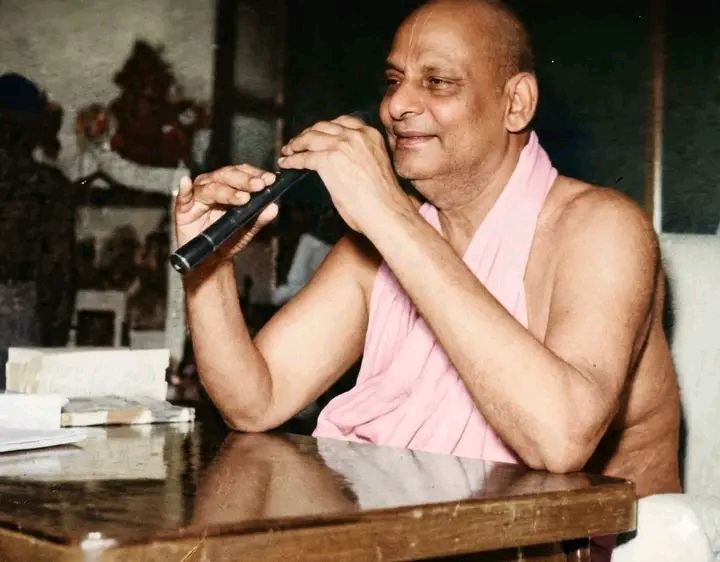
Swami Sivananda speaking into microphone seated at table. image
Celestial Collection of Divine Messages - Awakening the Divinity in Man, Swami Sivananda

Glory of Ramanama

Glory of Ramanama Sri Swami Sivananda Blessed Immortal Self, It gives me great pleasure to send you this short message on the celebration of the Ramanavami day. Lord Rama was the prince of the Ikshvaku race. He was virtuous and of manly strength. He was the Lord of the mind and the senses. Brave and valiant, he was yet gentle and modest. He was a sage in counsel, kind and sweet in speech and most courteous, and handsome in appearance. He was the master of divine weapons, and a great Atiratha. Ever devoted to the good and prosperity of his kingdom, he was a defender of the weak and the protector of Dharma. Endowed with wondrous powers of the mind, he was well versed in all sciences, in the science of arms or Dhanurvidya, as well as in the science of the Self. Deep and unfathomable like the ocean, firm and steadfast like the Himalayas, valiant like Vishnu, he was the joy of Kausalya. Though fierce like fire on the battle-field, he was calm like the cool breeze of the Mandara Hills, patient like Mother Earth, bounteous like Kubera and righteous like Dharma, the Lord of justice himself. In pains or griefs of his people his heart swiftly sympathised with the sufferer. In the festive scenes which held them in joy, he, like a father shared their joy. By his honour and heroism, as well as by his gentleness and love for his subjects, he endeared himself to the heart of his people. Such a great Lord, Rama was, and his birthday which you are celebrating today, is equally great and auspicious to us all. The Name of Sri Rama is sweeter than the sweetest objects. It is the haven of peace. It is the very life of pure souls. It is the purifier of all purifying agencies. It quenches the consuming fire of worldly desires. It awakens the knowledge of God which is dormant in our hearts. It bathes the aspirant in the ocean of divine bliss. Glory to Sri Rama and His Name. Blessed is the pious soul who drinks uninterrupted the nectar of Sri Rama’s Name, which has been churned out of the ocean of the Vedas, which removes the impurities of Kali Yuga or the iron age, which lives constantly on the tongue of Lord Siva, which is a sovereign remedy or unfailing specific to cure the disease of worldly existence and is life itself to mother Janaki. Tulsidas says, “Name is even superior to the Lord because the Aguna and Saguna aspects are tasted and realised by the power of Name. Rama delivered from the curse a single lady, Ahalya, whereas His Name has purified crores of wicked men! Rama gave salvation to two of his faithful servants, Jatayu and Sabari, but the Name has been the saviour of countless wicked persons.” He further says, “The two sweet fascinating letters RA and MA are like the two eyes of the alphabet and the very life-breath of the devotees. They are easy to remember and delightful to all. They are beneficial in this world and sustain us in the other world.” He tells the Sadhaka thus: “Put this jewel—Light of Rama-Nama at the gate of your door—the tongue, if you want to illuminate yourself, both inside and outside. All the world knows that by uttering the Name even in the opposite way, as ‘Mara, Mara’ instead of Rama, Rama’, the great saint Valmiki became Brahman Himself.” When such is the glory of the repetition of the Lord’s Name in the opposite way, then what to speak of the utterance of the right and proper Name! The means by which Sri Rama can be reached is to take His Name and to remain saturated in it. Always remain drunk, imbibing the Lord’s sweet Name. Let no ideas of purity or impurity enter your mind. There is no unholy object in this world. Should there be any, it becomes the holiest of the holy by contact with the Lord’s Name. Illusion, notwithstanding all her efforts, fails to get hold of him who remains deeply absorbed in the Lord’s Name and love. Glory to Lord Rama! Adorations to Sri Rama! Prostrations to Sri Rama! Lord Rama was Maryada Purushottama. He was a Prema Moorti. He was an ideal son, an ideal brother, an ideal husband, an ideal friend and an ideal king. He can be taken to embody all the highest ideals of man. He led an ideal life of a householder to teach humanity. He ruled his people so nicely that his rule came to be called “Rama Rajya,” meaning “the rule of righteousness,” the rule which bestows on all happiness and prosperity. May Lord Rama bestow his choicest blessings on you all! May he protect you all and bless you! May you all live drowned in the ocean of divine ecstasy through constant repetition of Lord Rama’s Name. May peace be unto all! May prosperity be unto all! May happiness be unto all! Let us all sing: Om Sri Ram Jaya Ram Jaya Jaya Ram,Om Sri Ram Jaya Ram Jaya Jaya Ram.

Glory of Ramanama Read Post »

The Three Governing Factors of Sadhana 1
Bhrama Muhurata Meditative Talks at Swami Sivananda Ashram - Rishikesh, Swami Sivananda

Looking at Problems from a Different Angle of Vision

Looking at Problems from a Different Angle of Vision By Sri Swami Chidananda Sometimes a seeker will ask themselves a question: Why is it that a spiritual seeker seems to be plagued with so many vexing problems, obstacles, hurdles and various complicated situations that do not seem to be present in the life of a normal human being going about his secular vocation? He may have some problems with income tax or getting his child admitted in a proper school, but he does not have too many deep problems and complications in the inner dimension of his subjective life. The answer is because spiritual life is going against the stream of life. It is like the difference between a person swimming downstream, going along with the current and a person swimming upstream against the current. So naturally the person swimming upstream has a great deal of counter-force to overcome, whereas the person going downstream need not make much effort. They take the means of least resistance, so flow along. This is an explanation of why you have these problems. You have set yourself a great goal, and to move towards it with the minimum of difficulty, one method is to walk in the footsteps of the great ones who have gone before. They went the same way, lived the same life, encountered many difficulties and attained the goal. Follow the steps they took to overcome everything until they reached the goal. So contemplate the lives of saints. Keep them as your ideal, see their life and draw inspiration. Be guided by their wisdom teachings also. They have given their life as an ideal, and they have left valuable pointers through their own personal teaching and words of advice. We get all these things from the lives of saints. So keeping the life of some ideal saint as your inspiration and guidance is the wise method of progressing upon this path. A second method of sometimes dissolving what appears to be a big difficulty, a hurdle on the way, is to look at it with a different angle of vision. Say: “No, this is not a problem. This situation is necessary for me. God knows my degree of evolution, where I stand. At this point in my spiritual evolution, this is what I require in order to learn many insights and to put forth my inner resources so that I may progress further.” This, therefore, is another way of looking at a problem. Welcome it! “This is necessary for me, therefore, it is coming. Otherwise, it would not come. If I go into a higher dimension or plane of evolution, then such things will not come because I have already gone beyond them. I don’t need them.” Thus, we take the problem not as a problem, but as an opportunity, an occasion, to manifest whatever inner resources we have developed up till now through our spiritual life and spiritual sadhana and practice–our dispassion, whatever we have learned. Now we have to test it in the field. Therefore, the situation, the seeming problem is giving us just that opportunity to test how far we are well established in our progress. We take it as a challenge, an opportunity to convince ourselves that we are well established in whatever we have gained thus far–we are not standing on a foundation of sand, but of rock. So, take everything in a creative attitude, in a positive and constructive attitude. This is the way to keep up enthusiasm and thus thrive in your spiritual life. See the inner value of these situations; know that they are important and necessary and that we can gain from them! May God bless us all!

Looking at Problems from a Different Angle of Vision Read Post »

214835459 4148525121893043 3198866625048083145 n
Celestial Collection of Divine Messages - Awakening the Divinity in Man, Swami Sivananda

The Key To Your Transformation

The Key To Your Transformation Sri Swami Chidananda Radiant Atman! The words aviveki, viveki and sadhaka refer to three different types of individuals. An aviveki is a person who does not discriminate. All the lessons in life which God sends him or her are wasted, because he or she is in ajnana (ignorance). And ajnana is the outcome of aviveka (non-discrimination). On the other hand, a viveki is a person who does discriminate. He learns the lessons of life, but they have no effect on him. His learning and the lessons he has learned are stored up in his head; they produce no fruit because they are not applied. He does not allow these lessons to have a powerful impact upon him. But a true sadhaka (spiritual aspirant) is one who is both a viveki as well as one who actively reacts to whatever lessons life brings in the course of going through it, the experiences that form part of it. Nothing is wasted upon the true sadhaka. Everything produces a change, a transformation for the better. Everything brings forth from the true sadhaka and seeker a certain positive, creative response, after which he is never the same as before. He is changed. His character, his nature, his very life becomes enriched, enhanced by something new which was not there previous to the impact the experience had upon him. Two hundred years ago, there was born a grandchild, a baby girl, in the family of a very renowned Japanese warrior, a samurai. He was a great warrior, very brave and heroic. And the baby girl was a most beautiful child. She grew up to be a maiden of such exceptional and unusual beauty that the family thought it fitting that she be offered to the Empress of the country as a handmaiden or servant. At that time the Japanese were ruled by emperors. So they took her to the palace and the Empress and the entire royal family were also struck by the beauty of this girl. She was found to be very keenly intelligent, very active and very perceptive. So she soon became a favourite and an important part of the Empress’ retinue. Unfortunately, within a few years, while the girl was still in her teens, the Empress, whose health had been apparently perfectly normal, suddenly passed away. This sudden passing had such a profound impact upon this young girl that something stirred deep within her and a sudden change came into her entire psychology. She said: “What is this life? Everything is vain. Everything passes away. There is no stability; nothing can be relied upon. Nothing is real. Everything is evanescent, transitory, ephemeral, perishable and passing.” She was very intelligent person, and so profound was this conviction that she lost all interest in life and determined then and there: “I must pursue the path of meditation and enlightenment.” She determined to become a Zen nun, a seeker and a meditator. Everyone was shocked. Her whole family was in an uproar. They said: “Impossible! It is against our family tradition. You are too young for this; you are unprepared. You must marry. Moreover, it will not be possible for you to be a nun having such great beauty as God has endowed you with.” She yielded to them upon one strict condition–that after she had mothered three children, the marriage agreement would be at an end she would then become a nun. No one believed that such a thing would be possible and so they readily agreed and arranged a match for her. She also told her future husband and in-laws the same thing–that only on this condition would she be willing to enter into wedlock. All agreed and so she was married. Dutifully she served her husband and in-laws, took a full interest in family affairs, looked after the household and behaved in a one hundred per cent normal way. But, at the same time she was a keen student of Zen literature and practised meditation. Still, in all ways she was an efficient house-wife, a good wife, and obedient daughter-in-law and a good daughter to her parents. However, after the third child had been born and reared for a few months, she suddenly announced that her promise had been fulfilled. She would no longer continue in the family life and instead would take to the life of a Zen nun. In spite of all protests, she shaved her head and silenced them with a reminder of their promise. She then left everything, put on a nun’s robe and wandered away in search of a Zen master. She went to a great city where a famous master was and asked to be taken in discipleship. She was refused due to her beauty. She went to another master where she was also refused on the ground of her beauty. Therefore, she determined that this obstacle should be removed. So, one day, in the privacy of her room she made a big fire, put a iron rod into it and branded her face. She made her face ugly beyond recognition and thus lost her beauty forever. She then went back to the second master who immediately accepted her as a disciple. She soon became a very earnest and sincere practitioner of the Zen way of life and advanced spiritually in an amazing manner. Such was her determination. And it was all due to the way in which she was able to react when confronted by the sudden death of her patron, the Empress. Of the hundreds of others who must have been in the service of the palace and the Empress, some would have wept, mourned for some time and then adjusted themselves. Others might have been thoughtful and reflected and for some time had some smasana vairagya (graveyard dispassion). They might have stopped wearing ornaments or good clothes. But soon they too would have reverted to normal, back to square one, as they say, or into the old rut. But here was one who was not only not an aviveki, not only not ignorance, not only not merely a viveki, but was one who was also practical,

The Key To Your Transformation Read Post »

1 Qp9JBmSoMGEEB444uj43Tg e1772095155743
Bhrama Muhurata Meditative Talks at Swami Sivananda Ashram - Rishikesh, Swami Sivananda

Practise Your Conviction

Practise Your Conviction By Sri Swami Atmaswarupananda Early Morning Meditation Talk given in the Sacred Samadhi Hall of Gurudev Sri Swami Sivanandaji Maharaj, Sivananda Ashram, Rishikesh The scriptures tell us that we live, move and have our being in God. More than that, they affirm our identity with God. To realise these truths, Gurudev urged us to practise integral yoga: “See your work as worship. Be devoted to God. Repeat His name. Meditate on Him. Think about Him. Enquire who am I?” But even if we are fortunate enough to have the temperament and ability to fill our days with spiritual practices, we can come to what could be called a stalemate. Pujya Swami Chidanandaji dealt with this in his book Ponder These Truths in a talk called “Practise Your Conviction.” In that talk, Swamiji related how a devotee had approached him saying, “We are convinced of the truth of the scriptures. There is no doubt in our minds that God alone is; He is the only permanent Reality. But our conviction doesn’t seem to make a change in our lives. We seem much the same as we have always been.” Swamiji offered a solution. Not a magic one, but a very practical one that follows the scriptures. He said, “You must practise your conviction.” Is there a difference between doing spiritual practices and actually practising them? The truth is, we can live a spiritual life without coming to the essence of it. So Swamiji said, “You are convinced that God alone is; He is the only reality; your only true relationship is with Him–which means that all other relationships are false relationships–therefore, practise that conviction. Constantly affirm the truth of your true relationship and deny and reject all other relationships.” This includes our relationships to our family, to our institution, even to our guru. All these are temporary relationships. Our only true relationship is with God. Swamiji continued, “If you will practise this, then gradually your intellectual conviction will deepen into feeling. You will feel the truth of it, and ultimately that bhav will ripen into anubhav or direct experience.” We can bring about the same results through devotion, through surrender, offering everything to God and putting ourselves into His hands. But it is only when we move away from the surface of our life right down to where we live, to where our deepest convictions are, that our spiritual life actually begins to move. We have to get down to who we think we are and to where our relationships have their source. Most of us are filled with a network of relationships and identities that have nothing to do with God in His essence. We must deny all those temporary relationships and affirm the truth of our real relationship. This is the practice of our conviction that Swamiji urged us to follow. He said, “This is the Vedantic method–the affirmation of your true relationship with God and the denial and rejection of all false, temporary relationships.”

Practise Your Conviction Read Post »

images 2026 02 24T121140.029
Celestial Collection of Divine Messages - Awakening the Divinity in Man, Swami Sivananda

The Heart Of The Spiritual Problem

The Heart Of The Spiritual Problem Sri Swami Chidananda What is the heart of the spiritual problem of the individual soul upon this earth plane, who is in a state of bondage to an earth consciousness, a limited individual consciousness which is referred to as jivahood? It is important to try to understand or to get to the essence of this metaphysical problem, this cosmic problem of the individual soul imprisoned in a structure made of flesh and bones, in a labyrinth, a net, of constant, unceasing thoughts, fancies, imaginations, memories and projections into the future. These constitute an inner mesh or net in which we are caught and held firmly, for the identification with the psycho-physical dimensions of our personality is so total, so complete, that it has become normal. It has become the one and only consciousness that we know. It has become our natural condition although Vedantic psychology would describe it as abnormal. It is an aberration. Thus, Swami Vivekananda, trying to make his Western audience understand this subtle, inner metaphysical point a hundred years ago used the term “dehypnotise.” When they suggested that Vedantic affirmations such as “I am Atman, I am immortal, I am without birth and death, name or form,” were only a form of self-hypnosis, he replied: “On the contrary, you have been hypnotised into thinking I am the body, I am a human being, I am so and so, I belong to this family, to this country.” What Vedanta wants to do is to dehypnotise you from the hypnotised condition you have fallen into through birth after birth of wrong thinking.” Thus it is that we have to go through a process of trying to discover what it is into which we have landed through ages of wrong thinking. That state Vedanta pinpoints as a state of identification with that which we are not, a total moving away from the centre of our real, natural awareness of what we are. Moving away, completely forgetting and becoming disconnected, as it were, from the awareness or from the consciousness of what we really and truly are, we have entered into a state of consciousness identifying ourselves and thinking ourselves to be something which we are not. We are immortal Spirit, but we think we are people subject to birth and death, a beginning and an end, a birth day and an epitaph. So, Vedanta precisely pinpoints our situation as this state of forgetfulness of our real nature and being totally caught up, entangled and overcome by a wrong awareness, an identification with a personality consciousness which is not our real consciousness. Out of this wrong identification has arisen a false ego-sense, and we are held in bondage to this wrong, vitiated consciousness dominated by ego and totally pervaded by selfishness which is the outcome of ego and which leads to a self-centred, self-seeking life. This is the present malady. And, this condition seems to be our real, natural condition, whereas it is a diseased one. It is called bhava-roga (disease of transmigration). The bondage of earth life is not outside you. It is not made up of anything other than your own self. It is not the outer world perceived by the five senses that constitutes prapancha or samsara or earth life. It is this inner state of becoming completely deprived of our true awareness and becoming enslaved by a wrong consciousness dominated by a false ego and further complicated by selfishness that is the natural immediate outcome of the ego and its attachments to so many things. It is this wrong awareness of ourselves, this self-centred, self-seeking life that is the root cause of all clash and conflict with others, differences of opinion, disharmony, discord, prejudice, bias, hatred, misunderstanding, envy, jealousy, suspicion and anger. Everything stems from this basic state which constitutes your bhava-roga. Bhava-roga is not outside, it is inside. Samsara or prapancha or bandhana (binding) are not outside, they are inside. Therefore, the first process is to somehow or other clearly perceive this. Because, as long as you do not clearly perceive this and honestly accept this state of yours, kaivalya moksha, liberation and illumination are all far, far away. They are only so much of fancy. They are only a vapour of imagination. We must clearly perceive this state, and we must be honest enough to admit this very painful truth about the actual inner state of our consciousness. It is not at all flattering, but unless there is honesty about oneself we cannot step into spiritual life even if we know all about Vedanta. For the spiritual life has two dimensions. One is the Vedanta siddhanta (doctrine) of the ultimate experience, but the other is vyavahara (worldly activity). Unless Vedanta is brought over into vyavahara, it is only a burden to us. Siddhanta is useless unless it is brought down to the level of abhyasa (practice), and takes the form of sadhana in day-to-day living—in your everyday activity, thinking and feeling, reaction to things around you, and your relationship with others with whom you have to live. These have been provided by God Himself for the jivatma as a field of sadhana so that siddhanta can be applied, so that one may begin to move towards Truth-experience, Reality-consciousness. Unless we understand our position in samsara to be thus, unless we see it as a gymnasium in which to exercise and strengthen our inner spiritual sinews and muscles, we are the losers. We shall ever be in a wonderful field, yet we will not be able to take advantage of it, because we will be thinking that sadhana is somewhere in a forest or inside a cave. It is inside a cave, but the cave is inside us. We must see very clearly that it is here, it is now, it is in this way that I have to evolve. There is not going to be another opportunity given. If we fail to recognise and bypass the opportunity that God has given, then we are losers. Every moment, every day that dawns is a great, golden chance and opportunity given. The field is immediately reopened afresh for you to exercise practical Vedanta, for you to put siddhanta into abhyasa. This constitutes practical

The Heart Of The Spiritual Problem Read Post »