








Hari Om

Menu

February 20, 2026

swami sivananda Guru seated with two women devotees image
Practice of Concentration, Swami Sivananda

Gist of Yoga of Concentration

Gist of Yoga of Concentration It is very difficult to say where concentration ends and meditation begins. Meditation follows concentration. Purify the mind first through the practice of Yama and Niyama. Then take to the practice of Dharana. Concentration without purity is of no use. Concentration is steadfastness of mind. If you remove all causes of distraction, your power of concentration will increase. A true Brahmachari who has preserved his Virya will have powerful concentration. Attention plays a prominent part in concentration. He who has developed his power of attention will have good concentration. You should be able to visualise very clearly the object of concentration even in its absence. You must call up the mental picture in a moment’s notice. If you have good practice in concentration you can do this without difficulty. He who has gained success in Pratyahara (abstraction) by withdrawing the Indriyas from the various objects will have good concentration. You will have to march in the spiritual path step by step, stage by stage. Lay the foundation of Yama (right conduct), Niyama, Asana (posture), Pranayama and Pratyahara to start with. The superstructure of Dharana (concentration), Dhyana (meditation), and Samadhi will be successful then only. Asana is Bahiranga Sadhana (external); Dhyana is Antaranga Sadhana (internal). When compared with Dhyana and Samadhi, even Dharana is Bahiranga Sadhana. He who has steady Asana and has purified Yoga-Nadis and the Pranamaya Kosha (vital sheath) through Pranayama will be able to concentrate easily. You can concentrate internally on any of the seven plexus or Chakras or centres of spiritual energy viz., Muladhara, Svadhishthana, Manipura, Anahata, Vishuddha, Ajna and Sahasrara, or on the tip of the nose, or on the tip of the tongue or externally on the picture of any Devata, Hari, Hara, Krishna or Devi. You can concentrate on the ‘tik-tik’ sound of a watch or on the flame of a candle, or on a black point of a wall, or on a pencil or rose flower or any pleasing object. This is concrete concentration (Sthoola). There can be no concentration without something upon which the mind may rest. The mind can be fixed easily on a pleasing object such as jasmine flower, mango or orange or a loving friend. It is difficult to fix the mind in the beginning on any object which it dislikes such as faecal matter, cobra, enemy, ugly face, etc. Practise concentration till the mind is well established in the object of concentration. When the mind runs away from the object of concentration, bring it back again and again to the object. Lord Krishna says in the Gita: “Yato yato nischarati manas-chanchalam-asthiram, Tatastato niyamyaitad-atmanyeva vasam nayet-As often as the wavering and unsteady mind goes forth, so often reining it in, let him bring it under the control of the Self.” If you want to increase your power of concentration, you will have to reduce your worldly activities (Vyavahara-Kshaya). You will have to observe Mouna (vow of silence) also for two hours daily. A man whose mind is filled with passion and all sorts of fantastic desires can hardly concentrate on any object even for a second. His mind will be jumping like a balloon. Regulate and master the breath. Subdue the senses and fix the mind on any pleasing object. Associate the ideas of holiness and purity with the object. You can concentrate on the space between the two eyebrows (Trikuti). You can concentrate on the mystic sounds (Anahata Dhvani) that you hear from your right ear. You can concentrate on ‘Om’ picture. The picture of Lord Krishna with flute in hand and the picture of Lord Vishnu with conch, discus, mace and lotus are very good for concentration. You can concentrate on the picture of your Guru or any saint. Vedantins try to fix the mind on Atman, the Inner Self. This is their Dharana. Dharana is the Sixth stage or limb of Ashtanga Yoga or Raja Yoga of Patanjali Maharshi. In Dharana you will have only one Vritti or wave in the mind-lake. The mind assumes the form of only one object. All other operations of the mind are suspended or stopped. He who can practise real concentration for half or one hour will have tremendous psychic powers. His will also will be very powerful. When Hatha Yogis concentrate their minds on Shadadhara or the six supports (the Shat-Chakras), they concentrate their minds on the respective presiding Devatas also, viz., Ganesha, Brahma, Vishnu, Rudra, Isvara and Sadasiva. Control the breath through Pranayama. Subdue the Indriyas through Pratyahara. And then fix the mind either on Saguna or Nirguna Brahman. According to the Hatha Yogic School, a Yogi who can suspend his breath by Kumbhaka for 20 minutes can have very good Dharana. He will have a very tranquil mind. Pranayama steadies the mind, removes Vikshepa (distraction) and increases the power of concentration. Those who practise Khechari Mudra by cutting the frenum lingua and lengthening the tongue and fixing it in the hole beyond the palate by taking upwards, will have good Dharana. Those who can practise concentration evolve quickly. They can do any work with scientific accuracy and great efficiency. What others do in six hours can be done by one who has concentration within half an hour. What others can read in six hours, can be read by one who has concentration within half an hour. Concentration purifies and calms the surging emotions, strengthens the current of thought and clarifies the ideas. Concentration helps a man in his material progress also. He will have a very good outturn of work in his office or business-house. What was cloudy and hazy before becomes clear and definite. What was difficult before becomes easy now and what was complex, bewildering and confusing before comes easily within the mental grasp. You can achieve anything through concentration. Nothing is impossible to a man who practises regular concentration. It is very difficult to practise concentration when one is hungry and when one is suffering from an acute

Gist of Yoga of Concentration Read Post »
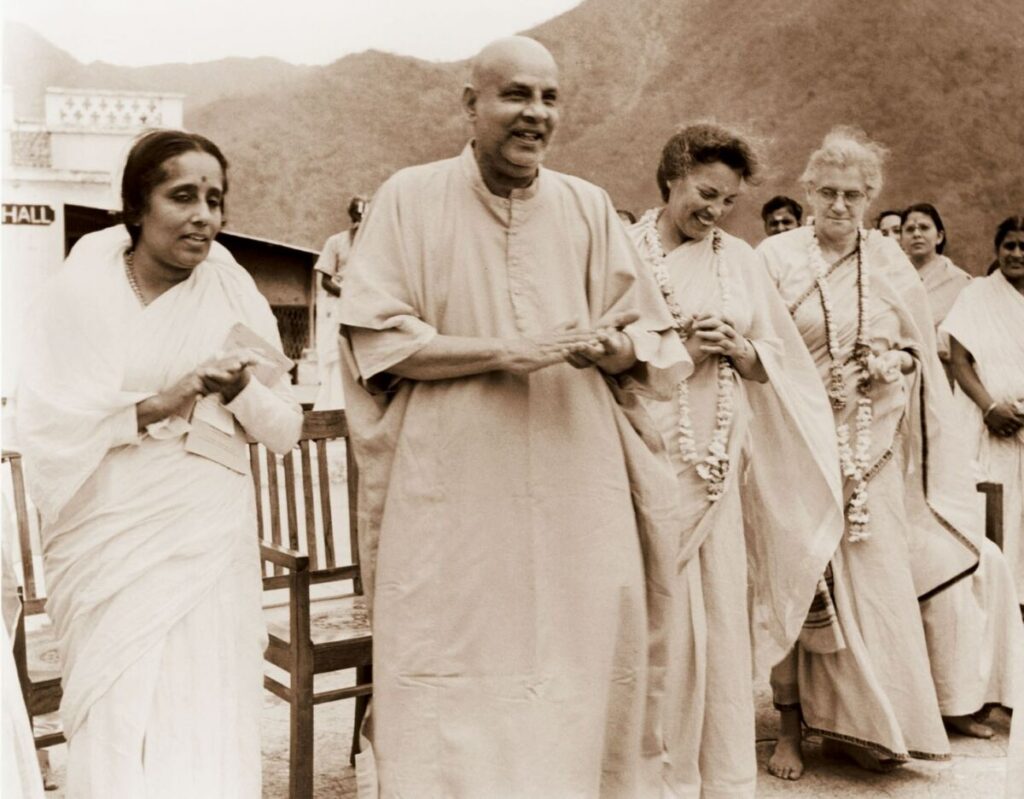
Swami Sivananda walking with devotees during spiritual gathering image
Practice of Concentration, Swami Sivananda

Concentration in Every Walk of Life

Concentration in Every Walk of Life Concentration is a very important qualification for a beginner in the spiritual path. Concentration is required not only in the spiritual path but also in every walk of life. A man without concentration is a failure in life. Concentration in a spiritual sense means the one-pointedness of the mind. It is the fixing of one’s mind on the Ishta Devata or the deity of one’s choice. To attain concentration you should drive off all useless thoughts of the world. You must be entirely free from all base desires of a worldly nature. You should substitute divine thoughts in their stead. Meditation follows concentration. Samadhi follows meditation. Jivanmukti state follows the attainment of Nirvikalpa Samadhi which is free from all thoughts of duality. Jivanmukti leads to emancipation from the wheel of birth and death. Therefore concentration is the first and foremost thing a Sadhaka or aspirant should acquire in the spiritual path. Every little act demands concentration and your whole- hearted attention. If you want to pass a thread through the eye of the needle you must remove all fibres that are disjointed. Then you must make it a single fibre and with great care and one-pointed thought pass the thread into the needle. When you climb a mountain or get down a steep descent you will have to be very careful. Otherwise you will have a slip and fall into the deep abyss below. When you ride a bicycle, you talk to your friends on the road, a motor-car will dash against you from behind. If you are a bit absent-minded when you walk on the road, you will strike against a stone and fall down. A careless barber will cut the nose of his customer. A careless washerman will burn the clothes of his master. A sleepy aspirant will dash his head against the wall or fall down prostrate on the ground. Therefore you must develop attention. Attention leads to concentration. Fix your mind on the work at hand. Give your complete heart and soul to it. Let it be even a small work like peeling off the skin on a plantain fruit or squeezing a lemon. Never do anything haphazardly. Never take your meals in haste. Be calm and patient in all your actions. Never arrive at hasty conclusions. Never do a thing in haste. No work can be done successfully without calmness and concentration. Those who have attained success and become great have all possessed this indispensable virtue. You will be successful in every attempt. You will never meet with failure if you can do your work with perfect attention and concentration. When you sit for prayers and meditation never think of your office-work. When you work in the office never think of the child who is sick or any other household work. When you take bath do not think of games. When you sit for meals do not think of the work that is pending in the office. You must train yourself to attend to the work on hand with perfect one-pointedness. You can easily develop your will-power and memory. Concentration is the master-key to open the gates of victory. If an ordinary man takes one hour to do a work, a man of good concentration will accomplish it in half an hour with better efficiency than the former. You will become a mighty man.You must know very well the science of relaxation of the mind. You must be able to eliminate all other thoughts from the mind. You must think of rest only. You should consider yourself as if you were dead. Mentally repeat the names of the Lord and think of the Ananda aspect of His attribute. You will not have dreams. You will rest in blissful sleep. You will be refreshed very easily. Even if you sleep for two hours you would feel quite refreshed.

Concentration in Every Walk of Life Read Post »

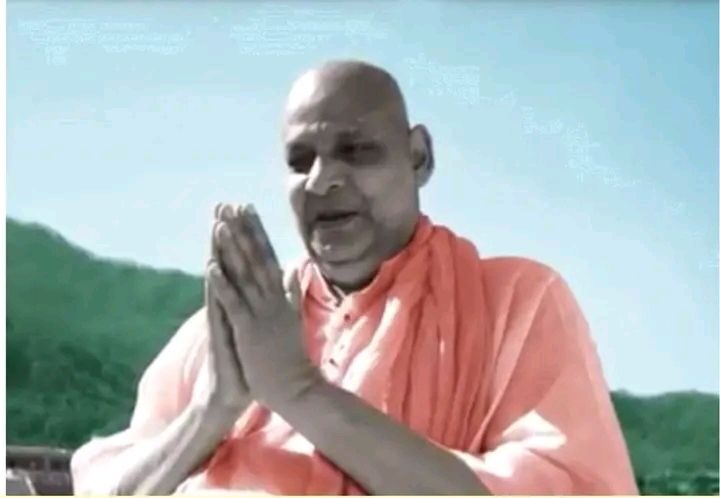
Swami Sivananda folded hands greeting outdoors image
Practice of Concentration, Swami Sivananda

Attention

Attention You must evince good interest in the practice of concentration. Then only your whole attention will be directed towards the object upon which you wish to concentrate. There can be really no concentration without a remarkable degree of interest and attention shown by the practitioner. You must, therefore, know what these two words mean. Attention is steady application of the mind. It is focussing of consciousness on some chosen object. Through attention you can develop your mental faculties and capacities. Where there is attention, there is also concentration. Attention should be cultivated gradually. It is not a special process. It is the whole mental process in one of its aspects. Perception always involves attention. To perceive is to attend. Through attention you get a clear and distinct knowledge of objects. The entire energy is focussed on the object towards which attention is directed. Full and complete information is gained. During attention all the dissipated rays of the mind are collected. There is effort or struggle in attention. Through attention a deeper impression of anything is made in the mind. If you have good attention, you can attend to the matter in hand exclusively. An attentive man has very good memory. He is very vigilant and circumspect. He is nimble and alert. Attention plays a very great part in concentration. It is the basis of the will. When it is properly guided and directed towards the internal world for the purpose of introspection, it will analyse the mind and illumine very many astounding facts for you. Attention is focussing of consciousness. Attention (Avadhana) plays a conspicuous part in concentration. It is one of the signs of trained will. It is found in men of strong mentality. It is a rare faculty. Brahmacharya wonderfully develops this power. A Yogi who possesses this faculty can even fix the mind on an unpleasant object for a very long time. It is easy to fasten the mind on an object which the mind likes best. Attention can be cultivated and developed by persistent practice. All the great men of the world who have achieved greatness have risen up through this faculty. Throw your entire attention into whatever you happen to be doing at the moment. Practise attention on unpleasant tasks from which you have been shrinking before on account of their unpleasantness. Throw interest upon uninteresting objects and ideas. Hold them on before your mind. Interest will slowly manifest. Many mental weakness will vanish. The mind will become stronger and stronger. The force wherewith anything strikes the mind, is generally in proportion to the degree of attention bestowed upon it. Moreover the great art of memory is attention; inattentive people have bad memories. The human mind has the power of attending to only one object at a time, although it is able to pass from one object to another with a marvellous degree of speed, so rapidly in fact, that some have held that it could grasp several things at a time. But the best authorities, eastern and western, hold to the “single idea” theory as being correct. It agrees with one’s daily experience also. If you analyse carefully the mental functions or operations, no one process can be singled out and called attention. It is not possible to separate attention as a distinct function. You observe something; therefore you are attentive. Attention belongs to every state of consciousness and is present in every field of consciousness. An attentive student in the spiritual path can do hearing (Sravana) of the Srutis in an efficient manner. The military officer says “attention,” and the soldier is ready with his gun to carry out his behests. An attentive soldier alone can hit the mark. No one can get success either in temporal or spiritual pursuits without attention. There are Yogis who can do eight or ten or even hundred things at a time. This is not strange. The whole secret lies in the fact that they have developed their attention to a remarkable degree. All the great men of the world do possess this faculty in varying degrees. Attention is of two kinds, viz., external attention and internal attention. When the attention is directed towards external objects, it is called external attention. When it is directed internally within the mind upon mental objects and ideas, it is known as internal attention. There are again two other kinds of attention viz., voluntary attention and involuntary attention. When the attention is directed towards some external objects by an effort of the will, it is called voluntary attention. When you have an express volition to attend to this or that, it is called voluntary attention. The man understands why he perceives. Some deliberate intention, incentive, goal or purpose is definitely involved. Voluntary attention needs effort, will, determination and some mental training. This is cultivated by practice and perseverance. The benefits derived by the practice of attention are incalculable. Involuntary attention is quite common. This does not demand any practice. There is no effort of the will. The attention is induced by the beauty and attractive nature of the object. Individuals perceive without knowing why and without observed instruction. Young children possess this power of involuntary attention to a greater degree than grown up people. If a man is not observant, he is not attentive. If he observes something, he is said to be attentive. Intention, purpose, hope, expectation, desire, belief, wish, knowledge, aim, goal and needs serve to determine attention. You will have to note carefully the degree, duration, range, forms, fluctuations and conflicts of attention. There is great attention, if the object is very pleasing. You will have to create interest. Then there will be attention. If the attention gets diminished, change your attention to another pleasant object. By patient training you can direct the mind to attend to an unpleasant object also by creating interest. Then your will will grow strong. If you closely watch, you will note that you observe different objects at different times. This

Attention Read Post »

swami sivananda Spiritual monk seated by riverside wearing shawl and garland photo
Practice of Concentration, Swami Sivananda

Practice of Concentration

Practice of Concentration by Swami Sivananda Fix the mind on some object either within the body or without. Keep it there steadily for some time. This is concentration. You will have to practise this daily. Purify the mind first through the practice of right conduct and then take to the practice of concentration. Concentration without purity of mind is of no avail. There are some occultists who have concentration. But they have no good character; that is the reason why they do not make any progress in the spiritual life. He who has a steady posture and has purified his nerves and the vital sheath by the constant practice of control of breath will be able to concentrate easily. Concentration will be intense if you remove all distractions. A true celibate who has preserved his energy will have wonderful concentration. Some foolish, impatient students take to concentration at once without undergoing, in any manner, any preliminary training in ethics. This is a serious blunder. Ethical perfection is a matter of paramount importance. You can concentrate internally on any of the seven centres of spiritual energy. Attention plays a very prominent part in concentration. He who has developed his powers of attention will have good concentration. A man who is filled with passion and all sorts of fantastic desires can hardly concentrate on any subject or object even for a second. His mind will be jumping like an old monkey. He who has gained abstraction (withdrawing the senses from the objects) will have good concentration. You will have to march on in the spiritual path step by step and stage by stage. Lay the foundation of right conduct, postures, regulation of breath and abstraction to start with. The superstructure of concentration and meditation will be successful then only. You should be able to visualise the object of concentration very clearly even in its absence. You will have to call up the mental picture at a moment’s notice. If you have concentration you can do this without much difficulty. In the beginning stage of practice, you can concentrate on the ‘tic-tic’ sound of a watch or on the flame of a candle or any other object that is pleasing to the mind. This is concrete concentration. There is no concentration without something to rest the mind upon. The mind can be fixed on any object in the beginning which is pleasant. It is very difficult to fix the mind, in the beginning, on an object which the mind dislikes. Sit in lotus-pose (Padmasana) with crossed legs. Fix the gaze on the tip of the nose. This is called the nasal gaze. Do not make any violent effort. Gently look at the tip of the nose. Practise for one minute in the beginning. Gradually increase the time to half an hour or more. This practice steadies the mind. It develops the power of concentration. Even when you walk, you can keep up this practice. Sit on lotus-pose and practise fixing the mind between the two eyebrows. Do this gently for half a minute. Then gradually increase the time to half an hour or more. There must not be the least violence in the practice. This removes tossing of mind and develops concentration. This is known as frontal gaze. The eyes are directed towards the frontal bone of the forehead. You can select either the nasal gaze or the frontal gaze according to your taste, temperament and capacity. If you want to increase your power of concentration you will have to reduce your worldly activities. You will have to observe the vow of silence every day for two hours or more. Practise concentration till the mind is well established on the object of concentration. When the mind runs away from the object bring it back again.When concentration is deep and intense all other senses cannot operate. He who practises concentration for three hours daily will have tremendous psychic power. He will have a strong will-power.

Practice of Concentration Read Post »
swami sivananda Vintage photo of guru teaching disciples by riverside image
Asanas for Dhyana, Swami Sivananda

padmasana

padmasana Padma means Lotus. When the Asana is demonstrated, it presents the appearance of a Lotus, in a way. Hence the name Padmasana. This is also known by the name Kamalasana. Amongst the four poses prescribed for Japa and Dhyana, Padmasana comes foremost. It is the best Asana for contemplation. Rishis like Gheranda, Sandilya and others speak very highly of this vital Asana. This is highly agreeable for householders. Even ladies can sit in this Asana. Padmasana is suitable for lean persons and for youths as well. TECHNIQUE Sit on the ground by spreading the legs forward. Then place the right foot on the left thigh and the left foot on the right thigh. Place the hands on the knee-joints. You can make a finger-lock and keep the locked hands over the left ankle. This is very convenient for some persons. Or you can place the left hand over the left knee and then place the right hand over the right knee with the palm facing upwards and the index-finger touching the middle portion of the thumb (Chinmudra). VARIATIONS I. Ardha-Padmasana: If you cannot place both the feet on the thighs at the very start, just keep one foot on one thigh for some time and the other foot on the other thigh for some time. After a few days’ practice, you will be able to keep both the feet on the thighs. This is half pose of Padmasana or Ardha-Padmasana. II. Virasana: Sit at ease. Place the right foot on the left thigh and the left foot underneath the right thigh. Lord Gauranga used to sit on this Asana for his meditation. This is a comfortable posture. Virasana means hero posture. III. Parvatasana (Mountain Pose): Do ordinary Padmasana. Stand on the knees and raise your hands above. This is Parvatasana. Keep a thick blanket on the ground and then do this Asana so that you will not injure your knees. In the beginning, for a few days, catch hold of a stool or bench till you get the balance. Afterwards you can raise the hands above. Sit on Virasana and then raise the hands above and be steady. Some persons call this also as Parvatasana. IV. Samasana (Equal Pose): Place the left heel at the beginning of the right thigh and the right heel at the beginning of the left thigh. Sit at ease. Do not bend either on the left or right. This is called Samasana. V. Karmukasana: Sit on ordinary Padmasana. Catch hold of the right toe with the right hand and the left toe with the left hand, thus making a cross of your hand at the elbow. VI. Utthita Padmasana: Sit on Padmasana. Keep your palms on the ground by your sides. Slowly raise the body. There should be no jerks. The body should not be trembling. Retain the breath as long as you remain in that raised position. When you come down you can exhale. Persons who cannot perform Kukkutasana can do this. The hands are kept by the sides in this Asana, but the hands are kept between the thigh and calf muscles in Kukkutasana. This is the difference.

padmasana Read Post »

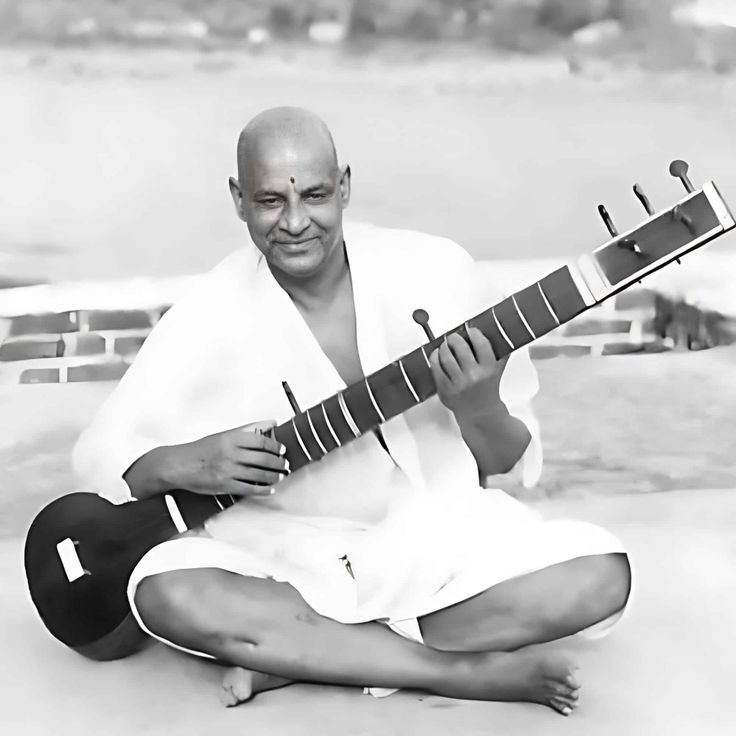
Swami Sivananda sitting and playing tanpura outdoors. image
Meditation, Swami Sivananda

Tap All Powers

Tap All Powers 1. In all man’s struggles and attempts at achieving any desired end, there is in reality no necessity at all for him to go in quest of external forces to aid him. Man contains within himself vast resources, inherent power, lying untapped or else only partially made use of. 2. It is because he has allowed his faculties to get scattered on a hundred different things that he fails to achieve anything great despite his inherent potentialities. If he intelligently regulates and applies them, quick and concrete results will accrue. 3. To learn to rationally and effectively use the existing forces, man need not wait for any striking new methods, etc., to be invented, to guide him. Since the dawn of creation, nature herself abounds in instructive examples and lessons to aid man in every walk of his life. Observation will tell us that every force in nature, when allowed to flow loosely over a wide area, moves slowly and with comparatively less power than it would do if gathered together in one mass and directed through a single restricted outlet. 4. This gathering together of the scattered rays and bringing this force to bear upon a given point,-any object, idea or action-forms the process. 5. As examples of the power generated by a concentration of force are cited (1) the sluggish and leisurely flow of a river, damned and accumulated, rushes out with an amazing force through the sluice, (2) the phenomenon of ton-loads of cargo in heavy wagons being hauled or propelled by the power of steam concentrated in the boiler of the engine, (3) the most common domestic sight, the clattering and displacement of the covering lid of a cauldron when the latter commences to boil very much, (4) the normally warm sun-rays become suddenly so hot as to burn up objects when centralised and brought into focus through the lens. And the simple and commonest of action, where one unconsciously uses this principle, is noticed when a man wishing to hail another a good distance away, automatically cups his palms and shouts through them. 6. This law is equally applicable to man in all branches of his life’s activities. With the utmost concentrated and careful attention, the surgeon executes minute operations. The deepest absorption marks the state of the technician, the engineer, architect or the expert painter, engaged in drawing the minute details of a plan, chart or sketch, where accuracy is of paramount importance. A like concentration is displayed by the skilled Swiss workmen that fashion the delicate parts of watches and other scientific instruments. Thus in every art and science. 7. This is specially so in the spiritual line where the aspirant has to deal with forces internal. The powers of the mind are always scattered and resist attempts at concentration. This oscillatory tendency is an innate characteristic of the mind-stuff. Of the various methods employed to curtail and arrest this tossing of the mind, those using the medium of sound and sight, stand prominent, because these two have a peculiar knack of catching the attention of and stilling the mind. It is seen how a hypnotist gently subdues the mind of the ‘subject’ by making the latter gaze steadily into his (the hypnotist’s) eyes and listen to the monotonous repetition of his steady, deliberate suggestions. We have still another clue to this when we note the mother gently croons the little child into slumber. Also the schoolmaster’s sharp, “Now then, boys look here,” whenever he desires them to pay special attention to what he is saying, is significant. He feels that by getting them to fix their gaze on him, he will draw the attention of their minds as well to his teaching. Therefore in the course of spiritual discipline too, the methods of developing concentration take the form of gazing steadily at a dot, or at the symbol of the Pranava, or the Mantra or the figure of the favourite chosen deity. With some others it is done by the audible repetition of the Mantra or the Lord’s name, or OM, or some select Kirtan tunes with regular rhythm and intonation. By these means the mind gradually gets indrawn and focussed. As this state deepens, the person slowly loses awareness of his surroundings. The concentration, when continued, leads to the state of Dhyana or meditation, when the practitioner tends to forget even that physical frame.Meditation, when persisted in and perfected, brings about the experience of superconsciousness or Samadhi, the ultimate state of Self-awareness or Realisation.

Tap All Powers Read Post »

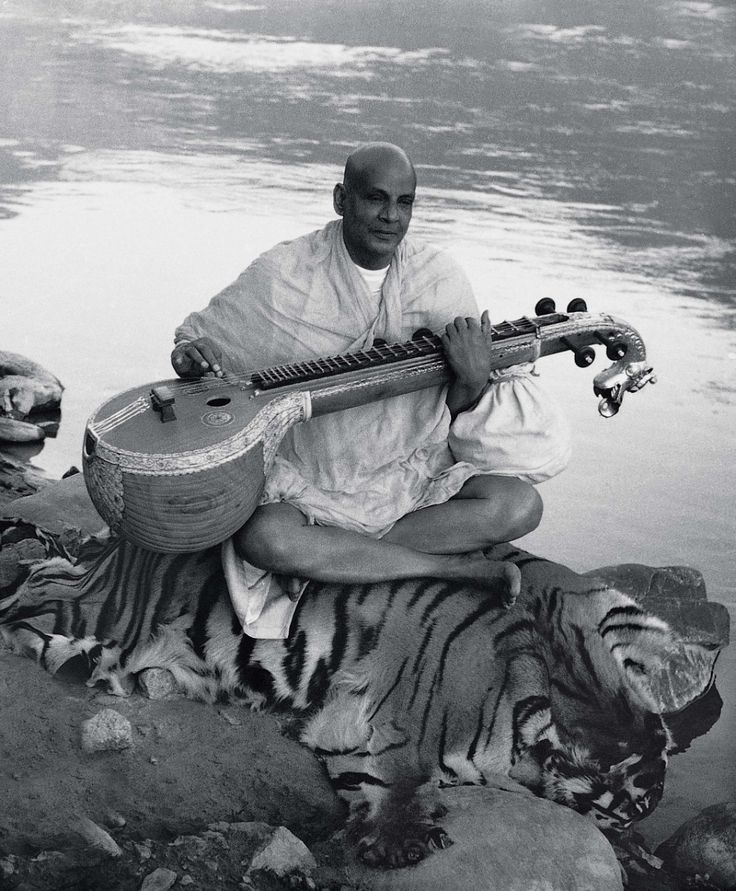
Swami Sivananda playing veena by riverside image
Meditation, Swami Sivananda

Reduce Mind-Wandering

Reduce Mind-Wandering A scientist concentrates his mind and invents many things. Through concentration he open the layers of the gross mind and penetrates deeply into higher regions of the mind and gets knowledge. He concentrates all the energies of his mind into one focus and throws them out upon the materials he is analysing and so finds out their secrets. He who has learnt to manipulate the mind will get the whole of Nature under control. When you see your dear friend after six years, the Ananda (happiness) that you get is not from the person but from within yourself. The mind becomes concentrated for the time being and you get Ananda from within your own self. When the rays of the mind are scattered over diverse objects you get pain. When the rays are gathered and collected by practice the mind becomes concentrated and you get Ananda from within. As mind evolves, you come into conscious relation with mental currents with the minds of others, near and distant, living and dead. When there is faith, the mind can be easily concentrated on the subject to be understood and then the understanding quickly follows. If you find it difficult to concentrate on your heart or the space between the two eyebrows (Trikuti) or top of the head, you can concentrate on any external object. You can concentrate on the blue sky, light of the sun, the all-pervading air or ether or sun, moon or stars. If you experience headache or pain in the skull, shift your centre of concentration to any object outside the body. If you get headache or pain by concentrating on the Trikuti (the space between the two eyebrows) by turning the eyes upwards, give up the practice at once. Concentrate on the heart. The mind thinks of words and their meanings. While at other times it thinks of objects. When you attempt to have one-pointedness of mind, you must make the mind not to think of objects and the words and their meanings. Some medical students leave the medical college soon after joining it as they find it disgusting to wash the pus in ulcers and dissect the dead bodies. They make a serious blunder. In the beginning, it is loathing. After studying pathology, medicine, operative surgery, morbid anatomy, bacteriology, the course will be interesting in the final year. Many spiritual aspirants leave off the practice of concentration of mind after some time as they find it difficult to practise. They also make a grave mistake like the medical students. In the beginning of the practice when you struggle to get over the body-consciousness, it will be disgusting and troublesome. It will be a physical wrestling. The emotions and Sankalpas will be abundant. In the third year of practice the mind will be cool, pure and strong. You will derive immense joy (Ananda). The sum total of pleasures of the whole world is nothing when compared to the Ananda derived from meditation. Do not give up the practice at any cost. Plod on. Persevere. Have patience (Dhriti), Utsaha (cheerfulness), and Sahasa (tenacity, application). You will succeed eventually. Never despair. Find out by serious introspection the various impediments that act as stumbling blocks in your concentration and remove them with patience and effort one by one. Do not allow new Sankalpas and new Vasanas to crop up. Nip them in the bud through Viveka, Vichara and Dhyana. A man’s duty consists in the control of the senses and concentration of the mind. There was a workman who used to manufacture arrows. Once he was very busy at his work. He was so much absorbed in his work that he did not notice even a big party of the Raja with his retinue passing in front of his shop. Such must be the nature of your concentration when you fix your mind on God. You must have the one idea of God and God alone. No doubt it takes some time to have complete Ekagrata of mind. You will have to struggle very hard to have single-minded concentration. Sri Dattatreya made the above arrow-maker as one of his Gurus. Even if the mind runs outside during your practice in meditation, do not bother. Allow it to run. Slowly try to bring it to your Lakshya (centre). By repeated practice the mind will be finally focussed in your heart, in the Atman, the Indweller of your heart, the final goal of life. In the beginning the mind may run out 80 times. Within six months it may run 70 times, within a year it may run 50 times, within 2 years it may run 30 times, within 5 years it will be completely fixed in the Divine Consciousness. Then it will not run out at all even if you try your level best to bring it out, like the wandering bull, which was in the habit of running to gardens of different landlords for eating grass but which now eats fresh gram and cotton seeds in its own resting place. Collect the Rays of Mind. Just as you will have to take back with care your cloth that is fallen on a thorny plant by removing the thorns one by one slowly, so also you will have to collect back with care and exertion the dissipated rays of the mind, that are thrown over the sensual objects for very many years.If there is any inflammatory swelling on your back with throbbing pain, you do not experience any pain at night when you are asleep. Only when the mind is connected with the diseased part through nerves and thinking, you begin to experience pain. If you can consciously withdraw the mind from the diseased part by concentrating it on God or any other attractive object, you will not experience any pain even when you are wide awake. If you have a powerful will and strong Titiksha (power of endurance), then also you will not experience any pain. By constant

Reduce Mind-Wandering Read Post »

Swami Sivananda meditating in lotus pose under tree
Meditation, Swami Sivananda

Know the Ways of Mind

Know the Ways of Mind Dharana is practised for stopping the modifications of the mind. Concentration is holding the mind to one form or object steadily for a long time. Kshipta, Mudha, Vikshepa, Ekagra and Niruddha are the five Yogic Bhumikas. The Chitta or mind manifests in five different forms. In the Kshipta state, the rays of the mind are scattered on various objects. It is restless and jumps from one object to another. In the Mudha state, the mind is dull and forgetful. Vikshipta is the gathering mind. It is occasionally steady and at other times distracted. By practice of concentration the mind struggles to gather itself. In the Ekagra state, it is one-pointed. There is only one idea present in the mind. The mind is under control in the Niruddha state. There is externalising or objectifying power in the mind. This leads to Bahirmukha-Vritti. The mind is drawn towards objects. Through constant Sadhana (spiritual practice) the mind must be checked from externalising. It must be made to move towards Brahman, its original home. There is no limit to the power of the human mind. The more concentrated it is, the more power is brought to bear on one point. You are born to concentrate the mind on God after collecting the mental rays that are dissipated on various objects. That is your important duty. You forget the duty on account of Moha for family, children, money, power, position, name and fame. Mind is compared to quicksilver, because its rays are scattered over various objects. It is compared to a monkey, because it jumps from one object to another. It is compared to moving air, because it is Chanchala. It is compared to a rutting, furious elephant, because of its passionate impetuosity. Mind is known by the name ‘Great Bird,’ because it jumps from one object to another just as a bird jumps from one twig to another, from one tree to another. Raja Yoga teaches us how to concentrate the mind and then how to ransack the innermost recesses of our minds. Concentration is opposed to sensuous desires, bliss to flurry and worry, sustained thinking to perplexity, applied thinking to sloth and torpor, rapture to ill-will. So long as the thoughts of one are not thoroughly destroyed through persistent practice, he should ever be concentrating his mind on one truth at a time. Through such unremitting practice, one-pointedness will accrue to the mind and instantly all the hosts of thoughts will vanish. To remove this (tossing and various other obstacles which stand in the way of one-pointedness of mind), the practice of concentration on one thing alone should be made. Mind is directly or indirectly attached to some pleasing or favourite ideas. When you are in Kashmir, when you are enjoying the picturesque scenery of Gulmarg, Sonmarg, Cheshmashai and Anantanag, your mind will be suddenly upset by shock if you receive a telegram which brings the unhappy tidings of the untimely demise of your only son. The scenery will no longer interest you. You have lost the charm for the scenery. There is ejection of attention. There is depression. It is concentration and attention that gives you pleasure in sight-seeing. “Having made Atman as the lower Arani (sacrificial wood) and the Pranava as the upper Arani, one should see God in secret through the practice of churning which is Dhyana (meditation).”-Dhyanabindu Upanishad. Place a picture of Lord Jesus in front of you. Sit in your favourite meditative pose. Concentrate gently with open eyes on the picture till tears trickle down your cheeks. Rotate the mind on the cross on the chest, long hair, beautiful beard, round eyes, and the various other limbs of His body and fine spiritual aura emanating from His head, and so on. Think of His divine attributes such as love, magnanimity, mercy and forbearance. It is easy to concentrate the mind on external objects. The mind has a natural tendency to go outwards. Desire is a mode of the emotive mind. It has got a power of externalising the mind. Fix the mind on Atman. Fix the mind on the All-pervading pure Intelligence and Self-luminous effulgence (Svayamjyotis). Stand firm in Brahman. Then you will become “Brahma- Samstha” (established in Brahman). Practise concentration of mind. Fix the mind on one object, on one idea. Withdraw the mind again and again when it runs away from the Lakshya and fix it there. Do not allow the mind to create hundreds of thought-forms. Introspect and watch the mind carefully. Live alone. Avoid company. Do not mix. This is important. Do not allow the mind to dissipate its energy in vain on vain thoughts, vain worry, vain imagination and vain fear and forebodings. Make it hold on to one thought-form for half an hour by incessant practice. Make the mind to shape itself into one shape and try to keep the shape for hours together through constant and incessant practice. In trying to concentrate your mind or project a thought even, you will find that you require naturally to form images in your mind. You cannot help it. Do not wrestle with the mind during meditation. It is a serious mistake. Many neophytes commit this grave error. That is the reason why they get easily tired soon. They get headache and they have to get up very often to pass urine during the course of meditation owing to the irritation set up in the micturition centre in the spinal cord. Sit comfortably in Padma, Siddha, Sukha or Svastika Asana. Keep the head, neck and trunk in one straight line. Relax the muscles, nerves and brain. Calm the objective mind. Close the eyes. Get up at 4 a.m. (Brahma Muhurta). Do not struggle with the mind. Keep it calm and relaxed. By manipulating the mind you will be able to bring it under your control, make it work as you like and compel it to concentrate its powers as you desire. In trained Yogis you cannot say where

Know the Ways of Mind Read Post »

Swami Sivananda smiling with open arms image
Meditation, Swami Sivananda

Antarmukha and Bahirmukha Vrittis

Antarmukha and Bahirmukha Vrittis Antarmukha-Vritti You will get Antarmukha-Vritti (inward-moving mind) only after you have destroyed all the externalising powers of the mind. The Antarmukha-Vritti is the indrawing energy of the mind owing to increase in Sattva. You must learn the art of making the mind introspective or turned inward upon itself through the Yogic Kriya, Pratyahara (abstraction). Those who know this practice can really be peaceful. They only can be really peaceful. They only can be really happy. Mind cannot do any havoc now. The mind cannot externalise itself. It can be kept inside in the Hridaya Guha (cave of the heart). You must starve the mind by Vairagya and Tyaga (renunciation of desires, objects and egoism). When the outgoing tendencies of the mind are arrested, when the mind is restrained within the heart, when all its attention is turned on itself alone, that condition is Antarmukha-Vritti. The Sadhaka can do a lot of Sadhana when he has this inward Vritti. Vairagya and introspection help a lot in the attainment of this mental state. Bahirmukha-Vritti The Bahirmukha-Vritti is the outgoing tendency of the mind due to Rajas. Further, on account of force of habit the ears and eyes at once run towards sound. Objects and desires are externalising forces. A Rajasic man full of desires can never dream of an inner spiritual life with Antarmukha-Vritti. He is absolutely unfit for the practice of introspection. When the vision is turned outwards the rush of fleeting events engages the mind. The outgoing energies of the mind begin to play.When you are firmly established in the idea that the world is unreal, Vikshepa (through names and forms) and Sphurana of Sankalpas (thoughts) will slowly vanish. Repeat constantly the formulae: “Brahman alone is real. World is unreal. Jiva is identical with Brahman.” You will gain immense strength and peace of mind through the repetition.

Antarmukha and Bahirmukha Vrittis Read Post »

Swami Sivananda sitting in meditation with calm spiritual expression
Meditation, Swami Sivananda

Aids to Concentration

Aids to Concentration Concentration or Dharana is centering the mind on one single thought. During concentration the mind becomes calm, serene and steady. The various rays of the mind are collected and focussed on the object of meditation. The mind is centred on the Lakshya. There will be no tossing of the mind. One idea occupies the mind. The whole energy of the mind is concentrated on that one idea. The senses become still. They do not function. When there is deep concentration, there is no consciousness of the body and surroundings. He who has good concentration can visualise the picture of the Lord very clearly within the twinkling of an eye. Manorajya (building castles in the air) is not concentration. It is wild jumping of the mind in the air. Do not mistake Manorajya for concentration or meditation. Check this habit of the mind through introspection and self-analysis. If you concentrate your mind on a point for 12 seconds, it is Dharana (concentration). Twelve such Dharanas will be a Dhyana (meditation) 12×12=144 seconds. Twelve such Dhyanas will be Samadhi-25 minutes and 28 seconds. This is according to Kurma Purana. Concentration may also be directed on the mental image of God. The practice of concentration and the practice of Pranayama are interdependent. If you practise Pranayama you will get concentration. Naturally Pranayama follows the practice of concentration. There are different practices according to different temperaments. For some the practice of Pranayama will be easy to start with; for others the practice of concentration will be easy to begin with. When there is deep concentration you will experience great joy and spiritual intoxication. You will forget the body and the surroundings. All the Prana will be taken up to your head. Pranayama or control of breath removes the veil of Rajas and Tamas that envelop Sattva. It purifies the nerves (Nadis). It makes the mind firm and steady and thereby renders it fit for concentration. The dross of the mind is cleansed by Pranayama just as the dross of gold is got rid of by melting. When you study a book with profound interest, you do not hear if a man shouts and calls you by your name. You do not see a person when he stands in front of you. You do not smell the sweet fragrance of flowers that are placed on the table by your side. This is concentration or one-pointedness of mind. The mind is fixed firmly on one thing. You must have such a deep concentration when you think of God or the Atman. It is easy to concentrate the mind on a worldly object, because the mind takes interest in it naturally through force of habit. The grooves are already cut in the brain. You will have to train the mind gradually by daily practice of meditation on God, or on the Self within. The mind will not move now to external objects as it experiences immense joy from the practice of concentration. A goldsmith converts 10 carat gold into pure gold by adding acids and burning it several times in the crucible. Even so, you will have to purify your sensuous mind through concentration, reflection on the word of your spiritual preceptor and Upanishadic sentences or meditation, Japa or silent repetition of the name of the Lord. Beginners will get jerks in meditation. Jerks of head, feet, hands, arms, forearms and trunk may take place. Timid persons are unnecessarily alarmed on this score. It is nothing. Meditation brings on changes in the cells of brain, nerves, etc. Old cells are replaced by new vigorous cells. They are filled with Sattva. New grooves, new channels for Sattvic thought-currents, new avenues are formed in the brain and mind. The muscles are therefore agitated a bit. Be courageous and bold. Courage is an important virtue and qualification for aspirants. Cultivate this positive quality. Sit in a proper posture. Shut your eyes. Imagine that there is nothing but God everywhere. Algebra, the science of abstract numbers cannot be understood without a preliminary practice and knowledge of arithmetic, the science of concrete numbers. Kavyas in Sanskrit and higher Vedantic books cannot be understood without a preliminary knowledge of Laghu and Siddhanta Kaumudis and Tarka-Sangraha. Even so, meditation on Nirguna, Nirakara (abstract) Brahman is impossible without a preliminary practice of concentration on a concrete form in the beginning. Approach to the Invisible and the Unknown is to be made through the visible and the known. The more is the mind fixed on God the more is the strength you will acquire. More concentration means more energy. Concentration opens the inner chambers of love or the realm of eternity. Concentration is the sole key for opening the chamber of knowledge. Concentrate. Meditate. Develop the powers of deep thinking and concentrated thinking. Many obscure points will be rendered quite clear. You will get answers and solutions from within. Suka Deva had to go to Raja Janaka to get confirmation of his knowledge and realisation. He was tested by Janaka in the Durbar. Raja Janaka arranged for music and dancing parties all around his palace to distract the attention of Suka Deva. There were various kinds of shows and entertainments. Suka Deva was asked to carry in his hand a cup of milk that was filled to the very brim, around his palace and to make three such rounds without allowing even a drop to fall to the ground. Suka Deva completely succeeded in his attempt as he was fully established in his Self. Nothing could distract his mind. Be slow and steady in concentration. By practice of concentration you will become superhuman. You will have to coax the mind in the beginning just as you coax the children. Mind is also like an ignorant child. Speak to the mind. “O Mind, why do you run after false, worthless, perishable objects? You will undergo countless sufferings. Look at Lord Krishna, the Beauty of beauties. You will get everlasting happiness. Why do you

Aids to Concentration Read Post »