







Hari Om

Menu

February 13, 2026

swami sivananda Monk seated in front of snowy mountains wearing shawl and beads image
Karma Yoga, Swami Sivananda

Law of Causation

Law of Causation All the phenomena of Nature are governed by one important law, the universal law of causation, which is also known by the name, the Law of Karma. The law of causation is a universal law that keeps up the inner harmony and the logical order of the universe. Man’s deeds are as much subject to this law as the events and occurrences in this physical plane. Karma is a Sanskrit term that comes from the root ‘Kri’, meaning to act, and signifies action or deed. Any physical or mental action is Karma. Thought is also Karma. Reaction that follows an action is Karma. Karma is a broad term. Attraction, repulsion, gravitation, breathing, talking, walking, seeing, hearing, eating, feeling, willing, desiring, thinking-all the actions of the body, mind and senses are Karma. Karma includes both cause and effect. All other laws of Nature are subordinate to this fundamental law. The sun shines, the fire burns, the river flows, the wind blows, the tree blossoms and bears fruit, the mind thinks, feels and wills, the brain and the various organs like the heart, lungs, spleen and kidneys work in harmony and in strict obedience to this grand law of cause and effect. This grand law operates everywhere on the physical and mental planes. No phenomenon can escape from the operation of this mighty law. The seed has its cause in the tree and itself becomes in turn the cause of a tree. The grown-up father procreates a son, and the son in turn becomes a father. The cause is found in the effect and the effect is found in the cause. The effect is similar to the cause. This is the universal chain of cause and effect which has no end. No link in the chain is necessary. This world runs on this fundamental, vital law. This law is inexorable and immutable. Scientists are carefully observing the phenomena of Nature and are trying to find out the exact causes of all that take place in Nature. The astronomer sits in his observatory with his long, powerful telescope and watches the heavenly map, and studies the stars and planets very carefully. He tries to find out the exact causes that bring about the phenomena. The reflective philosopher sits in a contemplative mood and tries to find out the cause of this world, the cause of the pains and miseries of this Samsara and the cause of the phenomena of this birth and death. No event can occur without having a positive, definite cause at the back of it. The breaking out of war, the rise of a comet, the occurrence of an earthquake or a volcanic eruption, thunder, lightning, floods, diseases of the body, fortune, misfortune-all have definite causes behind them. If you develop a carbuncle or get a fracture of the leg or arm, this is obviously due to some bad Karma in your previous birth. The bad Karma was the cause and the carbuncle or fracture is the effect. If you get some fortune in this birth, the cause is some good action that you must have done in your previous birth. There is no such thing as a chance or accident. The cause is hidden or unknown, if you are not able to trace out the cause for the particular accident. This law of cause and effect is quite mysterious. That is the reason why Lord Krishna says: Gahana karmano gatih-mysterious is the path of action. If your finite mind is not able to find out the cause in an accident or other incident, it does not mean that there is no cause behind such occurrences. All the physical and mental forces in Nature obey this grand law of cause and effect. The law and the Law-giver are one. The law and God are one. Nature and her laws are one. The laws of gravitation, cohesion, adhesion, attraction and repulsion, the law of like and dislike on the physical plane, the laws of relativity and contiguity, the law of association on the mental plane, all operate in strict accordance with this law of cause and effect. From the vibration of an electron to the revolution of a mighty planet, from the falling of a mango to the ground to the powerful willing of a Yogi, from the motion of a runner in athletics to the movement of radio-waves in the subtle ether, from the transmitting of a telegraphic message to the telepathic communication of a Yogi in the thought-world-every event is the effect of some invisible force that works in happy concord and harmony with the law of cause and effect. A close study of this law gives encouragement to the man who has lost hope, and to the desperate and ailing. Destiny is created by man’s thoughts, habits and character. There is every chance of his correction and improvement by changing his thoughts and his habits. The scoundrel can become a saint, the prostitute can become a chaste lady, a beggar can become a king. This mighty law provides for all this. The Law of Karma only can explain beautifully the inequalities of this world, such as why one man is rich while another is poor, why one is wicked while another is a saint, one is very dull while another is a genius or a versatile prodigy, one is born decrepit while another is strong and healthy, etc. How can you explain these inequalities? It is all Karma. God can never be unjust or partial. This world is a relative plane. It contains good, evil, and a mixture of good and evil. That is the reason why Lord Krishna says in the Gita: Anishtamishtam misram cha trividham karmanah phalam. “Good, evil and mixed-threefold is the fruit of action hereafter for the non-relinquisher.” Chapter: XVIII- 12. There can be neither absolute good nor absolute evil in this world. That which gives you comfort and pleasure, that which is beneficial to you, to the world and

Law of Causation Read Post »

swami sivananda Bald monk wearing red robe and flower garland outdoors image
Jnana Yoga, Swami Sivananda

Moksha or Release

Moksha or Release by Swami Sivananda The release from Samsara means, according to Sankara, the absolute merging of the individual soul in Brahman, due to dismissal of the erroneous notion that the soul is distinct from Brahman. According to Ramanuja, it only means the soul’s passing from the troubles of earthly life into a kind of heaven or paradise where it will remain for ever in undisturbed personal bliss. As Ramanuja does not distinguish a higher and a lower Brahman, the distinction of a higher and a lower knowledge is likewise not valid for him; the teaching of the Upanishads is not twofold but essentially one, and leads the enlightened devotee to one result only.

Moksha or Release Read Post »

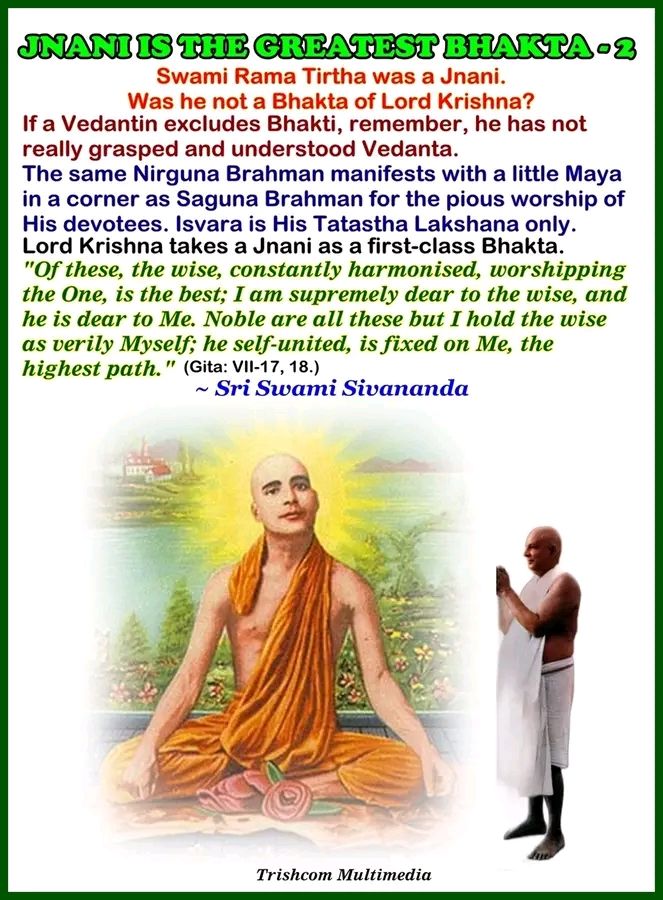
Swami Sivananda jnani greatest bhakta quote image
Karma Yoga, Swami Sivananda

Law of Karma

Law of Karma Every man should have a comprehensive understanding of Nature’s laws, and their operations. Then he can pull on in this world smoothly and happily. He can utilise the helping forces to serve his ends in the best possible manner. He can neutralise the hostile forces to serve his ends in the best possible manner. He can neutralise the hostile or antagonistic currents. Just as the fish swims against the current, so also he will be able to go against the hostile currents by adjusting himself properly and safeguarding himself through suitable precautionary methods. Otherwise he becomes a slave. He is tossed about hither and thither helplessly by various currents. Various hostile forces drag him in different corners. He drifts like a wooden plank in a river. He is always very miserable and unhappy although he is wealthy and possesses everything that the world can offer. The captain of a steamer who has a mariner’s compass, who has knowledge of the sea, the routes and the oceanic currents can sail smoothly. Otherwise his steamer will drift here and there helplessly and be wrecked by being dashed against some ice-bergs or rocks. Likewise, a wise sailor in the ocean of this life, who has a detailed knowledge of the laws of Karma and Nature can sail smoothly and reach the goal of life positively. Understanding the laws of Nature, you can mould or shape your character in any way you like. “As a man thinketh so he becometh” is one of the great laws of Nature. Think you are pure, pure you will become. Think you are noble, noble you will become. Think you are a man, man you will become. Think you are Brahman, Brahman you will become. Become an embodiment of good nature. Do good actions always. Serve, love, give. Make others happy. Live to serve others. Then you will reap happiness. You will get favourable circumstances or opportunities and environments. If you hurt others, if you do scandal-mongering, mischief-mongering, backbiting, talebearing, if you exploit others, if you acquire the property of others by foul means, if you do any actions that can give pain to others, you will reap pain. You will get unfavourable circumstances, conditions and environments. This is the law of Nature. Just as you can build your good or bad character by sublime or base thinking, so also you can shape your favourable or unfavourable circumstances by doing good or bad actions. A man of discrimination is always careful, vigilant and circumspect. He always watches his thoughts carefully. He introspects. He knows exactly what is going on in his mental factory, what Vritti or Guna is prevailing at a particular time. He never allows any evil thought to the gates of his mental factory. He at once nips them in the bud. When the mind raises its hood of Vritti, he takes the rod of Viveka and strikes at the hood. Just as the soldier kills his enemies one by one with his sword when they enter the fort, so also the man of discrimination kills the evil thought with his sword of Viveka when it tries to enter the fort of the mind. Thus he builds a noble character. He is careful in his speech. He speaks little. He speaks sweet loving words. He never utters any kind of harsh words that can affect the feelings of others. He practises Mauna (vow of silence). He develops patience, mercy and universal love. He speaks the truth. Thus he puts a check on the Vak Indriya and the impulses of speech. He uses measured words. He writes measured lines. This produces a deep and profound impression on the minds of the people. He practises Ahimsa and Brahmacharya in thought, word and deed. He practises Saucha and Arjava (straightforwardness). He tries to keep balance of mind and to be always happy and cheerful. He keeps up Suddha Bhava. He tries the three kinds of Tapas (physical, verbal and mental) and controls his actions. He cannot do any action that is evil. He who spreads happiness will always get such favourable circumstances as can bring him happiness. He who spreads pain to others will, doubtless, get such unfavourable circumstances, according to the law of Nature as can bring him misery and pain. Therefore man creates his own character and circumstances. Bad character can be transmuted into good character by means of good thoughts, and unfavourable circumstances can be changed into favourable circumstances by doing good actions. O Ram! You must understand the laws of Nature and become wise and happy. Your births and environments are determined according to the nature of your desires. Prarabdha places you in such suitable environments as are favourable for the gratification of your desires. The man is dragged to places where he can get his objects of desire. A man may be born in India as a poor Brahmin in one birth. If he desires to become a multi-millionaire, he may get his next birth in the United States of America. Suppose there is a poor intelligent boy in India. He has an intense desire to go to England for his I. C. S. examination. His desire to go in this birth cannot be fulfilled. Suppose also that there is a rich lady in England who has no son and has intense desire to get an intelligent one. The poor boy may get his next birth in London as the son of the rich lady according to the law of coincidence. He will thus have his old strong desire gratified now. God gives suitable surroundings according to the nature of the desire of the man for his growth and evolution. Suppose a shepherd boy gave a tumbler of water to a rich man to drink when he was very thirsty and when he could not get any water in a thick jungle. This boy may get his next birth as the son of this rich man for this little good

Law of Karma Read Post »

swami sivananda Spiritual monk seated by riverside wearing shawl and garland photo
Jnana Yoga, Swami Sivananda

The Six Khyatis : Theories of Error in Indian Philosophy

The Six Khyatis : Theories of Error in Indian Philosophy by Swami Sivananda Introduction An understanding of the characteristics of our judgments of truth and error forms an integral part of philosophical knowledge. This understanding is necessary for the discovery of the deeper implications of experience. Knowledge, ordinarily, presupposes a subject of knowledge and an object corresponding to it. The nature of this knowledge is dependent upon the mind and the cognitive organs of the knowing subject, as well as on the conditions in which the object is situated in relation to the subject. The knowledge of colour through eyes which are affected with jaundice may be incorrect, since there is every possibility of its being the perception of an apparently objective yellow colour, though what is really objective may be of some other colour. In the same manner, a distant object may be mistaken for something else, though the organs of perception may be in a healthy condition and this error may be caused by a peculiar relation obtaining between the percipient and the position of the object. Our perceptions of things greatly influence what we infer and decide, which means that our whole life is judged by us in accordance with the modes of our perception and the knowledge based on them. As every inference is based on previous perception, erroneous perception will nullify the value of the inferences built upon it. The different schools of philosophy have advanced different theories of error in accordance with their avowed theories of knowledge. These theories concerning the nature of erroneous cognition are technically called Khyatis. There are six important Khyatis in Indian philosophy, They are: 1. Satkhyati, 2. Akhyati, 3. Anyathakhyati, 4. Atmakhyati, 5. Asatkhyati and 6. Anirvachinayakhyati. The theory of Satkhyati is held by Ramanuja and his followers. According to this theory, there is no error in fact. What is experienced is real. Satkhyati, Akhyati and Anyathakhyati may be brought under the general head, Satkhyati, which is in opposition to Asatkhyati. The general theory of Satkhyati advocates the view that in wrong knowledge there is cognition of some kind of reality or existence. In a sense, even Atmakhyati may come under Satkhyati, for it admits the reality of cognition within. The theory of Asatkhyati is advanced by the Madhyamikas or Sunyavadins, who hold that in wrong knowledge there is cognition of unreality or non-existence. The Anirvachaniya- khyati is the view of the Advaitin, that experienced objects are indeterminable and that the object of erroneous cognition is neither real, nor unreal, nor real-unreal, i.e., it is Sadasadvilakshana. Atmakhyati is the theory of the Vijnanavadins, the Vaibhasikas and the Sautrantikas, having different theories of perception that the internal concept appears as the external percept, in erroneous cognition. Akhyati is the theory of the Sankhya, Yoga and the Prabhakara school of Purva-Mimamsa, according to which, in error, there is non-distinction between a memory-image and a percept. Anyathakyati is the view of the Nyaya, Vaiseshika and Kumarila Bhatta’s school of Purva-Mimamsa, and this holds that the substratum and the percept of erroneous cognition are real independently. A discussion of these several theories is an essential part of Indian epistemology. SATKHYATI Statement: According to Satkhyati, all objects exist independent of the knowledge which others have of them. The nonexistent cannot be perceived. Truth is the correspondence between knowledge and an object which has independent existence. The erroneous cognition of silver in nacre is not really the cognition of something unreal as such, for it refers to something which exists. The elements of silver that are contained in nacre are responsible for the perception of silver in nacre, though these elements require the aid of a peculiar constitution of the perceiving sense-organs. Though erroneous judgment may be due to defective sense-organs, the absolutely nonexistent cannot be perceived at any time. As, by the process of quintuplication, every element contains parts of other elements, it is possible that anything can contain any other thing. Even the perception of yellow colour in things by a person affected with jaundice is not the perception of some colour which is really not in objects, but of what all objects possess in some degree, though this cannot be perceived by all eyes. The eye which is affected with jaundice, being favourably conditioned, can see it. Hence, the distinction which is ordinarily made between truth and error does not really exist. But, in order that truth may be practically useful in life, it should correspond not merely to some existent thing, in some degree, but to the element which is preponderating others in that object which is perceived. Hence, only these elements which, being commonly predominant in things, are equally perceived by all others also, alone can be really useful in life. When something is perceived only by one individual, privately, and not by others, it becomes the so-called unreal or the illusory. But even the content of this private perception by an individual has existence, though it cannot be seen by others. What is called correction of error is not the negation of what is existent, but only the cessation of effort in regard to the non-predominant element in the object. Refutation: In quintuplication, the gross physical elements are not quintuplicated; only the subtle rudimentary principles of these elements are quintuplicated. Else, one would perceive silver in a stone-pillar. The constituents of nacre and silver are not mixed up in one object. If silver is really contained in nacre, the silver part of the nacre should melt when the nacre is thrown into fire. A snake is not present in the rope as one of the constituents of the latter. AKHYATI Statement: The theory of Akhyati holds that the inability to discriminate (Aviveka) between cognitions of different kinds and between their corresponding objects is error. Error is not the perception of something existent, but the non-perception of difference between different cognitions of different characteristics and contents. The two cognitions are real independently, without reference to each other. In the

The Six Khyatis : Theories of Error in Indian Philosophy Read Post »

Swami Sivananda playing sitar outdoors image
Karma Yoga, Swami Sivananda

Secret of Karma Yoga

Secret of Karma Yoga Attachment is the first child of Maya. This whole Lila of the Lord is kept up by the force of attachment. A sober man just tastes a small peg of champagne when he is caught up in evil company and he becomes an inveterate drunkard through attachment to liquor. A teetotaler just takes a whiff of gold-flake and becomes a terrible smoker in a short time through attachment. There is in the mind a gummy substance which is like a mixture of castor oil, glue, mucilage, gum-arabic, gluten paste, honey, glycerine, jack-fruit juice and all other pasty substances of this world. The mind is glued, as it were, to the objects with this mixture. Therefore the attachment is very strong. Man always thirsts for possession of objects, wife and cattle. This possession of objects surely brings selfishness. Selfishness causes attachment. Wherever there is attachment there are Ahamta and Mamata-‘I-ness’ and ‘mine-ness’. The whole Mayaic Chakra has begun to revolve. The man has become a slave now. Strong iron chains are fastened to his hands, knees and legs. He has entangled himself like a spider or the silk-worm. This is his own self-created trouble through attachment. Never say: “My wife, my son, my house.” Attachment is the root cause of the whole miseries and troubles of this world. Discipline the mind carefully. The old habits will creep in. Destroy them to the very root. Lead a life of non-attachment. This is the master-key to open the realms of Brahmic bliss. But work incessantly without any attachment, without identification. Then alone can you have real happiness. You will feel that you are a different being. Karma Yoga elevates a man to sublime, magnanimous heights. One should work patiently. No meditation or Samadhi is possible without a preliminary training in Karma Yoga. To work without attachment is doubtless a difficult task. It is uphill work. But it becomes easy and pleasant for a man of patience and determination. You will have to do it at any cost, if you want final beatitude and immortality. Everybody will do it, though not now, after taking five hundred births. But the question is, why not now? Cut short the cycle and enjoy the supreme bliss right now in this very second, in this birth. That is wisdom. Do you expect anything from your small son, if you do something for him? In a similar manner you will have to work for others also without expecting anything. You will have to expand your heart and think that this whole world is your own Self. It gives you a little pain in the beginning because you have never worked up to this time in this line of selfless and disinterested service. When you have tasted a bit of the Bliss of Karma Yoga, you can never leave it. The force of Karma Yoga will induce you to work more and more with great zeal and enthusiasm. You will begin to feel that this world is a manifestation of God. You will gain immense inner strength and purity of heart. Your heart will be filled with mercy, sympathy and pure love. Your spirit of self-sacrifice will grow ad infinitum. Selfishness of all sorts will be annihilated. Those who work in the public field for the welfare of the country and suffering humanity can realise the truth of this statement. Non-attachment is dispassion or indifference to the sensual enjoyments. Non-attachment is Ihamutrarthaphala-bhogaviraga-indifference to sensual pleasures of all kinds, herein and hereafter, which is one of the items in Sadhana Chatushtaya, or the four means of salvation for the aspirant on the path of Jnana Yoga or Vedanta. It is purely a mental state. The binding link is really in the mind. Ahamta and Mamata are the two poisonous fangs of the mind-serpent. Extract these two teeth and the serpent-mind is tamed. There can be no bondage. It is the mind that creates the ideas of ‘I-ness’ and ‘mine-ness’. It is the mind that links the Jiva and the man thinks: “I am the body.” It is the mind that causes attachment to wife, son and property. If the binding link in the mind is destroyed, you can remain wherever you like. You can roam about peacefully in any part of the world unattached, like water on the lotus-leaf. Nothing can bind you. The whole mischief is wrought by the mind. A man may rule a vast dominion and yet he can be unattached. Queen Chudalai and Raja Janaka had not a bit of attachment for their wealth and estate. Janaka said: “Even if the whole of Mithila is burnt, nothing of mine will be lost.” Look at the exalted mental state of Janaka! He was resting in his own Svarupa or essential nature. He had not a bit of attachment. The mental state of Chudalai also was the same as that of Janaka. Though Sikhidhvaja; the husband of Chudalai, lived in the forest with a piece of Kowpeen and a Kamandalu, his mind was full of attachment. He was attached to his body and his Kamandalu. A man may be intensely attached to a small piece of Kowpeen or a stick or a small tumbler or to his body, although he has left his family and property. At the time of death the mental pictures of a tumbler or stick only will come to his mind. Jada Bharata was attached to the deer, and the thought of the deer only came to his mind at the time of his death and he had to take the birth of a deer. Such is the power of attachment. Worldly people generally judge the state of dispassion of a Sadhu from external conditions. If a Sadhu has one Kowpeen and a long beard and matted hair, he is regarded as a first-class Virakta Mahatma. This man may fight with another Sadhu for his share when a pilgrim distributes an eight-anna piece to them. His mind may be full

Secret of Karma Yoga Read Post »

swami sivananda Sepia photo of garlanded monk seated cross-legged with calm smile image
Jnana Yoga, Swami Sivananda

Vedanta and the Masses

Vedanta and the Masses by Swami Sivananda Vedanta is the highest rung in the spiritual ladder of the Hindu philosophy. Some over-enthusiastic religious leaders, in their impatience to get the masses overnight to the zenith of Vedanta, overlook and ignore the initial steps of Karma and Bhakti, with the inevitable result that the ignorant masses neither reach the top nor catch a glimpse of the first stages. The masses do not understand the subtlety and the ultimate import of the Advaita thought, much less do they apply it in the everyday routine of life. It is a matter of common experience that only a microscopic minority of the religious-minded people is putting Vedanta into practice; but with the majority Vedanta does not go beyond a mere intellectual assent. It is not for nothing that Sastras have laid down a certain course of Sadhana after which an aspirant can be initiated into this sublime thought. Only very few are eligible for Vedanta, because only a very few people are capable of that rigorous and sincere Sadhana. The masses require to be taught Bhakti and Karma which are easily intelligible to them. It is said that Swami Rama Tirtha repented for preaching Vedanta because he realised that all his gigantic efforts had brought forth no corresponding substantial result. Swami Vivekananda was severely criticised in his life for overstressing Vedanta and ignoring Bhakti. People want facts, hard and tangible facts, practical principles which they can easily grasp, easy clues to solve the riddles of life, intelligible and concrete ways to feel the nearness of God. Vedanta seems to them a science meant for intellectual jugglers and dry Pandits, its teachings fall upon their minds like rain on arid sands. They would rather have a grain of a practical hint than bushels of theoretical knowledge. No doubt Vedanta contains the sublimest of truths, truths that need to be comprehended and applied in the daily walk of life but that is no excuse why one should ignore the allied truths which are equally great, if not greater. The Gita has elucidated in an inimitable manner the complementary nature of these various paths and has shown that Karma, Bhakti and Jnana are not competitive or alternative but the different ways to the same goal. So to preach Vedanta and especially the Advaita philosophy irrespective of time, place and person is carrying water in a sieve. You cannot teach Vedanta to anybody and everybody. The whole affair will become a square peg in a round hole. In proportion to the greatness of a truth, misapplications and misinterpretations are bound to crop up round it. Just as many thoughtless politicians have misused the weapon of Satyagraha to enforce their selfish desires, many unwary lovers have brought about grim and poignant tragedies under the shelter of Platonic love, even so many crooked persons have exploited this weapon of Vedanta for their personal ends. Vedanta is a sharp razor which can be trusted only in the hands of a skilful and a saintly warrior, not in the hands of a child or an ignorant man. Tat Tvam Asi, Aham Brahmasmi are the watchwords of Vedanta and under their pretext many sins are committed, sometimes consciously, and sometimes unconsciously. A man who has imperfectly understood the real significance of these Mahavakyas and easily poses himself as knowing God without considering others as such, easily deceives himself about his intellectual and spiritual superiority and commits countless sins, because he thinks and foolishly thinks, that he is not the doer but only the witness in justification of wicked deeds. Vedanta must be taught to a select few. Udia Baba teached Bhakti and Karma to the masses, to his disciples. He teached Vedanta to a select few only and did not allow the Bhaktas to attend his classes. Every intelligent teacher gives his teachings according to the temperamental leanings of the disciple. A promiscuous preaching of Vedanta will land the teacher and the taught in difficulties which may not be easily surmounted.

Vedanta and the Masses Read Post »

Swami Sivananda Monks walking together by riverside image
Karma Yoga, Swami Sivananda

Health and Yoga

Health and Yoga What is health? It is a state of equilibrium of the three humours of the body, viz., Vata, Pitta and Kapha (wind, bile and phlegm), wherein the mind and all the organs of the body work in harmony and concord, and the man enjoys peace and happiness, and performs his duties of life with comfort and ease. It is that condition in which man has a good digestion and a good appetite, normal breathing and pulse, a good quantity and quality of blood, strong nerves and a calm mind, a sound mind in a sound body, a free movement of bowels, normal state of urine, rosy cheeks, shining face and sparkling eyes. It is that state in which a man jumps, sings, smiles, laughs, whistles and moves about hither and thither with joy and ecstasy. It is that condition in which he can think properly, speak properly and act with alacrity, nimbleness and vigilance. This desirable state is coveted by all. A life with good health is a great blessing indeed. What is the earthly use of wealth and possession, if a man cannot eat well on account of disease of his stomach, if he cannot walk on account of rheumatism or paralysis, if he cannot see the beautiful scenery, of nature on account of cataract or any defective vision, if he cannot copulate on account of impotency. A great thinker says: “Give me health and a day: I will make the pomp of emperors ridiculous.” Life without good health is a miserable condition, even if one is the Lord of the whole earth. Man enjoys good health on account of good Karmas done in his previous birth. He who has done meritorious services in his previous incarnation, he who has shared what he had with others, he who has helped the poor and the needy, he who has done worship, meditation, Yogic Kriyas and Pranayama in his previous birth, enjoys sound health in this birth. The law of causation is inexorable and unrelenting. What is the greatest thing that a man can achieve in this world? It is Self-realisation. What are the advantages or benefits of Self-realisation? Why should we attempt Self-realisation at all? The attainment of Atma Jnana or realisation of the identity of the Jiva (individual soul) and Brahman (supreme soul) can alone put an end to the wheel of birth and death with its concomitant evils of disease, old age, pain, suffering, worries and various other sorts of trouble. It is Atma Jnana alone that can give you unalloyed eternal bliss, supreme peace, highest knowledge and immortality. The next question is, why should we have good health? We should have good health in order that we may achieve the four kinds of Purushartha-Dharma, Artha, Kama and Moksha (righteousness, wealth, desires and liberation). If you do virtuous deeds, you will get wealth and you can gratify your worldly desires. Then you can attempt realisation of the Self. Without good health you cannot achieve anything. Without good health you cannot perform any service of Nishkamya Karma Yoga. Without good health you cannot do Asanas and Pranayama. That is the reason why scriptures declare that this body is a boat to cross the ocean of Samsara, an instrument for doing virtuous deeds and attaining Moksha. That is the reason why, in Charaka Samhita you will find: Dharmartha Kamamokshanam Arogyam moolam uttamam�health is the best thing in this world. An aspirant should be free from Adhi and Vyadhi (diseases of the mind and the body), if he wants to do Karma Yoga and attain knowledge of the Self. According to the science of Yoga all physical diseases take their origin in the diseases of the mind, from an unhealthy state of mind. The Western psychologists also corroborate this fact. They say that the diseases of the body are attributable to hatred, anger, worry, depression, etc., which corrode the mind and react on the body and bring about various physical diseases by destroying the cells of the body. A student of Karma Yoga should have an elementary knowledge of Raja Yoga, psychology, Ayurveda, physiology, family medicine, hygiene, Sankhya and Vedanta. Then he will be able to turn out more real work easily. He can have a knowledge of the laws of the mind, also the nature, habits and ways of the mind. He will be in a position to keep a calm and healthy mind always. No one can work smoothly with a ruffled mind. A ruffled mind disturbs the three humours of the body and brings diseases in its turn. This is the theory of Ayurveda which quite tallies with the theory of Raja Yoga and the theory of Western psychologists. He can have an understanding of the laws of the universe and the operation of the world by having a knowledge of the Sankhya philosophy of Kapila Muni. An elementary knowledge of astrology is of immense value. The various Ritus or seasons are brought about by the movement of the earth round the sun. The atmospheric conditions affect the body of man. The planets have an influence on the mind and body of a man. They exercise benign or malevolent influence on him in accordance with their position in the various houses. He who has some knowledge of astrology can ward off the evil effects of unfavourable planets. At every second various kinds of vibrations from the various kinds of objects of the physical universe outside enter the mind of a man and produce various influences. The body is part of the universe. So is the mind. What is called world is only mind. The mind of a man is affected by the thoughts and opinions of others. There is pressure of thought from outside. All people entertain personal thoughts and the Karma Yogi should have immense strength to act against these outside thoughts. He should have courage. He should have patience and perseverance. Even if he fails twenty times he should stick to his

Health and Yoga Read Post »

swami sivananda Monk seated in front of snowy mountains wearing shawl and beads image
Jnana Yoga, Swami Sivananda

Vedantic Stories

Vedantic Stories by Swami Sivananda Prince or Fisherman? A prince is sailing in a ship. He is the royal heir to a great kingdom. His father is a great emperor. The ship is caught in a cyclone and dashed upon a rock and through shipwreck all perish and only this prince clings on to a wood and he is washed ashore to an unknown land where no one knows him, and the land is strange and he is penniless, and starvation has made him ill, and some fisherman takes pity on him and takes him into the fishermen’s colony and nurses him back to health, and after some t me he gains strength and becomes a part and parcel of the fishermen’s colony. He has completely forgotten everything about his former state. He has got but faint memories of his previous life in the palace, but he knows nothing more of the palace. In this way he grows up as a fisherman, putting up with all the hardships of a fisherman’s life. And then searchers have been sent by the king and these searchers are the saints, the children of God, and the spiritual books, and the Jiva is the ship-wrecked prince which has forgotten its home. From a state of plenitude it has come to the position of beggary, ill-fed, sometimes starving. Searchers are going country after country but who can recognise the prince among millions of people? Such a condition is the condition of Jiva. Ultimately someone manages to contact the prince after years of searching and he is one who is intimate with the emperor, who knows certain birth-marks on the prince through which he can identify the prince without any fear of error, and he happens to come across this boy and he recognises him and informs him that he was a prince, heir to a royal heritage. But attachment has grown between him and the fishermen and he cannot entertain the idea of leaving his foster-mother and foster-father. He declines to leave the fishermen. But the searcher tries to convince him. This is the process that takes place when the Guru tells the Jiva that Your real nature is bliss. Unlimited wealth is yours. But the Jiva is attached to this miserable existence. So, Guru has to wean the aspirant from the state of forgetfulness and then when the prince gets convinced by the knowledge given by the searcher, then a struggle comes. He has to make efforts to break attachment and if he has to get back h s lost heritage, he has to go back, and this going back is called Sadhana. The Distant Inheritance This brings about one more aspect of the previous story. There is a man in utter poverty. With great difficulty he is carrying out his living. He is in a certain country, and when he is in this condition, a multimillionaire has been travelling and somehow he came in contact with this person in a passing manner, and that man of unlimited wealth leaves in his will his entire fortune to this man as a legacy and he says in his will that this man has to come to the place where the rich man was living and establish his identity and claim this fortune, and he also says where the man is to whom he is leaving the will. Then the rich man dies and the solicitors who have got the will in their hands, send word to the poor man that he has to come there and get the wealth. News reaches him, You are the richest man in the world. You have inherited unlimited wealth and unlimited property. by cable this news is sent to him and he reads it, You are the richest man in the world. Now this man knows that he is a multimillionaire. So he will have no wants. He can buy anything that he wants. But at the moment he is actually penniless. He has to work hard for his livelihood. In his present condition he cannot get bread by merely saying that he is the richest man. Yet, undeniably it is a fact that he is the richest man, though he is not able to make use of his wealth. We are Nitya Suddha Atman. But if a mosquito bites us we get shivering and have to go to a hospital and take quinine. Yet, it is the real fact that we are Satchidananda Atman. This fact is true at all times. But practically it is of no use. We are unable to make use of it, because our condition is such. Now what he has to do? Suppose the place where he has to reach in order to claim the will is 15,000 miles away. Now he has to work hard to meet his expenses of travel. Nobody will trust him and advance him money, simply because he says that he is the richest man in the world. He has to work hard and earn his passage-money. It may take him six months or even two years. And then he has to purchase the ticket and undertake the trouble and face all the hazards in the travel, and when he actually reaches the place and proves his identity, the fact of his being wealthy becomes turned into a concrete, practical, effective, living fact. Fact is there always. Even before he reached the place where he has to claim his wealth, he is the richest man. Similarly even now the fact is there that we are the Satchidananda Atman. But if the self-same fact has to become a vibrant, thrilling and vital experience and fully effective, sword cannot pierce me, wind cannot dry me, water cannot moisten me, all these things have to be demonstrated as an actual fact. Therefore, the necessity for doing Sadhana. Sadhana is the claiming of the wealth on the actual spot. Unless this is done, the fact of his being wealthy is useless

Vedantic Stories Read Post »

Swami Sivananda meditating by river vintage photo
Karma Yoga, Swami Sivananda

No Loss in Karma Yoga

No Loss in Karma Yoga You do not lose anything in Karma Yoga. Even if you do a little service to the country or to the society or to poor sick people, it brings its own advantages and benefits. It purifies your heart and prepares the Antahkarana for the reception of knowledge of Atman. The Samskaras or impressions of these good actions are indelibly imbedded in your subconscious mind. The force of these Samskaras will again propel you to do some more good actions. Sympathy, love, the spirit of patriotism and service will be developed. Nothing is lost when the candle burns. In agriculture you may manure and plough the land. Your efforts will be rendered futile if you do not get rain in the year. This is not the case in Nishkamya Karma Yoga. There is no uncertainty here regarding the result of any effort. Further there is not the least chance of getting harmed by practising this Karma Yoga. If the doctor is injudicious, if he administers the medicine in over-dosage, some harm will certainly result. This is not the case in the practice of Karma Yoga. Even if you do a little service, even if you practise a little Nishkamya Karma Yoga in any form, it will save you from great fear, from the fear of Samsara and of birth and death with its concomitant evils. That is the reason why Lord Krishna says to Arjuna: Nehaabhikramanaasosti pratyavaayo na vidvateSvalpamapyasya dharmasya trayate mahato bhayat. “There is no loss of effort here, there is no harm. Even a little of this service delivers one from great fear.” Gita: Chapter II-40. The path of Karma Yoga, which eventually leads to the attainment of the infinite bliss of the Self, cannot be futile. Ignorant people say that one cannot work without any motive. It is a great pity that they have not understood the essence and truth of Karma Yoga. Their minds are saturated with all sorts of fantastic desires and selfishness, and as a result, their minds are very impure and clouded. They cannot grasp the underlying truth of Karma Yoga. They judge others from their own standpoint. Selflessness is a thing unknown to them. Their minds and brains are rendered callous and so they cannot vibrate properly to understand what a motiveless action is. Passionate householders cannot dream of doing any work without expecting some gain for themselves and their families. When the thought of doing good becomes part and parcel of a man’s very being, he will not entertain any motive at all. He takes immense delight in serving others, in doing good to others. There is a peculiar joy and Ananda in the practice of vigorous Karma Yoga. The Karma Yogi gets inner spiritual strength and power by performing motiveless and selfless actions. He should understand the secret of Karma Yoga. He should plunge himself in selfless work. He must work incessantly. He must nurse people with Atma Bhava. He must serve society in a variety of ways. Gradually he will understand the glory and splendour of unselfish work. He will become a changed being with divine effulgence and sweet Yogic fragrance. Many of his actions may be selfish in the beginning of his Yogic career. It does not matter. He should not be discouraged on this score. But, slowly when he grows in purity, some of his actions will turn out to be unselfish. In the long run all his actions will be unselfish. He should patiently work with indefatigable energy. He has to destroy his old mind of selfishness and build a new mind of selflessness. This is doubtless uphill work. This demands struggle and constant effort with asinine patience and iron determination. Selfless work elevates and brings freedom. Selfish work retards spiritual progress and fastens one more chain to your feet. If you find it difficult to work without any motive, have one strong motive for freedom when you work. This will not bind you. This will destroy all other lower selfish motives and will eventually die by itself, just as the stick used in burning a dead body burns the dead body and is itself consumed in the end. The joy of a developed Karma Yogi is really unbounded. Words cannot adequately describe his exalted state and inward happiness. Look at the stupendous and magnanimous work turned out by Lord Buddha, Sri Sankara and other Karma Yogis of yore. Their names are handed down from posterity to posterity. Their names are still remembered. The whole world worships them with reverence. Can you attribute an iota or grain of selfish motive to their actions? They lived for doing service to others. They were examples of absolute self-abnegation. Expand. Purify your heart. Live in the true spirit of Karma Yoga. Live every second for the realisation of the ideal and goal of life. Then and then alone will you realise the true glory of Karma Yoga. Keep before you the examples of the great Karma Yogis who served mankind and thus radiated peace, bliss and wisdom unto all.

No Loss in Karma Yoga Read Post »

swami sivananda Black-and-white portrait of monk seated with flower garlands image
Jnana Yoga, Swami Sivananda

Anubandha Chatusthaya

Anubandha Chatusthaya by Swami Sivananda THE INDISPENSABLE requisites of a work worth studying are four in number and are collectively called Anubandha Chatushtaya. They are: 1. Vishaya – A subject to be dealt with. In Vedanta it is Brahman. 2. Sambandh – A connection between the work as a whole and the subject dealt with. Here it is exposition. The four important Sambandhas are: Pratibhataka-Pratibhandhya Bhava Sambandha, Janak-janniya Bhava Sambandha, Kartru-kartavya Bhava Sambandha and Prabhaga-prapya Bhava Sambandha. The relation between the work and the subject is Pratibhataka-pratibhadhya Bhava Sambandha. Narration is Pratibhatakam. That which is told is Pratibhadhyam. The Grantha is Prati-bhatakam. The subject that is treated is Pratibhadhyam. The relation between the Grantha and Jnana is Janaka-jaaniya Bhava Sambandha. That which generates is janniyam; the Grantha is Janakam as it generates Jnana through Vichara (enquiry); Jnana is Janniyam, as it generated through Vichara. The relation between the Adhikari or qualified person and the subject is Kartru-kartavya Bhava Sambandha. He who does an act is the Kartru (actor). That which is done is Kartavya. That Adhikari who does Vichara is Karta. Vicharais Kartavya. The relation between the Adhikari and the fruit is Prabhaga-prapya Bhava Sambandha. He who obtains the fruit is Prabhaga. That which is obtained is Prapyam. 3. Prayojana – A benefit to be obtained by studying it. Here it is Moksha. This is of two kinds, viz., Parama-Prayojana and Avantara-Prayojana. The Parama-Prayojana is Moksha whose Svarupa is the complete eradication of all kinds of miseries (Sarva Duhkha Nivritti) and the attainment of supreme Bliss (Paramananda Prapti). Complete eradication of misery is Atyanta-Nivritti. Anartha means an evil. Avidya and its effect, the gross and the subtle worlds and the three bodies, viz., causal, subtle and gross and other Dharmas or characteristics, viz., birth and death are the causes for the misery. Hence they are Anartha. Avantara-Prayojana is the direct means (Sakshat Sadhana) for the attainment of the Parama-Prayojana. It is the Dridha-aparoksha Brahma Jnana (steady direct knowledge of Brahman or realisation of the identity of Jiva and Brahman). The Parama-Prayojana or the highest benefit that is obtained from the plantain is its fruit. That which is obtained in the middle, before the fruit is obtained, is the plantain leaf. This is Avatara-Prayojana. 4. Adhikari – A qualified student. Here it is one who is endowed with the four means of salvation. i.e., Sadhana Chatushtaya, viz., Viveka, Vairagya, Shad-sampat and Mumukshutva, who has removed Mala (impurities of the mind) by Nishkama Karma Yoga and Vikshepa (tossing of mind) by Upasana, who has Chitta Suddhi and one-pointed mind and who is endowed with Yukti (reason), Samartha (ability) and Buddhi (sharp intellect). Adhikaris are of two kinds, viz., Kritopasaka and Akritopasaka. He who has done full Saguna Upasana and who is endowed with perfect one-Pointed mind is a Kritopasaka. He will be equipped with all the Sadhanas mentioned in the scriptures. He who has done imperfect Upasana of Saguna Brahman is an Akritopasaka. He has only partial concentration of mind. He is equipped with only a few Sadhanas. He has Viparita-Bhavana though he possesses knowledge of Brahman by study of Vedantic Literature. He must practise constant and intense meditation.

Anubandha Chatusthaya Read Post »