Hari Om

Menu

February 13, 2026

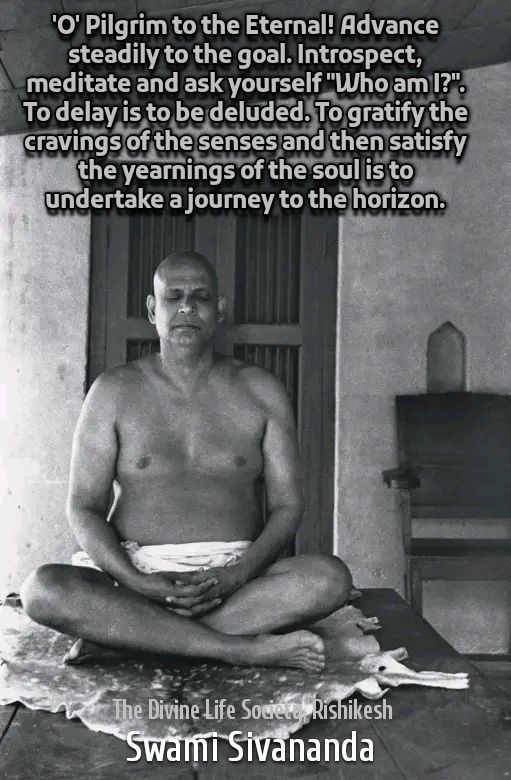
Swami Sivananda sitting cross-legged outdoors image
Jnana Yoga, Swami Sivananda

Meditation on Om

Meditation on Om by Swami Sivananda Retire into the meditation chamber. Sit on Padma, Siddha, Svastika or Sukha Asana to begin with. Relax the muscles. Close the eyes. Concentrate the gaze on Trikuti, the space between the two eyebrows. Repeat Om mentally with Brahman Bhavana. This Bhavana is a sine qua non, very, very important. Silence the conscious mind. Repeat mentally, feel constantly: All-pervading Ocean of Light I am Om Om OmInfinity I am Om Om OmAll-pervading infinite Light I am Om Om OmVyapaka Paripurna Jyotirmaya Brahman I am Om Om OmOmnipotent I am Om Om OmOmniscient I am Om Om OmAll-bliss I am Om Om OmSatchidananda I am Om Om OmAll-purity I am Om Om OmAll-glory I am Om Om Om All Upadhis will be sublated. All Granthis (heart-knots, ignorance) will be cut asunder. The thin veil, Avarana, will be pierced. The Pancha Kosha Adhyasa (superimposition) will be removed. You will rest doubtless in Satchidananda state. You will get highest knowledge, highest bliss, highest realisation, and highest end of life. Brahma vit Brahmaiva Bhavati. You will become Suddha Satchidananda Vyapaka Paripurna Brahman. Nasti Atra Samsayah, there is no doubt of that, here. There is no difficulty at all in the Atma Darshan. You can have this within the twinkling of an eye as Raja Janaka had, before you can squeeze a flower with fingers, within the time taken for a grain to fall when rolled over a pot. You must do earnest, constant and intense practice. You are bound to succeed in two or three years.Nowadays there are plenty of talking Brahmans. No flowery talk or verbosity can make a man Brahman. It is constant, intense, earnest Sadhana and Sadhana alone that can give a man direct Aparoksha Brahmic realisation (Svanubhava or Sakshatkara) wherein he sees the solid Brahman, just as he sees the solid white wall in front of him and feels Brahman, just as he feels the table behind him.

Meditation on Om Read Post »

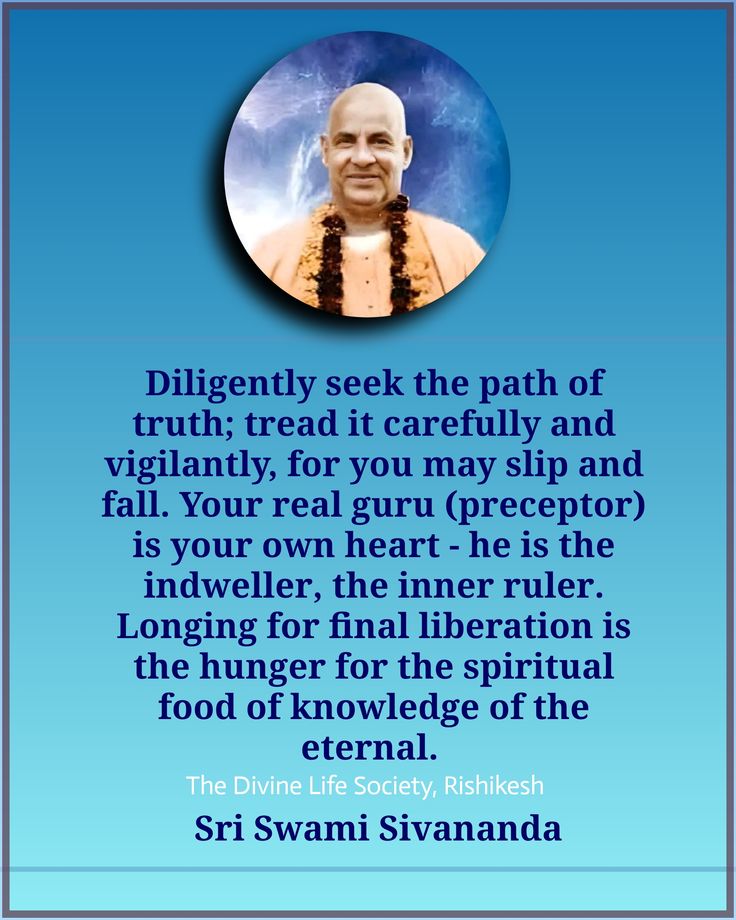
Swami Sivananda quote poster blue photo
Karma Yoga, Swami Sivananda

Naishkarmya (Actionless State)

Naishkarmya (Actionless State) by Swami Sivananda Simply sitting quiet cannot make a man actionless (Naishkarmya). He will have a thousand and one Sankalpas in the mind. The mind must become perfectly quiet. One should be absolutely thoughtless. Then only does he gain freedom from action. I repeat again the words of the Gita: “Nor can anyone, even for an instant, remain really actionless; for helplessly is everyone driven to action by the qualities born of nature.” Ch. III-5 The qualities force a man to do some action or other. Again the Gita says: “There is not an entity, either on earth, or again in heaven among the shining ones, that is liberated from these three qualities born of matter.” That Yogi who has transcended the three qualities of Rajas, Tamas and Sattva, and rests in the Self can be really actionless. The Lord further says: “Nor indeed can embodied beings completely relinquish action.” Ch. XVIII-11. If anyone sits quiet by merely controlling the organs of action through the practice of Hatha Yoga, and if his mind constantly dwells on the objects of the senses, he is no doubt a perfect hypocrite. Lord Krishna extols the man “who, controlling the senses by the mind, O Arjuna, with the organs of action, without attachment performs Yoga by action, he is worthy.” Ch. III-7. In verse three of the same chapter He says: “Nobody can attain perfection, i.e., freedom from action and devotion in the path of Jnana Yoga by mere renunciation, by merely abandoning action without acquiring Brahma Jnana.”

Naishkarmya (Actionless State) Read Post »

Swami Sivananda meditation quote poster
Karma Yoga, Swami Sivananda

Transcend The Dvandvas

Transcend The Dvandvas by Swami Sivananda Union with God is the goal of this human life. It is the be-all and end-all of our existence. It is the summum bonum of life. This can be achieved by following the path of Bhakti Yoga, Raja Yoga, Jnana Yoga or Karma Yoga. Bhakti Yoga is the path of devotion or the path of affection that is suitable for people of devotional temperament, in whom the love-element preponderates. Women are fit for this Bhakti Yoga Marga as affection predominates in them. Raja Yoga is suited to men of mystic temperament. Some are fond of acquiring Siddhis (powers). They can take up this path. Jnana is the path of Vedanta. Men of rational temperament with reasoning power, strong individual thinking and bold reasoning can take up this path. Those who have an active temperament can follow the path of Karma Yoga. Bhakti Yoga is suitable for the vast majority of devotees. Generally there is a mixture of devotional and intellectual temperaments in all men. Some are purely devotional. Some are purely intellectual. One can realise through selfless Karma Yoga also. Karma Yoga purifies the mind (Chitta Suddhi) and prepares the aspirant for Jnana Yoga. People of active temperament should take up Karma Yoga. Bhakti is also classified as mental Karma. It comes under Karma Yoga. Raja Yoga is also a form of Bhakti Yoga. In Bhakti Yoga the devotee does absolute self-surrender to the Lord. A Raja Yogi has subtle egoism. The Bhakta depends upon the Lord. He is extremely humble. A Raja Yogi exerts and asserts. He is of Svatantra type (independent). Bhakti Yoga and Jnana Yoga are not incompatibles like acid and alkali. One can combine one-pointed devotion with Jnana Yoga. The fruit of Bhakti Yoga is Jnana. Highest love (Para Bhakti) and Jnana are one. Perfect knowledge is love. Perfect love is knowledge. Sri Sankara, a Kevala Advaita Jnani, was a great Bhakta of Lord Hari, Hara and Devi. Jnana Dev of Alandi, Poona, a great Yogi, was a Bhakta of Lord Krishna. Sri Ramakrishna Paramahamsa worshipped Kali and got Jnana through Swami Totapuri, his Advaita Guru. Lord Gouranga of Bengal was a great Advaita Vedantic scholar and yet he danced in the streets and market-places singing the Names of Hari. Appaya Dikshita, a famous Jnani of Adaiyapalam, North Arcot District, the author of Siddhanta Lesha and various other Vedantic books, was a devotee of Lord Siva. It behoves therefore that Bhakti can be combined with much advantage with Jnana. Raja Yoga aims in controlling all thought-waves or mental modifications. The second Sutra in Yoga Darshan of Patanjali Maharishi in the first chapter reads: Yogas Chitta Vritti Nirodhah. “Yoga is the restraint of mental modifications.” This is the definition of Raja Yoga according to Patanjali Maharishi. Sri Jnana Dev, Goraknath, Raja Bhartrihari and Sadasiva Brahman were all Raja Yogis of great repute and glory. Bhakti is a means to the end. It gives purity of mind. It removes Vikshepa (tossing of the mind) Sakamya Bhakti (devotion with expectation) brings Svarga and Brahmaloka for the devotee (Uttamaloka Prapti). Nishkamya Bhakti (love without expectation of fruits) brings Chitta Suddhi and through the purity of the mind the aspirant gets Jnana.

Transcend The Dvandvas Read Post »

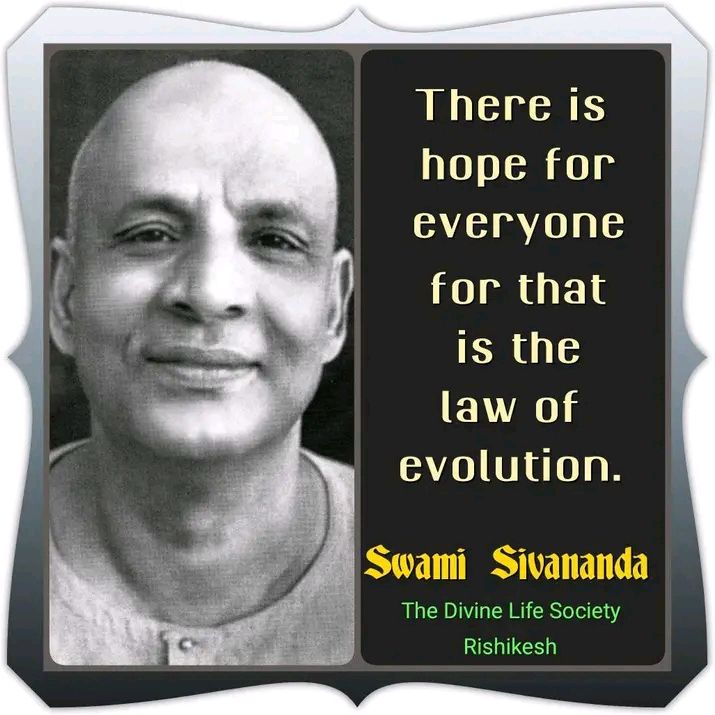
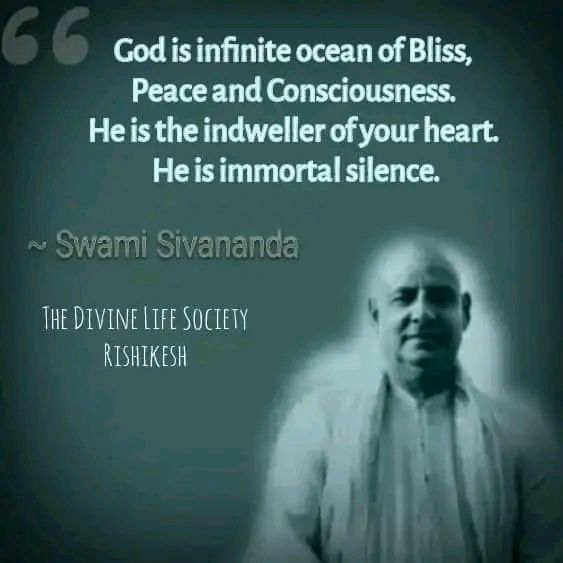
Swami Sivananda quote portrait photo
Karma Yoga, Swami Sivananda

Karma Nishtha

Karma Nishtha by Swami Sivananda The seer of the Isavasya Upanishad prescribes in the first Sloka the method to enter into Jnana Nishtha. The meaning of the Sloka is: “All this, movable and immovable, is indwelt by the Lord. Renounce the names and forms. Renounce the sensual pleasures and enjoy the Atmic bliss. Do not covet anybody’s wealth.” This is the path of Nivritti Marga for Sannyasins. In the second Sloka he prescribes the Karma Nishtha for householders, who are not competent to follow the path of renunciation by taking Sannyasa. Kurvanneveha karmani jijeevishechchatam samahEvam tvayi nanyathetosti na karma lipyate nare. “Should one wish to live a hundred years on this earth, he should live doing Karma. While thus, as man you live, there is no way other than this by which Karma will not cling to you.” The Narayana Upanishad says: “In the beginning these two roads were laid-the road through Karma and the road through Sannyasa. The latter consists in the renunciation of the threefold desire of wife, son and wealth. Of these, the road through Sannyasa is preferable.” The Taittiriya Upanishad also says: “Renunciation (Nyasa) certainly is to be preferred.” In the Gita also Sri Krishna mentions of Karma Nishtha and Jnana Nishtha: Lokesmin dvividha nishtha pura prokta mayaanaghaJnanayogena sankhyaanaam karmayogena yoginaam. “In this world there is a twofold path, as I have before said, O sinless one: that of Yoga by knowledge of the Sankhyas, and that of Yoga by action of the Yogis.” Here Sankhya Yoga signifies Vedanta and not the philosophy of Kapila Muni. Bhagavan Vyasa, after much discussion told his son his firm conviction: “These then are the two roads on which the Vedas are based. Both the courses-one which leads to Karma and the other which draws away from Karma-have been explained, etc.” Nishtha means perfect devotion and sticking to one’s ideal. There is no wavering or oscillation of the mind here. The Yogi of Karma Nishtha has the firm, unshakeable conviction that his Nishtha will lead him to the goal and attainment of supreme bliss. He plunges himself in Karma. He is absorbed in Karma. Raja Janaka had his Nishtha in Karma Yoga. Sri Mahatma Gandhiji was a Yogi of Karma Nishtha. He never deviated from his ideal. He was established in his Nishtha. Nishtha is a sine qua non for success. Then only one can apply his full heart, mind and intellect to the work on hand. Failure is due to lack of Nishtha. Nishtha develops will-power. Nishtha helps quick growth and rapid evolution. Nishtha removes the stumbling blocks on the path of realisation.

Karma Nishtha Read Post »

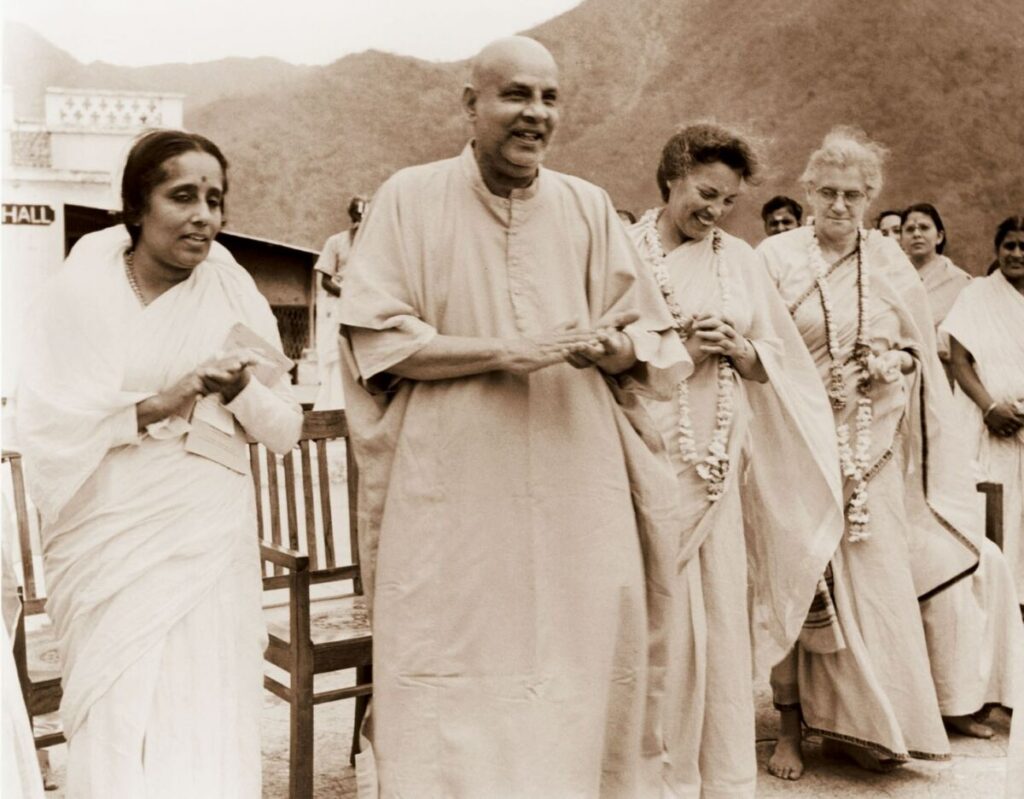
Swami Sivananda walking with devotees during spiritual gathering image
Karma Yoga, Swami Sivananda

Live up to Your Ideals

Live up to Your Ideals by Swami Sivananda You should have your own ideal in life and should try hard to accomplish the ideal. People vary in their capacities, mental and intellectual calibre, and in physical and mental strength to do things. Therefore, different people should have different ideals. Then only they can evolve quickly. Then alone they will realise sure and rapid progress. The ideal of one man will not suit another man. If one keeps an ideal that he cannot realise, an ideal that is beyond his reach and capacity, he will get disappointment. He will give up his effort and become Tamasic. You should have your own ideal. You may realise the ideal this moment or after ten years with faltering steps. It does not matter much how long it takes. Every man should endeavour his level best to live up to his ideal. He should put his whole energy, nerve-force and will in the realisation of his ideal. You can chalk out your own ideal according to your own standard. If you are unable to do this, have your guide to do so, and he will select for you the ideal that is suitable to your capacity and standard. One man may say: “I will teach the village boys and will give them free education. This is my ideal in life.” Another may say: “I will serve sick people and nurse them carefully. I will join any Seva institution and render free service till the end of my life. Service of the sick is my ideal.” A third man may say: “I will beg from door to door and start a Kshettar for feeding Sadhus and Sannyasins. This is my ideal.” A fourth man may say: “My ideal is Self-realisation. I will go to Gangotri and live in a cave and do intense meditation. This is my ideal.” All are quite correct according to their capacity and standard. You must gradually bring the ideal to the realisation of God or Brahman. The highest ideal is Self-realisation. Service, worship, etc., eventually result in the realisation of the inner Self. The ideal to have ethical perfection is just below the ideal of Self-realisation. But this will lead to Self-realisation. Self-realisation is the greatest ideal in life. It is the most difficult of all ideals to fulfil. One who attempts Self-realisation does the best service to mankind. One should not treat a man who has a low ideal, with contempt. He may be a baby-soul who is just crawling on the moral and spiritual path. Your duty is to help him in all possible ways in the realisation or accomplishment of his ideal. You should give him all sorts of encouragement in his sincere endeavour to live up to his own highest ideal. It is deplorable to note that the vast majority of persons have no ideal at all. Even educated persons do not cherish any ideal. They lead an aimless life and therefore drift hither and thither like a piece of straw. They make no progress in life. Is this not a very sad plight? Highly lamentable indeed! It is very difficult to get a human birth and yet people do not realise the importance of keeping up an ideal and living up to it. The ideal of ‘eat, drink and be merry’ is adopted by the Epicureans, the gluttons and rich people. This school of thought has countless followers and the number is increasing by leaps and bounds daily. This is the ideal of Virochana. This is the ideal of Asuras and Rakshasas. This ideal will lead a man to the darkest regions of misery and sorrow, the ‘eternal lake of fire’. Blessed is the man who keeps up an ideal and struggles hard to live up to his own ideal, for he will soon attain God-consciousness. Glory unto sincere struggling souls!

Live up to Your Ideals Read Post »

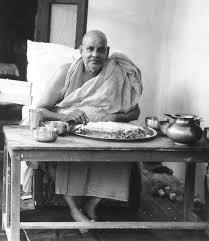
Swami Sivananda eating at table image
Jnana Yoga, Swami Sivananda

A Project of Education

A Project of Education by Swami Krishnananda The world has, first of all, to stand ‘outside there’ as an ‘object’ of the percipient individual, in order that the latter may make any sense of life at all. But, is it true that the world is really ‘outside there’, as an isolated object staring at the individual? This strange predicament which one encounters in the study of anything would testify to the value that seems to be attached to such processes and doctrines and ways of living as the purely astronomical, physical, chemical, biological, historical, political, social, economic, civic, aesthetic, and even ethical and epistemological envisagements of existence, as they stand today. The whole edifice may tumble down if the meaning of a life of this kind is rooted in the basic requirement that the world is ‘outside’ the individual. Modern astronomy and physics, to mention the least and the most obvious, fortunately, appear to have, unwittingly though, stumbled upon the fact that the universe is an undivided continuum, an organism, in which the space-time complex has to be transfigured into a four-dimensional perception, and that matter is not ‘outside there’ to be seen or dealt with by an ‘individual’. The ‘individual’ so-called goes with the universe. This should augur, evidently, a new vision of life in its entirety, awakening man from his slumber of empirical phenomenalism which, dream-like, is taken for reality, very erroneously. The return process to this great Fact of the Universe is education. A logical ascent to perfection is called for. The movement, then, is from the social scene to the psychology of the individual, the cosmical set-up and the Ultimate Reality. Education may be said to be the process of awakening to the structure of existence. It is a graduated widening and ascent in the dimension of consciousness to the degrees of reality. Life is essentially a system of adjustment of oneself to the laws of the universe. The meaning of human enterprise in the world, thus, is coordination of the individual with the facts of the cosmic arrangement of things and a harmonious cooperation in the fulfilment of its purpose. The evolutionary scheme of the universe would lay down the required curriculum of the educational career. But, the empirical insistence that the world is outside the individual has, however, to be taken into a matter-of-fact consideration, since all progress is from a lesser reality to a higher degree of being. This would also substantiate the empirical value of the stages of the evolution of the universe conceived and experienced as a reality of pragmatic existence in a world of enterprise and progress. The individual may be said to constitute a cross-section of the universe. The human being operates like a miniature cosmos. This would mean that the principles that are active in the universe direct and condition the existence and activity of all human life. The analysis would also reveal that there is a universal performance implicit in the existence of human beings and in their pursuits of what they consider as their objectives or aims. Towards this end, there is all the striving of human life, concerning which there has always been felt the necessity for intense educational training as a method of introducing a universal manifestation into the adventures of human individuality. These insights may perhaps be adequate to begin a spade-work for laying the foundation of a proper educational career for humanity. When a child is born and practically knows nothing except for the fact that it is evidently self-conscious of its bodily existence and has a feeling of awareness of a vague and nebulous atmosphere of persons and things around it, there is also in it a pressure towards objective consciousness, and the inclination of the child is more in the direction of externality of perception and feeling than an awareness of its own existence as a human unit. What we may call the cosmological scheme is naturally to be followed in an understanding of the educational project, since it would appear that education is nothing short of a conscious discipline of the individual to ascend gradually, stage by stage to levels indicated by cosmic evolution. The condition of the child-consciousness mentioned may pave the way with which the educational method could be commenced for implementation. In the earlier stages of education, call it the kindergarten, the Montessori stage, or the primary education level, there is always to be a psychological programme to bring slowly into a state of gradual integration the many-sided, rather distracted, perceptions of the external world by the child. Often education begins with training in writing reading and basic arithmetic and discipline. Later on, the mind of the child is allowed to move further in a similar integrated fashion along wider areas of human society around, together with the civic sense involved in every kind of human relationship, whether in the family or in the community of people outside, because, practically, the human individual is primarily concerned with other such individuals more than with things which are not human. There are instincts of the species which pull it to its own kindred individuals or kith and kin or others who are related humanly in any manner. Human relations may be said to be the immediately felt necessities in the process of study and training, which include the norms of civic duty and behaviour in regard to the immediate environment of any society, determined, of course, by the psychology, the social set-up or, rather, the sociological tradition and scheme operative. in the particular human environment,–it may be in a locality of a linguistic society bringing people together with an affinity of any cultural and fraternal thinking. With this method of what we may call human understanding scientifically introduced, an important barrier post in education is crossed. Then the student is further introduced to the world which is made up basically not only of human beings alone, but other things also that are there, which form the wider
A Project of Education Read Post »

Swami Sivadasananda
Karma Yoga, Swami Sivananda

The Four Paths

The Four Paths by Swami Sivananda Union with God is the goal of this human life. It is the be-all and end-all of our existence. It is the summum bonum of life. This can be achieved by following the path of Bhakti Yoga, Raja Yoga, Jnana Yoga or Karma Yoga. Bhakti Yoga is the path of devotion or the path of affection that is suitable for people of devotional temperament, in whom the love-element preponderates. Women are fit for this Bhakti Yoga Marga as affection predominates in them. Raja Yoga is suited to men of mystic temperament. Some are fond of acquiring Siddhis (powers). They can take up this path. Jnana is the path of Vedanta. Men of rational temperament with reasoning power, strong individual thinking and bold reasoning can take up this path. Those who have an active temperament can follow the path of Karma Yoga. Bhakti Yoga is suitable for the vast majority of devotees. Generally there is a mixture of devotional and intellectual temperaments in all men. Some are purely devotional. Some are purely intellectual. One can realise through selfless Karma Yoga also. Karma Yoga purifies the mind (Chitta Suddhi) and prepares the aspirant for Jnana Yoga. People of active temperament should take up Karma Yoga. Bhakti is also classified as mental Karma. It comes under Karma Yoga. Raja Yoga is also a form of Bhakti Yoga. In Bhakti Yoga the devotee does absolute self-surrender to the Lord. A Raja Yogi has subtle egoism. The Bhakta depends upon the Lord. He is extremely humble. A Raja Yogi exerts and asserts. He is of Svatantra type (independent). Bhakti Yoga and Jnana Yoga are not incompatibles like acid and alkali. One can combine one-pointed devotion with Jnana Yoga. The fruit of Bhakti Yoga is Jnana. Highest love (Para Bhakti) and Jnana are one. Perfect knowledge is love. Perfect love is knowledge. Sri Sankara, a Kevala Advaita Jnani, was a great Bhakta of Lord Hari, Hara and Devi. Jnana Dev of Alandi, Poona, a great Yogi, was a Bhakta of Lord Krishna. Sri Ramakrishna Paramahamsa worshipped Kali and got Jnana through Swami Totapuri, his Advaita Guru. Lord Gouranga of Bengal was a great Advaita Vedantic scholar and yet he danced in the streets and market-places singing the Names of Hari. Appaya Dikshita, a famous Jnani of Adaiyapalam, North Arcot District, the author of Siddhanta Lesha and various other Vedantic books, was a devotee of Lord Siva. It behoves therefore that Bhakti can be combined with much advantage with Jnana. Raja Yoga aims in controlling all thought-waves or mental modifications. The second Sutra in Yoga Darshan of Patanjali Maharishi in the first chapter reads: Yogas Chitta Vritti Nirodhah. “Yoga is the restraint of mental modifications.” This is the definition of Raja Yoga according to Patanjali Maharishi. Sri Jnana Dev, Goraknath, Raja Bhartrihari and Sadasiva Brahman were all Raja Yogis of great repute and glory. Bhakti is a means to the end. It gives purity of mind. It removes Vikshepa (tossing of the mind) Sakamya Bhakti (devotion with expectation) brings Svarga and Brahmaloka for the devotee (Uttamaloka Prapti). Nishkamya Bhakti (love without expectation of fruits) brings Chitta Suddhi and through the purity of the mind the aspirant gets Jnana.


The Four Paths Read Post »

Swami Sivananda bliss quote poster
Karma Yoga, Swami Sivananda

Karma Yoga Resources

Karma Yoga Resources In this section Karma Yoga Resources, there will be various reference materials collected on the vast subject of Karma Yoga would be provided for a study. We would be continuously adding materials to the section as and when we come across relevant study materials from the vast archive of Such Material of ours. Please explore the various sub-sections.

Karma Yoga Resources Read Post »

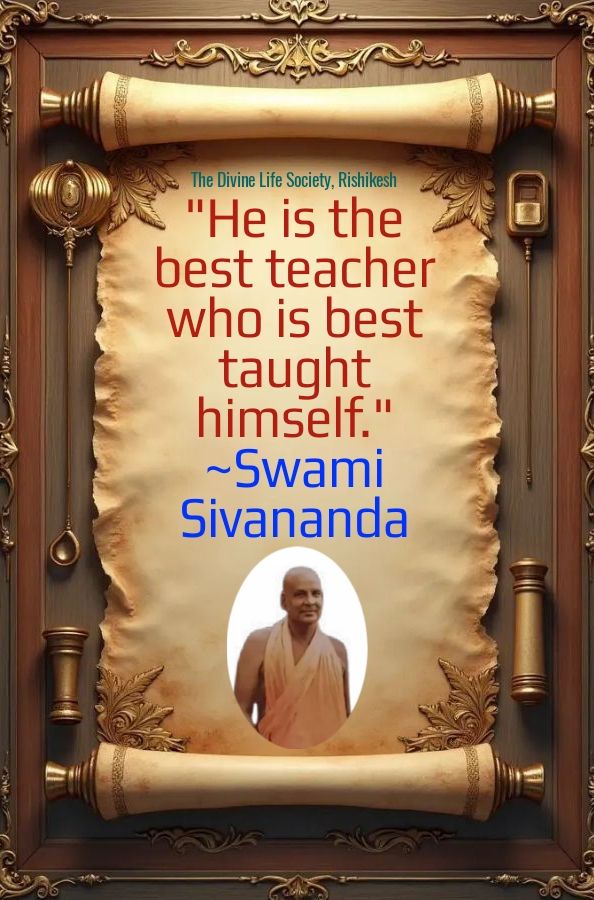
Swami Sivananda teacher quote scroll image
Karma Yoga, Swami Sivananda

Karma in the Jain Philosophy

Karma in the Jain Philosophy by Swami Sivananda Karma in the Jain philosophy is divided into eight classes: those which act as an impediment to the knowledge of truth; those which act as an impediment to the right insight of various sorts; those which give one pleasure and pain; and those which produce bewilderment. The other four are again divided into other classes so minutely that a student of the Jain Karma philosophy can trace any effect to a particular Karma. Persons who by right faith, right knowledge, right conduct, destroy all Karmas and thus develop fully the nature of their soul, reach the highest perfection, become divine and are called Jainas. Those Jainas, who, in every stage, preach the law and establish the order, are called Tirthankaras. Subject to the law of Karma man has to work out the effect of his previous actions. This Karma is a kind of force which holds the soul in bondage and prevents it knowing itself fully. There are many varieties of this force. The bondage of Karma arises on account of tendencies, and the most predominant of these determine the type of the body which the soul would make for itself in its future incarnation. The sum-total of these tendencies is what is called character, and this character contains in itself the well-digested and assimilated experience of the entire past of the soul. Now, if we would analyse the idea of tendency, we would not fail to observe that it is the modification of the mind in particular ways. The Jain books teach that the Karmic force is the product of a kind of matter, the particles of which have become combined with the soul. This explains the nature of the force which prevents the soul from realising its own blissful nature. It is obvious that all that the soul has to do is to get rid of the particles of matter which it has drawn to itself. As soon as this is accomplished the soul is freed from all kinds of bondage and acquires perfect knowledge and bliss. Karma is an energy which an embodied being generates-be it vital, mental or moral-and which keeps him in the mundane world, the Samsara. Karma, in short, is the whole Samsaric make-up of an embodied being. It is perfectly divested of the idea of sacrifice. Karmas which keep the individual in a backward condition are known as Papa; those which help him in advancement are Punya. The Jain philosophy gives a detailed enumeration of Karmas, and explains how they are attracted (Ashrava), how they are assimilated with the individual (Bandha), how their inflow can be stopped (Samvara), how they can be entirely worked out (Nirjara), and what the ultimate state of the perfected individual is (Moksha). This particular branch of philosophy, therefore, includes topics like sensations, perceptions, consciousness, pains and pleasures, moralities of life, moral depravities, building of the body and all factors of the individuality.

Karma in the Jain Philosophy Read Post »

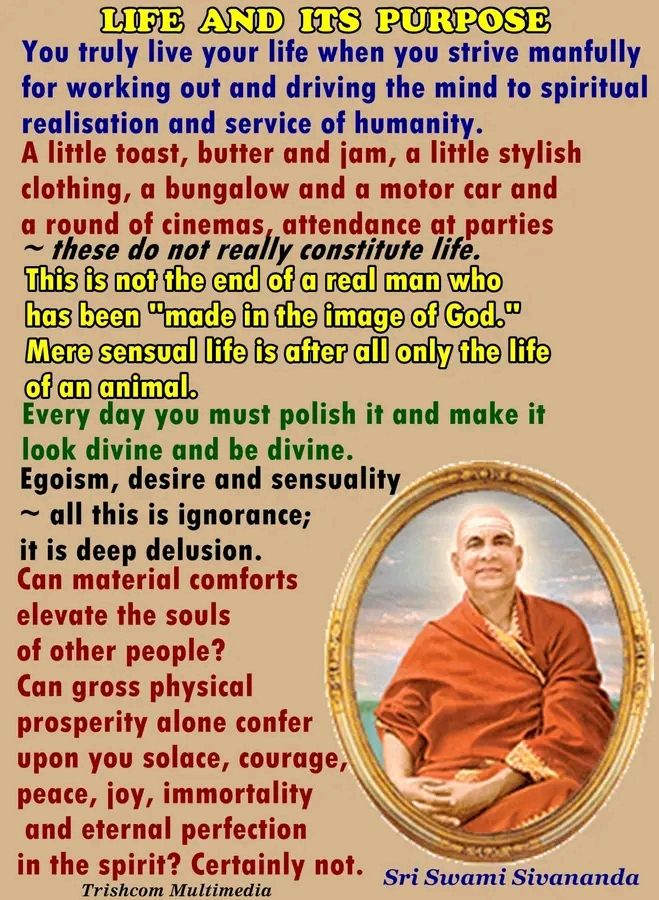
Swami Sivananda life purpose quote poster image
Karma Yoga, Swami Sivananda

Secrets of Karma

Secrets of Karma by Swami Sivananda Karma is the sum-total of works-good, bad and mixed-which an individual performs during his life. It is the collective totality of man’s actions. It is these actions that determine his future existence. There is double retribution or reward for man’s virtuous actions. He gets a good birth with suitable surroundings, environments and opportunities for his good actions: this is one reward. Another reward is that he gets a place in the abode of heaven also. But after the consummation of happiness he is sure to be hurled back to this physical plane. Lord Krishna says in the Gita: They, having enjoyed the spacious heaven world, their holiness withered, come back to this world of death. Following the virtues enjoined by the three (Vedas) and desiring objects of desires, they attain to the state of coming and going.” It is very difficult to say what Karma brings forth a particular disease. Is it a single Karma or a combination of several Karmas that brings epilepsy? The sages declare that the theft of a golden necklace brings Scrofula in the neck in the next birth. They say that leprosy, epilepsy and gulma (chronic gastric catarrh) are due to very bad Karmas. It is also difficult to say whether this body is the resultant product of a single Karma or a mixture of several Karmas. Generally one strong and powerful Karma determines the birth of an individual and keeps up the current of life of that particular birth. Some minor Karmas may be joined to the main trunk or the central thread. Learned persons say that one will have to take several births sometimes to exhaust the fruits of one important virtuous Karma. The secret of Karma is very mysterious. God only knows them because He is the Law-giver. Sometimes highly virtuous and vicious Karmas bring forth their fruits in the very life itself. It is impossible for a man to remain without doing any action either through the organs of action, feet, hand, etc., or through the mind. Even if he becomes a Sannyasin and retires into the cave in the Himalayas he must continue eating, drinking, answering the calls of nature, sleeping, etc. That is the reason why the Lord says in the Gita: “Nor can anyone, even for an instant remain really actionless; for helplessly is everyone driven to action by the qualities born of nature.” Ch. III-5. If work ceases to produce rebirth, literally no one can be freed. To avoid this difficulty knowledge is credited with powers of destroying Karmas. The Gita says: Jnanagnih sarvakarmani bhasmasatkurute. “The fire of wisdom reduces all actions to ashes.” Ch. IV-37. To sum up in a nutshell: there are three kinds of Karmas, viz., the Sanchita or accumulated ones, the Prarabdha or the fructiferous, and the Agami or current actions. Sanchita are works which have been accumulated in several previous births; Prarabdha are those which have given the present life and have already started to bear fruit; and Agami are the works which are being done in this present life. They will bring fruits in a future life. The Sanchita and Agami are destroyed by getting Brahma Jnana or knowledge of the Self or God. But the Prarabdha can only be exhausted by experiencing their fruits in the present life. A child is born blind, deaf or dumb-this is due to Prarabdha. One man dies at the age of ninety, another at thirty-five and the third at eighteen: this is due to Prarabdha. Jati (caste), longevity of life, Bhoga (enjoyment), are all due to Prarabdha. A virtuous man suffers, he is starving. A scoundrel is in a prosperous condition. An aged mother loses her only son who was her sole prop. A young girl who was newly married loses her husband. Instances like these can be multiplied ad infinitum. In all these cases Prarabdha operates unerringly with scientific accuracy and precision. See how Prarabdha operates. A lady from Paris came to me for an interview. She said that ever since she landed in India she was quite at home in the country. India was very familiar to her. She liked India and Indians very much. Within three months she forgot all about her parents and native place. She liked the Indian way of dressing. So she changed her dress. She wanted to domicile in India for the practice of Yoga. This clearly shows that in her previous birth she was born in India. Another American lady lived in Lakshman Jhula near Rishikesh fifteen years ago. She lived on Bhiksha, led the life of an ascetic and died on the banks of the Ganga. This is all Prarabdha. Hindus say that wherever there is Anna-Jala (food and drink) for a man, there he will be dragged. You cannot remain in a place even for a second more, when the Anna-Jala is finished. The last powerful thought that occupies the mind of a man in his dying moment determines the nature of his next birth. You will find in the Gita: Yam yam vaapi smaran bhavam tyajatyante kalevaramTam tamevaiti Kaunteya sadaa tadbhavabhavitah. “Whosoever at the end abandoneth the body, thinking upon any being, to that being only he goeth, O Kaunteya, ever to that confirmed by nature.” Ch. VIII-6. If the thought of tea comes in your mind at the moment of death, you may become a manager of a tea estate in the next birth, if you had done virtuous actions, or you may be born to do hard labour in a tea estate if you had done any evil actions. A drunkard will have thoughts of liquor when he is dying. A licentious man will think of women only when he is about to expire. I saw a dying man who had the habit of using snuff. When he was in an unconscious state he used to move his fingers towards the nose every now and then and do imaginary snuffing. Obviously he had thoughts

Secrets of Karma Read Post »