













Hari Om

Menu

February 12, 2026

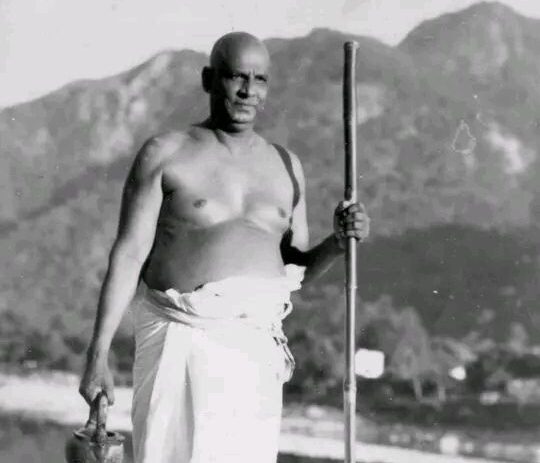
Swami Sivananda close-up black and white portrait image
Jnana Yoga, Swami Sivananda

Vedantic Sadhana

Vedantic Sadhana by Swami Sivananda O FRIEND! Why dost thou weep? Thou hast neither birth nor old age nor death. Thou hast neither passion nor craving. Thou hast neither gross nor subtle body. Thou hast neither mind nor Prana. Thou art the eternal, unchanging, all-pervading Self. Feel this and be free. O Friend! Why dost thou grieve? Thou hast neither name nor form. Thou hast neither caste nor age. Thou hast neither sex nor Indriyas. Thou art neither strong nor weak. Thou hast neither father nor mother. Thou art ever free, pure, eternal and immortal. Realise this and be free. Find out the real inner man. The real man is bodiless and formless. Do not identify the man with the outer food-sheath, Annamaya Kosha or the physical body. The gross physical body is like the shell of a coconut. The real man is the Immortal Spirit, which cannot be annihilated. Man in essence is the Imperishable Atman. He is the silent witness of the three states, viz., Jagrat, Svapna and Sushupti (waking, dreaming and deep-sleep states). Just as a rope is mistaken for a snake in the darkness, a post for a man, so also this impure body is mistaken for the pure Self through Avidya or ignorance. If you bring a light, the illusory snake in the rope will disappear. Even so, if you attain knowledge of the Self, the illusory identification with the body will vanish. The essential qualities of the man are not actually transferred to the post, nor the essential qualities of the post actually transferred to the man. Even so, consciousness does not belong to the body and the attributes of the body, such as decay and death, pleasure and pain, do not belong to the Self or Consciousness. If you have direct knowledge of the Supreme Self or Brahman through meditation, you will attain Immortality. There is no other way to reach the goal. If you know the Self you have gained the true end of life. You will be afraid of nothing. That Vastu or something which has neither beginning nor end is the Imperishable Brahman (Akshara). Akshara only is unchanging, infinite, eternal, self-luminous, indivisible, pure, perfect, ever free and independent. Akshara is your Immortal Soul. The fields or bodies are different but the knower of the field is one. Jivatmas are different but Paramatman is one. Wherever there is mind, there are Prana, egoism and Jiva-Chaitanya or reflected intelligence or Abhasa Chaitanya side by side. He who has the sense of duality (Dvaita Bhava) will take births again and again. This delusion of duality (Bheda Bhranti) can only be removed by the knowledge of identity of Jiva and Brahman. ‘Aham SukhiI am happy’, ‘Aham DuhkhiI am miserable’, ‘Aham KartaI am the doer’, ‘Aham BhoktaI am the enjoyer’ is the experience of all human beings. Therefore the Jivatma is a Samsarin and is subject to pleasure and pain. Jivatmas are different in different bodies, whereas Paramatman is free from pleasure and pain. He is Asamsarin. He is eternally free. He is one. If there is only one Jivatma in all bodies, all should have similar experiences at the same time. If Rama suffers from abdominal colic, Krishna also should experience the pain at the same time. If John experience joy, Jacob also should have a similar experience. If Choudhury is stung by a scorpion, Banerjee also should suffer from the sting. But this is not the case. When Rama suffers, Krishna rejoices. When John is jubilant, Jacob is depressed. When Choudhury suffers from the sting of a scorpion, Banerjee is enjoying his breakfast. Jivatma in essence is identical with Para-Brahman. Fields are different, bodies are different, minds are different and Jivatmas or individual souls are different. But the knower of Paramatman in all these fields or bodies is one. The Self is not affected by pleasure and pain, virtue and vice. He is the silent witness only. Pleasure and pain are the Dharmas of the mind only. They are ascribed to the Self through Avidya or ignorance. The ignorant man only regards the physical body as the Self. He is swayed by the two currents of Raga Dvesha and does virtuous and vicious actions, reaps the fruits of these actions, viz., pleasure and pain and takes births again and again. But the sage who knows that the Self is distinct from the body is not swayed by Raga Dvesha. He identifies himself with the pure eternal Brahman and is always happy and actionless, thought he performs actions for the welfare of the humanity. The disease Timira which causes perception of what is contrary to truth pertains to the eye but not to the man who perceives. If the Timira is removed by proper treatment, he perceives things in their true light. Even so, ignorance, doubt, pleasure and pain, virtue and vice, Raga Dvesha, false perception, non-perception of truth as well as their cause belong to the instrument, viz., mind, but not to the silent witness. The wheel of Samsara or the world’s process rotates on account of Avidya. It exists only for the ignorant man who perceives the world as it appears to him. There is no Samsara for a liberated sage. Any disease of the eye cannot in any way affect the sun. The breaking of the pot will not in any way affect the pot-ether. The water in the mirage cannot render the earth moist. Even so, Avidya and its effects cannot in the least affect the pure, subtle, attributeless, formless, limbless, partless and self-luminous Self. Avidya can do nothing to the Self. Avidya or ignorance born of Tamas acts as a veil and prevents man from knowing his essential Sat-Chit-Ananda Brahmic nature. It causes perception of what is quite the contrary of truth, or causes doubt or non-perception of truth. As soon as knowledge of the Self dawns, the three forms of Avidya vanish in toto. Therefore the three forms of Avidya are not attributes of the Self. They
Vedantic Sadhana Read Post »

Swami Sivananda with folded hands in prayer image
Jnana Yoga, Swami Sivananda

Vidyas from the Upanishads

Vidyas from the Upanishads by Swami Sivananda 1. Sat-Vidya This Vidya occurs in the Chhandogyopanishad, VI. 2. 1 & 2, where Uddalaka instructs Svetaketu on the nature of Existence. In the beginning O son, this was mere Exis�tence, one only without a second. Regarding this some others sayat first this was mere non-exis�tence, one alone without a second. From that non-existence proceeds existence. But verily, O son, how can this be? How can existence come from non-existence? Hence, O son, this was existence only in the beginning, one alone without a second. From non-existence existence cannot come out, for, even non-existence is an existence, a being. As regards the sentence in the Taittiriyopanishad which says that existence came from non-existence, it is explained that here non-existence refers to the state of Avyaktam where the manifold world does not exist and from which the existence of the world is evolved. Meditation on Sat-Vidya enables one to assert the reality of the Sat aspect of the Absolute whose essential nature is Chit and Ananda. In con�tinuation of this, Uddalaka asserts the great dictum of identity, Tat Tvam Asi, That thou art. 2. Bhuma Vidya This Vidya occurs in the Chhandogyopani�shad, VII. 24, where Sanatkumara instructs Narada in the nature of the Unconditioned Infinite Plenum or the Fullness of Being. Where one sees nothing else, hears nothing else, understands nothing else, that is called the Infinite Plenum. But where one sees something else, hears something else, understands something else, that is called the little finite. That which is Infinite is Immortal, and that which is finite is mortal This is perhaps the greatest of all the Upanishadic Vidyas, for it sums up the entire result of all philosophies and Vedantic enquiries. It treats of the most exalted Absolute State of unlimited bliss and immortal life after attaining which one returns not to mortal existence. In continuation of this, Sanatku�mara mentions that the Infinite, the Self, the I are all identical and that this One Being alone is the Truth. The knower of this Vidya becomes the Self-Emperor and exists as the Infinite whole. 3. Maitreyi Vidya This Vidya occurs in the Brihadaranyakopani�shad, II. 4 and IV. 5. Sage Yajnavalkya instructs his Brahmavadini wife, Maitreyi, on the nature of the Highest Self. O Dear, not for the love of this all, this all is dear, but for the love of the Self, this all is dear. This Atman (Self), O Maitreyi, is to be seen, heard of, reflected upon and meditated upon. O dear, through the seeing of hearing of reflecting upon and knowledge of this Self, all this becomes known. Where there is duality as it were, there one sees the other, smells the other, hears the other, speaks to the other, thinks of the other, understands the other. But where one’s Self alone exists everywhere, then through what can one see what, through what can one smell what, through what can one hear what, through what can one speak to what, through what can one think of what, through what can one understand what? Through what can one under�stand that by which everything else is understood? O dear, through what can one understand the understander? The Bhuma Vidya and the Maitreyi Vidya form the culmination of the entire philosophy of the Upanishads. The Absolute Reality is affirmed and declared in boldest terms in these two Vidyas. The non-existence or the illusory nature of the world-phenomenon and the truth of the One Indivisible Essence is asserted. When cause and effect are di�fferent from one another there arises the concept of duality. When cause and effect are blended into one, everything becomes One without a second. These two Vidyas are useful for the highest Advaitic Medita�tion on the unconditioned Absolute. 4. Sandilya Vidya This Vidya occurs in the Chhandogyopanishad, III, 1. This Vidya is ascribed to the sage Sandilya. Verily all this is Brahman; Tranquil, one must worship it as that from which this comes forth, as that into which this will be dissolved, as that in which this lives. This, the Soul of mine within the heart, is Brahman. Into Him I shall enter on departing hence. This Vidya further extends its form of meditation by conceiving of the Self as smaller than an atom and bigger than the universe, containing all works, desires, mind, life, odours, tastes, as being unspeaking and unconcerned, etc. Thus the Vidya is suited to Saguna Meditation, though by divesting it of such particular attributes it may be used for Nirguna Advaita Meditation also. 5. Dahara Vidya This Vidya occurs in the Chhandogyopanishad, VIII. 1. This abode, the small lotus that is here within this city of Brahman, and the small space within that lotuswhat is there within this space, that is to be searched out, that certainly is to be known. Verily, as extensive as the external Akasa, is this eternal Akasa. Within it are contained the hea�ven and the earth, both fire and wind, both Sun and moon, lightning and stars, both what exists here and what does not exist; everything here is contain�ed within it. This is one of the greatest of the Vidyas. The all-pervading and all-inclusive nature of the Self is stressed upon in this Vidya. In this meditation, the meditator feels the whole universe as his Self and excludes nothing from the One Self. This Vidya further explains the identity of the external and the internal, the objective and the subjective, the macrocosmic and the microcosmic, the universal and the individual. Brahman and Atman. 6. Vaisvanara Vidya This Vidya occurs in the Chhandogyopanishad, V. 12 to 18. Asvapati Kaikeya describes the Vaisvanara Vidya to Uddalaka and five other seekers after knowledge of the Vaisvanara Self. Its head is heaven, its eye Surya, its breath Vayu, its trunk Akasa, the Apas its bladder, its feet the earth, its breast the sacrificial altar, its hand the sacrificial grass, its heart the Garhapatya fire, its mind the Anvaharyapachana fire (Dakshinagni), its mouth the Ahavaniya fire. Thus the Vaisvanara

Vidyas from the Upanishads Read Post »

Swami Sivananda with Swami Venkatesananda with seated together image
Jnana Yoga, Swami Sivananda

Upanishadic Vidyas

Upanishadic Vidyas by Swami Sivananda The Vidyas or mystic meditations on Brahman are described in the Upanishads, mainly the Chhan dogya and the Brihadaranyaka. These are discussed in detail in the third Pada of the third Adhyaya of the Brahma-Sutras. These Vidyas are helpful in medita tion both on the Saguna Brahman and on the Nirguna Brahman too. There are, according to the Brahma-Sutras, three kinds of meditation: Nirguna, Saguna and Pratika. Unconditioned or Attributeless, Condi tioned or Qualified and Symbolical or Idolatrous. Many of the Vidyas abound in qualitative and relative con ceptions of the Highest Self. But, in spite of this limitation, these Vidyas can be utilised even for Nir guna Meditation provided the meditator conceives of the absolute aspect of the descriptions given therein and avoids ail dual and gradatory differentiations. Even then, some Vidyas like the Brahma Vidya, the Maitreyi Vidya etc., are highly useful even for Aham graha Upasana and Nirguna Dhyana of the Vedantins. Meditation must be practised only on one Vidya suitable to the temperament of the meditator. The fruit of these meditations is Atyantika-Sukha or absolute happiness, free from the pain of birth, life and death in Samsara. Here are described some of these im portant Vidyas enunciated in the Vedantic Upani shads. These Vidyas cannot be meditated upon without being directly initiated by a Guru (Tea cher). They are very complex and hard to under stand for oneself without a guide.

Upanishadic Vidyas Read Post »

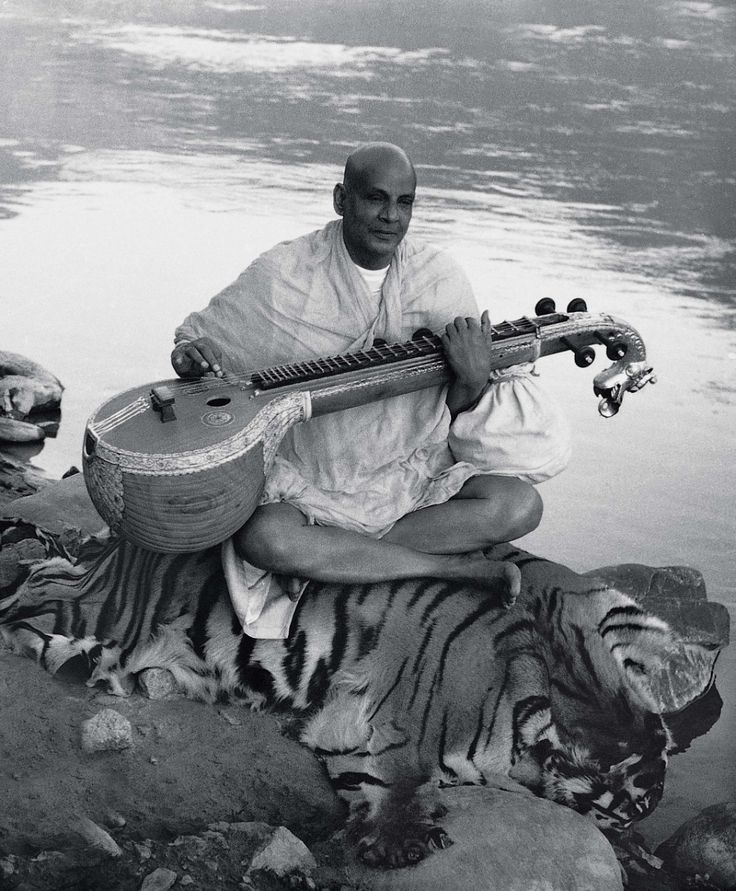
Swami Sivananda playing veena by riverside image
Jnana Yoga, Swami Sivananda

Wisdom of the Upanishads

Wisdom of the Upanishads by Swami Sivananda IGNORANT people identify themselves with the body, mind, Prana and the senses on account of nescience or Avidya. They mistake these false perishable limiting adjuncts or vehicles for the pure immortal Atman and so they are caught in the round of births and deaths. But some wise people abandon this false identification, separate themselves from these limiting adjuncts through enquiry, discrimination, Anvayavyatireka Yukti and practice of ‘Neti-Neti’ doctrine (I am not this body, I am not this Prana, I am not this mind, I am not the senses), identify themselves with the all-pervading, immortal, pure Brahman, obtain knowledge of Brahman and attain immortality. One becomes immortal by renouncing all desires. In this world man always talks of ‘my son’, ‘my wife’, ‘my house’, etc. The wise abandon all such worldly talks and worldly desires and attain immortality by meditation on Brahman who is the ear of the ear, the mind of the mind, etc. The Sruti says, Not by works, not by offspring, not by wealth, but by renunciation alone is immortality attained. When all desires are abandoned here they attain the Brahman. Having turned his senses inward for desire of immorality, the wise man attains Brahman. Just as water in a cup borrows it heat from sun or fire, so also the mind, Prana and senses borrow their light and power from Atman. Atman is the source for all these organs. The ear hears through the light of the Atman, the tongue speaks through the power of Atman, the mind thinks through the intelligence of Atman and Prana performs its function through the power of Atman only. Mind and these organs are inert and non-intelligent. They appear to be intelligent thought the light and power of the Atman. Brahman or the Atman gives to the ear the power of hearing, the mind the power of thinking, the tongue the power of speaking, the eye the power of seeing and the power of life to the Prana. It is therefore said that it is the ear of the ear, the mind of the mind, etc. There is a director for the ears, eyes, tongue, mind and life-force who is distinct from the ear, mind and Prana. The ears, eyes, mind and Prana exist for his use just as the house exists for the use of the owner. The director is Brahman or Atman. The eye and the organs cannot go to the Brahman. They cannot approach Him for one cannot go to one’s own Self. How can the eyes see the seer of sight? The eye is an object of perception for the mind and Atman. However clever and acrobat may be, he cannot jump on his own shoulders. So is the case with the senses. The eye can only see the external objects of the universe. That is its only function. How can it know or reach its source which is extremely subtle? It is not possible to go to one’s own self. Similarly, speech cannot go there. When you utter the word cow, that word enlightens the object ‘cow’ denotes by it. Then it is said that the word goes to the object. The source or support or abode or resting place for the word and the organ that utters it is Brahman. Therefore the word or the speech or the mouth does not go there, i.e., approach Brahman. The mind also cannot go there. How can it know the knower? Just as fire that burns and enlightens other objects cannot either burn or enlighten itself, so the mind which knows the external objects through the avenues of the senses, cannot know the Atman or Brahman, because Brahman is the source for the mind also, and the mind is gross, inert and finite. How can the finite know the Infinite? The gross impure mind cannot approach Brahman. But the subtle, pure mind only can go there, for pure mind is Brahman itself. Speech cannot reveal or illumine Brahman. Brahman is beyond the organs of speech. The tongue speaks through the power or light of Brahman. Speech is infinite. How can the finite speech reveal the infinite Brahman. Brahman only illumines speech and its organ Vak which is presided over by fire (Agni); so Brahman is speech of speech, tongue of tongue. The Vajasaneyaka says, Brahma is within speech and directs speech. This Atman is Brahman or Bhuma (infinite or the unconditioned). Brahman is unsurpassable, big, great, highest of all, all-pervading. So He is called Brahman. The mind is connected with all organs. It is the commander or the chief. The Srutis say, Desire, volition, deliberation, faith, negligence, courage, timidity, shame, intelligence, fear, etc., are mind. Mind is the Drik or seer, the objects are the Drishya or visible objects. Atman or Brahman is the Drik, mind is the Drishya. The mind cannot approach Brahman. The mind is enlightened by the intelligence of Brahman shining within. The mind functions through the light and power of Brahman. The mind is pervaded by the Brahman. So say the knowers of Brahman. The interior intelligence of the mind is Brahman. The mind comprehends the world or objects through the power or light or intelligence of Brahman. The senses carry the sense impressions or images of objects to the mind. The mind presents them to the Self or Atman or Purusha. The Purusha beholds them, gazes and fixes His seal and returns them back to the mind, just as the king puts his seal on papers and returns them back to the prime minister. Then only comprehension of objects becomes perfect. Brahman directs the eye towards form. Brahman cannot be seen by the eye, as He is not an object of perception. Eye is a finite instrument to carry the impressions of objects viz., colour, shape, form size, etc., to the mind. Eye derives its power of seeing from Brahman only who is its source. The eye is made to move towards its objects by

Wisdom of the Upanishads Read Post »

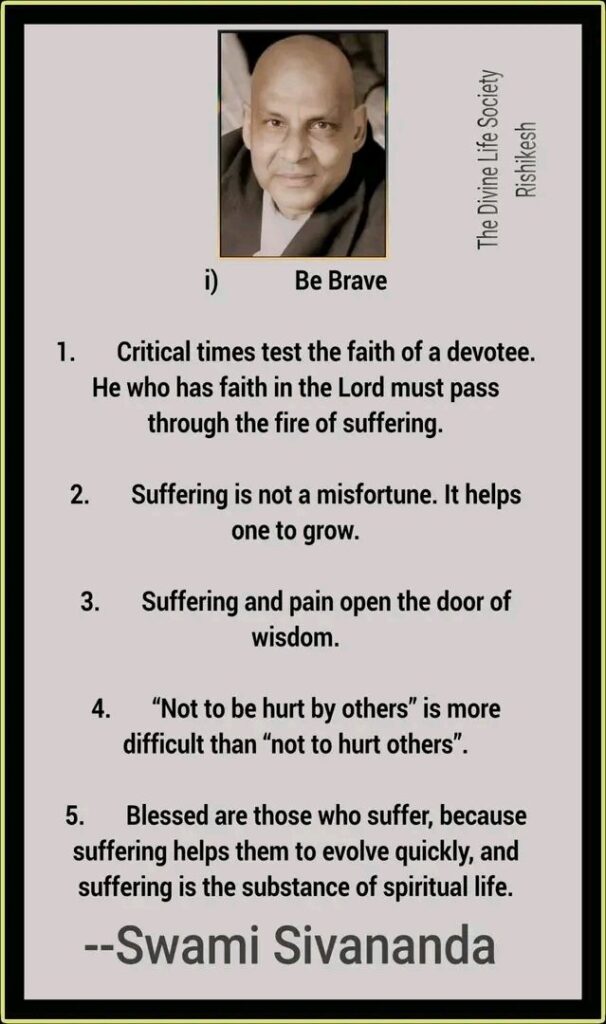
Swami Sivananda be brave spiritual guidance poster image
Swami Sivananda, Yoga of Synthesis

Sivananda Ashram

Sivananda Ashram Spiritual organisations with high aims and objects should be started only by Mahatmas who are absolutely free, perfect and unselfish. If religious institutions are started by selfish people, they become fighting centres and a menace to society and bring ruin to those who are associated with the workers. In the long run, through ill-managed Institutions and Ashrams, people lose faith in God and religion and condemn all Mahatmas as pseudo Yogis. Sometimes selfish persons start spiritual institutions as business undertakings. They misguide the people. Even an Ashram started by a self-realised person, with high aims and objects in the early stages may get polluted later on by mercenary motives. The founders must have extraordinary capacity to serve mankind. Then and then alone can real service be done at all times. When there is lack of interest and Sraddha in householders, it becomes difficult to carry on systematic work. Above all, it is extremely difficult to get workers with ability and devotion. These days aspirants do not appreciate much the value of selfless service. Many of the Ashrams suffer for lack of able workers. THE ASHRAM GREW BY ITSELF I never thought of starting an Ashram. When the great rush of students and devotees came to me for spiritual guidance, with a view to render help to them and to make them useful to the world, I created some fields of activities for their evolution and for public good, encouraged them much in their studies and their Sadhana, and arranged necessary comforts and conveniences for their boarding and lodging, using the donations I received from some admirers for my personal use. Thus, in course of time, I found around me a huge Ashram and an Ideal Institution with congenial environment-a big Spiritual Colony-SHIVANANDA NAGAR. I did not work with big plans or schemes. I did not approach any great person or Maharajah for getting money. The world appreciated the service done here on right lines. A little help came from the divine source and I carefully utilised every cent of it for bringing maximum spiritual good to the world. Several new palatial buildings crop up every year and yet there is lack of accommodation for the inmates and the stream of visitors. At every stage, there was splendid development of work. On many occasions devotees pressed me to undertake propaganda tours for collecting money. That was impossible for me. I take delight in giving and serving all. In 1940, grand arrangements were made for an extensive tour in the Punjab. I sent a telegram at once and cancelled the programme. The telegraphic message conveys the attitude with which I manage the affairs of the Ashram: “I do not care if the Divine Life Society flourishes or not. If it is the Grace of the Lord and if we carry on our Sadhana and service with the right attitude, Bhava and Sraddha, help is bound to come from Divine Source. Let me do as much as possible by remaining in my own small Kutir on the banks of the Ganga. When the honey is there, the bees will come by themselves. Shun ruthlessly the desire for money.” In a short period the work grew. Regular classes are now conducted on Yoga, Bhakti, Vedanta and Health. Today over 300 students live by my side with all comforts and conveniences, tread the path of Yoga, and serve the world in a variety of ways. Glory to the Lord. Blessed are the aspirants. Students of different cults and faiths come from various countries and stay with me for weeks and months. Devotees from all parts of India come to the Ashram frequently and join the collective Sadhana and Satsanga.

Sivananda Ashram Read Post »

Swami Sivananda seated wearing garland candid photo
Jnana Yoga, Swami Sivananda

Western Philosophy and Vedanta

Western Philosophy and Vedanta by Swami Sivananda EASTERN philosophy begins where Western philosophy ends. Western philosophy is not perfect as there is no proper foundation, as there is no real ethical basis. The scientist draws his conclusions from his observations and experiences of the wakeful state only. Hence they are not correct. True experiences include the experiences of the three states viz., waking, dreaming, and deep-sleep states. The Vedantin studies the three states. He gains more real knowledge from the deep-sleep state. He gets a clue for the existence of the fourth state or the state of Turiya from the deep-sleep state. Reason is the faculty of reasoning. Reason is also the process of reasoning of Kant. Reason (Buddhi) represents the intellect of Vedantins. Buddhi or intellect comes under the fourfold Antahkarana or inner instrument, Manas, Buddhi, Chitta and Ahamkara. Mind (Manas) is one. It assumes the form of Buddhi, Chitta and Ahamkara according to the function it performs viz., Sankalpa, Vikalpa, determination, memory and self-arrogation. Intuition is a spiritual faculty. It is the eye of wisdom. Super-intuition is knowledge itself or Brahman. Kant has admitted that there is something beyond reason, something which the reason cannot grasp and a transcendental something which transcends reason. That something is Brahman of the Upanishads. That something is the Immoral Self or Atman of the Vedantins. That something is the Paramam Gati or the highest goal of Gita. He has also admitted that the intellect is frail, finite, weak and impotent, as it is conditioned in time, space and causation, that it has its own limits incapable of directly knowing or realising that all-blissful Thing-in-itself which corresponds to Sat-Chit-Ananda Brahman of the Srutis. Reason is a help and a hindrance. It is a help if it serves you in any way to attain the goal of life. It is a hindrance if it stands in your way of realising the Self. It is a help if it can make you understand the doctrine of Sankara that Brahma satyam jagat mithya Jivo Brahmaiva naparah i.e., Brahman or Self alone is real, this world is unreal. Jiva or individual soul is identical with Brahman or the Supreme Soul. It is hindrance if it makes you a worldly-minded, passionate and ignorant man. It is a help if it can make you constantly remember the Atman, if it can serve you to fix your mind on the imperishable soul, if it can help you to rise above the body-consciousness. It is a hindrance if it makes you forget your ideal and goal, if it makes you identify with the impure body and if it forces you to indulge in sensual pleasure. It is a help if it can goad you to do rigorous Tapas, vigorous meditation, practice of self-restraint and develop the sublime divine virtues that are enumerated in the 13th and 16th chapters of the Gita, Amanitvam (humility), Adambhitvam (unpretentiousness), etc., and Abhayam (fearlessness), Sattva Samshuddhi (cleanliness of life) and to reach the goal eventually by developing intuition or the eye of wisdom. Intuition does not contradict reason but transcends reason. Intuition is the way to Brahma Jnana or knowledge of the Self attained through purity of heart and Nirvikalpa Samadhi brought about by constant, protracted and intense meditation on the attributeless, timeless, spaceless, brithless and deathless Self. Reason helps you to march to the door of intuition. Reason takes you to the threshold of intuition. Reason gives you the information that the experiences of this phenomenal world are unreal when compared with the true, everlasting experiences of Self-realisation (Atma Sakshatkara or Brahma Anubhuti). Reason tells you that there is a fourth state or Turiya which transcends the waking, dreaming and deep-sleep states, that one can attain immortality and eternal peace by attaining this state through meditation. You can clearly understand now that reason has its own definite utility. You should not ignore it altogether. You are in need of the help of reason in the beginning when you start the quest of Truth. You will have to discipline it properly and make it fit instrument for achieving your end. Then it will be your obedient and willing servant to carry out your behests. Manas (mind) is said to be of two kinds, the pure and the impure. That which is associated with the thought of desire is the impure, while that which is without desire is the pure. To men, their mind alone is the cause of bondage or emancipation. That mind which is attracted by objects of senses tends to bondage while that which is not so attracted tends to emancipation. Now in as much as to a mind without a desire for sensual objects there is stated to be salvation, therefore an aspirant after emancipation should render his mind ever free from all longing after material objects. When a mind freed from the desires for objects and controlled in the heart attains the reality of Atman, then it is in the Supreme Seat. The mind should be controlled till that which arises in the heart perishes. This only is true wisdom. According to the Upanishads, reason is of two kinds viz., pure reason (Vishuddha Buddhi or Suddha Manas) and impure reason (Viparita Buddhi or Ashuddha Manas). Impure reason is perverted intellect. It is a strong weapon of Maya or Avidya. It is surcharged with egoism, lust, delusion and other impurities. It forces you to mistake the impermanent, impure, pain-giving insentient body for the permanent, pure, all-blissful sentient Atman. Impure reason is turbid. It is under intoxication. The function of the impure reason is to make you worldly-minded. The function of the pure reason is to take you to the goal. Vichara or enquiry of the Self ‘Who am I?’ will arise in a man who is endowed with pure reason. The tendency of pure reason is to move towards the Atman. It has an upward pull. Impure reason has a downward pull. It hurls the man into the dark abyss of ignorance.

Western Philosophy and Vedanta Read Post »

Framed portrait of Swami Sivananda black and white
Swami Sivananda, Yoga of Synthesis

My Religion, Its Technique and Dissemination

My Religion, Its Technique and Dissemination I love seclusion. I have to hide myself at times. I do not crave for name and fame. I did not spend much time in a deep study of all the scriptures and religions of the world, for preparing thrilling lectures. I never liked to spend time in writing fine essays for publication through books or newspapers. I was not pleased when people called me: “Mahatma, Guru Maharaj.” I never planned for any Institution to perpetuate my name. But the Divine Will was different. The whole world came to me with all divine glory and splendour. That may be due to the intense prayers of thousands of sincere seekers after Truth coupled with my own inborn tendencies to share with others what I have and to serve the world on a large scale on the right lines, for the attainment of Light, Peace, Knowledge and Power. I was induced to start the Divine Life Society when I found some facility and useful hands to carry on the work. I carried the Message of the Sages and Saints and taught the world the way for Peace and Bliss. Because of the popularity of the Divine Life Society, many learned and pious souls from far off lands have come to see me and, sharing with me the love for selfless service, are doing valuable work in spreading right knowledge, which alone can confer lasting peace and happiness. Many foreign Branches of the Divine Life Society are reprinting parts of my writings and distributing them free in their respective regions. THE NEED OF THE HOUR When man gets entangled in selfishness, greed, lust, passion, he naturally forgets all about God. He always thinks of his body, family and children. He constantly attends to his food, drink, comforts and conveniences. He is drowned in the ocean of Samsara. Materialism and scepticism reign supreme. He gets irritated by little things and begins to fight. There is restlessness, misery, panic and chaos everywhere. Now the whole world seems to be in the grip of materialism. The invention of new kinds of bombs causes terror everywhere. People have lost faith in holy scriptures and the teachings of the sages and saints. People have become irreligious owing to wrong education and evil influences. The stirring events since the advent of the twentieth century did not fail to have their effect upon all spiritual-minded people, Sannyasins, saints and men-of-God. The horrors of world wars moved them greatly. The fateful epidemic and the world-wide depression that followed it, touched their compassionate heart. They saw that the sufferings of mankind were mostly brought on by its own deeds. To awaken man to his errors and follies and to make him mend his ways so that he may enthusiastically utilise his life for attaining worthier ends, was felt to be the urgent need of the age. Millions were eagerly looking for such guidance. This silent prayer was heard and I saw the birth of the Divine Life Mission with its task of rescuing man from the forces of bestiality and brutality and divinising his life upon this planet. Just at this critical juncture, I started the Divine Life Society. Now people consider it a blessing to the world. It has as its basis the quintessence of the teachings of all religions and of all saints and prophets of the world. Its principles are broad, universal, all-embracing and in accordance with science and reason. It has set for itself the task of raising man above the sorrows and miseries of this mundane life by making him see the Blissful Divinity that is hidden behind all outward forms. Good thoughts pervade and influence all good people. The thought-currents generated by the Divine Life Movement have had their effect upon the people of Europe and America, and now there is a great thirst for peace all over the world. Millions dread the speedy termination of the race by nuclear weapons. UNIVERSAL IDEALS FOR SPIRITUAL PERFECTION The Divine Life Society is an all-embracing and all-inclusive Institution; its objects, ideals and aims are very broad and universal. It does not condemn any of the principles or tenets of any cult. It includes all the fundamental principles of all religions and cults. There are no pet dogmas or sectarian tenets. It leads people to the spiritual path. It enables people to take easily to the Divine Life even while living in the world and following the teachings of some particular cult or religion. The Society has brought about a vigorous awakening throughout the world and has contributed much to a new life of freedom in action, a life of harmony amidst worldly turmoils and a life of bliss through mental non-attachment and mental renunciation of desires, egoism and mine-ness. There is universal appreciation of the principles, aims, ideals of the society and the method of its work. It lays great stress on the practical side of Sadhana. It expounds in a rational and scientific manner the Yoga of Synthesis. Members belonging to various institutions and organisations in all parts of the world become members of the Divine Life Society and write to me for spiritual guidance. I take special care of them and give them lessons through post for their spiritual progress and welfare. The Divine Life Society proclaims that any man can attain Wisdom in his own station of life, be he a Brahmachari, Grihastha, Vanaprastha or Sannyasi, be he a scavenger, Brahmin, Sudra or Kshatriya, be he a busy man of the world or a silent Sadhaka of the Himalayas. Divine Knowledge is not the sole property of Sannyasins, recluses. It explains how although the central basis is Jnana Yoga, Vedanta, it is necessary for one to practise Karma Yoga for purification of mind and heart; Hatha Yoga to keep up good health and strength and purify the Prana and steady the mind; Raja Yoga to destroy the Sankalpas and induce concentration in meditation; and Jnana Yoga to remove

My Religion, Its Technique and Dissemination Read Post »

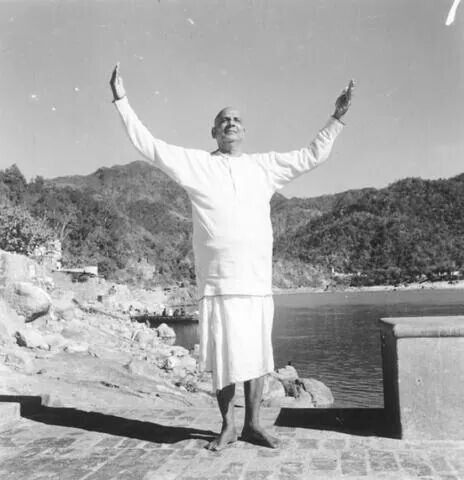
Swami Sivananda standing with raised hands by river image
Jnana Yoga, Swami Sivananda

Become the Svarat or Self-king

Become the Svarat or Self-king by Swami Sivananda Salutations to Sadguru who is of the nature of Sat-chidananda, who is the silent witness of all the attributes or Vrittis of the mind, who is the essence of Vedanta, who is of the nature of Brahman, who is one with Brahman, and who has merged himself in the ocean of eternal bliss. Para Brahman is Eternal, pure, all-wise, free, all-full, non-dual, partless, all-pervading, Infinite. In this city of nine gates dwells the Jiva or the individual soul. He has forgotten his essential divine nature on account of Avidya or ignorance. He is not able to behold the Supreme Self on account of the veil which separates him from Brahman. Vikshepa Sakti causes tossing of the mind. So he is not able to concentrate on the Self. Ahamkara is his minister. The twenty-four Tattvas are the members of his family. Pramatra, Pramana and Prameya are his three sons. Vitteshana, Dareshana and Putreshana and the Shad-Ripus or six enemies, viz., anger, lust, greed etc., have robbed him of the wealth of Atma Jnana. He has become a prey to all attachments. He is burnt by the three fires. He is led astray by the wind of hopefulness. He is enveloped by the fog of attachment to the body. He is deluded by the thoughts I am the doer (Karta). I am the enjoyer (Bhokta). He is attacked by the fevers of Pancha Koshas (five sheaths). He is fallen in the state of deep sleep of sensual enjoyments. O man! I shall show you now the way to get rid of these afflictions and attain the supreme goal of eternal bliss. Hearken attentively. Do Japa regularly. Do selfless service without expectation of fruits. Abandon the idea of doership. Consecrate all your works to the Lord. Cultivate Bhakti. Take shelter at the lotus feet of Sadguru who is ever in Nirvikalpa Samadhi under the banian tree of Nididhyasana, in the Siddhasana of Sravana and Manana on the banks of the great river, the grace of the Lord. Make prostrations unto Him wet with Bhakti. He will elevate you. He will inspire you and remove all your doubts and snares in the path and help you to attain the kingdom of Atma Svarajya. He will make you free. O Beloved Ram! You have forgotten your real Svarupa on account of egoism and desires. Thou art pure immortal, Eternal Soul. Thou art That. Tat Tvam Asi. Rise above Moha or delusion. Give up the identification with this impure, perishable body. Take bath in the Ganga of devotion to the lotus feet of Sadguru. Kill the thieves, lust, anger, etc. Abandon the ideas, I am the doer. I am the enjoyer. Be established in the idea of the unreality of the world. This is the practice of Pranayama for you. Make friendship with Mudita, Karuna, Upeksha, Sama, Dama. Fix the arrow of Manonasa on the bow of Vasana Kshaya. Burn the forest of Pratibandhatraya, the three obstacles. Have Vairagya as the shield, discrimination as helmet, Uparati as the necklace, Samadhana or one- pointedness of mind as your brave companion, Brahmanu-sandhana as armour, Satsanga as your minister, Jivanmukti as partner in life. Ascend the throne of Self-Samrajya or Nirvikalpa Samadhi. Become the Svarat or Self-King. Drink the nectar of Immortality or eternal bliss of Brahman. Being crowned with the knowledge of Brahman know that thou art the eternal, pure, all-pervading Atman. There is nothing else besides you. Thou art That.

Become the Svarat or Self-king Read Post »

Swami Sivananda seated by river peaceful portrait
Jnana Yoga, Swami Sivananda

Renunciation is a Glorious Thing

Renunciation is a Glorious Thing by Swami Sivananda Who is a real hero? He who has controlled his mind and senses, who has annihilated the Vasanas, Samskaras, cravings, who has attained Self-realisation, is a real hero of heroes. A liberated sage, a dynamic Yogi, a realised Bhagavata, is the real hero of heroes, indeed! Ordinarily, ignorant people of the world say that he who has renounced the world is a timid man who cannot earn his livelihood. This is a sad and terrible mistake. It is very difficult to renounce family, children, relations, possessions, property, wealth, One in a million only can take to renunciation. Now, take out all the leaders of the world and put them in solitude for a year in a forest. They will feel like fish out of water. They cannot remain. They will run back to the world within a week without informing their Guru. Such is their spiritual strength! The life of a Sannyasi is the best kind of life in this world. A true Sannyasi is the true monarch of the three worlds. Even an aspirant is the Emperor of the three worlds. Lord Krishna says: Only wishing to know Yoga even, the seeker after Yoga goeth beyond the world of Brahma (VI. 44). This world is full of difficulties and troubles. No one save a Yogi or a Jnani is free from these worldly miseries and anxieties. Go wherever you like. It is all the same. For a passionate man, there is much pleasure in this world. He runs after money and woman. His mind is intoxicated, perverted and clouded. For a Viveki or a man of discrimination, this world is a ball of burning fire. Lead a life of Vairagya and renunciation. Then and then alone can you be happy. You must show extreme contempt towards worldly objects. Treat all earthly possessions and sensuous enjoyments as dung, poison, dust and straw. Turn the mind away from them. Then only will you get Jnana. This world is a mere Mela of two days, and this body is a mere appearance for two seconds. Even if you become the sole monarch of the whole world, you cannot enjoy real bliss and peace. by the worldly affections, by the avarice of wealth, the acquirement of women and jewels and by the attachment to external fleeting forms and beauties, the mind gets fattened, while indifference to them thins it out! (Yoga Vasishta). The Mahabharata says: Desire is not gratified by indulgence. On the other hand it increases like fire after a pouring of ghee over it. All the wheat and maize grown in the world, all wealth, all cattle, all women even, will not be sufficient to gratify the desire of one person. Knowing this, a wise man should control his mind. To attain to an exalted state of spirituality, you should in the first instance fully realise the glory of life in the Spirit or the Soul. Then only will you have the requisite strength to kick and spurn this world mercilessly and take to a life of meditation on the Atman and of renunciation. Constant remembrance of and meditation on the following Slokas of the Bhagavadgita will help you to a great extent in the attainment of your goal: He whose self is unattached to external contacts, and findeth joy in the Self, having the self harmonised with the Eternal by Yoga, enjoys happiness exempt from decay (Ch. V-21). That in which he findeth the Supreme Delight, which the purified Reason alone can grasp, beyond the senses, wherein established, he moveth not from the Reality; which, having obtained, he thinketh there is no greater gain beyond it; wherein established he is not shaken even by heavy sorrow (Ch. VI-21, 22). The Yogi who thus, ever harmonising the Self, hath put away sin, he easily enjoyeth the infinite bliss of contact with the Eternal (Ch. VI-28). When the dweller in the body hath crossed over these three qualities, whence all bodies have been produced, liberated from birth, death, old age and sorrow, he drinketh the nectar of Immortality (Ch. XIV-20). Every moment you should be ready for Sannyasa. The very longing for Sannyasa shows that there is growth of spirituality. Deluded people bring various vain arguments: Mohammed was a householder. Nanak was a householder. Rama married. Krishna married. Ramakrishna Paramahamsa married. Delusion! Even if you are a Jnani, you will have terrible downfall when you come in contact with worldly persons and worldly things! Many Sannyasins have fallen. Many Yogis have fallen! The Bhagavata says that actual fire is not so dangerous, heated iron is not so dangerous, burning charcoal is not so dangerous, as the company of worldly persons! Worldly people always speak against Sannyasa, against renunciation and Tapas! Even a cobra is not so very dangerous as these deluded people! Even in an advanced stage of life, people remain in their house with family, wives and children, but take fancy to say: I have got mental detachment; I am a mental Sannyasin. Ah! There is a terrible attachment in them! Sannyasa has its own glory and splendour. Sannyasa is extremely necessary. One may say: I do not need orange-coloured robes. Still Sannyasa is necessary. Sannyasa has got its own psychology. All arguments against it are false! The Mundaka Upanishad will tell you how necessary Sannyasa is. The world has not produced a greater genius than Sankara, the greatest Sannyasin! Why did Ramakrishna Paramahamsa take Sannyasa? No use of argumentation and logic; mere vanity of the intellect! Sannyasa is necessary though you may have Advaitic Realisation. Totapuri, Ramkrishna’s Guru, though he had Brahmic Realisation, took Sannyasa. Why did Mandana Misra take Sannyasa? Yajnavalkya had the highest Realisation, but yet he took Sannyasa. Why? The world has not produced a greater sage than Yajnavalkya. Study his instructions to his wife, Maitreyi! Sannyasa destroys all worldliness, all evil Samskaras, and establishes you in Divine Meditation. You must come out of the house and wander

Renunciation is a Glorious Thing Read Post »