





Hari Om

Menu

January 2026

om10
Asatoma Sadgamaya

Sahana Vavatu

Sahana Vavatu ॐ सह नाववतु ।सह नौ भुनक्तु ।सह वीर्यं करवावहै ।तेजस्वि नावधीतमस्तु मा विद्विषावहै ।ॐ शान्तिः शान्तिः शान्तिः ॥ oṃ saha nāvavatu .saha nau bhunaktu .saha vīryaṃ karavāvahai .tejasvi nāvadhītamastu mā vidviṣāvahai .oṃ śāntiḥ śāntiḥ śāntiḥ .. May he (the Lord) protect both of us. May he nourish both of us (with knowledge). May both of us make effort for the capacity (for knowledge to take place). May what is studied by us, be brilliantly clear. Let not have any misunderstanding. Let there be freedom from three possible obstacles (the forces over which we have no control, adhidaivika; from the beings around us, adhibhautika; or from factors centred on ourselves, adhyatmika.) Description Note: Shanti mantra from Taittiriya, Katha Upanishad and Shvetashvatara Upanishads. Excerpt from the book ‘Prayer Guide’ by Swami Dayananda SaraswatiSa ha navavatu. Sah ha nau avatu. Sah means Isvara, the Lord. So, may the Lord ha, definitely, indeed, avatu, protect and bless, nau, both of us. The word ‘om’ is also derived from the same root as avatu, the root av. Av is used in the sense of protecting. Om means the one who protects being a source of blessing. Thus the Lord’s name is om. You can also say he is the one who sustains everything. May that Lord bless both of us, teacher and student. Sa ha nau bhunaktu. Sah, that Lord, ha, definitely, indeed, bhunaktu, nourish, nau, both of us. The root bhuj in the verb bhunaktu is also in the sense of protection. It does not mean eating here; in that case, the verb would have a different ending, the atmane-pada ending. The sense here is only of nourishing. May he nourish both of us with knowledge. May the Lord indeed, ignoring all my omissions and commissions, being blind to them, bless us and nourish us both. Both, student and teacher, seek Bhagavan’s blessing. Saha viryam karavavahai. Saha, together, karavavahai (may we) exert for virya, samarthya (capacity to gain knowledge). Whatever is required to gain this knowledge, may we make an effort for that. On the part of a student the capacity consists of certain conditions, commitment, sraddha, background knowledge, the power of retention and recollection. The teacher also needs commitment, health, time and so on. May we both enjoy the respective required qualifications.Tejasvinavadhitam astu: tejasvi nau adhitam astu. Whatever sastra is studied, adhitam, by both of us, communicated by one and gained by the other, let it not remain mere words; astu, let it be tejasvi, meaningful, nau, for us. Tejas means brilliance. Let the understanding not be vague, but brilliant like the sun that is not obscured by the clouds. You cannot miss the sun even when the clouds are there. It is not like inference in which you infer the presence of the sun upon seeing the silver lining of the clouds. The sastra is not a matter for inference. It is ‘I’ and has to be understood very clearly. Therefore, let what is studied be brilliantly clear, free from any vagueness, much less error. Ma vidvisavahai: A dvesha is any kind of dislike or misunderstanding. May we not be subject to this misunderstanding. Let nothing come in between us so that this communication is complete. Om santih santih santih: We chant santi three times. There are not three types of santi. There is only one santi, but there are three types of problems that can deny santi. Let there be freedom from those problems. Let problems not arise from the forces over which we have no control, adhidaivika; from the beings around us, adhibhautika; or from factors centred on ourselves, adhyatmika. The first set of problems comes from sources over which we have no control whatsoever, like cyclone. We can only protect ourselves from it. Let there not be obstacles from such sources over which we have no control. That is one santi. The second source of asanti is any kind of disturbance from the external world, political, social or domestic which is an obstruction to our pursuit. We pray for santi from these obstacles that we do not want to have. The third santi is to take care of problems centred on oneself. There can be physical problems, like an inability to sit comfortably for some time, physiological problems like indigestion, and so on. The mind itself can pose a problem. I pray that all the three capacities, physical, deha; physiological, prana; and mental, manah, be available to me in a manner that is conducive to my pursuit of this knowledge, vidya. In chanting these three santis, I pray for freedom from these three possible obstructions.
Sahana Vavatu Read Post »

om8
Asatoma Sadgamaya

Purnamadha Purnamidam

Purnamadha Purnamidam ॐ पूर्णमदः पूर्णमिदम् पूर्णात् पूर्णमुदच्यते |पूर्णस्य पूर्णमादाय पूर्णमेवावशिष्यते ||ॐ शान्तिः शान्तिः शान्तिः || oṃ pūrṇamadaḥ pūrṇamidam pūrṇāt pūrṇamudacyate .pūrṇasya pūrṇamādāya pūrṇamevāvaśiṣyate .oṃ śāntiḥ śāntiḥ śāntiḥ .. That is Whole and this is Whole, the perfect has come out of the perfect; having taken the perfect from the perfect, only the perfect remains. Let there be Peace, Peace, Peace. (This shanti-sloka of the Isavasyopanishad indicates the relation of the individual’s soul to the divine supreme spirit). Description of Purnamadha Purnamidham The dictionary meanings of the most important word “Purnam” in this verse are: full, whole, complete, boundless, accomplished, powerful, infinite, limitless etc. The word limitless (Anantam) has been used to describe Brahman in the Vedas and the Upanishads. We have chosen the word limitless or infinite for the word “Purnam” here. Mathematically, the word “infinite or limitless” fits better than any other word to describe the indescribable Brahman in our opinion. Taittiriya Upanishad (verse 2.0) defines Brahman as: Satyam Jnanam Anantam Brahma – Existent, Conscious, Boundless is Brahman. This Upanishad also states Brahman is that from which everything comes, and is sustained by, and into which everything enters in the end (verse 3.1). Reading any literal translation, a new student or any first time reader of Vedānta can get confused. But, as we will see, this verse is very profound. It is so profound that someone said: Let all the Upanishads and Vedic literatures disappear from the face of the earth, I don’t mind so long as this one verse survives and remains engraved in the mind of even a single individual. This is not an ordinary verse. It contains the Vedic vision, the universal Truth of oneself. It answers the fundamental question: Who am I and how can I live a peaceful and happy life in this world full of difficulties? The first part of this great mantra says that everything— unknown Spirit (Adah, That, Ātmā or I, Jagadish) and known objects of the world (or Idam, all this, Jiva and Jagat)— is nothing but the limitless (Brahman, Purnam). The Bhagavad-Gita also says in verse 7.19: Everything is Brahman (vāsudevah sarvam-iti). There is nothing that is not Brahman or Purusha. There is Brahman only and nothing else in the universe and that Brahman is limitless, infinite, one of a kind, and the source and sink of the entire cosmos. Our experience indicates that all the objects that we see seem to be limited in space, time, and in many other ways. Then how can everything in the universe and the world be unlimited? Ātmā or spirit is considered limitless, but how can visible objects, such as the world and our bodies, be called infinite? Can we call everything as infinite? The ocean can be called limitless, but not the waves. Some waves are quite large, some are small, all are limited in time and space, but not in numbers!! The waves appear limited as long as we look at the waves and the ocean as separate or “dual” entities. If we consider the wave as part and parcel of the ocean, or consider both the ocean and the wave as water only, then the wave is limitless like the ocean. From a non-dualistic viewpoint if ocean is limitless, so is the wave, because both the ocean and the wave are a single, non-dual entity. Thus from a dualistic view point, the wave “appears” incomplete, and limited, but is really infinite as the ocean itself. Thus, if there is only a single entity, then the question of one being infinite or complete and the other limited or finite does not arise at all. If we consider we are not the body, but the infinite spirit residing in the bodies, then, we are limitless and infinite. Duality is apparent, not real. The negation of duality means negation of the reality of duality, but not the negation of appearance or experience of duality. The experience of duality that we see in real life is apparent or relative, called unreal in Vedānta. From a dualistic viewpoint, a small wave is afraid of being swallowed by the large wave and prays to the ocean for protection from large waves. This is what prayers and worships are. From a non-dualistic point of view, there is no such fear. Everything in the world is an interaction, a play, a cosmic drama, only. Vedānta acknowledges duality as apparent—not real—experience of difference between various objects. The Unity appears diversified. The experience of non-duality brings joy and bliss. Even a temporary escape from duality and the experience of non-duality during Samādhi (or super-conscious state of mind) brings bliss and peace. The elimination of duality in Samādhi is temporary and beyond the reach of everyone. A complete and full negation of the reality of duality has a permanent, wonderful, blissful, effect on our entire psyche. It comes after the true Knowledge of the Self. The experience of duality does not create a problem as long as we fully understand that duality is apparent and not real. And I am not different or separate from the world, and the world is not different from me. Everything is Brahman only. The limitless, infinite or non-dual Brahman also means that no entity other than Brahman exists in the cosmos and Brahman is both the creator and the creatures. In other words, Brahman is both the material and efficient or instrumental cause of the creation, the cosmos. There is no other cause or existence, except Brahman. Vedānta cites two beautiful examples of how one and the same entity can be both the material and instrumental cause of creation. One example is that of the female spider who creates its web from the material within herself. The female spider is both: the creator and creation, the web. The entire creation, both visible and invisible, comes out during the creative cycle and gets dissolved or drawn into Brahman during great dissolution (see BG 9.07). Brahman brings the material from within, weaves the beautiful and wonderful tapestry called the cosmos,

Purnamadha Purnamidam Read Post »

om6
Asatoma Sadgamaya

Kale Varshatu Parjanyah

Kale Varshatu Parjanyah काले वर्षतु पर्जन्यः । पृथिवी सस्यशालिनी ।देशो ऽयं क्षोभरहितः । ब्राह्मणास्सन्तु निर्भयाः ।। kāle varṣatu parjanyaḥ . pṛthivī sasyaśālinī .deśo ‘yaṃ kṣobharahitaḥ . brāhmaṇāssantu nirbhayāḥ .. May there be prosperity to the subjects, the rulers protecting the world in a lawful manner; may the cows and brahmanas have auspiciousness eternally, may all the people be prosperous, may the rains shower in the proper season, may the earth be prosperous with the abundant crops; may the country be free from distress, may the brahmanas be fearless. Description Prayer for benedictions. The shanti mantra is an invocation for harmony and blessings for all of creation. Lokakshema is a Sanskrit word meaning global well being. This lokakshema/ mangala (auspicious) mantra is often recited after a pooja or religious ceremony. The origin seems to be from the stone inscriptions from the Rulers of the Sangama Dynasty (1336 A.D.-1485 A.D.)

Kale Varshatu Parjanyah Read Post »

om3
Asatoma Sadgamaya

Dyauh Shaantir Antarikssam

Dyauh Shaantir Antarikssam ॐ द्यौः शान्तिरन्तरिक्षं शान्तिःपृथिवी शान्तिरापः शान्तिरोषधयः शान्तिः ।वनस्पतयः शान्तिर्विश्वेदेवाः शान्तिर्ब्रह्म शान्तिःसर्वं शान्तिः शान्तिरेव शान्तिः सा मा शान्तिरेधि ॥ॐ शान्तिः शान्तिः शान्तिः ॥ oṃ dyauḥ śāntirantarikṣaṃ śāntiḥpṛthivī śāntirāpaḥ śāntiroṣadhayaḥ śāntiḥ .vanaspatayaḥ śāntirviśvedevāḥ śāntirbrahma śāntiḥsarvaṃ śāntiḥ śāntireva śāntiḥ sā mā śāntiredhi ..oṃ śāntiḥ śāntiḥ śāntiḥ .. May peace radiate there in the whole sky as well as in the vast ethereal space everywhere. May peace reign all over this earth, in water and in all herbs, trees and creepers. May peace flow over the whole universe. May peace be in the supreme being Brahman. And may there always exist in all peace and peace alone. Aum peace, peace and peace to us and all beings! Description This peace invocation is from the Rig Veda.

Dyauh Shaantir Antarikssam Read Post »

om1v
Asatoma Sadgamaya

Bhadram Karne

Bhadram Karne ॐ भद्रं कर्णेभिः शृणुयाम देवाः ।भद्रं पश्येमाक्षभिर्यजत्राः ।स्थिरैरङ्गैस्तुष्टुवागँसस्तनूभिः ।व्यशेम देवहितं यदायूः । स्वस्ति न इन्द्रो वृद्धश्रवाः ।स्वस्ति नः पूषा विश्ववेदाः ।स्वस्ति नस्ताक्षर्यो अरिष्टनेमिः ।स्वस्ति नो वृहस्पतिर्दधातु ॥ॐ शान्तिः शान्तिः शान्तिः ॥ oṃ bhadraṃ karṇebhiḥ śṛṇuyāma devāḥ .bhadraṃ paśyemākṣabhiryajatrāḥ .sthirair aṅgais tuṣṭuvāgam̐sas tanūbhiḥ .vyaśema devahitaṃ yadāyūḥ . svasti na indro vṛddhaśravāḥ .svasti naḥ pūṣā viśvavedāḥ .svasti nastākṣaryo ariṣṭanemiḥ .svasti no vṛhaspatirdadhātu ..oṃ śāntiḥ śāntiḥ śāntiḥ .. O devas, may we (always/only) hear what is auspicious with our ears,O gods/worthy of sacrifice, may we (always/only) see what is auspicious with our eyes;O gods/who are praised, may we reach/attain with steady limbs and bodies the life(span) that has been established by the gods. May Indra (of) exalted fame give us well being;May the omniscient Pūṣā give us well being;May Tārkṣya of indestructible wheel rims give us well being;May Bṛhaspati give us well being.Om, peace, peace, peace. ॐ OM : Supreme Parabrahman, manifested and unmanifestedभद्रं Bhadram : Good, auspiciousकर्णेभिः Karnebhih : With earsशृणुयाम Shrunuyaama : May we hearदेव Devaa : Shining ones or elevated beings on the Higher Emotional, Lower Mental and Higher Mental planesभद्रं Bhadram : Good, auspiciousपश्येमाक्षभि Pashyemaakshabhih : “Pashyemaa” means see or visualise and “Akshabhih” is with eyesर्यजत्राः Yajathraah : Those deserving worship, the Devasस्थिरैःअङ्गैः Sthirairangai (Sthirai-Angai) : Stable (and healthy) limbsतुष्टुवांसः Tushtuvaam-Sahah: Praying to Godतनूभिः Tanoobhi : By using the body (or bodies)व्यशेम Vyashema : May we attain or gainदेवहितं Deva-Hitam : Allotted by Presiding Devaयदायुः Yadaayuh : With in the given lifespanस्वस्ति नः Swasti nah : Bless usइन्द्रो Indro : Lord Indraवृद्धश्रवाः Vruddhashravaah : Long known and heard of or Ancient, and famousस्वस्ति नः Swasti nah : Grant or endow usपूषा Pooshaah : Lord Sunविश्ववेदाः Vishwa-Vedaah : Knower of the Universe or everythingस्वस्ति नः Swasti nah : Bless usतार्क्ष्य Taaksharya : Lord Vayuअरिष्टनेमिः Aristanemih : Protector from evil or from all harmस्वस्ति नः Swasti nah : Bless usबृहस्पति Bruhaspatih : Guru of Devasर्दधातु Dadhaatu : May give (intellectual wealth for Spiritual upliftment)शान्तिः Shanti, Shanti, Shanti hi : May there be peace Description The first part of the verse starting with Bhadram Karnebih … is a prayer to the gods for well-being, asking for the ability to hear and see auspicious things, to live a healthy life, and to engage in activities that are beneficial to the divine order. The prayer seeks the strength to fulfill one’s duties with stable and healthy limbs, living a life dedicated to good deeds. The second part starting with svasti na indro offers specific invocations to the gods for blessings. It asks for Indra, the god of strength and power, to grant prosperity and renown. Pūṣā, the all-knowing sun god, is called upon to bless with wisdom and guidance. Tārkṣya (Garuda) is invoked to protect from harm and negative forces, while Bṛhaspati, the guru of the gods, is asked to bestow wisdom and good fortune. In summary, the complete verse is a holistic prayer for physical, mental, and spiritual well-being, invoking various gods to bless the reciter with protection, knowledge, strength, and longevity. This peace invocation is from the Atharva Veda. This is a shanti mantra from the Mandukya Upanishad. It is also found in other Upanishads, like, Prashna and Mundaka Upanishad. It is an invocation for well-being, protection and obtaining knowledge for all and for fostering the ability in all to perceive, pickup and engage in only that which is good and utilize their time and capabilities optimally in contributing to humanity. The idea is that one offers up prayers to the gods, so that they may look favorably upon this study and grant that both student and teacher should remain healthy and alert for the duration. OM – is spoken at the outset of all prayers and scriptures both as an effective ‘name’ for God and as a symbol for the aim of the study – freedom from ignorance, i.e. enlightenment or mokSha. When chanted before an Upanishad, of course, it is also the very subject of the study, representing all states of consciousness and reality itself. bhadraM karNebhiH shRRiNuyAma devAH – Oh, Gods! May we hear auspicious (words – i.e. those words to come in what follows – shRRiNuyAma has the same root as shruti; shru means to hear from a teacher, study or learn). bhadraM pashyemAkShabhiryajatrAH – grant that we may see that which is auspicious, oh (Gods who are) worthy of worship (yajatra)! sthiraira~NgaistuShTuvA{m+}sastanUbhiH | vyashema devahitaM yadAyuH – grant us long lives (Ayus), with strong (sthira) limbs (a~nga) and bodies (tanU), (in order that we may) praise you! svasti na indro vRRiddhashravAH – may the great God Indra (vRRiddhhashravas literally means ‘possessed of great swiftness’) grant us (naH) good fortune (svasti)! svasti naH pUShA vishvavedAH – may the omniscient (vishvavedas) sun God grant us good fortune! (pUShA is another, less-common name for sUrya and should be understood as Ishvara) svasti nastArkShyo ariShTanemiH – May the limitless tArkShya grant us good fortune! “svasti” – means “well-being” or “blessings.” “naḥ” – means “for us” or “to us.” “tārkṣyaḥ” – has a couple of interpretations. It can refer to Garuda, the divine eagle and vehicle (vahana) of Lord Vishnu, often invoked for protection and strength. It can also refer to a mythical bird, or Vayu the powerful wind God, but in any case, the word retains a connotation of strength, protection, and speed.“ariṣṭa” – means “free from harm” or “safe.”“nemiḥ” – refers to the wheel or rim (sometimes symbolic of protection or defense). svasti no bRRihaspatirdadhAtu – May bRRihaspati afford (dadhAtu) us success. Om shAntiH shAntiH shAntiH – All prayers tend to end with these three words, which ask for freedom from obstacles to receiving the teaching. (shAnti means ‘peace’.) Obstacles may arise in three ways:1. From the gods, in the form of catastrophic and unavoidable events such as natural disasters. These are called Adhidaivika – related to or proceeding from supernatural or divine agents.2. From other humans who create problems or prevent us in some way. These are called Adhibhautika – related to created beings.3. From our own shortcomings, be it

Bhadram Karne Read Post »

56a9557256ab3a850dd58620ee3c0fd9
Asatoma Sadgamaya

Apyayantu Mamangani

Apyayantu Mamangani ॐ आप्यायन्तु ममाङ्गानि वाक्प्राणश्चक्षुःश्रोत्रमथो बलमिन्द्रियाणि च सर्वाणि।सर्वम् ब्रह्मोपनिषदम् माऽहं ब्रह्मनिराकुर्यां मा मा ब्रह्मनिराकरोद निराकरणमस्त्व निराकरणम् मेऽस्तु।तदात्मनि निरते य उपनिषत्सु धर्मास्तेमयि सन्तु ते मयि सन्तु।ॐ शान्तिः शान्तिः शान्तिः॥ oṃ āpyāyantu mamāṅgāni vākprāṇaścakṣuḥśrotramatho balamindriyāṇi ca sarvāṇi.sarvam brahmopaniṣadam mā’haṃ brahmanirākuryāṃ mā mā brahmanirākaroda nirākaraṇamastva nirākaraṇam me’stu.tadātmani nirate ya upaniṣatsu dharmāstemayi santu te mayi santu.oṃ śāntiḥ śāntiḥ śāntiḥ.. May my limbs, speech, vital air, eyes, ears, strength, and all the senses be fully developed, all that is revealed by the Upanishads is Brahman. May I never deny Brahman, May Brahman never disown me, Let there be no repudiation (from Brahman), Let there be no infidelity from my side, May all the dharmas extolled by the Upanishads shine in me, Who am intent on knowing the Self. May they shine in me Om! Peace! Peace! Peace! Description This Shanti (Peace) invocation appears in the Kenopanishad and Chandogyopanishad. This Peace Chant ends with the prayer for protection from the Tapatrayas (Threefold miseries) – Adhyatmika (body, mind), Adhi Bhautika (animals, other living beings) and Adhi Daivika ( natural calamities like earthquake, flood, tsunami, etc.)

Apyayantu Mamangani Read Post »

ed96b81d68c5caf6afd66ed57eaa048e
Asatoma Sadgamaya

Asatoma Sadgamaya

Asatoma Sadgamaya ॐ असतो मा सद्गमय ।तमसो मा ज्योतिर्गमय ।मृत्योर्मा अमृतं गमय ।ॐ शान्तिः शान्तिः शान्तिः ॥ Oṁ asato mā sadgamayatamasomā jyotir gamayamrityormāamritam gamayaOṁ śhānti śhānti śhāntiḥ Om,Lead me from the unreal to the real,Lead me from darkness to light,Lead me from death to immortality.May peace be, may peace be, may peace be. Description This is a Shanti mantra from the Brihadaranyaka Upanishad. It is also known as the Pavamana Mantra (pavamāna meaning “being purified, strained”, historically a name of Soma) and is an ancient Indian mantra introduced in the Bṛhadāraṇyaka Upaniṣad (1.3.28.) The mantra was originally meant to be recited during the introductory praise of the Soma sacrifice by the patron sponsoring the sacrifice.Om, Asato ma sadgamayaTamaso ma jyotirgamayaMrityorma amritam gamayaOm shanti, shanti, shanti! Om,Lead me from the unreal to the real,Lead me from darkness to light,Lead me from death to immortality. This is a prayer of all human beings everywhere and in this Upanishad it has been so briefly and beautifully expressed. In this short prayer all the aspirations of the human heart have been included. We all want to go from darkness to light, from untruth to truth and from death to immortality. This is a prayer for total cessation of all attachment and false identifications. A prayer to take us from death to immortality. Immortality cannot be achieved unless one is free from the lower impulses of lust, anger and other such demonic qualities. Unless these devils are destroyed and divinity restored, until evil is annihilated and death is transcended by establishing purity in thought, word and deed, one cannot hope to attain immortality. Thus, the human heart here pours out in prayer. asataḥ — “from falsehood”; ablative case of asat “falsehood”, from a (negation) + sat “truth”; becomes asato due to sandhi; can be a synonym for “evil”mā — “me”; first person pronoun, singular number, accusative casesat — “to truth”; accusative case of sat “truth”; here accusative case shows the destination; see also Sat (Sanskrit); becomes sad due tosandhi; can be a synonym for “good”gamaya — “lead”; causative, imperative mood, active voice, singular number, second person of root gam “to go”tamasaḥ — “from darkness”; ablative case of tamas “darkness”; becomes tamaso due to sandhijyotiḥ — “to light”; accusative case of jyotis “light”; becomes jyotir due to sandhimṛtyoḥ — “from death”; ablative case of mṛtyu “death”; see also Mrtyu; becomes mṛtyor due to sandhiamṛtaṃ — “to immortality”; accusative case of amṛta “immortal”, literally “not dead”, from a (negation) + mṛta “dead”; becomes ‘mṛtaṃ due to vowel elision.Traditionally the word shanti is chanted three times after om as it is invoking peace on three levels of consciousness: waking, dreaming and sleeping. It has also been thought that it is chanted three times to harmonize the three lokas, or worlds: earth, heaven and hell. It can also be said that shanti is chanted three times to soothe and bring peace to the body, mind and spirit. Detailed meaningLine 1. “asato ma sadgamaya”The word “sat” means truth, reality and pure existence. On the other hand “asat” just means the opposite – untruth, unreality and non-existence. The student here is seeking the ultimate truth in life. He has come to understand the limitations of the present life that he is leading. He now realizes that all his “possessions” – wealth, health, food, housing, means of transportation, success and fame etc. – are all transitory in nature. They come and go. They are not a source of permanent happiness or joy. Anything that can be considered true or real must exist in all three stages of time – past, present and the future. Everything in this ephemeral universe is constantly undergoing change. Our human bodies go through constant change. Our mind and intellect are constantly changing. Thus, none of these can be labeled as a source of eternal joy. The student, in the first line of this verse, is thus seeking the ultimate truth and reality in life which never undergoes any change. Line 2. “tamaso ma jyotirgamaya”The word “tamas” means darkness and “jyoti” means light. In all the ancient scriptures, the Vedas and the Upanishads etc., tamas refers to the darkness of ignorance and jyoti refers to the light of wisdom or true knowledge. The Sanskrit word for ignorance is “avidya”. In the yoga sutras, Patanjali states that avidya is the root cause of all suffering. He defines ignorance as, “Ignorance is regarding the impermanent as permanent, the impure as pure, the painful as pleasant, and the non-Self as Self.” (sutra 2.5). This definition seems to echo the state of our mind most of the time when we are in a state of confusion. The only remedy for darkness is light. In the Vedanta tradition, the most commonly quoted example is the “snake in a rope”. A man is walking in the street late in the evening when the light is very dim. He sees something lying curled up on the ground and runs away fearing that it is a snake. A passerby who has a flashlight is able to throw light on the object and show to this man that it was only a piece of rope there. In the darkness of ignorance the man suffered the emotions of fear and anxiety. Our life, for the most part, is built around similar instances of ignorance where we take unreal for real and go through suffering. Through the process of mental purification we can begin to remove the ignorance and get the light of true wisdom and understanding. This process will ultimately lead to self-realization. Line 3. “mrityorma amritam gamaya”The word “mrityu” means dealth and “amritam” means immortality. Since we do not know our true nature as being pure consciousness, we identify ourselves with this mind, body, ego complex. This puts us in this interminable cycle of birth, death and rebirth. The Sanskrit term for this cycle is “samsara”. The term immortality here means that we want to get out of this cycle of “samsara” by attaining self-realization. We

Asatoma Sadgamaya Read Post »

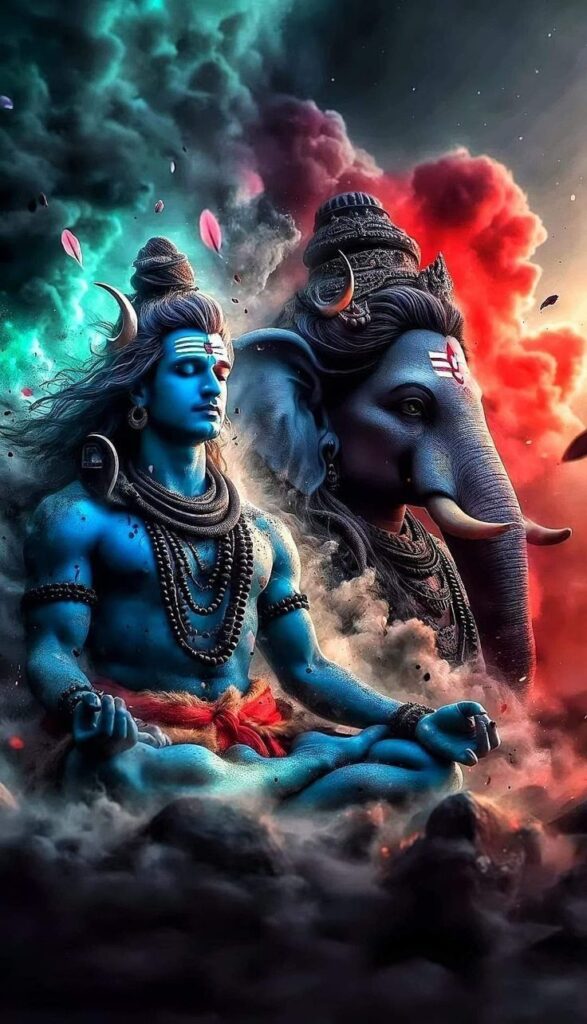
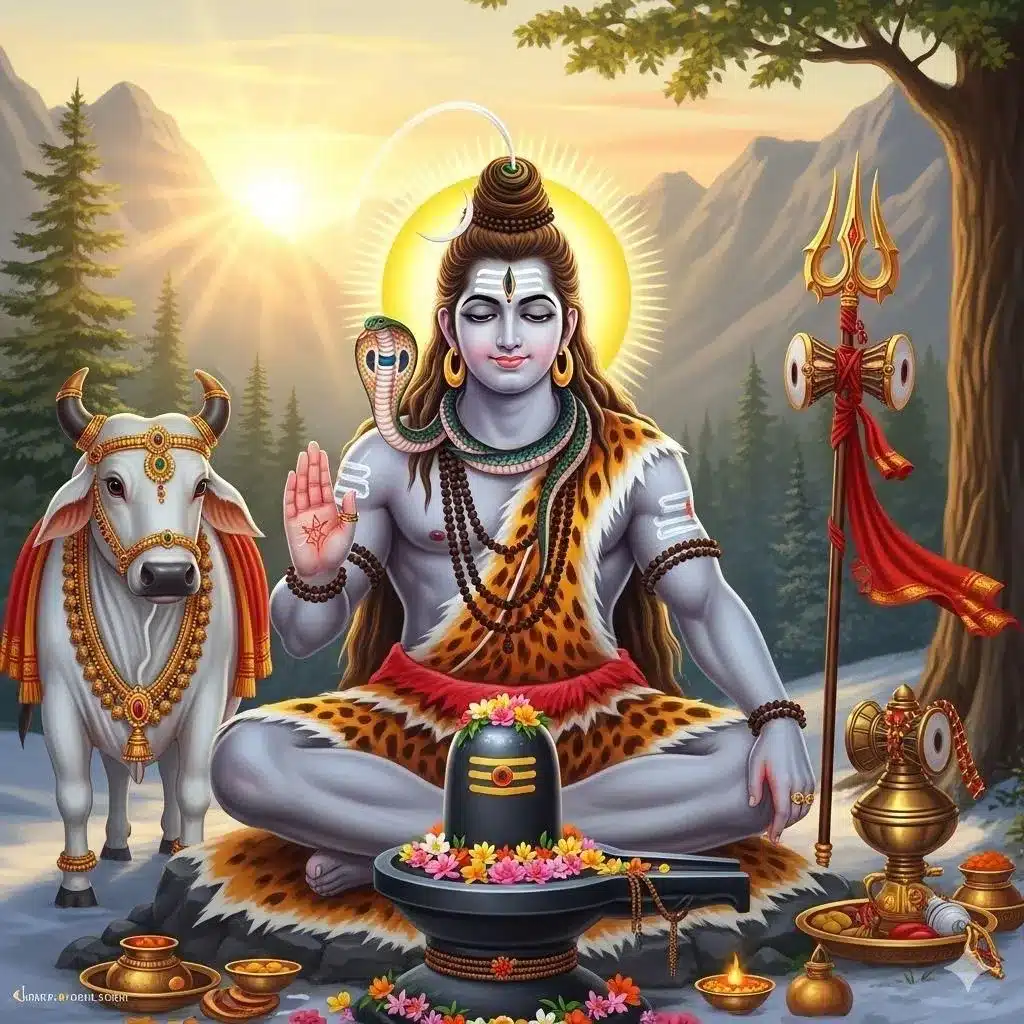
Lord Shiva meditating with Lord Ganesha behind in dramatic cosmic clouds. image
Ganesha Mantra

Vakratunda

Vakratunda वक्रतुण्ड महाकाय सूर्यकोटि समप्रभ ।निर्विघ्नं कुरु मे देव सर्वकार्येषु सर्वदा ॥ vakratuṇḍa mahākāya sūryakoṭi samaprabhanirvighnaṃ kuru me deva sarvakāryeṣu sarvadā O Lord with a curved trunk, with a broad body, and with a brilliance equal to that of millions of suns,Please remove all obstacles and make all my undertakings free of hindrances at all times. Vakra-Tunndda: Who has a curved trunk.Maha-Kaaya: Who has a large bodySuurya-Kotti Samaprabha: Whose splendour is similar to a million SunsNirvighnam: (Please make my undertakings) free of obstaclesKuru: Make or EnsureMe Deva: For me O Lord.Sarva-kaaryeshu: In all my worksSarvadaa: Always Description This is a very popular prayer to Lord Ganesha, typically chanted at the beginning of any new undertaking or even any activity, where we seek Lord Ganesha’s blessings to pave the way for our desired undertaking to happen. This prayer can be chanted upon waking as well. The time or activity is less important. The sincerity with which we pray is what matters. Invocation of Ganesha:This verse invokes Ganesha, who is traditionally worshipped at the beginning of any task, as he is known as Vighnaharta (the remover of obstacles). Symbolism of Vakratuṇḍa and Mahākāya:Vakratuṇḍa (the curved trunk) and mahākāya (massive body) signify the immense power and wisdom of Ganesha to remove hurdles, no matter how big they seem. Sūryakoṭi Samaprabha:The reference to Ganesha’s radiance being equal to ten million suns reflects his divine brilliance, which dispels ignorance and illuminates the path of success and wisdom. Seeking Blessings for Success:This śloka is a prayer for nirvighnaṃ (a smooth path free from obstacles) in all kāryas (activities), emphasizing the significance of beginning any venture with Ganesha’s blessings. Visit our Ganesh Chaturthi home page for more information, Pooja videos and popular Lord Ganesh songs all Ad-Free! Ganapati means “Lord of the people” (gana-“Host, group of people”, pati-“father, Lord”) and is also known asGanesha Gana-Esha, again referring to a Lord (Isha) of the Host/People.Lord Ganesha, who is known as the Lord of New Beginnings, is also worshipped as the Remover of Obstacles. Sri Swami Chinmayananda describes the symbolism of Lord Ganesha as follows: The Lord of Obstacles, Sri Vighneswara has four arms representing the four inner equipments, the Anthahakarana(Mind, Intellect, Memory and Ego).In one hand He has the ROPE and in the other He has an AXE. On the spiritual pilgrimage, all obstacles are created by the very subjective and objective worlds in the seeker himself. SriVighneswara chops them off with the AXE. He cuts off the attachments of His devotees to the world of plurality and thus ends all the consequent sorrows. He holds the attention of the seeker constantly towards the Higher, and pulls us nearer and nearer to the Truth and ultimately ties him down to the Highest Goal with the ROPE. With one hand, He blesses all His devotees and protects (ABHAYA) them from all obstacles on their spiritual path of seeking the Supreme, and with the other hand He feeds the seeker with MODAKA, representing the reward of the joys of sadhana — the “Joy of Experiencing the Reality”. Sri Sai Baba on Significance of Vinayaka WorshipBy Sri Sathya Sai Baba The following are a few more salient features of Ganesha’s symbolism that we ought to know 1. He is the first God to awaken in our consciousness and the first God to preside over our inner transformation. 2. As Vighneswara, the remover of obstacles, he removes ignorance, the biggest obstacle in our spiritual transformation. 3. Seated in the Muladhara chakra, he opens the blockages of inertia (tamas) present in the body and facilitates the passage of Kundalini and the free flow of spiritual energy. 4. As the harbinger of good, messenger of God and lord of the divinities, he fulfills the desires of his devotees and opens to them the doors of prosperity and abundance. 5. He is not only the son of Siva but also of Parvathi (nature). Since he is born out of their union, he personifies life, duality and manifestation in its diverse aspects. 5. His vehicle is the lowly mouse. His association with it symbolizes his lordship or control over fear, hesitation, weakness, doubt and nervousness, which the mouse symbolizes. He removes these obstacles to facilitate success and achievement for those who pray to him. 6. Lord Ganesha is the enjoyer of food. As the eater of various forms of food, he symbolizes Brahman, the ultimate recipient of all sacrificial offerings, In the body he symbolizes the individual Self, which is described in the Vedas as the enjoyer and the witness consciousness. 7. Lord Ganesha is the lord of Siva ganas. In the body, the ganas symbolize desires, thoughts and impulses. They are responsible for the instability and the modifications of the mind. They are also responsible for our distractions and failures in life. As their lord, Ganesha helps us in stabilizing our minds and experiencing peace and sameness. Lord Ganesha is our friend and benefactor in the fulfillment of the four aims of human life, namely duty (dharma), wealth (artha), enjoyment (kama) and liberation (moksha). He helps both the householders as well as the ascetics in realizing their goals. He is also described as a galactic god, who keeps balance among various worlds. He is the true son of God, Isvara, the Lord of the Universe.

Vakratunda Read Post »

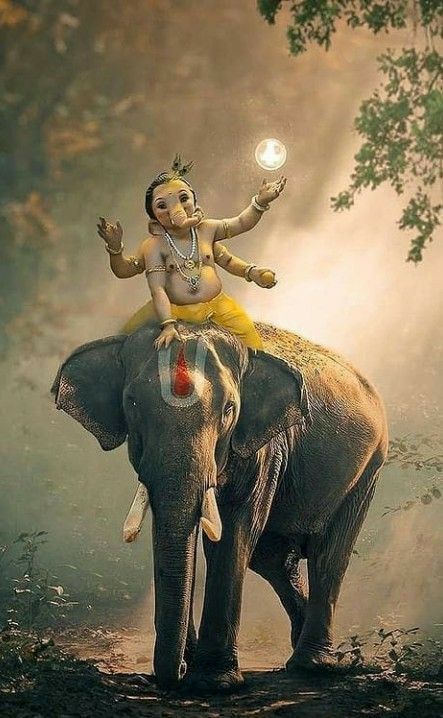
Baby Lord Ganesha sitting on an elephant in a forest holding glowing light. image
Ganesha Mantra

Shuklambaradharam

Shuklambaradharam शुक्लाम्बरधरं विष्णुं शशिवर्णं चतुर्भुजम् ।प्रसन्नवदनं ध्यायेत् सर्वविघ्नोपशान्तये ॥ śuklāmbaradharaṃ viṣṇuṃ śaśivarṇaṃ caturbhujam .prasannavadanaṃ dhyāyet sarvavighnopaśāntaye I meditate upon (Lord Ganesa), the one who wears a white garment, who is all-pervasive, who has a (bright) complexion like the moon, who has four hands, who has a cheerful face, for the removal of all obstacles. Description Excerpt from the book ‘Prayer Guide’ by Swami Dayananda SaraswatiThis is a very popular verse of prayer to overcome vighnas, obstacles.There are obstacles possible in your effort to achieve any desired end. To avoid the obstacles, vighnas, you offer a prayer in the beginning requesting that all obstacles be removed. This is a prayer to Lord Ganesa, the one who removes all obstacles. The word dhyayet should be understood dhyayami, I meditate, because the meaning would be, “May one meditate upon.” You are asking yourself to do dhyana, to visualise, think of, and pray. To whom should you pray and why? Visnum, the one who is sarva-vyapi, all pervasive. This aspect of all pervasiveness indicates that there is no place where he is not. All that is here is isvara. If you say he is inside, then the Lord is limited. If you say he is outside, then again, the Lord is limited. However, if you say he is inside and outside, you mean that he is limitless. Visnum dhyayami, I salute, I pray to, I meditate upon Visnu, who is all-pervasive. For the purpose of meditation, we give the Lord a form. Sasivarnam, he is of the colour of the moon, the autumnal moon. He has four hands, caturbhujam; each hand indicating one type of blessing. Suklambaradhara is the one who wears white clothes. White stands for purity, suddha-sattva. He is the who is all sattva, meaning all-knowledge. Prasannavadana is one who has a cheerful face. He is the one whose nature is fullness, ananda-svarupa. You will find seeming contradictions in all such descriptions. He is all-pervasive but wears white clothes! He is all-pervasive but one who has four hands! If you look beyond this, you can understand the beauty of it; one is the truth, svarupa, and the other is the form for your visualisation, upasana. You need a form to offer a flower. Sarva-vighna-upasantaye, for the removal of all forms of obstacle. This verse is generally chanted to propitiate and obtain the blessing of Lord Ganesa, the remover of all obstacles.

Shuklambaradharam Read Post »

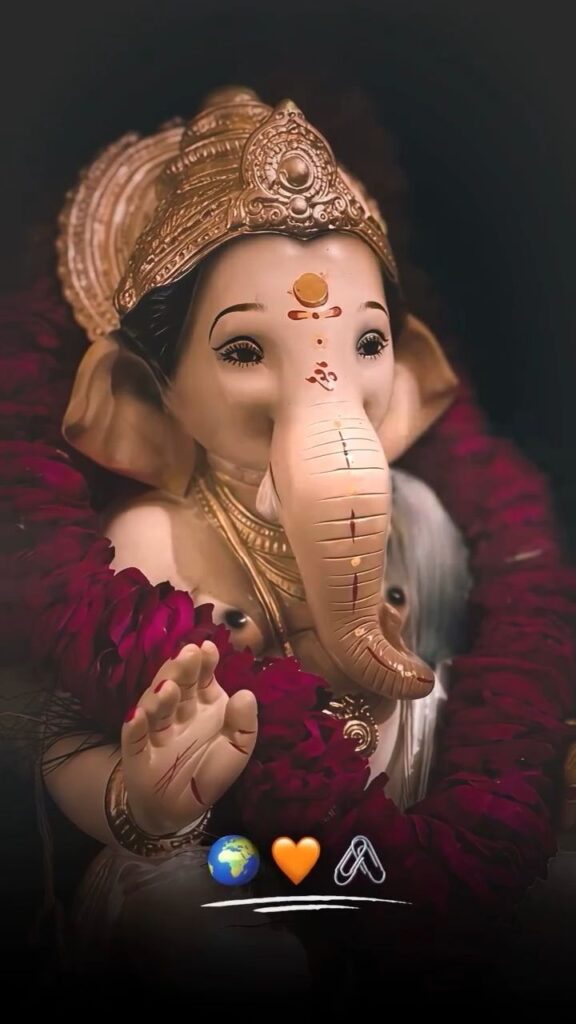
Close-up of Lord Ganesha idol with crown and flower garland giving blessing. image
Ganesha Mantra, Stotra

Sankata Nashana Ganesha Stotram

Sankata Nashana Ganesha Stotram प्रणम्य शिरसा देवं गौरीपुत्र विनायकम् ।भक्तावासं स्मरेन्नित्यायुष्कामार्थसिद्धये ॥१॥ praṇamya śirasā devaṃ gaurīputra vināyakam .bhaktāvāsaṃ smarennityāyuṣkāmārthasiddhaye ..1.. The learned one, who wishes, for more life, wealth and love, should salute with his head, Lord Ganapathi who is the son of Goddess Parvathi प्रथमं वक्रतुण्डं च एकदन्तं द्वितीयकम् ।तृतीयं कृष्णपिङ्गाक्षं गजवक्त्रं चतुर्थकम् ॥२॥ prathamaṃ vakratuṇḍaṃ ca ekadantaṃ dvitīyakam .tṛtīyaṃ kṛṣṇapiṅgākṣaṃ gajavaktraṃ caturthakam ..2.. Think of him first as god with broken tusk, second as the god with one tusk, third as the one with reddish black eyes, fourth as the one who has the face of an elephant लम्बोदरं पञ्चमं च षष्ठं विकटमेव च ।सप्तमं विघ्नराजं च धूम्रवर्ण तथाष्टमम् ॥३॥ lambodaraṃ pañcamaṃ ca ṣaṣṭhaṃ vikaṭameva ca .saptamaṃ vighnarājaṃ ca dhūmravarṇa tathāṣṭamam ..3.. Fifth as the one who has a very broad paunch, sixth as the one who is cruel to his enemies, seventh as the one who is remover of obstacles, eighth as the one who is of the colour of smoke. नवमं भालचन्द्रं च दशमं तु विनायकम् ।एकादशं गणपतिं द्वादशं तु गजाननम् ॥४॥ navamaṃ bhālacandraṃ ca daśamaṃ tu vināyakam .ekādaśaṃ gaṇapatiṃ dvādaśaṃ tu gajānanam ..4.. Ninth as the one who crescent in his forehead, tenth as the one, who is the leader of remover of obstacles, eleventh as the leader of the army of Lord Shiva, and twelfth as the one who has the face of an elephant. द्वादशैतानि नामानि त्रिसन्ध्यं यः पठेन्नरः ।न च विघ्नभयं तस्य सर्वसिद्धिश्च जायते ॥५॥ dvādaśaitāni nāmāni trisandhyaṃ yaḥ paṭhennaraḥ .na ca vighnabhayaṃ tasya sarvasiddhiśca jāyate ..5.. Any one reading these twelve names, at dawn, noon and dusk, will never have fear of defeat, and would always achieve whatever he wants. विद्यार्थी लभते विद्यां धनार्थी लभते धनम् ।पुत्रार्थी लभते पुत्रान्मोक्षार्थी लभते गतिम् ॥६॥ vidyārthī labhate vidyāṃ dhanārthī labhate dhanam .putrārthī labhate putrānmokṣārthī labhate gatim ..6.. One who pursues education will get knowledge, one who wants to earn money will get money, one who wishes for a son, will get a son, and one who wants salvation will get salvation. जपेद् गणपतिस्तोत्रं षड्भिर्मासैः फलं लभेत् ।संवत्सरेण सिद्धिं च लभते नात्र संशयः ॥७॥ japed gaṇapatistotraṃ ṣaḍbhirmāsaiḥ phalaṃ labhet .saṃvatsareṇa siddhiṃ ca labhate nātra saṃśayaḥ ..7.. Results of chanting this prayer, of Ganapati will be got within six months, and within a year, he would get all wishes fulfilled, and there is no doubt about this. अष्टाभ्यो ब्राह्मणेभ्यश्च लिखित्वा यः समर्पयेत् ।तस्य विद्या भवेत्सर्वा गणेशस्य प्रसादतः ॥८॥ aṣṭābhyo brāhmaṇebhyaśca likhitvā yaḥ samarpayet .tasya vidyā bhavetsarvā gaṇeśasya prasādataḥ ..8.. One who gets this prayer, written by eight brahmanas, and offers it to Lord Ganesha, will become knowledgeable, and would be blessed with all stellar qualities, by the grace of Lord Ganesha. Description This stotram is from Narada Purana. Sankata means problems, difficulties and Nashanam means to destroy. So, by chanting this stotram one is praying to Lord Ganesha (who is the remover of obstacles) to remove their problems forever. Here, Sage Narada explains the magnificence of Lord Ganesh. Lord Ganesha’s different names should be called out including Vakratunda, Ekdanta, Krishna Pingaksha, Gajvakra, Lambodara, Chata Vikata, Vighna Rajendra, Dhumravarna, Bhalachandra, Vinayaka, Ganpati. These twelve names should be worshipped in all three time periods of the day. It frees a person from all kinds of impediments and destroys all sorrows. As said in the stotram, when prayed with sincerity results will happen within six months.

Sankata Nashana Ganesha Stotram Read Post »