












Hari Om

Menu

January 22, 2026

Shri Sathya Sai Baba compassion
Sai Thought for the Month - Eternal Blessings

Develop One-Pointedness

Develop One-Pointedness From the tree of the mind comes the seed of impulses (vasanas). These impulses in turn make the mind. To free the mind from the influence of the impulses one has to get rid of ignorance (ajnana). But ignorance does not exist alone; it has a fiendish offspring—the ego (ahamkara). And the ego in turn has two children—attachment and craving; both of these are closely interrelated. Attachment gives rise to feelings of ‘my’ and ‘mine’ that cause desires (or cravings), this leads to worries. Therefore, to remove ego, attachment, and desires have to be annihilated. And the way to achieve this is through meditation and other spiritual practices. When this is done liberation can be attained. In this era of technology, it is becoming increasingly difficult to lead a peaceful life; people are falling victim to various physical and mental ailments. Many people in the cities which are on the front line of civilization, have lost the delight of natural sleep. They experience only artificial sleep induced by tablets. Due to such excessive use of medication, heart and blood pressure problems are on the rise. People are becoming unhealthy wrecks who are lost in fear and anxiety. Drugs and pills are produced in millions, but the general health has not improved. In fact, new varieties of illnesses have emerged and are developing fast. Only a few intelligent people have realized the efficacy of yoga and other spiritual practices. This they have confirmed through their own experience. Attachment makes the mind dwell on the things of the world. When the mind is free of attachment, it remains unaffected by the objective world. The mind is like a cloth and there are three different impulses which color it: satwic, pure impulses that make it white; rajasic, restless tendencies that turn it red, while tamasic, slothful impulses that give it a black color. Some people find these impulses extremely difficult to control even after many years of practice. If you are disturbed by such inclinations, you must fortify yourself with faith and act to conquer them by will power. Meditation and concentration can help you overcome these impulses. The body is the most wonderful workshop in the entire world, because it is the temple of the Lord. In this ‘spiritual factory’, impulses ought to be sublimated, impurities have to be weeded out and good tendencies nurtured. The uprooting of impulses is the goal here, though this is a very difficult task. While intoxicants enslave you only temporarily, impulses can overpower you for a whole lifetime! But they can be overcome with will-power, faith and determination. Do not give up, whatever the hardship you might face in this struggle. The very purpose of meditation is to attain freedom from these mighty and manifold impulses The mind plans and executes innumerable deeds and roams over vast expanses, all in the twinkling of an eye! It operates with unimaginable speed. However, while meditating, the mind should not be allowed to wander away from the object of meditation. Whenever it flies off at a tangent, it must be led back to the form meditated upon. Only one form has to be meditated upon in the beginning; do not change the object of focus every day. To concentrate effectively, you must be careful not to have as your focus something your mind does not like, or that which causes pain or shakes your faith; for however hard you may try, your mind will not stay fixed on these. With time, even if unpleasant thoughts come, learn gradually to welcome them as beneficial, and seek to grasp the good in them.

Develop One-Pointedness Read Post »
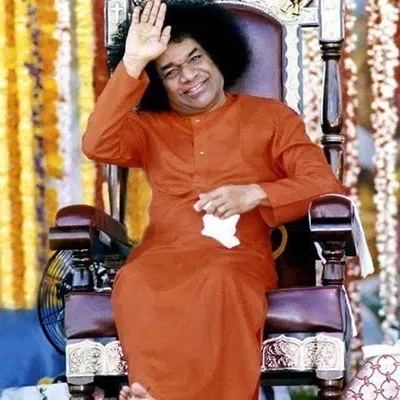
Sathya Sai Baba universal love photo
Love Offerings - Devotees Writings to Lord Sri Sathya Sai

With Love and Gratitude

With Love and Gratitude Excitement ran high amongst the vanara [monkeys] ranks. The Lord’s work was at hand. The bridge to Lanka had to be built as soon as possible and they could not afford to waste any time. They threw into the sea whatever they could lay their hands on—tree trunks, rocks, boulders; even hills were uprooted for the purpose. On the shore a tiny squirrel was keenly watching all the action. All of a sudden, this little creature, too, felt a sudden urge to participate in the Lord’s mission. He was aware that he was too small to be of any use. “I am too little,” he thought to himself. “What will I be capable of doing amongst these gigantic monkeys?” Then, somewhere in his tiny little mind, an idea flashed. He rolled about in the sand, ran down to the bridge, shook off a few grains of sand, ran back to the shore, collected some more sand and deposited it on the bridge. The tiny squirrel repeated this ceaselessly, without any break. Some distance away, Lord Rama was seated in His tent watching the antics of this little squirrel. Amply pleased by its service, Lord Rama picked it up and lovingly caressed it. As a mark of Lord Rama’s appreciation of this little squirrel, three golden streaks appeared along the squirrel’s spine where the Lord’s fingers had touched it. Even today squirrels bear the sign of God’s appreciation on them in the form of the three stripes running across their back. When God Himself has shown so much of appreciation for a task that is so insignificant, how much of gratitude must we show the Lord for all that He has done for us? He has given us everything bountifully and made our lives peaceful and happy in His presence. This is true of Swami’s own students—whom He considers as His own property. To enumerate all that He Has done for us would be an impossible task. He has given us education of the highest standards free of cost, a spiritual foundation too strong to be shaken, and above all this, His physical proximity, which is the envy of gods, and His limitless love, which is unmatched in any way. To be with Him is what the devas and the gandharvas yearn for. We enjoy His presence day and night and drink the nectar of His love. Sages perform penance for thousands of years to earn His grace, and here He is showering it on us in abundance. What more can we ask for? Bhagavan is like a potter who has shaped us with His own hands into beautiful pots from mere lumps of clay. It is time we offered our heartfelt gratitude to Bhagavan for having given us everything in life. What does our great Lord ask from us in return? The lines of a song drift into my mind—”All I want is your Love, my child, all I want is your faith. All I want is your Love in God, no matter what your faith. So says Baba, Sathya Sai Baba, Sathya Sai Baba, my Lord.” Love is all that He seeks. Is it too much to ask for? The word ‘Love’ reminds me of a touching incident, which according to me is the best example of gratitude. When preparations were being made to commence the construction of Sri Sathya Sai Institute of Higher Medical Sciences in Prasanthi Nilayam, Bhagavan was looking into every detail connected with the construction. During one darshan session, while moving amongst the students He accepted a letter from a little boy. Clutching the letter in His hand, he went inside the interview room accompanied by some doctors. He suddenly came out and beckoned that small boy. He asked him, “Should I read out aloud what you have written to me in this letter so that everyone can hear?” The little boy was hesitant for a while and then he replied, “Whatever You wish Bhagavan.” Bhagavan then read out this boy’s letter for everyone present to hear. The boy recounted in the letter how Bhagavan was providing free education to all His students and was now constructing a big hospital that would provide the most modern health care facilities to every section of the society totally free of cost. This little schoolboy prayed that he, too, wanted to be a part of Bhagavan’s glorious mission. Yet, being a small boy from a middle-class family, he did not know how he could contribute to Bhagavan’s work. He mentioned in the letter that for the last three months he had been trying to save from the meagre amount his parents sent him every month. In order to do this, he had avoided giving any clothes to the washerman and had been washing his clothes himself every day. He had also resisted the temptation of chocolates and other delicacies so as to save some money. In all his innocence, this boy now wanted to offer a hundred rupees to Bhagavan. While he was ashamed that he could offer only such a small amount for this gigantic task, he prayed to Bhagavan to accept this offering saying that he would be the happiest child in the world if this money could be used to buy a small brick for the new hospital. So saying, he had enclosed a hundred rupee note with his letter. There was a twinkle in Bhagavan’s eyes when this letter was read out. Like a proud mother Bhagavan held the 100 rupee note in His hand and told the little boy, “My dear son, this is not a 100 rupee note for me. This note is worth much, much more than crores for me.” It was not the amount that Bhagavan saw, but the feeling of love and gratitude that had poured forth from the innocent boy’s heart. The Lord is ‘bhaava priya‘ and not ‘baahya priya‘—[He] loves intent and not fear. We must also make an effort to repay our debt to Bhagavan. The onus is upon us to participate in Bhagavan’s mission

With Love and Gratitude Read Post »

Bhagwan Shri Sathya Sai Baba spiritual energy
Sai Thought for the Month - Eternal Blessings

Everything is God’s Creation

Everything is God’s Creation Right from an ant to Brahma, everything is God’s creation. When we look at God’s most beautiful, wonderful and sublime creation, we are filled with bliss. Humanity has been given every right to enjoy God’s creation. One does not need God’s permission for this. However, God has prescribed one rule. You may do whatever you want, but you must face the consequences of your actions, whether they are good or bad, sacred or unsacred. This is the law of creation. Keeping this law in view, one should decide what path is to be followed and what type of actions are to be performed. As you sow, so shall you reap. Similarly, as is the action, so is the result. God’s creation is very sacred. Do not pollute it. How sacred are the five elements given by God! But, today, the air we breathe, the food we eat, the water we drink, the sound we hear—everything is polluted. All these sacred elements have been made unsacred by humanity. That is why the world today is afflicted with so many diseases. That one is a true human being who makes sacred use of the five elements. Never waste natural resources. Sri Sathya Sai Speaks, Vol 29 (1996) Man is not making efforts to understand the relationship between Prakriti (phenomenal world) and Jeevatma (man) and Paramatma (Supreme Spirit). These are very intimately interrelated to one another. They are not disparate. The relationship between Paramatma and Prakriti, God and Nature, is the same as that between mother and child. The relationship between man and society is the same as that between the honeybee and the flower. Just as the child is fed by mother’s milk, as the honeybee is fed by the honey in a flower, man must enjoy the gifts of nature. From time immemorial man has been plagued by negative ideas. There is a legendary tale in which one greedy man killed the goose that laid, golden eggs thinking that he can extract all the eggs from it in one lump. Such acts of folly are committed freely by scientists today by exploiting Nature’s gifts beyond all limits, creating disastrous imbalance resulting in natural calamities such as earthquakes, spelling danger to humanity. We cannot blame science for this. Those who apply the scientific discoveries without discrimination are to be blamed for this. They fail to consider with deep deliberation the effects of excessive depletion of the natural resources. Man must consider himself as a limb of the society and help in the welfare of society, just as the organs of one’s body are used for one’s well-being. Again, society is a limb of Prakriti (Nature) and Prakriti is a limb of Paramatma (Supreme Lord). Thus, there is close relationship between man and God. Nature is more progressive than man, and to protect Nature, man must exploit it within limits. When man tampers with Nature recklessly, it reacts adversely, and trouble arises. In order to protect Nature, man must practice ceiling on desires. He should not trigger the negative aspect of Nature. In this respect, scientists have no concern for the harmful effects that may accrue to society by their inventions. They don’t care for the welfare of the mankind and go on making use of intelligence to produce their weapons of destruction. Care should be exercised in providing comforts as excessive comforts may spoil man’s mind and cause misery instead of happiness. “Na Shreyo Niyamam Vina” (Nothing good can be achieved without certain restraints). Because of the advancement of technology and provision of excessive comforts, life has become mechanical, and spirituality has declined. Science fragments everything to pieces while spirituality builds up unity in diversity. Today man is not making efforts to cultivate the feeling of oneness among humanity. 

Everything is God’s Creation Read Post »

Shri Sathya Sai Baba humanity picture
Love Offerings - Devotees Writings to Lord Sri Sathya Sai

Be Perfect!

Be Perfect! Years ago, Bhagavan granted interview to a group of youngsters from Kerala. Bhagavan graciously materialized a ring and put it on the finger of one of the boys. Amazed and overjoyed, he was enjoying the beauty of the Creator’s creation. “Is ring perfect?” queried the Lord. “Yes, Swami!” the boy answered. To this, Swami said, “Be perfect!” Life’s journey as a humble child of our Beloved Bhagavan is a journey ‘from Sai, with Sai, to Sai’. This journey demands perfection at each and every step, then only can we realize the perfection that is within ourselves! This journey to perfection demands constant self-audit; the ‘ABC of Life’ that Swami has given us, “Always Be Careful” is very important in this regard. During one of the Vishu celebrations, I got the opportunity to speak in the Divine Presence. In the speech, I highlighted Bhagavan’s assurance, “When you take one step, I take a hundred.” In the Divine Discourse that followed, Bhagavan said, “What Mukundan said is correct. When you take one step, I take a hundred. But that one step must be in the right direction.” The awareness about this ‘right direction’ must be the light that guides our life’s journey. Another important aspect of this journey is: be positive always. The second Sadhana Camp of the Sai Youth of Kerala was in progress at Brindavan. On 11th of April 2004, a drama was to be staged by the Sai Youth in the Sai Krishan Kalyanamandapam. At 4.45 p.m., we went inside Trayee to report to Bhagavan that everything was ready. But Bhagavan gave us the opportunity to sit near Him and talked to us on the theme of the drama. When the discussion came to the point of positivism, Bhagavan asked “Where does this positivism come from?” Bhagavan was evidently not satisfied with the various answers that we gave; He went on asking the question over and over again. All that we could do was to pray for the Divine answer on this vital point. Finally, Swami declared, “Positivism need not come from outside; it is inside only. Our duty is to develop it.” Bhagavan’s Love knows no limits. On one of the days of the Sadhana Camp for the Sai Youth of Kerala in 2005, two youngsters were selected to speak in the Divine Presence, as instructed by Bhagavan. When Swami came to the verandah of the Sai Kulwant Hall, the boys were about to get up to come to Swami. I signaled to them to sit down and conveyed to them that they could come to Swami after Swami occupied the chair. But Swami intervened and told me, “No… They are coming from distant places… Let them come to Me…” It was on the first day of the Sadhana Camp for Sai Youth in 2003. All the Sai Youth had assembled at the Sai Ramesh Hall, when Swami came for darshan. I prayed to Bhagavan to inaugurate the Camp, to which Swami asked, “At what time?” “Swami… 8.30.” I replied. “Why so early?” asked Swami, “The boys and girls have just come. They may not have had their breakfast.” It was another instance that revealed how much Swami cares for each one of us. Bhagavan has categorically remarked that His love for us is to the level of seeing Himself in every one of us. Let us see Swami in all, so that our love is pure, selfless, and perfect. In this divine journey, it is best to realize that we are nothing and He is everything. It is He who plans; it is He who does. In 2004, a school named ‘Sri Sai Vidya Vihar’ was opened in Aluva [in India]. The response from the public was tremendous and applications piled up in our office. It became necessary that we purchased a new plot and constructed a bigger building. Banks came forward to offer help. Everything was set to take a financial loan from a bank. Suddenly a devotee came to our office and said, “Why take a loan? This is Swami’s school… I shall contribute the cost of the entire project.” We are amazed at the amount of confidence the society has in Swami and His Principles. When we announced the opening of the Sai School, many parents withdrew their children from prestigious schools (despite the heavy donations they had paid to them) and enrolled them in our school. To one of the Muslim parents who had come for admission, we made it clear that we would teach the children Bal Vikas lessons, Vedas, and Yoga, he happily responded, “Why not? These are part of our culture, let my child also learn them…” After one of the sessions of ‘Sai Parenting’ that was held in the school, a mother approached us and said, “I am terribly upset after today’s session; to this day, I have not been a good mother.” It is a matter of great joy seeing how the society of Kerala is adhering to Sai ideals. ‘Sai Parenting’ has become the guiding principle of families all over the state. When our young ‘Sai Soldiers’—the team formed to take Swami’s message to newer and newer areas—visited new areas, they observed that Swami was not at all new there. Wherever they went, they were greeted by Bhagavan’s photographs. Now Swami’s Message is reaching every nook and corner of Kerala. Bhagavan’s infinite love has transformed the Sai Youth of the state. The three sadhana Camps in the Divine Presence were unique and have provided golden opportunities for them. Now they are fully involved in the Grama Seva Project. We have also been arranging Summer Camps for the Bal Vikas children all over the state for the past three years. Going through the responses of the children, we understand that much more than the sessions of the camp, what touched and transformed them was the love and care the Sai brothers and sisters shared with them. They are motivated to involve themselves in the Sai activities. Now we have ‘Deenajanodharana Projects’ in all the 14 districts of the state for rehabilitating destitute—old and young. One

Be Perfect! Read Post »

Bhagwan Sathya Sai Baba peace image
Love Offerings - Devotees Writings to Lord Sri Sathya Sai

The Fettered Fire

The Fettered Fire Indra Devi, who is well known to our readers, has had the experience of a great big act of Grace from Baba, something which we love to call a Miracle. “In person and through writings in most of the 11 languages Indra Devi speaks, she has tried to help lead the world `from darkness to light’, in such seeming diversity of places as the Kremlin and the White House”, says a Los Angeles magazine. The writer of that article speaks of `sitting in the shadows on the deep carpeting’ of the Sathya Sai Hall, which is so vast `that it becomes its own psychic experience’. “This center, the Yogic Nilayam, is on Rancho El Cachuma, which adjoins La Puerta.” Recently, Indra Devi has added a 100-acre piece of land adjacent to this Yoga Institute and named it Sai Nilayam. On September 26, the Bocks (Janet and Richard) wrote to us from Los Angeles: “Bhagavan’s Grace has blessed us with protection in the midst of disaster. We have just learned that a major fire has burned over 6000 acres of land in Tecate, which is, as you know, the location of Indra Devi’s Yoga Foundation, and of the property called Sai Nilayam—a retreat for those who wish to practice sadhana (spiritual exercises) in an atmosphere devoted to Him. Indra Devi’s property was untouched by the fire! Although most of the property, Sai Nilayam, was burned, the miraculous will of the Lord protected the house (!) and the ancient trees (!), as the fire burnt everything else including tents and a truck! The people at the house in the Sai Nilayam were forced to seek shelter on top of Mount Cachuma, the only escape possible for them. When they came down later, they found the whole house blackened with soot, except for the Shrine Room, which was untouched! Richard Bock writes, “We cannot explain the reason for His Grace; we only hope that with His help we will someday be worthy of it”. Writing about the incident, Indra Devi says in a letter, “While I was away in Chicago, big fires broke out in South California. The newspapers carried reports that they were turning 200 yards from our Center”. (The Tecate Fire, worst in the country in more than a year, was started by campers who abandoned a smoldering campfire along the border, four miles west of the village of Tecate. It was reported at 10.05  A.M., and it spread rapidly up the eastern slopes of the 3885-foot Tecate Mountain and in a south‑westerly direction to Mexico. A total of 2000 acres were afire in the United States, and Mexican officials estimated their burned acreage at 4500. Indra Devi continues, “But that didn’t disturb me one bit since I was confident that Bhagavan will protect the place dedicated to Him. And if they were to be lost, there must be a good reason for it. And so it was. On the Mexican side, only the hillside behind our vegetable garden was burned down. On the American side, Sai Nilayam had suffered the destruction of some trees and bushes, a truck and tents. But the house was untouched. When the devotees who fled to the mountain top from the devastating flames returned, they found that all rooms were thickly covered by black soot with the exception of Bhagavan’s Meditation Room. Nobody could explain it otherwise than by the fact: “Baba must have been here.” There is a consciousnessbeyond this bodywhere love feels no bounds There is a spacebeyond this mindfree from narrow confines There is a Truthbeyond this delusionwhere myself is known Divine MotherI pray I mayCome home ~Michele MalvinSource: Sanathana Sarathi, Nov. 1970

The Fettered Fire Read Post »

Sathya Sai Baba divine inspiration
Love Offerings - Devotees Writings to Lord Sri Sathya Sai

Silence

Silence Have you ever enjoyed the pleasure of deep silence? By silence I mean absolute stillness of the mind. Shastras say, “If one can completely stop the mind for a moment, he is saved forever.” What are the implications of this statement? We all know what deep sleep is, sleep undisturbed by even a dream. Is it not enjoyable beyond measure? The clamor of the senses has ceased; the waves of the mind have subsided; there is not the slightest trace of the body-consciousness, either. Even if a cobra curls on the pillow, we are not aware of it! In fact, there is nobody to experience the joy at the time of sleep! The mind and the senses are inoperative, and joy alone remains. If at any time during the wakeful state the mind and the senses similarly cease to function, then, too, joy alone remains! Seers say that this is our real Swarupa, our real nature. Our inherent nature is bliss; but the mind and the senses cover it up and hide it. Let them be silenced; we remain as we really are.… as Pure Joy! The practice of such deep silence, according to the Yoga Shastras, prolongs life. After deep silence, we find answers to our problems. Silence is a great storehouse of energy and peace. A few minutes of real silence keeps us peaceful and cheerful throughout the day. The easiest way to attain the state of silence is to sit in an undisturbed place and repeat the mantra [formula] given by the Guru, or any one of the Names of the Lord that we like most. It is best to sit in the same place and at the same time every day. In a few months, peace will descend upon us. As we proceed, waves of joy begin to envelop us. In a couple of years (or if we are fortunate, even earlier), in one of our sittings unknowingly the repetition stops and we are conscious only of joy and nothing else! By sadhana, the mind becomes subtler and subtler till at last it subsides and is rendered inactive. After that joy alone remains! We are that joy! We are that truth! ~C. S. RamaswamiSource: Sanathana Sarathi, 1959

Silence Read Post »

Shri Sathya Sai Baba spiritual calm
Love Offerings - Devotees Writings to Lord Sri Sathya Sai

Human Destiny

Human Destiny The human predicament The human predicament resembles that of Arjuna [from the epic Mahabharata], who with the vision provided by the Lord saw the Cosmic Form—the Vishwarupa. What is striking of the cosmic vision is that Krishna gave Arjuna the ability to see not only the four dimensions, but the fourth dimension of time was accelerated so much that he saw, “As the moths rush in headlong into the blazing fire for destru­ction, so do these heroes in the mortal world enter Your flaming mouths.” “Seeing this marvelous and dreadful Form of Yours, O Mahatma, all the three worlds are trem­bling with fear.” This is exactly the plight of humanity because of the “accelerative” thrust of change, the future shock. Jonas Salk, the well-known research-­physician biologist in his book, “Man Un­folding”, says, “Although man’s physical evolution has its own natural pace, man has so accelerated his cultural evolution as to make it seem that physical and cultural evolutionary processes are now taking place at intolerably different rates… In a world in which change has accelerated from its natural tempo to one in which man has made change the order of the day, change itself has become man’s principal problem.” Arjuna, like the three worlds that trembled at the sight of the Cosmic Form, was also tormented with fear and he appealed to the Lord to have mercy on him and show him His former form. Is it any wonder that Oppenheimer, the famous nuclear physicist, who was responsible for the eventual manufacture of the atom bomb, remarked on seeing the first test bursting of the atom bomb that it looked like what Arjuna saw when he witnessed the Cosmic Form? “If there be the effulgence of thou­sand suns bursting forth all at once in the heavens, even that would hardly approach the splendor of the mighty Lord.” Oppen­heimer must have trembled with fear at the unleashing of this fraction of tremendous power imprisoned within the atom. Humanity is waiting for the Lord for assurances that He gave Arjuna: “Seeing such a dreadful Form of Mine as this, be not perturbed or perplexed; with a fearless and complacent mind, behold once again the same Form of Mine, which drove your chariot.” Arthur Koestler says: “Science turns out to be the most glorious achievement of the human mind—and its most tantalizing de­feat. We have become a good deal cleverer since Pico-della Mirandola, but not much wiser in knowing what it all means.” He concludes, “The limitations of biological equipment may condemn us to the role of Peeping Toms at the keyhole of eternity. But at least let us take the stuffing out of the keyhole, which blocks our limited view”, says Koestler. Koestler speaks of the evolution of man and his brain, he says that man has three brains, reptilian, mammalian, and neo‑mammalian. “The rise of the human cortex is the only example of evolution providing a species with an organ that it does not know how to use. The actualization of its reasoning potentials has been obstructed, throughout by the effect­ based activities of the phylogenetically older structures in the nervous system. Inade­quate co‑ordination between old and new structures made man’s instinct and intellect fall out of step. The wide range of intra­-specific differences between individuals, races and cultures became a source of mutual repellence. Language increased cohesion within groups, heightened the barriers between groups. The discovery of death by the intellect, and its rejection by instinct became a paradigm of the split mind. Nature has let us down, God seems to have left the receiver off the hook and time is running out.” The human destiny It is against this background that we must understand the significance of the Advent of Bhagavan Sri Sathya Sai Baba and the spiritual revolution that He is spearhead­ing. In His message to Karanjia of the Blitz He declared, “Millions of years of upward struggle have produced the present human society; thousands of seers and sages in all lands have taught man to see the Truth that underlies the panorama of Crea­tion, to adore the Creator, and to practice the virtues of humility, equanimity, and service so that the spark of God that is enshrined in his heart might reveal its full glory. But man has brought human society to the verge of total destruction. He has used his intelligence to pollute the land he lives on, the air he breathes, and the water that is the very source of life. He has turned the mind that is the instrument of liberation into a chain that keeps him in bondage. He has used the methods of Education, Codes of Law, Systems of Poli­tics, Modes of Commerce and the Results of Science to imprison himself in prejudices, creeds, and nationalities. The world is becoming smaller and smaller with every increase in the speed of communication, but neighborly love is nowhere evident.” Baba has confirmed what all the great thinkers have struggled to express. The cure for the ills of humanity lies in the inevitable culmination of this process of shrinking of the world when mankind will be knit into one, when knowledge will per­colate through all types of barriers, because we will reach a stage when there will be no barriers. Who can control mass communi­cation when the satellites transmit television pictures all over the world? For the first time humanity will become aware that the only security lies in accepting each other as neighbors, and that national barriers and all barriers of caste, creed, or language will be irrelevant and invalid! What humanity is now witnessing is the death‑pangs of out­lived modes of exclusive thinking, and the dead shells of rules and regulations that were relevant to the pre‑Atom bomb era. We see the last struggles of organized theocracy trying to chain segments of humanity by slogans and labels, empty shells from which the living force of the great Truths have disappeared. Sai has come to redeem humanity at this crucial stage in the Ascent

Human Destiny Read Post »

Bhagwan Shri Sathya Sai Baba meditation spiritual portrait image
Sai Thought for the Month - Eternal Blessings

Duty of Resistance to Adharma

Duty of Resistance to Adharma Only in the nation in which the goddesses of dharma (righteousness) and shanti (peace) are adored will genuine prosperity and happiness exist. Today many are indulging in actions opposed to dharma and truth, and on the basis oftheir caste or community are promoting strife and conflict in the country. Elders in the nation are remaining mere spectators of all the unrighteous and violent actions that are being done by the evil elements. Even the scholars and intellectuals are remaining silent. Persons holding high office are merely watching what goes on. No one, however, is making any effort to stop this menace. They are not resisting the evil elements. It appears as if all their knowledge, position, and influence have been reduced to nothing. Such persons, though they may not be indulging in unrighteous acts, are giving encouragement to them. Here is an example from the Mahabharata: Considering that war would be a great universal calamity, Dharmaja (the eldest of the Pandavas) appealed to Krishna to go as an ambassador of peace to the Kauravas. Entering the audience hall of Duryodhana, Krishna described at length the disastrous consequences of war. The great Acharyas—Bhishma, Drona, Kripa and Ashwathama—who were present in the court were intently listening to Krishna’s words. But Krishna’s appeal was of no use to them. Because of their long association with the wicked Kauravas, they became abettors in the crimes of Duryodhana and others. Vidura, who was a witness to the evil that was being committed, resolved to oppose it. He pleaded with the Kauravas in many ways to listen to the wise words of Krishna. His appeal fell on deaf ears. Rather than stay amongst such evil-minded persons, Vidura felt that it was better to go on a pilgrimage and left the country immediately. Bhishma, Drona and others, having been beneficiaries of the sustenance provided by the wicked Kauravas, chose to be loyal to them and stayed on. All of them were great preceptors. They knew well the distinction between righteousness and evil. They had enquired into the nature of the eternal and the permanent. Of what avail was all that knowledge? When it came to practicing what they knew, all their knowledge was of no use. In the final outcome, all of them met with the same end in the great war as the evil-minded Kauravas. Krishna looked upon those who, even if they were good in themselves, did not oppose unrighteousness and injustice committed in their presence when they had the capacity to do so, as actual participants in the crimes. When evil and injustice and violence are being perpetrated, if individuals look on unconcerned, they must be regarded as accomplices in the crimes. In the end they also suffer as much as the criminals. By their passive association, they provide encouragement to the evildoers. When the good are associated with the wicked and do not oppose them, they share the responsibility for the deeds of the evil doers. The Divine destroys even those who either do not oppose or remain passive while injustice and wrongdoing are perpetrated. The Divine will not consider whether they are learned or ignorant, wise or unwise. If they are learned or wise, why did they not stand up for truth and justice? Why did they remain silent? It means they are tainted by the same guilt. The failure to resist evil is their offence. It is only when we resist acts of unrighteousness and injustice and try to put down malpractices in society that we can claim to be assisting in the task of restoring Dharma.

Duty of Resistance to Adharma Read Post »

Shri Sathya Sai Baba Blessing Crowd Spiritual Image
Sai Thought for the Month - Eternal Blessings

“I am always with you, beside you, before your very eyes”

“I am always with you, beside you, before your very eyes” When a person is shown round a house, there is no need to tell him specifically, ‘This is the kitchen’ for, the blackened walls and the flavor of condiments, will reveal that to him. There should be no need to tell him, “This is the Puja Room”, for, the spotless cleanliness of the walls, the calmness in the air, and the perfume of pure thoughts charged with devotion should reveal that to him. Therefore, have a fixed room or place in the house to do your regular puja and meditation. Take a hurricane lantern; the flame within has three things to pass through: the soot inside the chimney, is tamoguna; the dust outside is rajoguna; and the transparent glass is satwaguna. All these three, surround the illumination of the flame in the center. So too, the jivatma must transcend the three gunas, in order to shine in its pristine Effulgence. Source: Sanathana Sarathi, July 1959 Life is a flight of steps towards Godhead; each day is a step that must be climbed; so, be steady and earnest and watchful. Do not slide down or climb and slide. Every step climbed is a victory to be cherished; every day wasted or ruined is a defeat to be ashamed of. A pot of water, if kept in the open will soon evaporate; but if it is kept neck deep in water, the contents will be intact. So, fill your hearts with prema and, then do not move about in the company of the wicked and the cruel. Immerse yourselves in satsang, the company of the good and the true; then, the prema will not evaporate and disappear. Source: Sanathana Sarathi, March 1960 What is sin? Weakness, the feeling that you are a sinner, that you are therefore lost beyond redemption, the despair that overwhelms, these are the things called sin avoid these. What is punya? Courage, buoyancy, hope, the feeling that you are an Amritaputra, Immortal, blessed by the Lord, strong enough with the Lord’s grace to overcome everything that overwhelms, these are the things called punya. Accumulate these. The rat falls into the trap, because it is enamored more of the strong-smelling cheap eatable, that is, the bait inside the trap than of the finer, costlier, healthier ghee and sugar, that lies in plenty outside the trap, in the same room! Do not, like the stupid rat, lose all sense of values and run into the deadly trap, seeking the cheap fascination of petty tinsels. Develop viveka and vairagya. For the cultivation of your farms in summer, do you not store the water of rains, in reservoirs and tanks? So too, for the attainment of Lord’s Feet when the body falls off, store the thought of the Lord by the contemplation of the Name and Form of the Lord, when you are young and strong. Source: Sanathana Sarathi, Aug 1959 There are certain drugs which come in bottles or capsules, whereon is written “Effective until the end of Dec. 1961” etc. After that date, the drug will be in the container, but its efficacy would have disappeared. So too once you win the Grace of Lord, the prarabdha or the consequence of previous karma might be there but, it would have shed its efficacy in your life. Suppose you are the guest at a house where there is a Gurkha watchman. The Gurkha will obey you too, if you are connected with the Master, through kinship or friendship. So too know that the mind is the Gurkha appointed by the Lord; therefore, if you somehow connect yourself with the Lord, it will obey you and never trouble you anymore. ~ Sathya Sai Baba

“I am always with you, beside you, before your very eyes” Read Post »

Shri Sathya Sai Baba divine presence
Sai Thought for the Month - Eternal Blessings

How to Ensure Rest for the Mind

How to Ensure Rest for the Mind The clock, to all appearances, keeps on ticking away continuously. But this is really not the case. It is not continuous, for there is, one can notice, a short pause between one tick and the next. That is the interval of rest. But the mind does not have even this short interval between one thought and the next. And in the continuous succession of thoughts, there is no order or relationship. This adds to the confusion and concern. This is the main source of ill-health in man. We are at present planning and preparing for physical rest and recreation and we know that even machines need hours of rest! But we have neglected the duty of ensuring rest for the mind. Dhyana (meditation) is the name for the period of rest we provide for the busy and wayward mind. The heart is engaged, like the ticking of the clock, in beats, but a new pulse of energy is generated between one beat and another. It makes for the flow, regardless of the past or the future moments. It is a constant flux toward a goal. The swimmer in the river must push aside the waters in front to the sides and to kick the waters to the back so that he can move forward straight and fast. Forcing the water back is the act that takes him forward. That is to say, do not attach importance to it, throw it back, give it up, renounce; that alone can help you to progress even an inch. Instead, man collects and stores, accumulates and takes pride in what he holds firm, regardless of the preciousness of the human trait of renunciation. So we sink into material possessions, victories, and vagaries. We do not float or swim across the temptations. We must try to discover and learn the means of progress… When the tiny squirrel decided to share in building the passage across the sea, did it not receive the blessings of Lord Rama? The squirrel knew that its help could only be infinitesimal, but the feeling of dedication that prompted it won the grace of God. Sri Sathya Sai Speaks, Vol. 16 (1983) A restless mind is another important source of ill health. Man is constantly afflicted with some source of worry or other. He is never free from anxiety. Why? Because he is identifying himself with the body. How did he acquire this body? Through his past activities and deeds. What were they caused by? By the twin pulls of love and hate. How did they originate? They were born out of the entanglement in duality, in the opposites. And why does he get snared by them? Ignorance of the Truth, the ONE. You must know that each one is a pilgrim, and each life is but a stage in the journey toward the city of liberation. This body is a resthouse in which we stay for a short time during the pilgrimage. The mind is the caretaker, the watchman in the choultry where we rest. We are not to treat him as if he is master or owner. But we ought to take care that the house we are privileged to occupy is not damaged or polluted. We must take good care of it and its furnishings and treat the watchman politely. The pilgrim is either helped or handicapped by the antics of the mind. The mind has as its warp and woof desire or thirst for something or other, getting some gain or avoiding some loss. Desire arises from attachment, often the consequence of delusion. Desire distorts and denigrates the mind. It keeps the mind incessantly agitated. No sheet of water can be calm when stones are dropping on it, and if there is a perpetual shower of desires, the mind, too, will be pitifully restless. The ananda (bliss) that emanates from the atma in man has, in fact, to be stored with the help of the buddhi as channel, in the reservoir, the mind. That is its genuine function. But if the reservoir has many cracks and crevices, namely the senses, the ananda will be frittered away, and the reservoir will be rendered dry. When the hunger of the senses is sought to be appeased, the mind becomes vacillating and wayward. The mind is the master of the senses. That is its legitimate role. The senses are the servants. When the master serves the servants, he loses his self-respect and falls in the esteem of all. Sri Sathya Sai Speaks, Vol. 15 (1981-82) Flying hither and thither, higher and higher, the bird has at last to perch on a tree for rest. So, too, even the richest and the most powerful man seeks rest, peace (shanti). Peace can be got only in one shop, in inner reality. The senses will drag you along into a mire, which submerges you deeper and deeper in alternate joy and grief, prolonged discontent. Only contemplation of unity can remove fear, rivalry, envy, greed, desire—all feelings that prompt discontent. Every other avenue can give only pseudo-contentment, and a day will come when you will throw away all these playthings and toys and cry, “Lord! Grant me unruffled peace.” The bandit Valmiki prayed so; the confirmed atheist, too, has one day to pray for peace and rest.

How to Ensure Rest for the Mind Read Post »