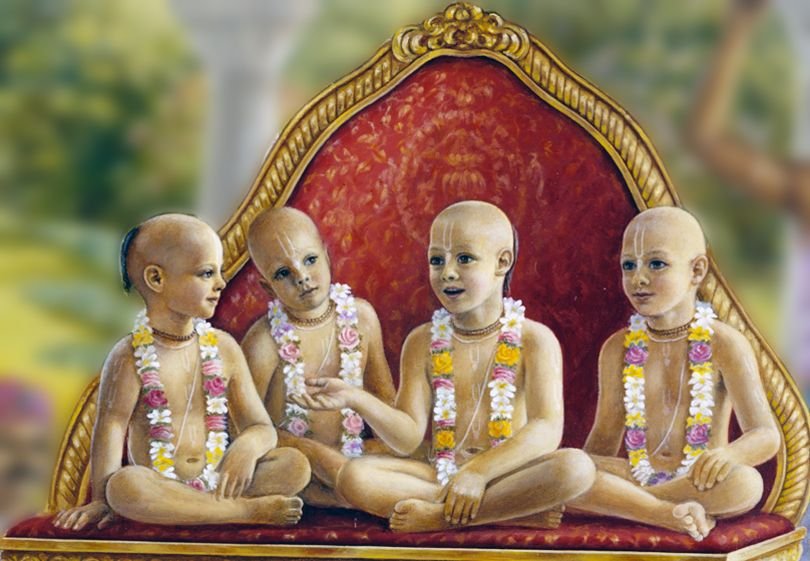
The 4 Kumars – ‘I taught this yoga to My disciples, the four brothers headed by Sanaka’. (In the wallpaper: in the middle Lord Shri Narayana, 4 Kumaras, in the left side Lord Brahma and child Shiva, in the right 4 Kumaras). Four Kumaras. The Four Kumaras namely: Sanaka, Sanandana, Sanatana, and Sanat Kumara are traditionally the four mind-born sons of Lord Brahma. Famous throughout the Puranic literature, they are found also in the Upanishads. They are renowned yogis, who requested their father for the boon of remaining perpetually five years old. They were created by their father in order to advance creation, however, they chose to undertake lifelong vows of celibacy (brahmacharya). After obtaining initiation into the Shri Gopala Mantra, these four brothers then left meditations into an impersonal God, and realised the truth lies beyond the impersonal, in the Highest Person, the Supreme Lord Shri Krishna. Having obtained His grace and being initiated into Vaishnava tradition, they began to spread the teachings of the path of renounciation. During initiation into this Vaishnava tradition, they received the Shri Shaligrama Shila known as Shri Sarve Svara Bhagavan, which has been passed on from each Guru to disciple since their time. The Supreme Lord Shri Krishna, in His conversation with Uddhava in the 11th Canto of the Bhagavata Purana declares: etavan yoga adisto macchisyaih sanakadibhih – ‘I taught this yoga to My disciples, the four brothers headed by Sanaka’. Having obtained His grace and being initiated into Vaishnava tradition, they began to spread the teachings of the path of renounciation. During initiation into this Vaishnava tradition, they received the Shri Shaligrama Shila known as Shri Sarve Svara Bhagavan, which has been passed on from each Guru to disciple since their time. The Supreme Lord Shri Krishna, in His conversation with Uddhava in the 11th Canto of the Bhagavata Purana declares: etavan yoga adisto macchisyaih sanakadibhih – During initiation, the most holy 18-syllabled Shri Gopala Mantra was given to them, a fact recorded in the Vishnu Yamala: This mantra is the Vaidika mantra from the Gopalatapinyupanishad of the Atharva Veda. This is the initiatory mantra still used in the Sampradaya today. Shri Sanat Kumara Samhita is a famous treatise on the worship of Shri Radha Krishna authored by the brothers, and they have also produced the Shri Sanat Kumara Tantra, part of Pancharatra literature. Their teachings can be found throughout all Vedic literature. It is due to the tradition coming into contact with the Four Kumaras that it came to be known as the Sanakadi Sampradaya or the Kumara Sampradaya. A man meets a virtuous person when his ‘good fortune’ arrives and his soul attains enlightenment and his mind becomes pure by the destruction of his ignorance and attachment. When Brahma decided to commence the sequence of creation, he first of all created four Kumaras by just having a wish in his mind. They were Sanaka, Sanandana, Sanatana and Sanatkumara. Brahma had experienced the sight of Lord Vishnu sleeping on the back of Ananta Shesha after performing penance for thousands of years. Lord Vishnu pleased with his penance gave to him the basic knowledge of the Veda. Only after getting that knowledge, he commenced his creation. When the four Kumaras came into existence, they were all embodiments of pure qualities. They did not have any sign of negative qualities like laziness, sleep etc. Brahma had created these four Kumaras so that they could help in the process of creation. But they refused when they were ordered by Brahma to do so. So these four Kumaras—kumara means unmarried brahmacaris. Because in the beginning Brahma begot so many sons, and each of them were asked to increase the population. Sanaka, Sananda, Sanatana, they were also requested by their father to increase population, but they refused. They said, “No, we are not going to be entangled in these material affairs. We shall remain kumaras, brahmacaris, and preach the glories of Godhead,” by which Brahma became angry. And while he was angry, from his anger Rudra, Siva, was produced frm his forehead. These four Kumaras, as siddhesvaras, had achieved all the yogic perfectional achievements ( siddhis ), and as such they travel in outer space without machines. Shaivas believe that Shiva assumed the form of Dakshinamurti, the great teacher and meditating facing South observing a vow of silence. The four Kumaras approached Shiva for self-realisation. He taught them about the Supreme Reality, Brahman, by making the chin mudra gesture with his hand. The index finger is touched to the thumb, indicating the union of Brahman and jiva. Thus, Shiva made the Kumaras as his disciples. An incident about the meeting of the four Kumaras with Vishnu’s avatar Rama is narrated in the Uttarakanda of the Ramcharitmanas. The Kumaras once stayed in the hermitage of the sage Agastya, who told them about the glory of Rama. So to meet Rama, they went to a forest grove where Rama with his brothers and disciple Hanuman had come. Source: sanskritimagazine