






Hari Om

Menu

guru ji

Screenshot 2025 11 29 104702
Mahatmas

Saint Namdev

Saint Namdev So, the next day, she herself accompanied Namdev (but without his knowledge) to see and verify for herself the correctness of Namdev’s explanation. The same performance was repeated and the mother had the satisfaction of seeing the Lord actually accepting their offerings. Her joy and pride in Namdev was unbounded. She felt grateful to the Lord that she was the mother of such a great devotee. Lord Vithoba–his only interest In other respects, however, Namdev was the despair of his parents, and later, of his wife and other relatives. From the beginning he had no interest in worldly affairs; he neglected studies in school; he would not take interest in his father’s profession as a tailor, or in any other trade. His sole interest was to spend day and night in devotion to Vithoba. His parents were getting old; the family prosperity was waning. Therefore, their dearest wish was that Namdev, while devoting a reasonable spare time to his devotions, should help in maintaining the family in comfort. So, Namdev was sent to the bazaar one day to sell a few pieces of clothes. But Namdev was innocent of the tricks of the trade.To him, such things as prices, and money and its value, were unknown subjects. He went to the bazaar with the clothes, because his father forced him. He sat there on a stone doing Bhajan, entirely forgetting that he had gone there to sell the clothes. After a few hours the sun set and it was time for him to go to the temple for the evening devotional performance.Then only he remembered that he had not sold the clothes and that he would get a thrashing from his father. He was impatient to go to the temple. He therefore sold all the clothes to the very stone on which he was seated, i.e., he kept the clothes on the stone, appointed another stone as a guarantee that the first one would pay the money the next day, and went to the temple. Namdev’s father was furious on hearing his son’s adventures and asked him to bring forth Dhondya (which means a stone and which is also used as a proper name among certain classes of people of Maharashtra) who had guaranteed the money. The next day Namdev went back to the bazaar, found that the clothes had vanished during the night and took the second stone (Dhondya) home, as it refused to pay the money, and locked it in a room. He then went to the temple and narrated all the events to Vithoba and explained his difficulties also. When Namdev’s father asked him to show him Dhondya who had guaranteed the money, Namdev replied that Dhondya had been kept in a closed room in the house and ran to the temple. When the father opened the room to demand the money, he found, to his surprise, a lump of gold. Great was the father’s joy; but Namdev was quite indifferent to it. He only praised God for saving him from a thrashing. Thus it went on. In the meantime, Namdev married Radha Bai. Radha Bai was a worldly-minded woman. In response to Namdev’s invitation, Vittal attended the naming ceremony of Namdev’s child in the guise of a human being, named the child ‘Narayana’ and gave good gifts on the occasion. There was extreme poverty in the house of Namdev. Namdev neglected his worldly duties. Namdev’s mother and wife abused Lord Krishna. Under the guise of Dharma Setti of Vaikunthapuram and the pretence of past friendship with Namdev, the Lord visited Namdev’s house, gave magnificent gifts to Radha Bai and disappeared. A Bhakta, named Parisha Bhagavat, propitiated Rukmini and got the philosopher’s stone which could convert iron into gold. Parisha’s wife gave the stone to her friend Radha Bai one day. Radha Bai showed the stone to her husband and said that his Bhakti was of no use and was inferior to the Bhakti of Parisha Bhagavat. Namdev threw the stone into the river. Next day Parisha came to know of everything and took Namdev to task. Namdev showed Parisha the place where he had dropped the stone. Parisha searched for the stone and found, not a single stone, but a whole lot. Parisha was struck with wonder. He admired the spirit of renunciation and the spiritual powers of Namdev. Sur also composed the Sur Saravali and Sahitya Lahari. In contempary writings, it is said to contain one lakh verses, out of which many were lost due to obscurity and uncertainty of the times. It is analogical to the festival of Holi, where the Lord is the Great Player, who, in his playful mood, creates the universe and the Primerial man out of himself, who is blessed with the three gunas, namely Sattva, Rajas and Tamas. He describes 24 incarnations of the Lord interspersed with the legends of Dhruva and Prahlada. He then narrates the story of the incarnation of Krishna. This is followed by a description of the Vasant (Spring) and Holi festivals. Sahitya Lahari consists of 118 verses and emphasises on Bhakti (devotion). Namdev felt it increasingly difficult to take interest in household affairs and in his parents, wife and children; and no amount of persuasion from all those people or his friends was successful in bringing him back to the worldly life. To him there was only one interest and that was Lord Vithoba. He used to spend hour after hour sitting before Vithoba, talking to Him, discussing spiritual matters with Him and doing Bhajan. To Namdev, Vithoba was the beginning and the end of everything.

Saint Namdev Read Post »

Surdass Artistic Depictions How Art Imagines the Blind Poet
Mahatmas

Surdas

Surdas After sometime Surdas with his Gurudev went to Govardhan from Gokul. Here he saw Shrinathji’s temple and decided to spend the rest of his life at the holy feet of the Lord. Sri Vallabhacharya appointed Surdas as the chief singer of the Shrinathji temple. After that there was no stopping him. Surdas attained a mystical union with Lord Krishna and from then on he could bring before his mind/eyes any episode of the life of Lord Krishna he chose which he then rendered into verse almost as if an eyewitness report. Though Surdas was blind, he used to get the divine darshan of Lord Krishna and Radha Rani, and he could actually tell the attire worn by the Lord. Once, blind Surdas fell into a well. He called upon Lord Krishna for help. Lord Krishna came immediately to help Surdas. Krishna took hold of his devotees hand and pulled him out of the well. When Surdas came out of the well, Krishna began to leave. As soon as Surdas recognised the divine touch of Krishna, his heart sank and with tears filled his eyes. He said हाथ छुड़ाये जात हो, निर्बल जानि के मोय।         हृदय से जब जाओ, तो सबल जानूँगा तोय।।         हाथ छुड़ाये जात हो, निर्बल जानि के मोय।         हृदय से जब जाओ, तो सबल जानूँगा तोय।। Radha Rani also came to meet his devotee. Surdas recognised Radha Rani by the ting-a-ling sound of her anklets. Surdas fell onto her lotus feet and took her anklets. When Radha Rani asked him to return her anklets, he refused. At that moment, Lord Krishna gave him the vision in his eyes and asked him to ask for a wish. Surdas returned the anklets and said- “My Lord, you have already given me everything. After receiving your divine darshan (sight) there is nothing more left for me to see in this world. Please make me blind as before“. Krishna granted him his wish. Surdas had a remarkable talent for memorising Sanskrit hymns such as Srimad Bhagavata along with many others. It was this that made him such an in-demand figure wherever he went, with his ability to pass on such important compositions. He also had a firm grasp of the life and achievements of Krishna and was able to portray all of this in his exquisitely crafted poetry. Many historians say that no one has ever done it better. The fact that the writer was blind makes it all even more remarkable. He went into incredible details about Krishna’s early life, such as where and when he took his first steps and what were his first utterances. He even described the infant cutting a first tooth! These tiny details were woven into poems and songs and some of them are sung even today by parents who see in their children some elements of Krishna. Surdas’s reputation as a singer and a devotee spread far and wide. One day in the court of the mogul emperor Akbar the court singer Tansen sang one of Surdas’s songs. Akbar was charmed. Tansen admitted that the tune and the lyrics were of Surdas, the blind devotee of Lord Krishna. Akbar being a broad-minded Muslim invited Surdas to his court. Surdas declined saying that he only sang in the court of his beloved Krishna. On hearing this Akbar came to Surdas and listened to his prayer songs in the temple. Surdas is best known for his composition the Sur Sagar. Sursagar in its 16th century form contain descriptions of Krishna and Radha as lovers; the longing of Radha and the gopis for Krishna when he is absent and vice versa. In addition, poems of Sur’s own personal bhakti are prominent, and episodes from the Ramayana and Mahabharata also appear. The Sursagar’s modern reputation focuses on descriptions of Krishna as a lovable child, usually drawn from the perspective of one of the cowherding gopis of Braj. Sur also composed the Sur Saravali and Sahitya Lahari. In contempary writings, it is said to contain one lakh verses, out of which many were lost due to obscurity and uncertainty of the times. It is analogical to the festival of Holi, where the Lord is the Great Player, who, in his playful mood, creates the universe and the Primerial man out of himself, who is blessed with the three gunas, namely Sattva, Rajas and Tamas. He describes 24 incarnations of the Lord interspersed with the legends of Dhruva and Prahlada. He then narrates the story of the incarnation of Krishna. This is followed by a description of the Vasant (Spring) and Holi festivals. Sahitya Lahari consists of 118 verses and emphasises on Bhakti (devotion). Sur’s compositions are also found in the Guru Granth Sahib, the holy book of the Sikhs. He is referred to as Bhagat Surdasji by the Sikhs.

Surdas Read Post »

Sage Ashtavakra devotional
Mahatmas

Sage Ashtavakra

Sage Ashtavakra In Mahabharata,In the Vana Parva of the Mahabharata, the legend of Ashtavakra is described in greater detail. On losing the game of dice with the Kauravas, the fivePandava princes and Draupadi are exiled for twelve years. On their pilgrimage, they meet the sage Lomasha, who shows the river Samanga to Yudhishthira. Lomasha says that this is the same river, on bathing in which the deformed Ashtavakra was cured of his eight deformities. On being asked by Yudhishthira, Lomasha narrates to the Pandava princes the legend of Ashtavakra, which forms three chapters of the Mahabharata. It all starts when King Janaka asks the sage Ashtavakra how he can attain Knowledge, detachment, liberation. Ashtavakra tells him. Ashtavakra expounds to King Janaka the characteristic of the self and instructs him on the knowledge of the self that is natural and ever-existent. It works! Upon hearing Ashtavakra’s words Janaka realizes his True Nature. Enraptured, he describes the joy and wonder of his new state. An amazed Janaka relates the joy of his own experiences on realizing the subtleties of the principles explained. Ashtavakra is delighted for Janaka but sees inconsistencies. He fires off a series of confrontational verses about attachment to worldly pleasure. Ashtavakra deprecates the attachments within and without and enunciates the status of the realized.Janaka asserts that the Lord of the Universe can do as he pleases. Janaka dwells at length on the glory of jnana – the state of self-realization.Ashtavakra does not disagree, but in a terse four verses points to the next step dissolution. Ashtavakra instructs Janaka that the world and its objects and the experiences in the world are all imagines and unreal and exhorts him therefore to gain equanimity of perception and get dissolved in the self.Janaka says “I know that already,” matching him in style and number of verses. Janaka replies that the self being the substratum of the circumscribed world of insentience, the question of rejecting it or accepting it or making it naught doesn’t arise. Unable to leave it at that, however, Janaka goes on to further describe his enlightened state. Janaka says that the knower of the self is one who is firmly poised in the expansive or limitless experience and sees only one and therefore the world appearances create no impact either favorable or unfavorable in him; nor do they generate attraction or repulsion towards them. Where do you search me? I am with you, Not in pilgrimage, nor in icons; Neither in solitary living; Not in temples, nor in mosques; Neither in Kaba nor in Kailas; Not in prayers, nor in meditation; Neither in fasting or prohibition; Not in vedic procedure; Nor in yogic postures; Not even in sky or universe; Neither in womb of nature; Not in the breath of the breaths; If you are a true seeker; In a moment than you discover; Says Kabir, listen with care, where your faith is, I am there. Ashtavakra’s profound understanding of the scriptures and philosophical concepts enabledhim to defeat Bandin decisively. His victory led to the release of the sages, including his father,who had been defeated and imprisoned by Bandin. This triumph underscored Ashtavakra’sspiritual and intellectual prowess, earning him great respect and admiration.

Sage Ashtavakra Read Post »

Bhagavan Sri Ramana Maharshi
Mahatmas

Sri Ramana Maharshi

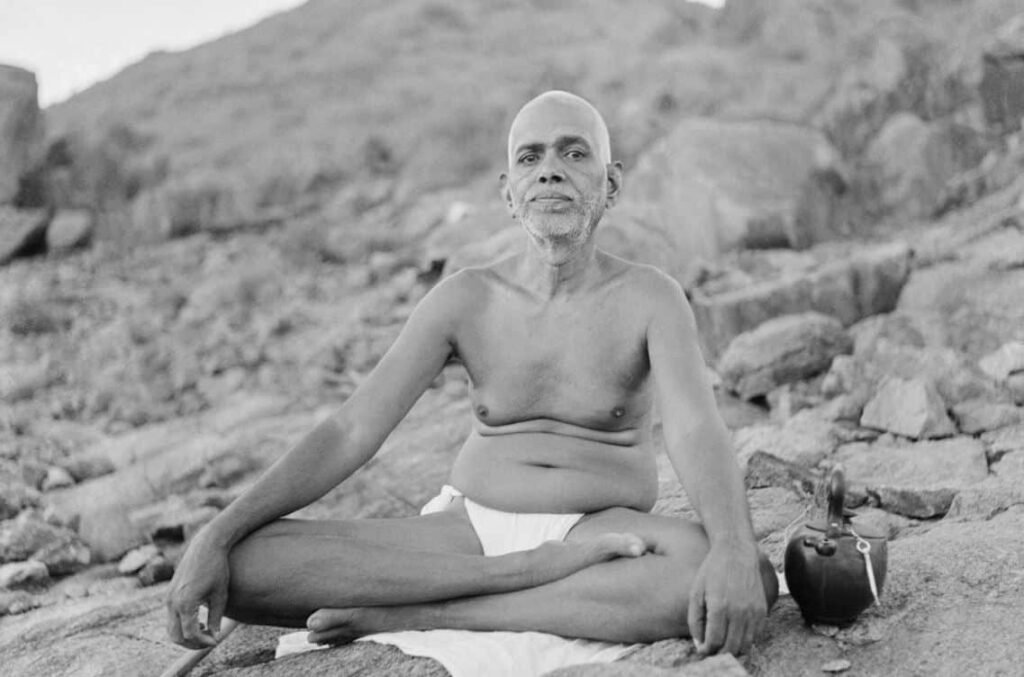
Sri Ramana Maharshi Born as Venkataraman Iyer but revered as Bhagavan Ramana Maharshi, he wasn’t just a sage who shared wisdom—he lived it. His life and teachings have touched countless hearts, mine included. The simplicity of his message, the profoundness of his realisation, and the way he embodied peace make him one of the greatest spiritual figures of modern times. Also known as Maharshi Ramana, Sri Ramana, or simply Ramana, he showed us that enlightenment isn’t some far-off, unreachable goal. Through his method of self-inquiry, he revealed that the answer lies in turning inward and asking the most fundamental question: Who am I?  Ramana Maharshi, born on December 30, 1879, in a small village called Tiruchuzhi in Tamil Nadu, India, began life as a regular boy named Venkataraman Iyer. As a boy, Venkataraman showed no extraordinary signs of spiritual inclination. In fact, he was like any other child—playing, attending school, and occasionally getting into mischief. What stands out about his early life is its simplicity. There were no miraculous signs or grand prophecies about his future. If anything, this normalcy makes his transformation into Bhagavan Ramana Maharshi all the more remarkable. When Venkataraman was just 12 years old, his father passed away unexpectedly. This event brought significant changes to the family’s life, forcing them to move to his uncle’s house in Madurai. While this loss was undoubtedly a turning point, it wasn’t yet the moment that would awaken the Maharshi Ramana we now revere. However, during this time, Venkataraman began hearing about Arunachala Hill, the sacred mountain in Tiruvannamalai. Stories of its divine significance captured his imagination, though he had no idea how pivotal Arunachala would become in his life. It’s said that even as a child, he felt an unexplainable pull toward the mountain, which Hindus regard as a physical manifestation of Lord Shiva. The upadesa of Sri Bhagavan, that is to say, the guidance or instruction given by Him, was secret in a sense. Although he was accessible to all alike, and although questions were normally asked and answered in public, the guidance given to each disciple was nevertheless intensely direct and adapted to his character. When asked once by Swami Yogananda, a Swami with a large following in America, what spiritual instruction should be given to the people for their uplift, he replied: “It depends on the temperament and spiritual maturity of the individual. There can be no mass instruction.” Ramakrishna’s teachings regarding the highest truths of spiritual life were delivered in the simplest language and were punctuated by parables and homely metaphors as illustrations. Many noted writers and philosophers—Mahatma Gandhi, Leo Tolstoy, Aldous Huxley, Christopher Isherwood, Thomas Merton, Arnold Toynbee, Joseph Campbell—have been deeply impressed and influenced by him. Sri Bhagavan was intensely active, yet so concealed was his activity that casual visitors and those who failed to perceive it believed that he gave no upadesa at all or that he was indifferent to the needs of seekers. It is generally agreed that realization is possible only through the grace of a guru. Sri Bhagavan was as definite about this as other Masters. Therefore, it was not enough for the sadhaka (aspirant) to know that his teaching was sublime and his presence inspiring; it was necessary to know that he was a Guru giving diksha (initiation) and upadesa (instruction). It is axiomatic that one who is a Guru in this supreme sense of having realized his identity with the Absolute does not say so, inasmuch as there is no ego left to affirm the identity. Also, he does not say that he has disciples, for, being beyond otherness, there can be no relationship for him. As a boy, Venkataraman showed no extraordinary signs of spiritual inclination. In fact, he was like any other child—playing, attending school, and occasionally getting into mischief. What stands out about his early life is its simplicity. There were no miraculous signs or grand prophecies about his future. If anything, this normalcy makes his transformation into Bhagavan Ramana Maharshi all the more remarkable. When Venkataraman was just 12 years old, his father passed away unexpectedly. This event brought significant changes to the family’s life, forcing them to move to his uncle’s house in Madurai. While this loss was undoubtedly a turning point, it wasn’t yet the moment that would awaken the Maharshi Ramana we now revere. However, during this time, Venkataraman began hearing about Arunachala Hill, the sacred mountain in Tiruvannamalai. Stories of its divine significance captured his imagination, though he had no idea how pivotal Arunachala would become in his life. It’s said that even as a child, he felt an unexplainable pull toward the mountain, which Hindus regard as a physical manifestation of Lord Shiva. Bhagavan Ramana Maharshi remained indifferent to the material aspects of the ashram. He continued living a simple life, often joining devotees in their daily tasks, whether it was preparing meals or tending to the cows. The ashram slowly developed around him, with devotees contributing their time, skills, and resources. Over the years, various structures were added: Even as the ashram grew, it retained the essence of Sri Ramana’s teachings—simplicity, humility, and a focus on self-realisation. Walking through the ashram today, it’s easy to feel the calm and silence that must have pervaded during Ramana’s time. While Maharshi Ramana rarely engaged in abstract philosophy, his teachings naturally aligned with the principles of Advaita Vedanta (non-dualism). Some of his core ideas include: The Self is EternalAccording to Sri Ramana, the self is not something to be attained—it’s already present within each of us. The journey is about removing ignorance and recognising this eternal truth. The Illusion of the EgoRamana often spoke about the ego as the false “I” that creates a sense of separation. Through self-inquiry, this ego dissolves, revealing the true self. Silence as the Ultimate TeachingFor Bhagavan Ramana, words were secondary. He often said that silence was the purest form of communication. Sitting in his presence, many devotees reported profound inner experiences without a single word being spoken. The later years of Bhagavan

Sri Ramana Maharshi Read Post »