




















Religious Freedom
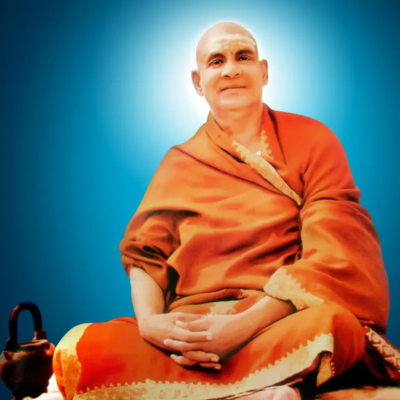
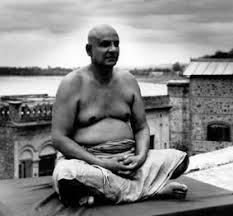
Religious Freedom Swami Venkatesananda It is good to remind ourselves at this point that technically the Master (Swami Sivananda) was a non-dual Vedantin. He belonged to what is known as the advaita cult. Perhaps this doesn’t mean very much to you. Belief in a God is not an essential part of the advaitins’ doctrine. The non-dual doctrine implies the total absence of all duality. There is a distinction between monotheism and monism. The Master’s official cult was monism, not monotheism. Monotheism still has some sort of duality built into it. It implies the unity of Godhead-God is one, so that “we” are all still outside that. Monism says, “There is only ONE”, and it is only because you are standing in front of me that I say so, otherwise I shouldn’t even do that. So it is true to say, as did the monists, that God is not in an idol, or in a temple, in the sense that he is not confined to that form. BUT God, being omnipresent, is everywhere. When this doctrine is heard, the obvious question that arises in the mind is, “Then why do you want to worship a God in a temple, in a church, in a synagogue, why don’t you worship God everywhere?” But when you look at this paper, you see it as paper, not as God! For the mind has been so conditioned and it is not able to drop this conditioning. You seem to be trapped. So that in practice Gurudev had a rather interesting and remarkable theory which was reflected in his own daily life. He didn’t ridicule the views of people belonging to other sects who were opposed to monism and who declare that “God and man are eternally separate, and it is ridiculous to say that man can ever become one with God”. Paradoxically the Master was both a bhakta (devotee) and a jnani (sage). He did not say that he was a bhakta and would therefore not study Vedanta or meditate. No, he preferred the integral yoga approach not merely this, not merely that, for the simple reason again that the mind is capable of playing all these tricks. Both the bhakta and the monist, by each denying an aspect of yoga, are caught in the same ego illusion. The Master never criticized either attitude. That was his genius. He tried to include all this, knowing that at a particular stage, to a person of that temperament, all this is essential. He knew that all these are steps that lead to the same goal. He knew that if once in that idol worship you recognize or touch the core, you are bound to realize that that which you worship there in that image is here in ‘you’ too. As it is said in the Upanihsad, “That which shines in the sun, is also that which shines in me.” The genius of the Master was in the blending of these, what superficially appear to be, conflicting doctrines. In Rishikesh, when he first came there, there were these two completely opposite camps. One which said, “Forget all your Vedanta, your enquiry and meditation. To have a vision of God is the highest goal. For this you must worship an idol.” The other camp called them idolaters, men who were unfit for meditation and who did not understand the sublime philosophy of the Upanishads. It was given to the Master to bring one group up and the others down a little, and this was done in a very beautiful and subtle way. I have seen the Master deal with all these people; never once did he challenge anyone. If someone said, “God is in this idol,” immediately he would agree and add “Come on, build a small shrine for your image. Worship there.” Then someone else came along and declared : “I don’t believe in all this, Swamiji. I can raise my consciousness to the seventh plane.” And the Master never argued with him, never. He was prepared to understand and did not condemn even the fanatic, because this person sees something and is just not mature enough to see that it is not the whole picture. He must be allowed to come to maturity in his own time. So, often Gurudev bowed down to satisfy even the fanatics. In the ashram temple there used to be puja three times a day-morning, noon and evening. Swami Sivananda who lived on the Ganges bank at the foot of the hill would climb all the way up to be there three times a day. This was when his health was still good. But a younger swami who was living nearer the temple would not attend the worship. What was Gurudev’s attitude? As soon as the arati was over and the prasad (food offering which was also our breakfast in those days) was about to be distributed, he would call one of us, “Take some prasad to Swami So-and-so.” But that is not the end of the story. That swami is not in the ashram now, he has since set up an ashram of his own, and I believe that there, puja and chanting of mantras goes on 24 hours of the day and that he insists that his devotees worship some form of God or other in a small private shrine in their rooms. If that is not the miracle of the ‘prasad’, I don’t know what else it is. That maturity must happen within yourself. Gurudev did not even fight with fanatics. If you fight with a fanatic, you become another fanatic. This was a marvellous aspect of the Master’s teachings. He was eager to listen to everyone; even to someone holding a diametrically opposite view. You pursue your own path, you have your own philosophy of life. You don’t have to abandon your religion, your method of worship and meditation, or your mode of life. The others may also have something interesting to say. Study others’ points of