




Hari Om

Menu

Divine Times

5d9a041f17b7e31c9adec2ba05eabfc3
Glory of Bharat

Types of Bhoomi’s

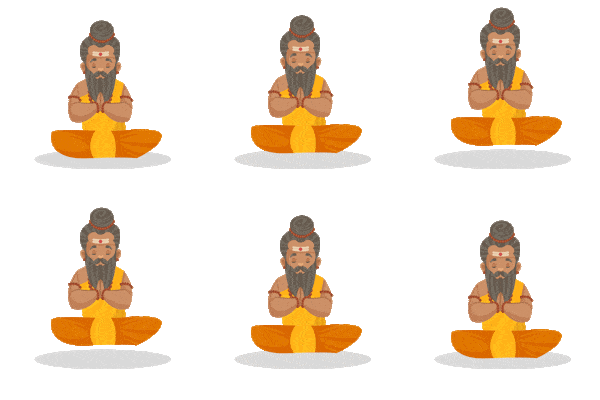
Types of Bhoomi’s Tyag Bhoomi The land of sacrifice or renunciation, where people value renunciation rather than enjoyment. India is the land of Forbearance and patience, Hindus have forbeared the attacks of mugals & the britishers most peacefully. India is the land of Tyaga that is renunciation. Tyag Bhoomi refers to land associated with renunciation, detachment, and spiritual discipline. In the Indian spiritual and Vastu traditions, land is not viewed merely as physical space but as a living field of energy that influences the purpose for which it is used. Tyag Bhoomi is considered suitable for those who have chosen a life of simplicity, contemplation, and inner realization rather than material prosperity. Such land is traditionally selected for ashrams, hermitages, monasteries, meditation centers, and places of penance, where the primary aim is spiritual growth and self-purification. The word tyag means renunciation—renunciation not only of possessions but also of ego, desire, and attachment. Tyag Bhoomi therefore symbolizes an environment that supports inward movement of the mind. In contrast to Bhog Bhoomi, which is meant for enjoyment, commerce, and household life, Tyag Bhoomi encourages austerity, silence, and restraint. It is believed that the natural energies of such land are subtle and sattvic, helping seekers turn away from distractions and cultivate awareness, discipline, and devotion. Yoga Bhoomi Meaning: The place or land where yoga and meditation are practiced, where people come together for inner peace and holistic wellness. Yoga Bhoomi refers to land or a sacred space dedicated to the practice of yoga, spiritual discipline, and inner awakening. In the Indian spiritual tradition, bhoomi (land) is not regarded as inert matter but as a field of subtle energies that supports the purpose for which it is used. Yoga Bhoomi is therefore considered an environment that naturally encourages balance, purity, and harmony of body, mind, and spirit. Such land is traditionally chosen for ashrams, yoga centers, gurukuls, and places where seekers gather to practice yoga as a way of life. The word yoga means union—the integration of the individual consciousness with universal consciousness. Yoga Bhoomi symbolizes this sacred intention. Unlike land meant solely for material gain or pleasure, Yoga Bhoomi supports disciplined living, self-observation, and inner growth. The atmosphere of such land is believed to be sattvic, promoting clarity, calmness, and awareness. Regular practice of asana, pranayama, meditation, and ethical living on Yoga Bhoomi gradually purifies the mind and strengthens inner stability. Bhog Bhoomi Bhog Bhoomi refers to land associated with enjoyment, material prosperity, and worldly life. In Indian spiritual philosophy and Vastu Shastra, land is understood not only in physical terms but also as a carrier of subtle energies that influence human experience. Bhog Bhoomi is considered suitable for household life, commerce, social activity, and material growth. It supports comfort, productivity, relationships, and the pursuit of wealth when used with balance and ethical awareness. The word bhog means enjoyment or experience through the senses. Bhog Bhoomi therefore represents the domain of active engagement with the world. Unlike Tyag Bhoomi, which supports renunciation and austerity, Bhog Bhoomi is meant for those living the path of grihastha dharma—family life and social responsibility.

Types of Bhoomi’s Read Post »

73a579d02979fb8a8bada5d4a77e43f4
Glory of Bharat

Nine Types of Devotion

Nine Types of Devotion In the Srimad Bhagavata and the Vishnu Purana it is told that the nine forms of Bhakti are Sravana (hearing of God’s Lilas and stories), Kirtana (singing of His glories), Smarana (remembrance of His Name and presence), Padasevana (service of His feet), Archana (worship of God), Vandana (prostration to the Lord), Dasya (cultivating the Bhava of a servant with God), Sakhya (cultivation of the friend-Bhava) and Atmanivedana (complete surrender of the self). A devotee can practise any method of Bhakti which suits him best. Through that he will attain Divine illumination.1. SRAVANA Sravana is hearing of Lord’s Lilas. Sravana includes hearing of God’s virtues, glories, sports and stories connected with His divine Name and Form. The devotee gets absorbed in the hearing of divine stories and his mind merges in the thought of Divinity, it cannot think of undivine things. The mind loses, as it were, its charm for the world. The devotee remembers God only, even in dream. Sri Sankaracharya says, “The company of the wise, even for a moment, becomes the boat to cross across the ocean of Samsara.” Without Satsanga, Sadhana does not become perfect and strong. The fort of Sadhana should be built on the foundation of Satsanga. Mere austerities are not the end of Sadhana. Satsanga illumines the devotee and removes his impurities. It is only then that subtle truths are grasped well by the devotee. Lord Krishna says to Uddhava that nothing but Satsanga alone can put an end to all worldly attachments. In the Bhagavata Mahatmya it is told that the best Dharma in this world is to hear Lord’s glories. For, thereby, one attains to the Divine Abode.2. KIRTANA Kirtana is singing of Lord’s glories. The devotee is thrilled with Divine Emotion. He loses himself in the love of God. He gets horripilation in the body due to extreme love for God. He weeps in the middle when thinking of the glory of God. His voice becomes choked, and he flies into a state of divine Bhava. The devotee is ever engaged in Japa of the Lord’s Name and describing His glories to one and all. Wherever he goes he begins to sing the praise of God. He requests all to join his Kirtana. He sings and dances in ecstasy. He makes others also dance. Such practices should be the outcome of a pure heart, and they should not be merely a show. God knows the inner secret of all and none can cheat Him. There should be perfect straightforwardness and all his actions should be the natural outpouring from his heart. This is the easiest of all modes of approach to God. In the Kali Yuga, iron age, Kirtana alone is the best Yoga-‘Kalau Kesavakirtanam.’ This is the prescribed method of devotion for this age. The mind is ever intent upon singing Lord’s Names and glories and it has no occasion to take interest in things of the world. Day and night the devotee feels the presence of God and thins out his ego. He becomes Sattvic and pure at heart.3. SMARANA Padasevana is serving the Lord’s feet. Actually this can be done only by Lakshmi or Parvati. No mortal being has got the fortune to practise this method of Bhakti for the Lord is not visible to the physical eyes. But it is possible to serve the image of God in idols and better still, taking the whole humanity as God. This is Padasevana. Padasevana is service of the sick. Padasevana is service of the poor. Padasevana is service of the whole humanity at large. The whole universe is only Virat-Svarupa. Service of the world is service of the Lord. Service of the Lord’s feet can be done through formal worship to Murtis or idols in temples or to a mental image of God.5. ARCHANA Archana is worship of the Lord. “Those who perform the worship of Vishnu in this world, attain the immortal and blissful state of Moksha.” Thus says the Vishnu-Rahasya. Worship can be done either through an image or a picture or even a mental form. The image should be one appealing to the mind of the worshipper. Worship can be done either with external materials or merely through an internal Bhava or strong feeling. The latter one is an advanced form of worship which only men of purified intellect can do. Worship should be done according to the rules laid down in the Varnashrama-Dharma or in the case of advanced devotees worship can be done in any manner they like. The purpose of worship is to please the Lord, to purify the heart through surrender of the ego and love of God. Serving the poor people and worshipping saints is also worship of the Virat-Svarupa of the Lord. The Lord appears in all forms. He is everything. The scriptures declare that the Lord alone appears as the sentient and the insentient beings. The devotee should have Narayana-Bhava or Isvara-Bhava in all beings. He should consider all creatures, down even to the worm as merely God. This is the highest form of Worship. Vandana is prayer and prostration. Humble prostration touching the earth with the eight limbs of the body (Sashtanga-Namaskara), with faith and reverence, before a form of God, or prostration to all beings knowing them to be the forms of the One God, and getting absorbed in the Divine Love of the Lord is termed prostration to God. The Bhagavata says: “The sky, air, fire, water, earth, stars, planets, the cardinal points (directions), trees, rivers, seas and all living beings constitute the body of Sri Hari. The devotee should bow before everything in absolute devotion, thinking that he is bowing before God Himself.” Lord Krishna says to Uddhava: “Giving no attention to those who laugh in ridicule, forgetting the body and insensible to shame, one should prostrate and bow down to all beings, even to the dog, the ass, the Chandala and the cow. All is Myself, and nothing is

Nine Types of Devotion Read Post »

e376abffdc0200b243ca4e60c97801a2 1 1
Glory of Bharat

May I Answer That

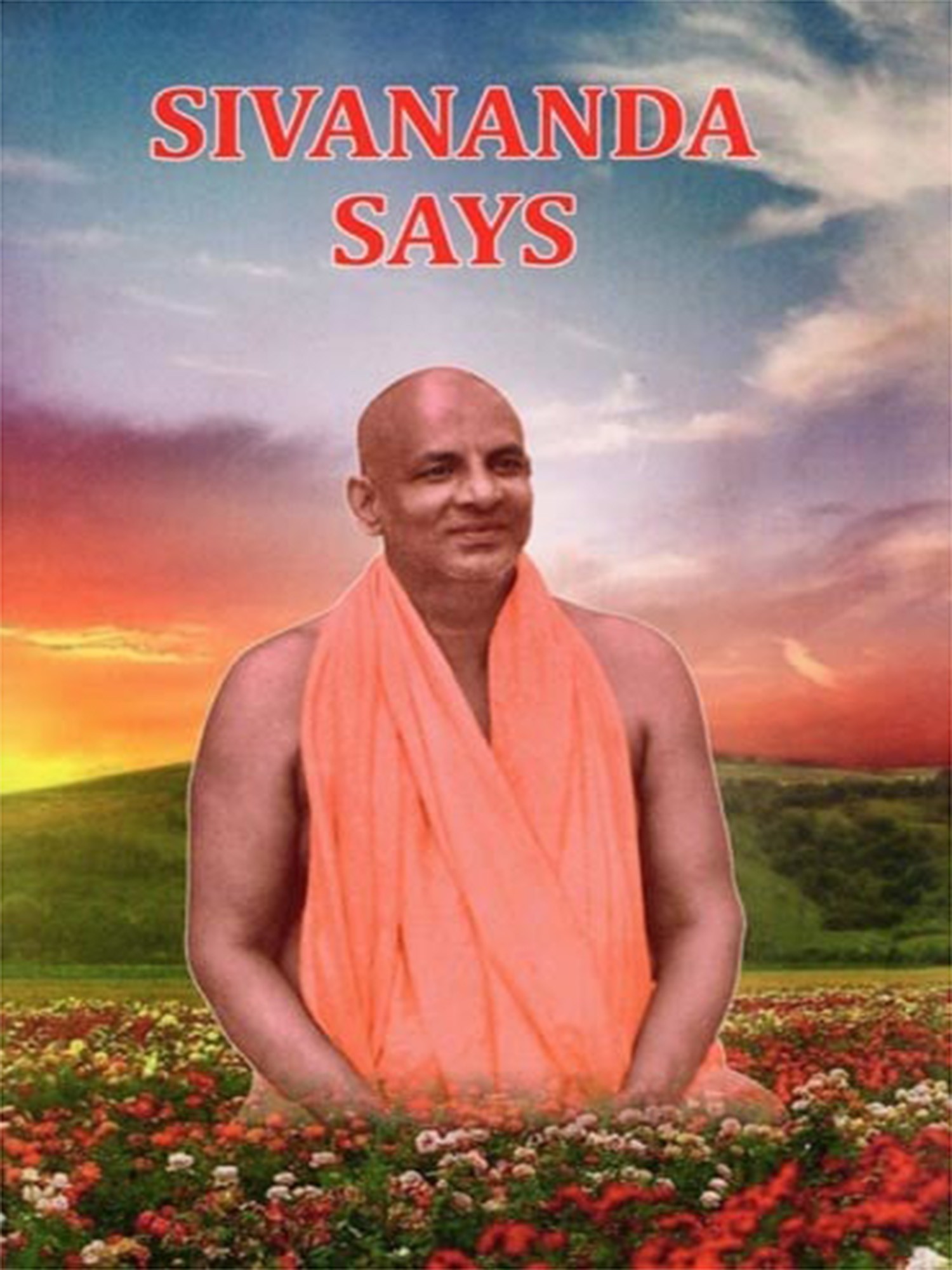
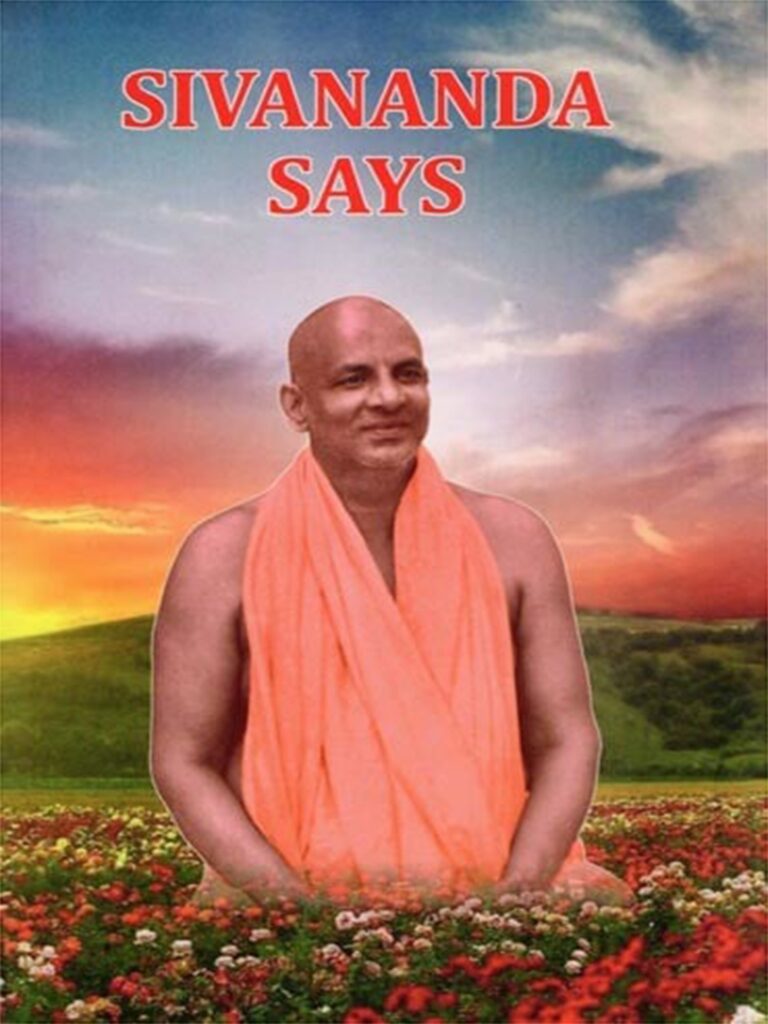
May I Answer That This book is a compilation from the various published works of the holy Master SriSwami Sivananda, including some of his earliest works extending as far back as the late thirties.The questions and answers in the pages that follow deal with some of the commonest, butmost vital, doubts raised by practising spiritual aspirants. What invests these answers andexplanations with great value is the authority, not only of the sage’s intuition, but also of hispersonal experience. Swami Sivananda was a sage whose first concern, even first love, shall we say, was thespiritual seeker, the Yoga student. Sivananda lived to serve them; and this priceless volume isthe outcome of that Seva Bhav of the great Master.We do hope that the aspirant world will benefit considerably from a careful perusal of thepages that follow and derive rare guidance and inspiration in their struggle for spiritualperfection.May the holy Master’s divine blessings be upon all.

May I Answer That Read Post »

c2d836428f1e7739a6b0465fbbd53760
Glory of Bharat

Hiranyagarbha – The Golden Womb

Hiranyagarbha – The Golden Womb We become eligible for Knowledge of Atma (Brahma Vidya) only when we understand the relation between Brahma and humanity in the cosmic cycle of creation and destruction. “Brahma” means the vast, infinite principle. The element of sound (akasa) emanated from this infinite expanse of Brahma. From sound emerged air (vayu), fire (tejas) from air, wind from fire, earth (prithvi) from wind, oceans from earth, food from oceans, and finally, humans from food. Ponder this sequential cycle and you will arrive at the truth that humanity has emerged from the infinite Brahma. Divine Bliss, Brahmanandam, is composed of two words: Brahma + anandam (bliss). Brahma and bliss are separate. Man journeys from food (annam) to bliss (anandam). Man’s aim is bliss alone. When this bliss joins with Brahma, it acquires the form of Brahmanandam. So, it is possible for us to understand the close association between Brahma and humanity. Such Knowledge of Brahma (Brahma Vidya) is available through Brahman alone. People, however, disregard the divine principle and trust only the world. Thus, people blind themselves to the universal Brahman. Afflicted with attachment, fear, and anger, the ordinary person is far from Divine Bliss. Bliss can dawn with the conquest of attachment, fear, and anger, but only to a certain extent. Why? Renouncing attachment, fear ,and anger is not sufficient. Love for God must be cultivated as well. But even that is not enough! You must become close to God’s love for you. Finally, even proximity to God’s Love is inadequate. You must place total reliance on the all-encompassing Transcendental Principle (parathathwa). Then it is possible for you to become Divine. The Siksha-valli imparted by gurus to their students in the Taittireya Upanishad sheds light on the path leading to Brahmanandam. Do not consider Brahma Vidya to be beyond human understanding. Brahma Vidya consists of simple spiritual practices like the practice of truth in daily life and the blossoming of character. One must accumulate the wealth of spiritual pracices with patience. The Upanishads elaborate on the principle of Brahman through three names: Virat, Hiranyagarbha, and Avyakruta. These three forms relate to gross (sthulam), subtle (sukshmam), and cause (karanam) and to the three states of waking, dream, and deep sleep. Virat The Atma principle that personifies the waking state is Virat. Virat is that form of the Atma that dons a physical body, lives a long life, and embodies the waking state. He assumes various forms and is known by various names. That is, He demonstrates that the movable and immovable world is really His manifestation, as also the five elements. From the ant to Brahma, everything is His form. He is called Virat because He has reached the state of asserting, All is My Form (Sarvam Visva Swarupam). The entire visible universe is a form of Virat, without exception, without any distinction of “this” or “that”. Therefore, Virat is the principle that manifests as the external, gross, visible world and demonstrates ideals to the world. Virat has two other names: Vaiswanara and Vairajasuta. Vaiswanara is He who appears as the “I” consciousness in each individual. From the king to a farmer, from a beggar to a millionaire, from a child to an old person, male or female – everyone uses the word “I” to identify oneself. Individuality is present in everyone. The one who asserts “I” in every being in Vaiswanara. The third name is Vairajasuta. Virat, Vaiswanara and Vairajasuta are three names of the same Being. Vairajasuta is one who exists in a mysterious form. He exists in everyone but is undetected. He performs all actions but behaves as if He does not. He experiences everything but does not reveal it. Hiranyagarbha The second form of Brahman is Hiranyagarbha: the basis, the source of all wisdom. All knowledge – worldly, ethical, dharmic, spiritual, scientific – has emanated from Hiranyagarbha. Therefore, He is also called the Sun of Knowledge (Jnana Bhaskara). When the Sun rises, He appears golden (Hiranya) and colours the world with a golden hue. Creation emerged from Hiranyagarbha, which is oval in shape, a golden egg, like the one I materialised a few days ago. The mouth was the first to emerge from this shape. From the mouth, sound. Then, the nose, through which air began flowing. Eyes came next, with fire emanating through them. Ears arrived next. Therefore, Hiranyagarbha is the origin of the human form. All beings evolved from Hiranyagarbha, who also bestowed insightful wisdom, the ability to distinguish right from wrong, and intuitive wisdom (vijnana, sujnana and prajnana) to them to facilitate discrimination between the temporary and the permanent. What should be attained, what is not worth pursuing? What deeds should be done, what should not? What is the chief form of wisdom achievable by man? What path makes human life well spent? What is the purpose of life? Hiranyagarbha granted wisdom to man to clarify such issues. Hiranyagarbha, like Virat, has two other names: Sutratmaka and Prana. Just as a thread (sutra) passes through a necklace of gems, Sutratmaka is the principle that underlies all beings and brings bliss to them. This unifying thread-like principle is also called Brahma Sutra. The thread called God is present in equal measure in all humans without distinction, promoting unity of mankind – this is the principle of Hiranyagarbha. Hiranyagarbha assumes a subtle (sukshmam) form during the dream state – the form of the Atma. This means that Hiranyagarbha is one who is awake during the dream state. Virat creates everything in the waking state. Hiranyagarbha creates everything in the dream state by mere willing. Every object is created by will alone. Whatever is seen in dreams is created by Hiranyagarbha. Avyakruta The third form of Brahman is Avyakruta. He is absolutely formless. He exists in the causal body and enjoys the state of deep sleep. He has no limbs but does all actions. He travels to distant places. He has no eyes but sees everything. He has no ears but listens to

Hiranyagarbha – The Golden Womb Read Post »

b86c4c2439f084f56639801fc12bf145
Glory of Bharat

The Divine Fakir

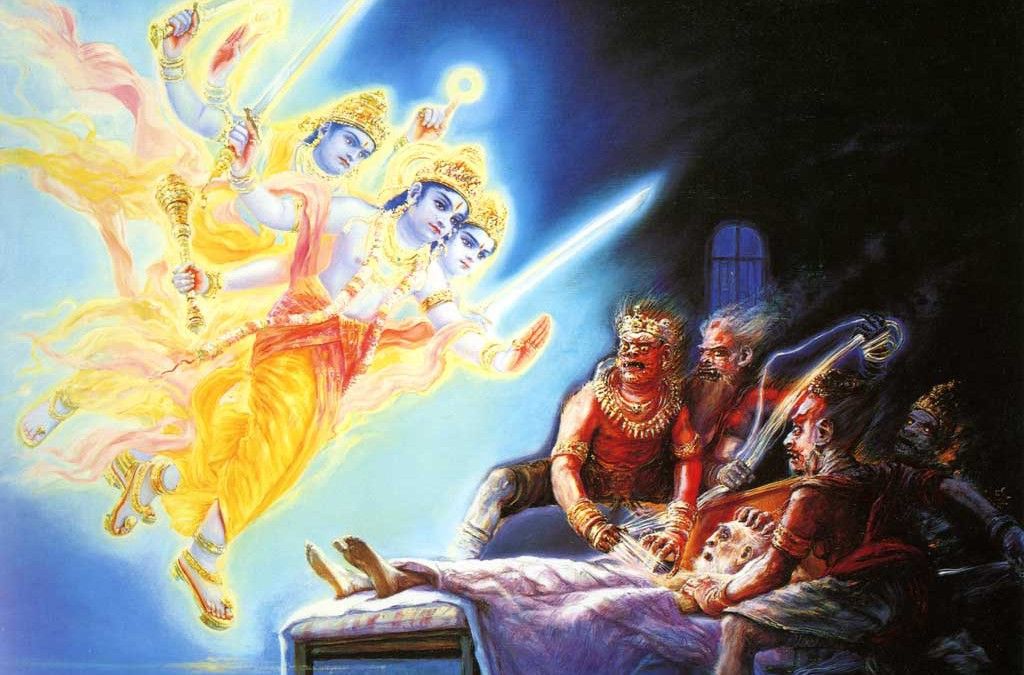
The Divine Fakir will be – The Story of Ajamila Throughout Śrīmad-Bhāgavatam there are descriptions of ten subject matters, including creation, subsequent creation and the planetary systems. Śukadeva Gosvāmī, the speaker of Śrīmad-Bhāgavatam, has already described creation, subsequent creation and the planetary systems in the Third, Fourth and Fifth Cantos. Now, in this Sixth Canto, which consists of nineteen chapters, he will describe poṣaṇa, or protection by the Lord. The First Chapter relates the history of Ajāmila, who was considered a greatly sinful man, but was liberated when four order carriers of Viṣṇu came to rescue him from the hands of the order carriers of Yamarāja. A full description of how he was liberated, having been relieved of the reactions of his sinful life, is given in this chapter. Sinful activities are painful both in this life and in the next. We should know for certain that the cause of all painful life is sinful action. On the path of fruitive work one certainly commits sinful activities, and therefore according to the considerations of karma-kāṇḍa, different types of atonement are recommended. Such methods of atonement, however, do not free one from ignorance, which is the root of sinful life. Consequently one is prone to commit sinful activities even after atonement, which is therefore very inadequate for purification. On the path of speculative knowledge one becomes free from sinful life by understanding things as they are. Therefore the acquirement of speculative knowledge is also considered a method of atonement. While performing fruitive activities one can become free from the actions of sinful life through austerity, penance, celibacy, control of the mind and senses, truthfulness and the practice of mystic yoga. By awakening knowledge one may also neutralize sinful reactions. Neither of these methods, however, can free one from the tendency to commit sinful activities. By bhakti-yoga one can completely avoid the tendency for sinful life; other methods are not very feasible. Therefore the Vedic literature concludes that devotional service is more important than the methods of karma-kāṇḍa and jñāna-kāṇḍa. Only the path of devotional service is auspicious for everyone. Fruitive activities and speculative knowledge cannot independently liberate anyone, but devotional service, independent of karma and jñāna, is so potent that one who has fixed his mind at the lotus feet of Kṛṣṇa is guaranteed not to meet the Yamadūtas, the order carriers of Yamarāja, even in dreams. To prove the strength of devotional service, Śukadeva Gosvāmī described the history of Ajāmila. Ajāmila was a resident of Kānyakubja (the modern Kanauj). He was trained by his parents to become a perfect brāhmaṇa by studying the Vedas and following the regulative principles, but because of his past, this youthful brāhmaṇa was somehow attracted by a prostitute, and because of her association he became most fallen and abandoned all regulative principles. Ajāmila begot in the womb of the prostitute ten sons, the last of whom was called Nārāyaṇa. At the time of Ajāmila’s death, when the order carriers of Yamarāja came to take him, he loudly called the name Nārāyaṇa in fear because he was attached to his youngest son. Thus he remembered the original Nārāyaṇa, Lord Viṣṇu. Although he did not chant the holy name of Nārāyaṇa completely offenselessly, it acted nevertheless. As soon as he chanted the holy name of Nārāyaṇa, the order carriers of Lord Viṣṇu immediately appeared on the scene. A discussion ensued between the order carriers of Lord Viṣṇu and those of Yamarāja, and by hearing that discussion Ajāmila was liberated. He could then understand the bad effect of fruitive activities and could also understand how exalted is the process of devotional service.  Mahārāja Parīkṣit said: O my lord, O Śukadeva Gosvāmī, you have already described [in the Second Canto] the path of liberation [nivṛtti-mārga]. By following that path, one is certainly elevated gradually to the highest planetary system, Brahmaloka, from which one is promoted to the spiritual world along with Lord Brahmā. Thus one’s repetition of birth and death in the material world ceases.  O great sage Śukadeva Gosvāmī, unless the living entity is freed from the infection of the material modes of nature, he receives different types of bodies in which to enjoy or suffer, and according to the body, he is understood to have various inclinations. By following these inclinations he traverses the path called pravṛtti-mārga, by which one may be elevated to the heavenly planets, as you have already described [in the Third Canto]. You have also described [at the end of the Fifth Canto] the varieties of hellish life that result from impious activities, and you have described [in the Fourth Canto] the first manvantara, which was presided over by Svāyambhuva Manu, the son of Lord Brahmā.

The Divine Fakir Read Post »

04f127564d00d1e01c690ccd318c2cca
Glory of Bharat

What is Vaastu

What is Vaastu 1. Introduction All of us have a place we call home. The kind of home we live in can be very different based on our lifestyle. Depending on where we live, how our house is built, how we maintain it etc., our home can give off different spiritual vibrations too. Our spiritual research has shown that improving the spiritual vibrations of our homes can have many positive effects such as increased financial security, improved relationships between those living in the home, more happiness among residents, and less obstacles to spiritual practice done by those in the home. In this article we will understand what affects the spiritual vibrations of our homes. 2. Studying vibrations in premises In spiritual research, importance is given to studying the spiritual realm. Through this study we are able to start understanding the true cause and effect of any experience. For example, through spiritual research we understand that marital discord can be caused by our departed ancestors. In the same way, spiritual research can help us understand why some types of homes bring good fortune and happiness while others cause distress to their residents. To study spiritual vibrations in housing, let us first understand some basic concepts from the science of vāstushāstra, as explained in the next section. 2.1 What is vastushastra? Definition: Vastushastra is a Vēdic science that explains the difference between pleasant and distressing frequencies generated in premises. 2.2. What is a vastu ? Vastu  (or ‘premises’) refer to an open space enclosed by walls on all sides, irrespective of whether it has a roof. Every such built space has a centre of energy, also known as the Deity of the premises. Its mission is to endow energy to any pleasant or distressing event occurring there. 2.3 Frequencies in premises In order to understand the difference between pleasant and distressing frequencies generated in premises, let us first understand how these frequencies are created. There are three kinds of frequencies in empty premises:

What is Vaastu Read Post »

e44de74b232d1f497cdf6e8c9d8bacbb
Glory of Bharat

Daily Panchang

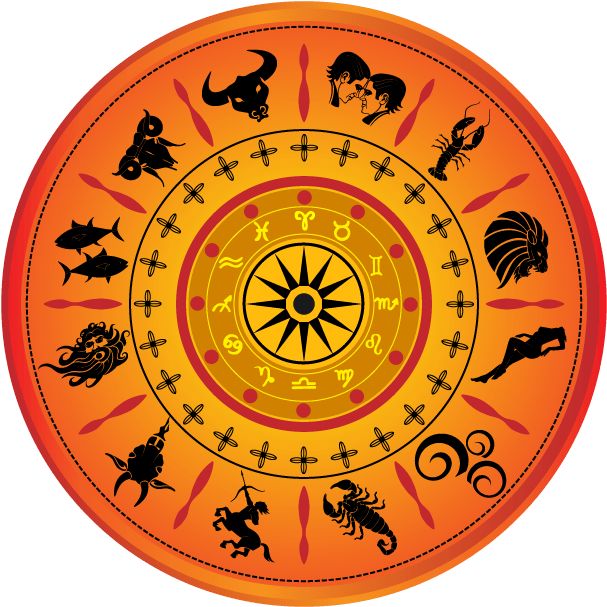
Daily Panchang Daily Panchang is an ancient Vedic timekeeping system that reveals the subtle cosmic influences governing each day, helping individuals align their actions with the natural rhythms of the universe. Derived from the Sanskrit words pancha (five) and anga (limbs), the Panchang consists of five essential elements—Tithi, Nakshatra, Yoga, Karana, and Vaar—each offering a distinct insight into the energetic quality of the day. For thousands of years, sages and astrologers of Bharat have used the Panchang to understand how planetary movements affect human life, predict auspicious moments, and choose appropriate times for spiritual, personal, and practical activities. The Daily Panchang provides a detailed cosmic calendar through which a seeker can flow in harmony with the universe rather than struggle against unseen forces. It guides when to begin new ventures, perform rituals, travel, or engage in significant tasks, and also indicates periods that are better suited for rest, reflection, or caution. By studying the Tithi, one learns the lunar phase and emotional tone of the day; the Nakshatra reveals the star’s influence on temperament and destiny; the Yoga shows the subtle qualities of cosmic combinations; the Karana indicates the day’s dynamic potential; and the Vaar connects each day to the ruling planetary deity. Together, these five elements shape the energetic blueprint of the day. The Panchang also includes sunrise, sunset, moonrise, moonset, Rahu Kaal, Gulika Kaal, Abhijit Muhurat, and other critical time segments, allowing a more precise understanding of divine timing. Through this, the Daily Panchang becomes not just a calendar but a spiritual guide, offering clarity, rhythm, and purpose. In ancient households, reading the Panchang at dawn was considered a sacred discipline, reminding one of the vast cosmic order within which life unfolds. Even today, millions check the Panchang to plan ceremonies, business openings, marriages, travel, temple visits, and fasting days. It serves as a bridge between the physical and the metaphysical, linking human life with celestial motion. The Panchang does not force one into destiny but empowers individuals to make wiser choices by understanding the cosmic climate. When embraced with faith and awareness, it brings balance to daily life, enhances decision-making, and deepens one’s connection with nature and the divine order. It reminds us that time is not merely counted by clocks but shaped by energies, cycles, and vibrations beyond the senses. In the rush of modern life, the Daily Panchang stands as a timeless instrument of spiritual alignment, allowing every seeker to move through life with grace, awareness, and harmony. Whether used for ritual purity, personal growth, or traditional practices, the Panchang reveals that each day carries a unique spiritual message and an opportunity to tune into the cosmic rhythm of creation. By understanding and honouring it, we walk in step with the universe itself.

Daily Panchang Read Post »

a9f501f5dc82cfbcad2a876e2d99aa31
Glory of Bharat

Sanskrit – Language of Gods

Sanskrit – Language of Gods SANSKRIT- the mother of all languages is regarded as the ancient language in Hinduism, where it was used as a means of communication and dialogue by the Hindu Celestial Gods, and then by the Indo-Aryans. It is also a liturgical language of Hinduism, Buddhism, and Jainism. The term ‘Sanskrit’ is derived from the conjoining of the prefix ‘Sam’ meaning ‘samyak’ which indicates ‘entirely’, and ‘krit’ that indicates ‘done’. Thus, the name indicates perfectly or entirely done in terms of communication, reading, hearing, and the use of vocabulary to transcend and express emotion. HISTORY OF THE SANSKRIT LANGUAGE- The Sanskrit language was termed as Deva-Vani (‘Deva’ Gods – ‘Vani’ language) as it was believed to have been generated by the god Brahma who passed it to the Rishis (sages) living in celestial abodes, who then communicated the same to their earthly disciples from where it spread on earth. The origin of the language in written form is traced back to the 2nd millennium BCE when the Rig Veda, a collection of sacred hymns, is assumed to have been written after being continued for centuries through oral tradition and preservation of verbal knowledge in the Guru-Disciple relationship. The purity of this version (Vedic period, 1500 – 500 BCE) of Sanskrit is doubtlessly reflected in the flamboyance of the perfect description of the forces of nature in the Rig Veda. VEDIC SANSKRIT-  Sanskrit in terms of its literary association is classified into two different periods, the Vedic and Classical. Vedic Sanskrit was the earliest form of Sanskrit language approximately around 1500-200 B.C.), when “knowledge” was handed down through the generations orally. Vedic Sanskrit is found in the Vedas sacred texts, especially the Rig Veda, the Puranas, and the Upanishads, where the most original form of the language was used. The composition of the Vedas is traced to the period of 1000 to 500 BCE, until when Sanskrit had a vigorous tradition of being used consistently through oral communication. This early Sanskrit is rich in vocabulary, phonology, grammar, and syntax, which remains undiluted in its purity to this day. It consists of 52 letters in total, 16 vowels and 36 consonants. These 52 letters have never been tweaked or altered and are believed to have been constant since the beginning, thus making it the most perfect language for word formation and pronunciation. The language is believed to have been generated by observing the natural progression of sounds created in the human mouth, thus considering sound as an important element of language formation. This is one of the prime reasons why Sanskrit has been rich in poetry and its expressive quality of bringing out the best meaning through perfect sounds that are soothing to the human ear. Vedic Sanskrit also contains abstract nouns and philosophical terms that are not to be found in any other language. The consonants and vowels are flexible enough to be grouped to express nuanced ideas. In all, the language is like an endless ocean without a base due to its reach, complexity, and hundreds of words to express a single meaning or object. CLASSICAL SANSKRIT- ASHTADHYAYI– Classical Sanskrit has its origin at the end of the Vedic period when the Upanishads were the last sacred texts to be written down, after which Panini, a descendant of Pani and grammar and linguistic researcher, introduced the refined version of the language. Panini’s timeline is assumed to be around the 4th century BCE when he introduced his work ‘Ashtadhyayi’, which means eight chapters, forming the only available foundational and analytical text of Sanskrit grammar. It is considered to be the only source of Sanskrit grammar and vocabulary today because everything that existed before had never been recorded except via their mention in Panini’s Ashtadhyayi. The language is so vast that it has more than 250 words to describe rainfall, 67 words to describe water, and 65 words to describe the earth, among other descriptions. This proves the magnanimity of Sanskrit when compared with current modern languages. Panini was responsible for the standardization of the language, which to this day remains in use in multiple forms. Sanskrit as a spoken language is rare and is spoken in some regions in India, some even claiming it as their first language, but it is proudly mentioned as one of the 14 original languages of India in its Constitution. It is largely used in Carnatic music in the form of bhajans, shlokas, stotras, and kirtans, all indicating various hymns to the Gods, and songs and mantras of God worship. SANSKRIT LITERATURE- Sanskrit literature forms the oldest stage for millions of years. The Sanskrit language has a wonderful structure and is more perfect than other languages. Over thousands of years, many scholars have contributed to Sanskrit literature. Sanskrit is written in the Devanagari (literally means “cities of the gods”) and Brahmi based scripts Sage Panini’s Sanskrit grammar called Ashtadhyayi produced around 4th century B.C gives the details of how the language works and forms the basis for modern Sanskrit grammars. The Sanskrit language has an extremely rich complex grammatical structure and an enormous vocabulary. The three major Hindu philosophic concepts which were formulated in Sanskrit are Dvaita (Madhvacharya), Advaita ( Sankaracharya), and Vishistadvaita (Ramanujacharya). Among the best-known masterworks of Sanskrit, works of literature are Ramayana (Valmiki) and Mahabharata (Vyasa) epics, Panchatantra (Vishnu Sharma), Artashastra (Chanakya), Bhagavadgita, poems, and plays of Kalidasa, Puranas & Upanisads. Apart from these kinds of literature on astronomy, science, astrology, medicine, and law have been taken place.

Sanskrit – Language of Gods Read Post »

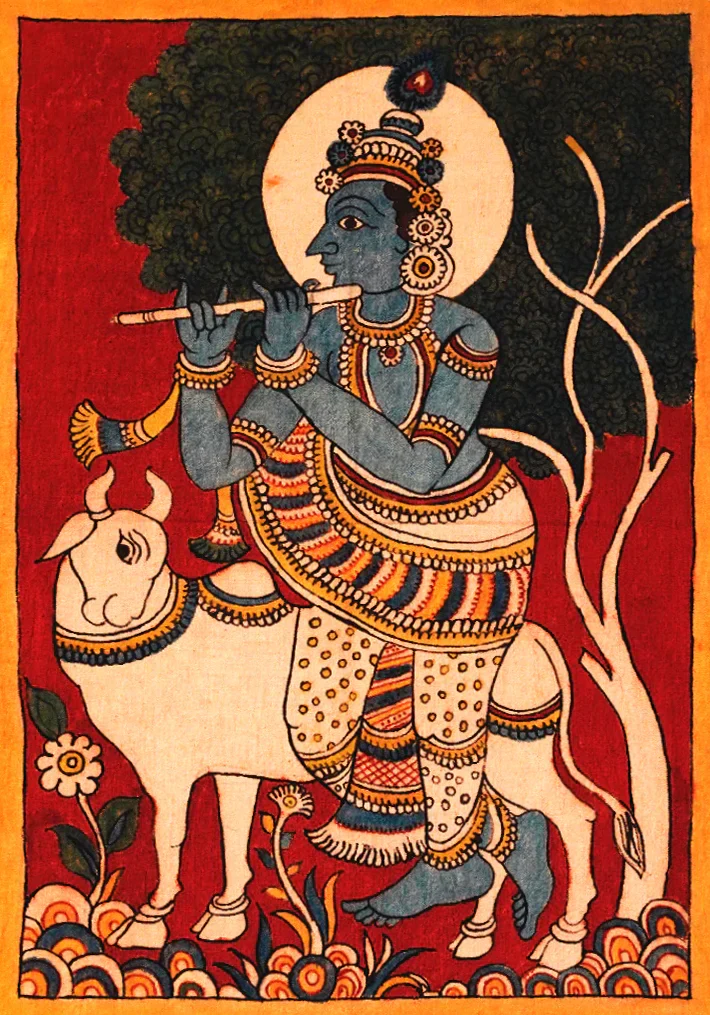
Krishna with Cow Kalamkari Painting by Siva Reddy 2 900x fd65aa3c f21b 42a9 9e1b befd3e05d226
Glory of Bharat

Deities and Their Divine Vehicles

Deities and Their Divine Vehicles In Indian mythology and art, the concept of vahana (vehicle or mount) holds a unique place, with each deity being associated with a particular animal. These animals are far more than mere companions, these vahanas are the divine mounts upon which deities are often depicted, acting as extensions of their power and personality. Be it the mighty Garuda soaring with Vishnu, the serene swan gliding with Saraswati, or the humble mouse seated at Ganesha’s feet, each vahana carries a symbolic meaning that deepens our understanding of the deity it accompanies. In Indian art forms, from temple sculpture to paintings, vahanas not only complete the divine image but also express profound philosophical ideas associated with the deity, as well as ideas related to the communities that worship these gods, making them integral to the daily life, spiritual thought and aesthetic tradition of India. The origins of vahanas can be traced back to ancient Sanskrit literature, where these animals were not simply companions, but symbols of cosmic principles. Each mount embodies an aspect of nature, human instinct or universal energy, channeling the deity’s essence into a form that devotees could relate to. Through this blog, we aim to explore the stories behind each animal as a vahana, as depicted in Indian art with their deity. Mushaka Lord Ganesha, the remover of obstacles and the patron God of wisdom, is always depicted with a small yet significant companion at his feet- Mushaka, the mouse. While the contrast between the mighty deity with his elephant head and the tiny, seemingly insignificant mouse may appear striking, this pairing is highly symbolic. The mouse represents desire, greed and restless energy, qualities that, if unchecked, can gnaw away at human life. By making the mouse his vahana, Ganesha demonstrates mastery over these impulses, teaching devotees that wisdom lies in controlling one’s desires rather than being consumed by them. The mouse, being small and able to enter hidden spaces, also symbolises Ganesha’s ability to reach into the deepest corners of the human mind, uncovering hidden knowledge and removing unseen obstacles. In folk traditions, Mushaka also represents humility, proving that no matter how small or overlooked one may be, everyone has a role in the cosmic order. In traditional and folk Indian art,Mushaka is often seen gazing upward at Ganesha, highlighting his devotion and service, as seen in the below Madhubani and Pattachitra paintings. Garuda Garuda is the vahana of Lord Vishnu, the mighty eagle, also depicted as a half-human and half-eagle. He symbolises swiftness, strength and devotion to dharma. His wings represent speed and expansive vision, enabling him to soar across the three worlds, carrying Vishnu as the preserver of cosmic order. In art, Garuda is also often shown kneeling with folded hands before Lord Vishnu, emphasising on humility and service despite his immense power. As eagles are considered the enemy of serpents (nagas), associated with ignorance and bondage, Garuda symbolically represents the eternal struggle against darkness. He is often shown with a naga held between his claws. Thus, in both philosophy and visual representation, Garuda signifies the triumph of divine truth, courage and the unwavering devotion that sustains cosmic harmony. This oleograph by Raja Ravi Verma depicts Garuda carrying Vishnu and his consorts Shri Devi and Bhu Devi on his back, and holding a serpent in his claws. Krishna with Cow Kalamkari Painting by Siva Reddy Cows are the most popular motif in Pichwai paintings, shown with Shrinathji, in herds, as a part of festivals like Gopashtami or Govardhan puja, or even by themselves with calves, surrounded by lotus flowers, etc. They are often depicted with saffron handprints on them, symbolising the divine presence of Lord Krishna. Nandi Nandi, the sacred bull, is the constant companion and vehicle of Lord Shiva. He holds a deep and symbolic meaning in Indian art and philosophy. A bull represents strength, virility and endurance – all attributes associated with Lord Shiva. Nandi can often be seen seated in front of Shiva in temples, facing the sanctum. He is the eternal devotee whose gaze never wavers from the divine, highlighting his unshaken faith, patience and discipline in spiritual practice. Nandi also embodies dharma or righteousness and the controlled use of power, reflecting Shiva’s role as protector of cosmic balance, who holds the power to destroy the world with his energy, but chooses to protect it instead. Hamsa (swan) is the  Vehicle of Brahma. It stands for discerning intelligence (buddhi), purity, judgment, skill, grace, knowledge, and creativity. The word “Hamsa” is a combination of two words, “aham”+ “sa”. It means “I am He”. This awareness that one is God exists only in enlightened people. Rightly Brahma is the friend and philosopher of all the enlightened beings in the world, and he has the power to give us this knowledge about our true nature. The bird hamsa is also very beautiful, peaceful and graceful. It suggests that Brahma is the master of all the beauty and grace of the world, and He can help us in our effort to acquire these qualities. It is also believed that the bird has the capacity to separate milk from water. This symbolically means that Brahma can help us to transform our intelligence, or the buddhi, or our ability to discriminate between the rights from the wrong so that we can select the correct path to achieve salvation. The bird moves in waters, especially lake waters that are placid. The water symbolically stands for our consciousness and the lake itself for a limited consciousness such as ours. Brahma moves in our consciousness on his Vehicle hamsa and purifies it with his touch and grace. If you want to develop super fine intelligence, you should worship Brahma and invoke him in you during meditation. Lord Shiva rides the Bull, Nandi, which stands for the bullying, aggressive, blind and brute power in man. It also stands for unbridled sexual energy, Kama. Only Lord Siva can help us control these and transform them. They are usually manifestations

Deities and Their Divine Vehicles Read Post »

1055dd9b 9e8e 42e7 b3b0 ca43082f520d
Glory of Bharat

What Happens After Death

What Happens After Death What Happens After Death has been one of humanity’s deepest questions since ancient times, and the spiritual traditions of Bharat offer profound insights into this mystery. According to these teachings, death is not an end but a continuation, a transition from one state of existence to another. The body falls, but the Jīvātmā, the individual soul wrapped in subtle impressions, continues its journey. In the final moments, as the physical senses cease, the consciousness withdraws from the outer world and moves inward, passing through the subtle channels of prāṇa. The soul then separates from the body like a bird leaving its cage, entering a dimension invisible to physical eyes. What happens next depends on the karmas, desires, tendencies, and spiritual maturity accumulated during life. For those who lived with purity, truth, and devotion, the passage is peaceful, filled with light and ease. Such souls often experience a sense of expansion, a weightless clarity, as if freed from a long-carried burden. They are guided by higher forces, devas, or luminous beings toward realms of harmony. Others, whose lives were clouded by negativity, fear, or unresolved desires, may face confusion or darkness until they gradually adjust to their new state. In this subtle world, thoughts manifest instantly, and one’s inner state becomes one’s outer reality. After leaving the body, the soul reviews its entire life in a matter of moments — not through judgment by an external power but through direct, compassionate understanding. Every action, intention, and emotion becomes clear, showing how each experience shaped consciousness. This life-review helps the soul recognise what lessons were learned and what remains unfinished. Depending on its karmic balance, the soul moves to different realms: some experience temporary heavens of joy, others undergo cleansing processes to shed heavy karmic impressions, and some remain in a dream-like intermediate state until they are ready to move forward. Eventually, the soul is drawn again toward a new birth, pulled by its vasanas — deep-seated desires and impressions that seek fulfilment. Rebirth is not a punishment but a continuation of learning, allowing the soul to evolve, balance karma, and realise its divine nature. Highly evolved beings, yogis, and saints may remain conscious even during death, leaving the body willingly. They merge into the higher realms or attain moksha, complete liberation, where the soul dissolves into the limitless Brahman, never to return to the cycle of birth and death. In moksha, there is no individuality, no separation — only infinite peace, bliss, and pure consciousness. Thus, death is neither a full stop nor a tragedy; it is a doorway, a return journey from the physical world to the spiritual. It reminds us to live consciously, cultivate purity, and awaken to the eternal Self that never dies. Understanding death transforms the way we live, turning every moment into an opportunity for growth, love, and inner freedom.

What Happens After Death Read Post »